Orthodontics Market Report by Product Types, Age-groups, End-Users, Countries and Company Analysis 2026–2034
Buy NowOrthodontics Market Size and Forecast 2026-2034
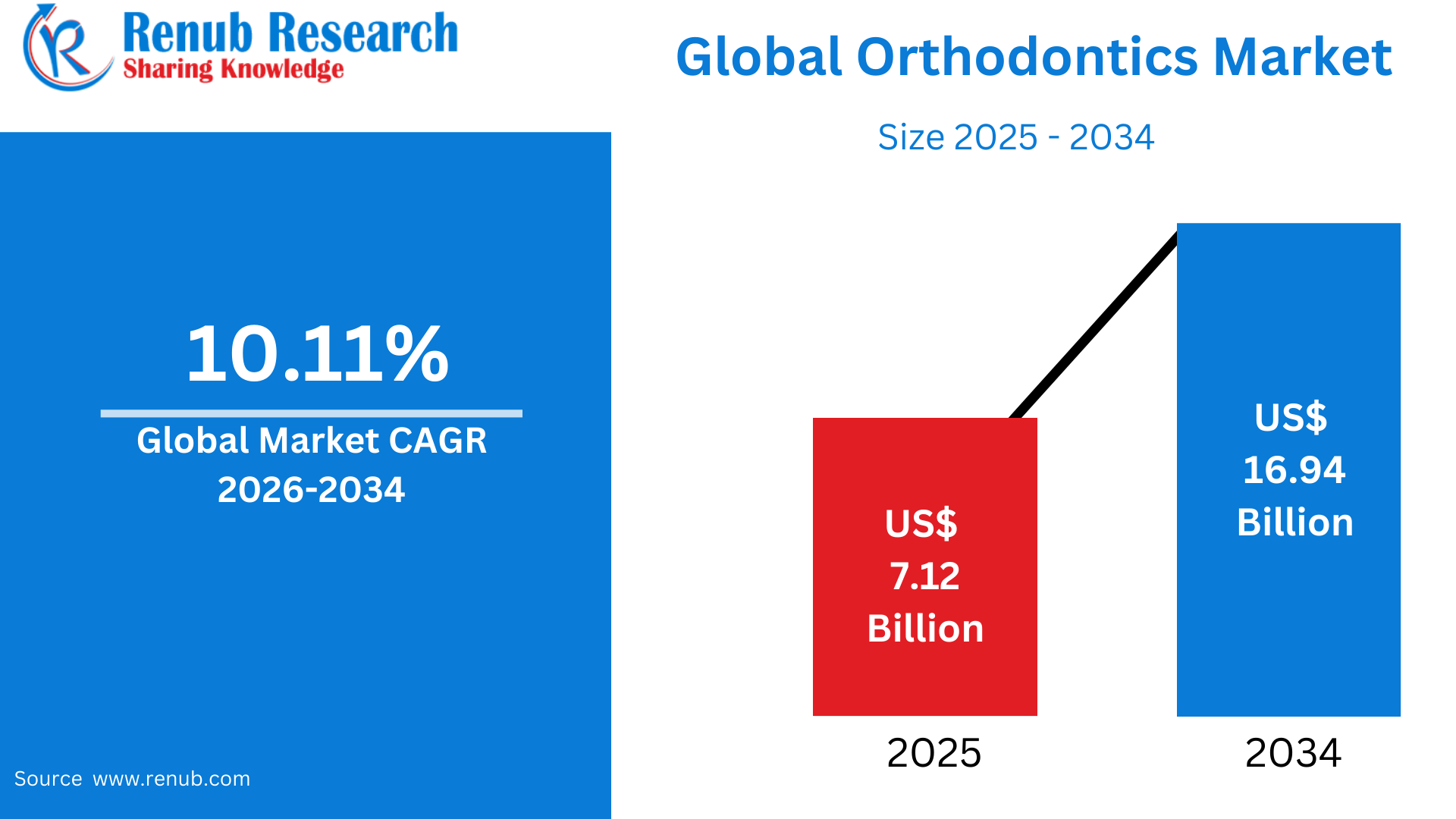
Orthodontics Market is expected to reach US$ 16.94 billion by 2034 from US$ 7.12 billion in 2025, with a CAGR of 10.11% from 2026 to 2034. Growing interest in aesthetic dental care, widespread adoption of clear aligners, rapid advances in digital orthodontic tools, and expanding oral-health awareness worldwide collectively strengthen global orthodontics market momentum across both established healthcare systems and developing regions.
Orthodontics Industry Overview
Orthodontics is a dental specialty devoted to identifying, preventing, and correcting misaligned teeth and jaw irregularities. Through appliances such as braces, aligners, retainers, and corrective devices, orthodontists gradually reposition teeth to improve bite function, appearance, and long-term oral health. Proper alignment reduces risks such as gum disease, tooth decay, jaw strain, and speech issues. Modern orthodontics incorporates digital imaging, AI-guided planning, and 3D-printed components, enabling more precise, efficient, and comfortable treatments. These innovations allow practitioners to deliver customized care for children, teens, and adults, enhancing both dental function and facial aesthetics.
One major driver of orthodontics market expansion is the rapid integration of digital technologies that elevate diagnostic accuracy and treatment precision. AI-guided modeling, 3D imaging, and digitally crafted aligners offer faster, more predictable outcomes with less discomfort. Growing adult interest in invisible orthodontic solutions further accelerates demand. At the same time, rising awareness of how jaw alignment influences overall oral health encourages earlier orthodontic evaluation. Increasing investment in dental infrastructure across developing economies supports broader accessibility. Together, these factors continually strengthen global market growth and adoption of technologically enhanced orthodontic solutions.
Growth Drivers for the Orthodontics Market
Digital Transformation & Clear Aligner Adoption
A key factor boosting global orthodontics market growth is the accelerating shift toward digital workflows and clear aligner treatments. Patients are increasingly choosing discreet, comfortable corrective options that integrate seamlessly with their lifestyle, leading to widespread adoption of digital scanners, AI-supported treatment planning tools, and 3D-printed appliances. These technologies enhance precision, reduce revisions, and shorten appointment times, making treatment more appealing for both patients and providers. A notable advancement occurred in November 2023, when Vivos Therapeutics, Inc. formed a strategic collaboration with Ormco to connect IVOS CARE technologies with Spark Clear Aligners. This integration seeks to enhance treatment speed, comfort, and predictability. As digital-first orthodontics continues evolving, more clinics invest in advanced equipment, strengthening global demand. This movement toward high-precision, patient-friendly systems remains one of the strongest drivers of market expansion.
Integrated Oral-Care Ecosystems & Strategic Partnerships
Another important growth catalyst is the rising emphasis on integrated oral-care ecosystems created through partnerships among major dental technology companies. Patients increasingly prefer unified solutions that combine orthodontic correction with preventive and cosmetic care. This has encouraged strategic collaborations aimed at expanding clinical capabilities and improving treatment efficiency. A strong example arose in February 2023, when Koninklijke Philips N.V. partnered with Candid Care Co. to deliver a broader line of interconnected oral-care products, including orthodontic services and whitening solutions. Such alliances streamline workflows, enhance digital monitoring, and offer patients more convenient, comprehensive care experiences. The trend toward product integration also supports remote-care models and encourages adoption of oral-health technologies across dental clinics. As these ecosystems grow, they significantly strengthen global orthodontics market expansion.
Rising Oral-Health Awareness & Preventive Care Expansion
A further contributor to orthodontics market growth is the increasing global focus on oral-health education and preventive dental care. Awareness campaigns, school-based dental programs, and expanding insurance coverage encourage earlier diagnosis of misalignment issues. As a result, more patients—especially children and young adults—seek orthodontic evaluation before problems progress. Meanwhile, rising income levels in developing economies are expanding access to premium orthodontic services, including clear aligners and advanced braces. Clinics are also adopting next-generation tools such as 3D-printed brackets, self-adjusting wires, digital impression systems, and AI-assisted simulation platforms, which improve accuracy and reduce treatment duration. Tele-orthodontics continues growing, providing remote consultations that make care more accessible in underserved regions. These combined dynamics—greater awareness, technological innovation, and increased affordability—substantially boost global orthodontics market growth.
Challenges in the Orthodontics Market
High Treatment Cost and Limited Affordability
A major challenge in the orthodontics market is the high overall cost of treatment, which can place a significant financial burden on patients. Clear aligners, digital scanning, advanced imaging systems, and 3D-printing technology all contribute to higher service prices. Smaller clinics often struggle to invest in these tools, limiting their ability to compete with larger or well-equipped providers. Insurance coverage in many countries remains limited, especially for adult orthodontic care, making treatment less accessible. As aesthetic orthodontics becomes more popular, premium pricing structures widen affordability gaps. These factors slow market penetration, particularly in low-income regions where cost remains a major barrier to adopting modern orthodontic solutions.
Shortage of Orthodontic Specialists & Regulatory Complexity
Another obstacle affecting orthodontics market growth is the shortage of specialized orthodontic professionals in various regions. Orthodontic training requires several additional years of education, and many countries lack enough accredited programs to meet demand. This results in uneven distribution of specialists, long waiting lists, and significant gaps in rural care access. Additionally, rapid advancements in digital orthodontics require continuous training, raising costs for practitioners and creating skill disparities. Regulatory variations across countries add further complexity, slowing product approvals and limiting international expansion for manufacturers. These constraints collectively restrict service availability and slow market development despite rising global interest in orthodontic care.
United States Orthodontics Market
The orthodontics market in the United States is fueled by strong consumer preference for aesthetic dental solutions, widespread adoption of clear aligners, and a highly advanced dental-care infrastructure. Clinics readily integrate technologies such as 3D printing, digital impressions, and AI-guided planning, enabling efficient and precise treatments. Adult orthodontics continues to grow as more individuals prioritize appearance and long-term oral health. Additionally, the U.S. hosts many leading manufacturers and innovators, fostering ongoing product development and competitive pricing. Expanded financing options and insurance support for children increase treatment accessibility. These factors position the U.S. as one of the most mature and technology-driven orthodontics markets globally.
Germany Orthodontics Market
The orthodontics market in Germany benefits from a strong public healthcare system, high dental-care standards, and widespread awareness of preventive dentistry. German patients increasingly choose discreet orthodontic solutions such as clear aligners and lingual braces, enhancing demand for advanced treatment options. The country’s precision-engineering culture supports rapid adoption of digital tools, including CAD/CAM workflows, 3D imaging, and robotic wire-bending technologies. Collaboration between universities, dental manufacturers, and specialist clinics drives research and innovation. Insurance coverage for children and adolescents further encourages early orthodontic intervention. With its focus on high-quality care and technological excellence, Germany remains one of Europe’s most influential orthodontics markets.
China Orthodontics Market
The orthodontics market in China is expanding rapidly, driven by rising disposable incomes, increased interest in aesthetic dentistry, and fast-growing urban populations. Clear aligners are especially popular among young adults seeking convenient, subtle treatment options. Government initiatives promoting oral hygiene, combined with the rapid growth of private dental chains, improve access to orthodontic services. Local manufacturers are becoming strong competitors by producing cost-effective aligners and digital systems tailored to domestic demand. Major cities are adopting AI-powered diagnostics, remote monitoring apps, and 3D-printing technologies at accelerating rates. While regional affordability varies, China remains one of the world’s fastest-developing orthodontics markets.
Saudi Arabia Orthodontics Market
The orthodontics market in Saudi Arabia is supported by growing investment in healthcare modernization, a youthful population, and a strong cultural emphasis on appearance. Demand for advanced braces and clear aligners is rising, especially among teenagers and working professionals seeking aesthetic solutions. Expansion of private dental centers and increased government efforts to improve oral health are enhancing treatment accessibility. International manufacturers are strengthening their presence through partnerships with local distributors, bringing in digital tools such as intraoral scanners and AI-driven planning systems. Although specialist availability varies across regions, Saudi Arabia continues to emerge as a leading orthodontic market in the Middle East.
Recent Developments in Orthodontics Market
- November 2024: The International Orthodontics Foundation partnered with the ADA Forsyth Institute to strengthen global orthodontic innovation by advancing research, technology development, and professional training.
- August 2024: Angelalign Technology Inc. entered a strategic collaboration with The Lubrizol Corporation to accelerate innovation in clear aligner materials and design, supporting improved performance and treatment outcomes.
- January 2024: Henry Schein, Inc. introduced the Carriere Motion Pro bite corrector, created to address Class II and Class III malocclusions while helping reduce total orthodontic treatment time.
- December 2023: BRACES ON DEMAND collaborated with EasyRx to enhance orthodontic workflow efficiency through integrated digital imaging and 3D-printed custom braces.
Market Segmentation
Product Types
- Instruments
- Supplies
Age-groups
- Adults
- Children
End-Users
- Hospitals
- Dental Clinics
- Others
Country
North America
- United States
- Canada
Europe
- France
- Germany
- Italy
- Spain
- United Kingdom
- Belgium
- Netherlands
- Turkey
Asia Pacific
- China
- Japan
- India
- South Korea
- Thailand
- Malaysia
- Indonesia
- Australia
- New Zealand
Latin America
- Brazil
- Mexico
- Argentina
Middle East & Africa
- Saudi Arabia
- UAE
- South Africa
All the Key players have been covered from 5 Viewpoints:
- Overviews
- Key Person
- Recent Developments
- SWOT Analysis
- Revenue Analysis
Company Analysis:
- 3M Corporation
- Henry Schein, Inc.
- Dentsply Sirona
- Align Technology, Inc.
- Straumann AG
- Danaher Corporation
- Envista Holdings Corporation
Report Details:
| Report Features | Details |
| Base Year |
2025 |
| Historical Period |
2022 - 2025 |
| Forecast Period |
2026 - 2034 |
| Market |
US$ Billion |
| Segment Covered |
Product Types, Age-groups, End-Users and Countries |
| Countries Covered |
|
| Companies Covered |
|
| Customization Scope |
20% Free Customization |
| Post-Sale Analyst Support |
1 Year (52 Weeks) |
| Delivery Format |
PDF and Excel through Email (We can also provide the editable version of the report in PPT/Word format on request) |
Customization Services available
- Analysis of Market Size and Its Segments
- More Company Profiles (Upto 10 without any additional cost):
- Additional Countries (Other than mentioned Countries):
- Region/Country Specific Reports:
- Market Entry Strategy:
- Region-Specific Market Dynamics:
- Regional Market Share Analysis:
- Trade Analysis:
- Production Insights:
- Others Customized Requests:
For more information contact our analysts.
Need More Assistance?
- Talk to our analysts to get more precious information on the current market trends.
- Include more countries and segments and customize the report based on the final requirement.
- Get a competitive advantage in your industry by knowing the report findings and making a positive impact on your revenues and operations.
- Our analysts are always ready to provide more help and pertinent information if you need any additional assistance.