Online Education Market Size, Share, Growth Trends, Industry Analysis, Key Companies & Forecast 2026–2034
Buy NowGlobal Online Education Market Forecast & Trajectory
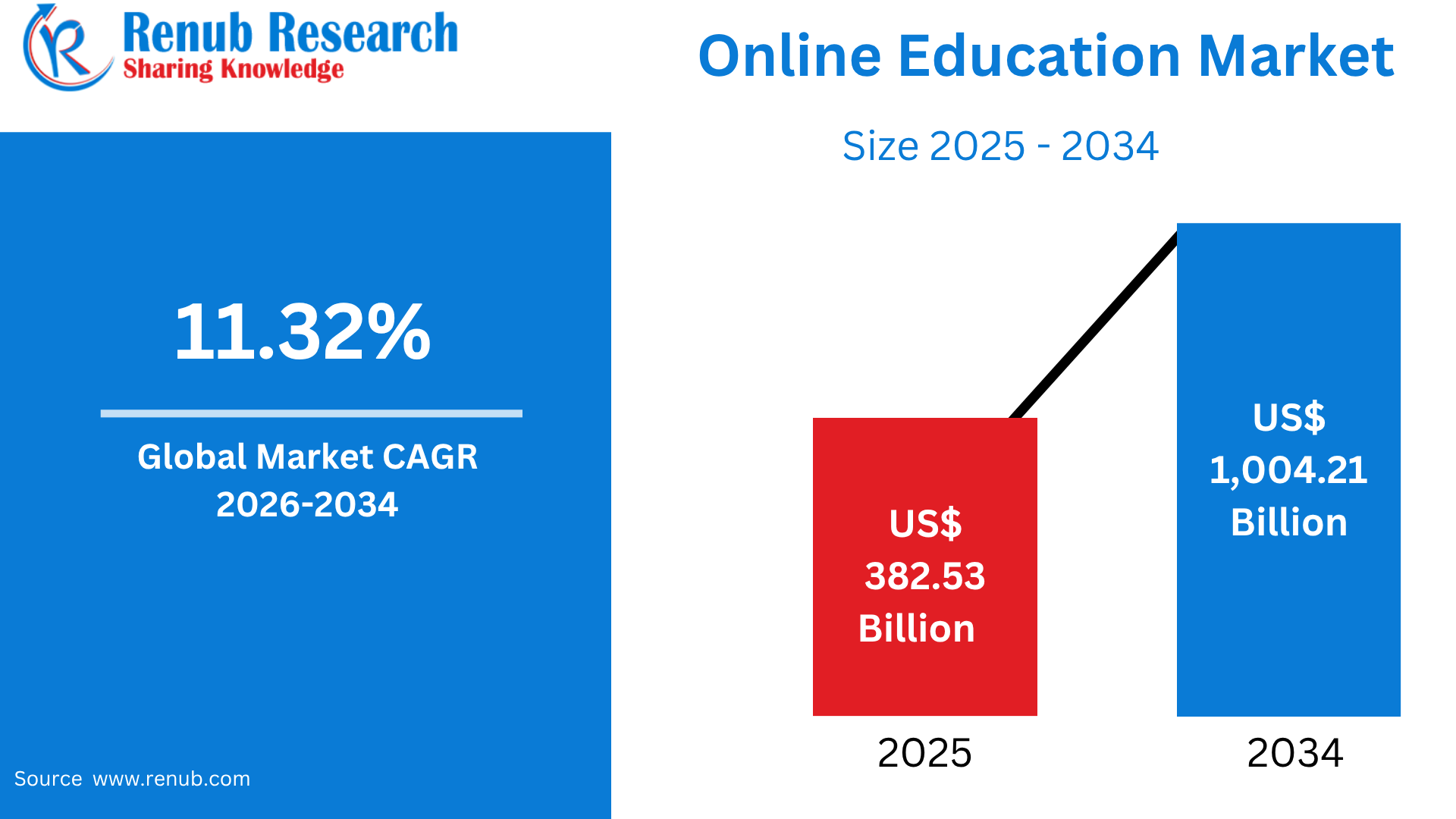
Online Education Market is projected to grow from US$ 382.53 billion in 2025 to approximately US$ 1,004.21 billion by 2034, registering a compound annual growth rate (CAGR) of 11.32% during the forecast period of 2026–2034. Market expansion is being driven by widespread internet penetration, increasing demand for flexible learning solutions, and the growing integration of digital technologies into education. Online education provides learners and working professionals with greater accessibility, cost-effectiveness, and convenience, enabling education anytime and anywhere.
What is Online Education and Its Uses & Popularity Worldwide
Online education is a digital learning method that enables students, professionals, and lifelong learners to access educational content through the internet using computers, smartphones, or tablets. It includes live virtual classes, recorded lectures, interactive learning platforms, online certifications, and self-paced courses that allow users to study anytime and from virtually any location. Online education is widely used in K–12 schooling, higher education, professional certification, corporate training, language learning, and technical skill development. It supports personalized learning through artificial intelligence, adaptive assessments, cloud-based collaboration, and multimedia resources that enhance student engagement and learning outcomes.
The popularity of online education has increased significantly worldwide due to expanding internet connectivity, widespread smartphone adoption, and growing demand for flexible learning opportunities. Universities, schools, businesses, and government organizations increasingly use online platforms to deliver education and workforce training efficiently. The rise of remote work and continuous upskilling has further accelerated adoption among working professionals seeking career advancement. Additionally, online education offers cost-effective access to quality learning resources, making education more inclusive and accessible across developed and emerging economies, thereby establishing it as a vital component of the modern global education ecosystem.
Smartphone Ownership Statistics
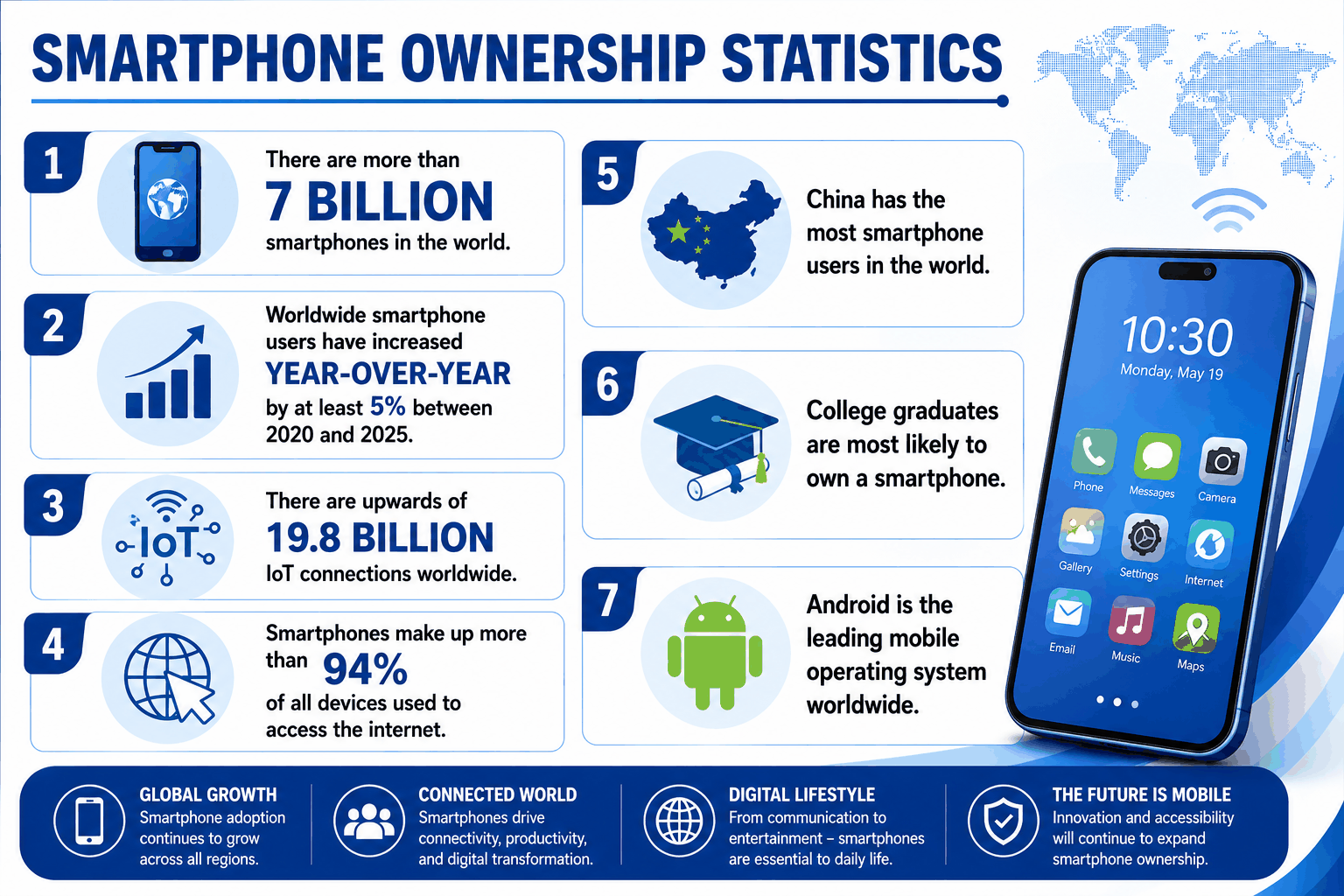
- There are more than 7 billion smartphones in the world.
- Worldwide smartphone users have increased year-over-year by at least 5% between 2020 and 2025.
- There are upwards of 19.8 billion IoT connections worldwide
- Smartphones make up more than 94% of all devices used to access the internet
- China has the most smartphone users in the world
- College graduates are most likely to own a smartphone
- Android is the leading mobile operating system worldwide
Individuals using the Internet
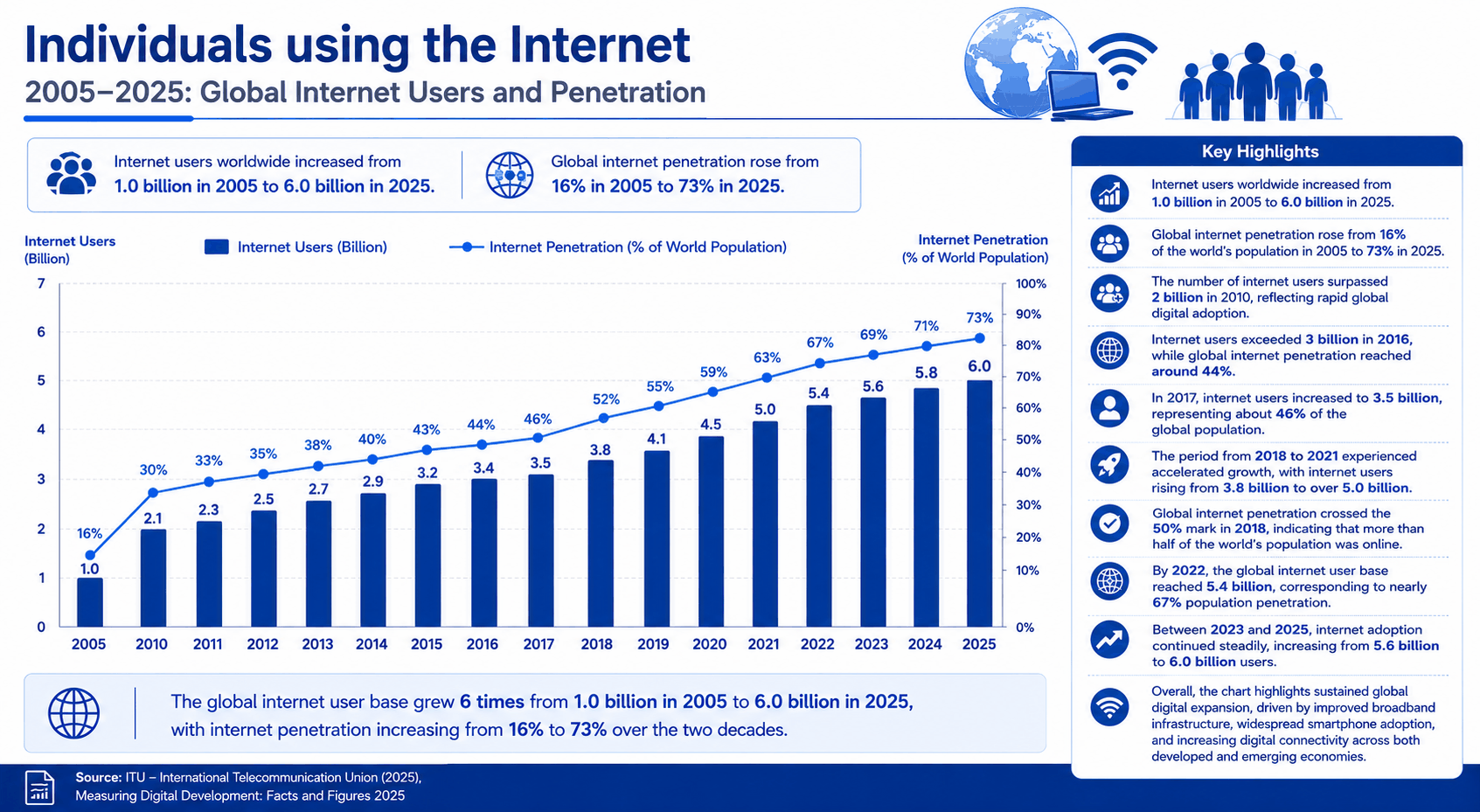
- Internet users worldwide increased from approximately 1.0 billion in 2005 to 6.0 billion in 2025.
- Global internet penetration rose from around 16% of the world’s population in 2005 to approximately 73% in 2025.
- The number of internet users surpassed 2 billion in 2010, reflecting rapid global digital adoption.
- Internet users exceeded 3 billion in 2016, while global internet penetration reached around 44%.
- In 2017, internet users increased to approximately 3.5 billion, representing about 46% of the global population.
- The period from 2018 to 2021 experienced accelerated growth, with internet users rising from 3.8 billion to over 5.0 billion.
- Global internet penetration crossed the 50% mark in 2018, indicating that more than half of the world’s population was online.
- By 2022, the global internet user base reached approximately 5.4 billion, corresponding to nearly 67% population penetration.
- Between 2023 and 2025, internet adoption continued steadily, increasing from 5.6 billion to 6.0 billion users.
- Overall, the chart highlights sustained global digital expansion, driven by improved broadband infrastructure, widespread smartphone adoption, and increasing digital connectivity across both developed and emerging economies.
Notable Online Education Product Launches Worldwide
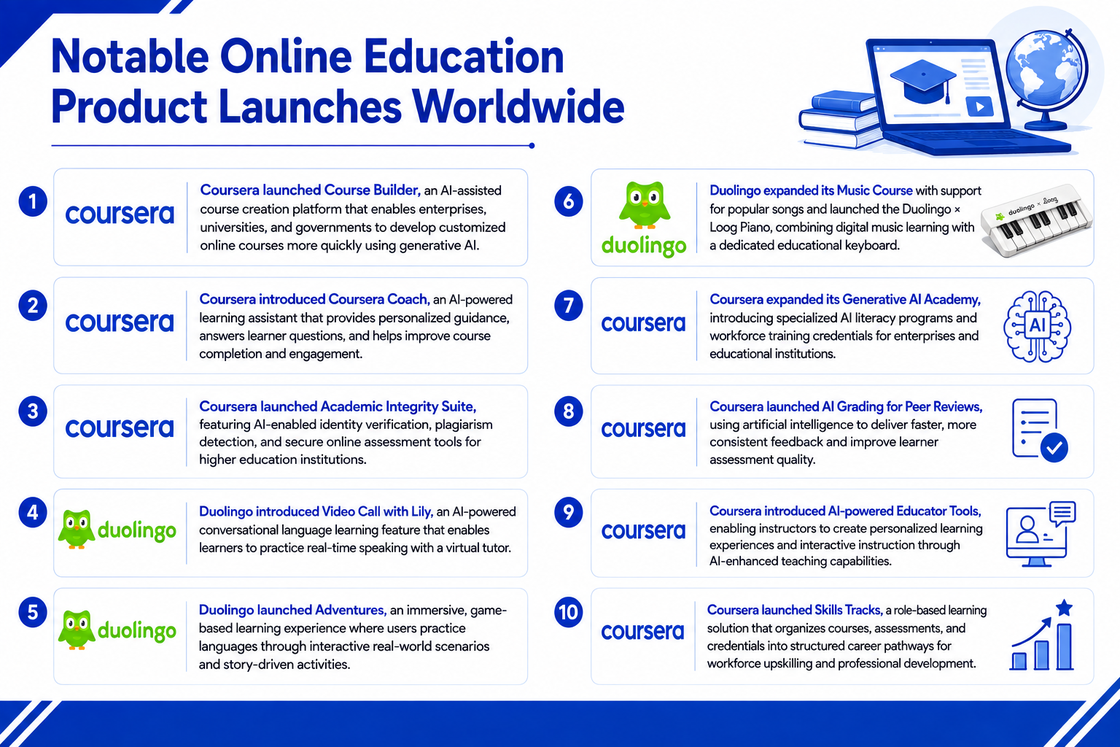
- Coursera launched Course Builder, an AI-assisted course creation platform that enables enterprises, universities, and governments to develop customized online courses more quickly using generative AI.
- Coursera introduced Coursera Coach, an AI-powered learning assistant that provides personalized guidance, answers learner questions, and helps improve course completion and engagement.
- Coursera launched Academic Integrity Suite, featuring AI-enabled identity verification, plagiarism detection, and secure online assessment tools for higher education institutions.
- Duolingo introduced Video Call with Lily, an AI-powered conversational language learning feature that enables learners to practice real-time speaking with a virtual tutor.
- Duolingo launched Adventures, an immersive, game-based learning experience where users practice languages through interactive real-world scenarios and story-driven activities.
- Duolingo expanded its Music Course with support for popular songs and launched the Duolingo × Loog Piano, combining digital music learning with a dedicated educational keyboard.
- Coursera expanded its Generative AI Academy, introducing specialized AI literacy programs and workforce training credentials for enterprises and educational institutions.
- Coursera launched AI Grading for Peer Reviews, using artificial intelligence to deliver faster, more consistent feedback and improve learner assessment quality.
- Coursera introduced AI-powered Educator Tools, enabling instructors to create personalized learning experiences and interactive instruction through AI-enhanced teaching capabilities.
- Coursera launched Skills Tracks, a role-based learning solution that organizes courses, assessments, and credentials into structured career pathways for workforce upskilling and professional development.
Growth Driver
Rising Internet Penetration and Smartphone Adoption Expanding Digital Learning Access
The rapid expansion of internet connectivity and smartphone ownership is one of the strongest growth drivers for the online education market. According to industry estimates, over 5.5 billion people worldwide use the internet, representing nearly 68% of the global population, while smartphone users have surpassed 7 billion globally. These technological advancements have significantly improved access to digital education across both developed and emerging economies. High-speed 4G and 5G networks enable uninterrupted video lectures, virtual classrooms, and interactive assessments, making online learning more engaging and accessible. Governments are also investing in digital infrastructure to bridge educational gaps in rural and underserved regions. The affordability of smartphones has further enabled students to access learning platforms without requiring expensive computing devices. Educational institutions are increasingly adopting cloud-based learning management systems (LMS), while educational content is becoming available in multiple languages. The combination of expanding digital infrastructure, improved mobile connectivity, and increasing internet accessibility continues to drive global enrollment in online education programs across academic, vocational, and professional learning segments.
Increasing Demand for Flexible Learning and Workforce Upskilling
Growing demand for flexible education and continuous skill development is significantly accelerating the online education market. Modern learners increasingly seek educational solutions that fit around work schedules, family responsibilities, and personal commitments. Industry surveys indicate that more than 70% of working professionals prefer flexible online learning for acquiring new skills and professional certifications. Companies worldwide are also investing heavily in employee reskilling and digital training to address rapid technological changes, particularly in artificial intelligence, cybersecurity, cloud computing, data analytics, and digital marketing. Online education platforms offer self-paced courses, live instructor-led sessions, micro-credentials, and internationally recognized certifications, making lifelong learning more accessible. Universities are expanding hybrid and fully online degree programs to attract domestic and international students. Furthermore, the growing gig economy and remote work culture have increased demand for affordable, career-focused education. As industries continue to experience digital transformation, online education provides scalable, cost-effective solutions that support workforce competitiveness and long-term employability, contributing substantially to sustained market growth.
Advancements in Educational Technology and Artificial Intelligence
Technological innovation is transforming online education into a highly personalized and interactive learning experience. Artificial intelligence, machine learning, virtual reality (VR), augmented reality (AR), cloud computing, and learning analytics are enabling educational platforms to deliver customized content based on individual learning behavior. Industry estimates indicate that more than 60% of major online learning platforms have integrated AI-powered features such as personalized recommendations, automated assessments, adaptive quizzes, and intelligent tutoring systems. Video conferencing technologies, interactive whiteboards, gamification, and collaborative digital classrooms have also improved learner engagement and course completion rates. Educational institutions and corporate training providers are investing in advanced learning management systems capable of tracking student performance in real time and identifying knowledge gaps. Additionally, AI-powered chatbots provide instant academic support, improving student satisfaction and retention. Continuous technological advancements are enabling institutions to deliver high-quality education at scale while reducing operational costs, making online education increasingly attractive to learners, educators, governments, and enterprises worldwide.
Challenge
Digital Divide and Unequal Access to Technology
Despite rapid digitalization, unequal access to internet infrastructure and digital devices remains a significant challenge for the online education market. According to global estimates, approximately 2.5 billion people worldwide still lack reliable internet access, particularly in low-income and rural regions. Many students continue to face limited broadband availability, unstable network connectivity, or insufficient access to laptops and tablets required for effective online learning. In several developing countries, electricity shortages and high internet costs further reduce participation in virtual education. These infrastructure limitations create disparities in educational opportunities and negatively impact learning outcomes. Educational institutions also encounter difficulties in delivering consistent digital experiences when students possess varying levels of technological access. Governments and private organizations are investing in broadband expansion, affordable devices, and digital literacy programs to reduce these inequalities. However, bridging the global digital divide remains a long-term challenge that could limit the full adoption and inclusive growth of online education across underserved populations.
Maintaining Student Engagement and Ensuring Education Quality
Maintaining learner engagement and ensuring consistent educational quality remain critical challenges for online education providers. Studies indicate that online course completion rates are often 10–20 percentage points lower than traditional classroom programs, primarily due to reduced motivation, limited face-to-face interaction, and increased distractions in home learning environments. Students may experience feelings of isolation, making sustained participation more difficult over extended learning periods. Educational institutions must continuously invest in engaging content, interactive teaching methods, and advanced digital tools to improve learner retention. In addition, ensuring academic integrity during online examinations presents ongoing challenges despite the adoption of AI-based proctoring and identity verification technologies. The quality of online education also varies considerably among providers, affecting employer recognition and student confidence. To remain competitive, institutions are increasingly emphasizing accreditation, instructor training, personalized learning support, interactive assessments, and continuous curriculum updates to deliver educational experiences that match or exceed traditional classroom standards.
Online Higher Expanding Access to Degree and Professional Education
The online higher education market has experienced remarkable growth as universities and colleges increasingly offer bachelor’s, master’s, doctoral, and professional certification programs through digital platforms. Industry estimates indicate that over 35–40% of higher education institutions worldwide now provide fully online or hybrid degree programs, reflecting strong demand for flexible learning. Online higher education enables students to pursue accredited qualifications without geographical limitations while reducing accommodation and commuting costs. The market is further supported by rising enrollment among working professionals seeking career advancement through part-time and self-paced education. Universities are integrating artificial intelligence, virtual laboratories, cloud-based learning management systems, and interactive assessments to enhance educational quality. International student enrollment has also increased due to broader access to globally recognized institutions. Government support for digital education, expanding broadband connectivity, and growing acceptance of online degrees by employers continue to strengthen market growth. Continuous innovation in curriculum delivery and digital student engagement is expected to sustain long-term expansion across developed and emerging economies.
Corporate Upskilling Driving Digital Learning Investments
Large enterprises represent one of the fastest-growing customer segments in the online education market as organizations increasingly prioritize workforce upskilling and reskilling. Industry surveys suggest that more than 80% of multinational companies have adopted digital learning platforms for employee development, compliance training, leadership programs, and technical certification. Rapid digital transformation has increased demand for courses covering artificial intelligence, cybersecurity, cloud computing, project management, and data analytics. Online education enables enterprises to train thousands of employees simultaneously while reducing travel, classroom infrastructure, and instructor costs. Learning management systems equipped with analytics, personalized learning paths, and AI-powered assessments help organizations monitor employee progress and improve training effectiveness. Remote and hybrid work models have further accelerated demand for cloud-based corporate learning platforms that support continuous education regardless of employee location. As competition for skilled talent intensifies, enterprises continue investing in digital learning ecosystems that improve productivity, employee retention, and organizational competitiveness, making corporate online education a significant contributor to overall market expansion.
Comprehensive Digital Learning Solutions Supporting Online Education Services Market Growth
The online education services market encompasses a broad range of offerings including virtual tutoring, learning management systems, curriculum development, assessment services, technical support, certification management, and educational consulting. Industry estimates indicate that services account for nearly 35–40% of total online education spending, reflecting the growing importance of comprehensive learning ecosystems. Educational institutions, corporations, and government organizations increasingly outsource digital content creation, platform management, instructor training, and student support services to specialized providers. Cloud-based education services enable institutions to scale operations efficiently while improving accessibility and learner engagement. AI-driven student analytics, automated grading, multilingual support, and adaptive learning technologies further enhance service quality. The expansion of subscription-based education models has created recurring revenue opportunities for service providers offering continuous platform maintenance and technical assistance. Growing demand for customized learning experiences, digital transformation in education, and increasing institutional investments in educational technology continue driving the rapid expansion of online education services across global academic and corporate sectors.
Digital Learning Platforms Transforming Global Education
The online e-learning market has become one of the largest segments within digital education, offering structured courses, certification programs, skill development, and professional training through internet-based platforms. Industry estimates indicate that over 300 million learners worldwide actively participate in online learning through educational websites, virtual classrooms, and massive open online courses (MOOCs). E-learning provides learners with flexible scheduling, lower educational costs, and access to internationally recognized instructors regardless of geographical location. Educational providers continuously enhance learning experiences through interactive videos, gamification, discussion forums, AI-powered recommendations, and personalized assessments. Businesses increasingly utilize e-learning for onboarding, compliance training, and employee development, while schools and universities integrate digital learning into traditional classroom instruction. The rapid adoption of cloud computing, artificial intelligence, and data analytics has significantly improved learner engagement and course completion rates. Growing demand for lifelong learning, professional certifications, and continuous workforce development continues to position online e-learning as a key pillar of the global digital education ecosystem.
Smartphone-Based Learning Expanding Educational Accessibility
Mobile e-learning has emerged as one of the fastest-growing segments of the online education market due to widespread smartphone adoption and expanding mobile internet connectivity. Industry estimates suggest that over 70% of online learners access educational content through mobile devices, highlighting the growing importance of mobile-first learning experiences. Mobile learning applications allow users to participate in live classes, watch recorded lectures, complete quizzes, download study materials, and earn certifications from virtually any location. Features such as offline access, push notifications, microlearning modules, voice-enabled learning, and AI-powered recommendations have significantly improved learner convenience and engagement. Educational institutions and enterprises increasingly optimize digital content for smartphones and tablets to support remote learning and workforce training. The rollout of 5G networks, affordable smartphones, and cloud-based educational platforms has further accelerated adoption across emerging markets. As learners increasingly prefer flexible, on-the-go education, mobile e-learning continues to reshape global learning habits while expanding educational access across diverse demographic groups.
United States Digital Learning Ecosystem Supporting Lifelong Education
United States is the world’s largest online education market, supported by advanced digital infrastructure, widespread internet access, and strong adoption across academic institutions and corporate organizations. Industry estimates indicate that over 75% of universities and colleges in the country offer fully online or hybrid degree programs, while more than 90% of households have internet access, enabling broad participation in digital learning. Corporate e-learning has also expanded significantly as organizations invest in employee reskilling in artificial intelligence, cybersecurity, cloud computing, and leadership development. Massive Open Online Courses (MOOCs), virtual classrooms, and AI-powered learning platforms continue to attract millions of learners annually. Growing demand for flexible education among working professionals, increasing enrollment in online graduate programs, and employer acceptance of digital certifications are strengthening market growth. Continuous investments in adaptive learning technologies, cloud-based learning management systems, virtual laboratories, and immersive educational tools position the United States as a global leader in online education innovation and digital workforce development.
United Kingdom Adoption and Digital Skills Development
United Kingdom remains one of Europe’s leading online education markets, supported by internationally recognized universities, widespread broadband connectivity, and increasing emphasis on lifelong learning. Industry estimates suggest that more than 95% of UK households have internet access, creating a favorable environment for digital education adoption. Universities increasingly offer online undergraduate, postgraduate, and executive education programs that attract both domestic and international students. The country’s growing focus on digital skills, vocational education, and workforce reskilling has encouraged greater investment in e-learning platforms and professional certification programs. Corporate organizations increasingly use online education for compliance training, leadership development, and technical upskilling. Artificial intelligence, cloud computing, and interactive learning technologies are improving learner engagement and academic outcomes. Government initiatives supporting digital transformation and flexible learning continue to encourage educational innovation. The increasing popularity of hybrid education models and employer recognition of online qualifications further contribute to sustained expansion of the United Kingdom’s online education market.
India Rapid Digital Adoption Driving Exceptional Market Growth
India has emerged as one of the fastest-growing online education markets globally due to expanding internet connectivity, affordable smartphones, and a large student population. Industry estimates indicate that the country has more than 950 million internet subscribers, while smartphone users exceed 800 million, creating enormous opportunities for digital education providers. The rapid growth of online tutoring, competitive examination preparation, higher education, and professional certification platforms has transformed India’s education landscape. Working professionals increasingly enroll in online programs to develop skills in data science, artificial intelligence, software development, finance, and business management. Educational institutions are adopting cloud-based learning management systems, virtual classrooms, and AI-enabled assessment tools to improve learning outcomes. Government initiatives promoting digital learning and technology integration in schools further support market expansion. The combination of rising disposable incomes, increasing digital literacy, expanding broadband coverage, and growing awareness of career-focused education continues to position India as one of the most dynamic online education markets worldwide.
Saudi Arabia Digital Transformation and Vision 2030 Accelerating E-Learning Adoption
Saudi Arabia’s online education market is experiencing steady growth as the country continues implementing digital transformation initiatives under Vision 2030. Industry estimates indicate that internet penetration exceeds 99%, while smartphone adoption is among the highest in the Middle East, providing an excellent foundation for digital education. Universities, schools, and vocational institutions are increasingly adopting online and hybrid learning models supported by cloud-based educational platforms and virtual classrooms. Corporate organizations are investing heavily in online employee training to strengthen capabilities in digital technologies, healthcare, engineering, finance, and business management. The growing demand for internationally recognized certifications and flexible professional education has expanded enrollment in online learning programs. Artificial intelligence, digital assessment systems, and mobile learning applications are enhancing educational accessibility and learner engagement. Continued government investments in digital infrastructure, educational modernization, and workforce development, combined with increasing demand for lifelong learning, are expected to sustain strong growth in Saudi Arabia’s online education market across academic and corporate sectors.
Market Segments
Type
1.Academic
- Higher Education
- Vocational Training
- K-12 Education
- Others
2.Corporate
- Large Enterprises
- SMBs
3.Government
Provider
- Content
- Services
Technology
- Online e-learning
- Learning Management System (LMS)
- Mobile e-learning
- Rapid e-learning
- Virtual classroom
- Others
Countries
North America
- United States
- Canada
Europe
- France
- Germany
- Italy
- Spain
- United Kingdom
- Belgium
- Netherlands
- Turkey
Asia Pacific
- China
- Japan
- India
- Australia
- South Korea
- Thailand
- Malaysia
- Indonesia
- New Zealand
Latin America
- Brazil
- Mexico
- Argentina
Middle East & Africa
- South Africa
- Saudi Arabia
- United Arab Emirates
All companies have been covered with 5 Viewpoints
- Overviews
- Key Person
- Recent Developments
- SWOT Analysis
- Revenue Analysis
Company Analysis:
- Coursera Inc.
- Instructure Holding Inc.
- Adobe Inc.
- Alphabet Inc.
- Udemy
- Pearsons Inc.
- Stride Inc.
- NetEase Inc.
Report Details:
| Report Features | Details |
| Base Year |
2025 |
| Historical Period |
2022 - 2025 |
| Forecast Period |
2026 - 2034 |
| Market |
US$ Billion |
| Segment Covered |
Type, Provider, Technology and Countries |
| Countries Covered |
|
| Companies Covered |
|
| Customization Scope |
20% Free Customization |
| Post-Sale Analyst Support |
1 Year (52 Weeks) |
| Delivery Format |
PDF and Excel through Email (We can also provide the editable version of the report in PPT/Word format on request) |
Customization Services available
- Analysis of Market Size and Its Segments
- More Company Profiles (Upto 10 without any additional cost):
- Additional Countries (Other than mentioned Countries):
- Region/Country Specific Reports:
- Market Entry Strategy:
- Region-Specific Market Dynamics:
- Regional Market Share Analysis:
- Trade Analysis:
- Production Insights:
- Others Customized Requests:
For more information contact our analysts.
Need More Assistance?
- Talk to our analysts to get more precious information on the current market trends.
- Include more countries and segments and customize the report based on the final requirement.
- Get a competitive advantage in your industry by knowing the report findings and making a positive impact on your revenues and operations.
- Our analysts are always ready to provide more help and pertinent information if you need any additional assistance.