North America Sugar-free Chewing Gum Market Report by Flavor Type, Application, Country and Company Analysis 2026-2034
Buy NowNorth America Sugar-Free Chewing Gum Market Size & Forecast
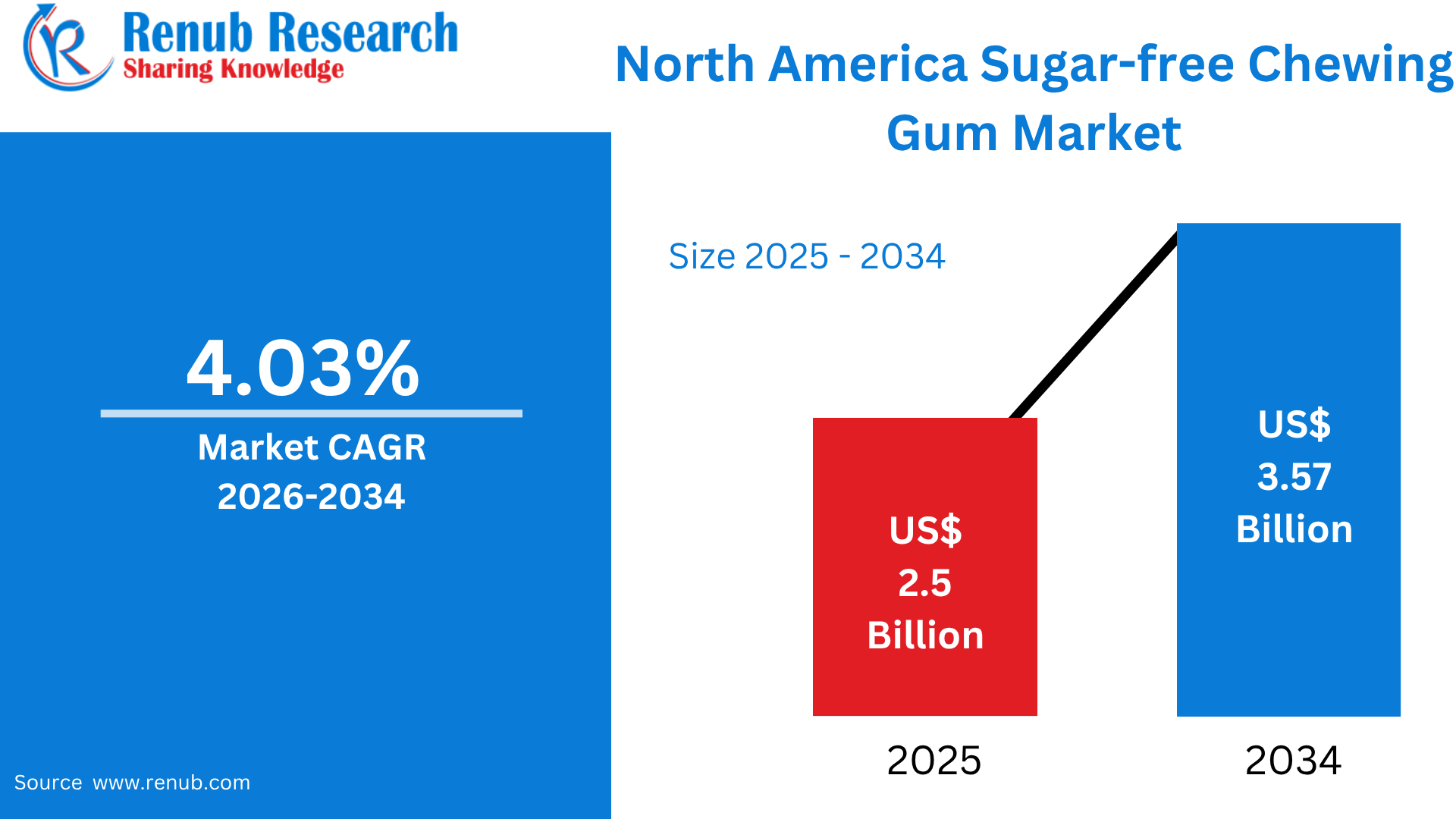
North America sugar-free chewing gum market is projected to grow from US$ 2.50 billion in 2025 to US$ 3.57 billion by 2034, registering a CAGR of 4.03% during 2026–2034. Market growth is supported by increasing consumer preference for low-calorie and oral-health-friendly chewing gum, rising awareness of dental hygiene, and growing demand for products made with natural and alternative sweeteners. Continuous innovation in flavors, textures, functional ingredients, and oral-care benefits is further expanding the market's consumer base.
What Is Sugar-Free Chewing Gum? Uses & Popularity in North America
Sugar-free chewing gum is a confectionery product made without conventional sugar and sweetened with alternatives such as xylitol, sorbitol, mannitol, maltitol, stevia, or aspartame. It provides the chewing experience and flavor of traditional gum while generally containing fewer calories and avoiding fermentable sugars associated with tooth decay. Sugar-free gum is used for freshening breath, increasing saliva production, supporting oral hygiene, reducing cravings, and providing a convenient low-calorie snack alternative. The American Dental Association notes that chewing sugar-free gum for about 20 minutes after meals can help prevent tooth decay by stimulating saliva flow, although it does not replace brushing and flossing.
Sugar-free chewing gum is particularly popular in North America because of increasing awareness of dental health, sugar reduction, and healthier snacking. North America accounted for approximately 42.92% of global sugar-free chewing gum revenue, making it the largest regional market. The United States is the leading market, while Canada and Mexico are also witnessing growing adoption. The availability of diverse flavors, functional ingredients, convenient formats, and widespread retail and online distribution continues to strengthen its popularity.
Sugar-Free Chewing Gum Production Data in North America, 2025
- United States: Approximately 204,000 metric tons of chewing gum were produced in 2025, representing around 80% of Northern America’s total output. The country remains the region’s largest manufacturing hub, supported by major multinational gum manufacturers, established ingredient suppliers, advanced production facilities, and extensive domestic demand.
- Canada: Canada produced approximately 51,000 metric tons of chewing gum in 2025, making it the second-largest production base in Northern America. Its manufacturing sector benefits from proximity to the U.S. market and established export-oriented production capabilities.
- Mexico: Separate 2025 production data specifically for sugar-free chewing gum are not publicly disclosed in the accessible sources. Mexico is nevertheless an important regional consumption market, with sugar-free gum sales growing strongly; industry data indicate that Mexico’s sugar-free gum market grew 14.3% between 2021 and 2023.
Growth Drivers of the North America Sugar-Free Chewing Gum Market
Rising Awareness of Oral Health Benefits
Increasing awareness of dental hygiene is a major growth driver for the North America sugar-free chewing gum market. Consumers are increasingly looking for convenient products that can complement their regular oral-care routines, particularly after meals when brushing may not be immediately possible. Sugar-free gum sweetened with ingredients such as xylitol, sorbitol, mannitol, and maltitol does not provide fermentable sugars for cavity-causing bacteria. The American Dental Association states that chewing sugar-free gum can increase saliva flow, helping dilute and neutralize plaque acids, and clinical trials have reported lower cavity incidence among people chewing sugar-free gum for 20 minutes after meals. Oral-health demand is particularly relevant in the United States, where approximately 21% of adults aged 20–64 have at least one untreated cavity. These concerns are encouraging consumers to consider sugar-free gum as an additional oral-care product. Manufacturers are also strengthening this positioning through ADA-accepted products and formulations featuring xylitol, fluoride, whitening ingredients, and breath-freshening benefits. Consequently, the combination of convenience and oral-health functionality is supporting market growth across North America.
Growing Preference for Low-Calorie and Reduced-Sugar Products
The increasing focus on healthier eating habits and sugar reduction is encouraging consumers to shift from conventional sugar-containing chewing gum toward sugar-free alternatives. Sugar-free chewing gum generally uses polyols or high-intensity sweeteners instead of sucrose, allowing manufacturers to offer sweet flavors while reducing or eliminating conventional sugar. This positioning is particularly attractive to consumers who monitor calorie intake, follow reduced-sugar diets, or seek healthier snack and confectionery options. The American Dental Association recognizes polyols such as xylitol, sorbitol, mannitol, and maltitol as noncariogenic sweeteners commonly used in sugar-free gum. Manufacturers are expanding their portfolios with zero-sugar, low-calorie, natural-sweetener, and functional products to respond to changing preferences. The trend also extends beyond traditional mint flavors, with brands introducing fruit, berry, tropical, cinnamon, and specialty flavor combinations. Convenient packaging, including small packs and resealable containers, further supports consumption as an on-the-go alternative to higher-calorie confectionery. As North American consumers increasingly evaluate sugar content and nutritional characteristics when purchasing food products, sugar-free chewing gum is positioned to benefit from the broader clean-label and healthier-snacking movement.
Product Innovation and Functional Gum Applications
Continuous product innovation is expanding the consumer base and creating new growth opportunities for sugar-free chewing gum in North America. Manufacturers are increasingly moving beyond basic breath-freshening products by incorporating oral-care, whitening, energy, vitamins, minerals, botanical ingredients, and functional sweeteners. The American Dental Association has established a dedicated category for sugar-free chewing gums that can help prevent cavities when chewed for 20 minutes after eating, demonstrating the growing importance of scientifically supported functional positioning. Existing ADA-accepted products also illustrate the breadth of flavor innovation; for example, Trident’s accepted sugar-free portfolio includes 12 flavors, ranging from Berry Lime and Pineapple to Watermelon Twist and Wintergreen. Innovation is also occurring in textures, formats, packaging, and sweetener systems. Manufacturers are experimenting with natural flavors, alternative sweeteners, longer-lasting flavor, and specialized formulations targeting different consumer needs. E-commerce and social media further enable brands to introduce niche products and reach younger consumers. The combination of functional benefits, flavor variety, premium positioning, and convenient formats is helping sugar-free gum evolve from a traditional confectionery product into a broader oral-care and wellness-oriented category.
Challenges of the North America Sugar-Free Chewing Gum Market
Digestive Concerns Associated with Sugar Alcohols
One of the key challenges for sugar-free chewing gum is the use of sugar alcohols such as sorbitol, mannitol, maltitol, and xylitol. These ingredients are widely used because they provide sweetness while generally being less cariogenic than conventional sugars. However, consuming excessive quantities of certain polyols can cause digestive discomfort, including bloating, abdominal discomfort, and laxative effects. This can create consumer concerns and potentially limit consumption among sensitive individuals. The challenge is particularly relevant because manufacturers depend heavily on sugar alcohols to reproduce the sweetness and mouthfeel expected from conventional chewing gum. The American Dental Association identifies polyols as common sweeteners in sugar-free gum and notes their noncariogenic characteristics, but their functional properties still require careful formulation. Manufacturers therefore need to balance sweetness, texture, flavor duration, oral-health benefits, and digestive tolerance when developing products. Reformulating products with combinations of sweeteners or alternative ingredients can also increase development and production costs. As consumers become more knowledgeable about ingredients and actively examine labels, brands must communicate the benefits and appropriate consumption of sweeteners clearly. Addressing digestive concerns through optimized formulations will remain important for maintaining consumer confidence and supporting long-term market expansion.
Competition from Alternative Oral-Care and Confectionery Products
Strong competition from alternative products presents another challenge for the North American sugar-free chewing gum market. Consumers can choose from breath mints, sugar-free candies, mouthwash, oral sprays, lozenges, dental products, and functional snacks, while bottled beverages and other low-calorie products also compete for impulse-purchase spending. The growing availability of specialized oral-care products can reduce the need for consumers to rely on chewing gum solely for fresh breath or oral-health support. At the same time, traditional confectionery remains highly competitive because consumers continue to seek convenient and flavorful treats. Sugar-free gum therefore needs to demonstrate clear differentiation through taste, functionality, ingredient quality, and convenience. Oral-health positioning provides an important advantage because the ADA states that sugar-free gum can stimulate saliva flow and help reduce plaque acids when chewed after meals. However, manufacturers cannot position gum as a substitute for brushing and flossing, limiting the extent of its oral-care claims. Additionally, changing consumer preferences toward natural ingredients and minimally processed products can challenge products containing artificial sweeteners or flavors. Continued innovation in natural sweeteners, functional ingredients, flavors, and packaging will therefore be essential for brands to maintain competitiveness in North America.
Sugar-Free Chewing Gum Launches in North America
- Trident Vibes Cotton Candy – Perfetti Van Melle (2025): Trident Vibes introduced Cotton Candy, a sugar-free gum with a sweet cotton-candy flavor. It entered the U.S. national retail market in May 2025 after a six-month exclusive launch at a major U.S. retailer.
- EXTRA Plant-Based Sugar-Free Gum – Mars Wrigley (2024): Mars Wrigley expanded its EXTRA portfolio with a plant-based sugar-free chewing gum, responding to increasing consumer interest in ingredients of plant or natural origin.
- Refresh Gum Garden Mint – Refresh Gum (2024): Refresh Gum expanded its plant-based, sugar-free range with Garden Mint, targeting consumers looking for natural ingredients and fresh mint flavor.
- Refresh Gum Raspberry – Refresh Gum (2024): The brand added a Raspberry flavor to its plant-based sugar-free gum portfolio, providing a fruit-forward alternative to traditional mint varieties.
- Refresh Gum Peppermint – Refresh Gum (2024): Refresh Gum introduced a Peppermint variant as part of its expanded plant-based sugar-free portfolio, strengthening its natural-positioned product range.
- Mastiqe Sugar-Free Gum – Mastiqe (2026): Mastiqe showcased its premium clean-label, sugar-free chewing gum in North America in 2026. The vegan, gluten-free, non-GMO range is naturally sweetened with xylitol and is available in six flavors, including Original, Spearmint, Peppermint, Watermelon, Ginger, and Cinnamon.
- EXTRA Spearmint Without FD&C Colors – Mars Wrigley (2026): Mars Wrigley announced a new EXTRA Spearmint option made without FD&C colors for the U.S. market, with online availability planned for summer 2026.
- Trident Vibes Sour Patch Kids Tropical Peach Mango – Trident (2025/26): Trident expanded its Vibes portfolio with Sour Patch Kids Tropical Peach Mango, combining sugar-free gum with a popular confectionery flavor profile.
- Trident Vibes Sour Patch Kids Watermelon – Trident (2025/26): Trident also introduced Sour Patch Kids Watermelon, a sugar-free gum inspired by the recognizable watermelon flavor of the Sour Patch Kids brand.
- Simply Gum Sugar-Free Bubble Gum – Simply Gum: Simply Gum offers a sugar-free bubble gum made with plant-based xylitol and natural chicle tree-sap gum base. The product is vegan, kosher, non-GMO, and available in 15- and 55-piece formats.
Classic Mint Flavor Maintains Strong Consumer Demand
North America sugar-free spearmint chewing gum market continues to benefit from the strong popularity of mint-flavored products and consumer demand for convenient breath-freshening solutions. Spearmint is one of the principal flavor categories in the regional sugar-free gum market, alongside peppermint, fruit flavors, and original bubble gum. Spearmint products appeal to consumers seeking a milder and smoother mint experience than peppermint, making them suitable for everyday consumption. Growing awareness of oral hygiene and the preference for sugar reduction are supporting demand, while manufacturers are introducing longer-lasting flavors, natural sweeteners, and functional ingredients. Sugar reduction is particularly important in the region, with 8 out of 10 U.S. consumers reportedly engaged in sugar reduction. Product availability through supermarkets, convenience stores, specialist retailers, and online platforms further supports consumption. Innovation in natural flavors, xylitol-based formulations, recyclable packaging, and resealable formats is expected to strengthen the segment’s position in North America.
Strong Freshness and Oral-Care Positioning Supports Peppermint Growth
North American sugar-free peppermint chewing gum market is supported by the strong consumer association between peppermint flavor and freshness, breath care, and oral hygiene. Peppermint is among the key flavor categories analyzed in the North American sugar-free chewing gum industry and has maintained strong consumer appeal because of its intense cooling sensation and distinctive taste. Peppermint gum is widely consumed after meals, during work or travel, and as a convenient alternative to breath mints. Manufacturers are developing products using sugar alternatives such as xylitol and sorbitol while introducing longer-lasting flavor technologies and functional oral-care claims. Premium peppermint variants incorporating natural flavors and botanical ingredients are also helping brands differentiate products. The popularity of mint flavors is further supported by consumers’ desire for immediate freshness without conventional sugar. As oral-health awareness and sugar-reduction trends continue across North America, peppermint is expected to remain a core flavor within the sugar-free chewing gum category.
Flavor Innovation Attracts Younger and Health-Conscious Consumers
North America sugar-free fruit flavor chewing gum market is gaining opportunities as manufacturers diversify beyond traditional mint profiles and respond to consumers seeking more enjoyable and distinctive flavor experiences. Fruit-flavored products include varieties such as strawberry, watermelon, berry, citrus, tropical fruit, and mixed-fruit combinations. These flavors are particularly attractive to younger consumers and shoppers looking for sweet-tasting products without conventional sugar. The North American market is segmented specifically into spearmint, peppermint, fruit flavor, and original bubble gum, highlighting fruit flavors as an established product category. Manufacturers are increasingly experimenting with combinations of fruit and cooling notes, natural flavoring, and longer-lasting taste technologies. Clean-label positioning is also becoming important as consumers show greater interest in natural sweeteners and recognizable ingredients. Natural sweeteners are projected to grow faster than artificial sweetener-based products. Consequently, fruit-flavored sugar-free gums using natural sweeteners, innovative packaging, and functional benefits could gain greater shelf presence across North American retail and e-commerce channels.
Specialized Retailers Create Opportunities for Premium and Functional Products
Specialist stores represent an important niche distribution channel for sugar-free chewing gum in North America, particularly for premium, natural, functional, and health-oriented products. These outlets can include health-food stores, specialty confectionery retailers, organic-product stores, and other focused retail formats. Their advantage lies in offering consumers more targeted product selections than conventional mass retailers. This makes them particularly suitable for sugar-free gums featuring xylitol, natural sweeteners, botanical ingredients, functional benefits, or specialized dietary positioning. This trend creates opportunities for specialist retailers to attract consumers specifically searching for cleaner ingredient profiles and differentiated products. Specialist retailers therefore need to compete through product expertise, curated assortments, premium brands, personalized service, and health-focused positioning. Increasing consumer interest in functional gum and natural ingredients should provide opportunities for these outlets, particularly in urban markets and among wellness-oriented consumers.
E-Commerce Emerges as the Fastest-Growing Distribution Channel
North America sugar-free chewing gum online retail market is expanding rapidly as consumers increasingly use digital platforms to discover, compare, and purchase specialized gum products. Online stores provide access to a broad selection of flavors, sweetener types, functional formulations, multipacks, and niche brands that may have limited physical-store distribution. The segment is projected to make online retail the fastest-growing distribution channel for North American sugar-free chewing gum. E-commerce is particularly beneficial for brands offering natural sweeteners, aspartame-free formulations, functional ingredients, and specialty flavors because consumers can search specifically for desired attributes. Direct-to-consumer websites and subscription models also encourage repeat purchasing and automatic replenishment. Digital product descriptions, customer reviews, social media marketing, and targeted advertising further influence purchasing decisions. However, online retailers face challenges related to shipping costs and advertising expenses, particularly for relatively low-priced gum products. Despite these limitations, increasing internet penetration and consumer preference for convenience are supporting channel expansion. As brands increasingly combine online subscriptions with marketplace sales and omnichannel strategies, e-commerce is expected to become increasingly important for sugar-free chewing gum distribution across North America.
Strong Oral-Health Awareness and Product Innovation in the USA
United States represents the largest sugar-free chewing gum market in North America, supported by strong consumer awareness of oral health, increasing sugar-reduction efforts, and continuous product innovation.. Consumers increasingly choose sugar-free gum as a low-calorie alternative to conventional confectionery and for its potential oral-health benefits. The American Dental Association recognizes sugar-free gum as beneficial for stimulating saliva production, which can help neutralize acids after meals. Manufacturers are expanding offerings with xylitol, natural sweeteners, functional ingredients, caffeine, vitamins, botanical extracts, and longer-lasting flavors to appeal to younger consumers and professionals. Supermarkets, pharmacies, convenience stores, specialty retailers, and major e-commerce platforms provide extensive product availability. The growing popularity of clean-label and wellness-oriented products is also encouraging niche brands to compete with established manufacturers. As consumers continue to monitor sugar intake and seek convenient functional products, the U.S. market is expected to remain dynamic and innovation-driven.
Clean-Label Preferences and Dental Wellness Support Canada Expansion
Canada sugar-free chewing gum market is expanding steadily as consumers increasingly seek healthier confectionery, low-sugar products, and dental-friendly alternatives. Growing awareness of oral hygiene is encouraging consumers to select sugar-free gum, particularly products formulated with sweeteners such as xylitol, sorbitol, and stevia. Canadian consumers are also increasingly interested in clean-label, natural, allergen-conscious, and responsibly sourced products, encouraging brands to develop formulations aligned with these preferences. Supermarkets, pharmacies, convenience stores, specialty retailers, and e-commerce platforms provide broad distribution coverage across major urban centers and smaller communities. Product variety is also increasing, with manufacturers offering mint, fruit, berry, tropical, and specialty flavors to accommodate diverse consumer preferences. Sustainability is becoming another competitive consideration, encouraging companies to explore recyclable packaging and responsibly sourced ingredients. Online retail is further improving access to niche and premium products that may not be widely available in traditional stores. Continued health awareness, product innovation, and changing consumer preferences are expected to support steady expansion of Canada’s sugar-free chewing gum market.
Rising Health Awareness and Expanding Urban Mexico Consumer Base
Mexico sugar-free chewing gum market is experiencing increasing demand as consumers become more conscious of sugar consumption, oral health, and healthier confectionery choices. Government initiatives and public awareness surrounding nutrition and dental health are encouraging consumers to reconsider products containing high levels of added sugar. Mexico’s expanding urban population, growing middle class, and greater exposure to international wellness trends are further supporting adoption of sugar-free alternatives. The country’s chewing gum market benefits from strong consumer familiarity with gum as an affordable and convenient confectionery product, creating a favorable foundation for sugar-free variants. Mint and fruit flavors remain popular, while products incorporating natural sweeteners such as xylitol and stevia are gaining attention among health-conscious consumers. Functional gums featuring oral-care, breath-freshening, energy, or other benefits are also creating new opportunities for manufacturers. Supermarkets, convenience stores, pharmacies, traditional retailers, and street vendors provide extensive distribution coverage, while e-commerce is gradually expanding access to premium and specialized products. Price sensitivity remains an important consideration, particularly among value-conscious consumers, but increasing willingness to pay for healthier formulations is creating opportunities for manufacturers. Continued urbanization, rising health awareness, and product innovation are expected to strengthen Mexico’s sugar-free chewing gum market.
Recent Developments in North America Sugar-free Chewing Gum Market
- March 2025: Wrigley Extra strengthened its global oral-care advocacy by partnering with dental professionals to highlight the benefits of sugar-free gum for better oral health. Through the Wrigley Oral Health Program, the brand emphasized that gum base plays a key role in giving chewing gum its signature soft, cohesive texture.
- October 2024: Mars Wrigley broadened its product lineup with the release of EXTRA plant-based sugar-free chewing gum. The company noted that this new formulation responds to rising consumer interest in products made with plant-derived or naturally sourced ingredients.
- April 2024: Refresh Gum expanded its plant-based, sugar-free chewing gum range by introducing three additional flavors. The new varieties—Garden Mint & Raspberry, Peppermint, and Bubble Gum & Peach—aim to offer consumers more vibrant, clean-label flavor options.
North America Sugar-free Chewing Gum Market Segments
Flavor Type
- Spearmint
- Peppermint
- Fruit Flavor
- Original Bubble Gum
Application
- Hypermarket/Supermarket
- Convenience Stores
- Specialist Stores
- Online Retail
- Others
Country
- Canada
- Mexico
- United States
- Rest of North America
All companies have been covered with 5 Viewpoints
- Overviews
- Key Person
- Recent Developments
- SWOT Analysis
- Revenue Analysis
Key Players Analysis
- Ford Gum & Machine Company Inc.
- Mars Incorporated
- Mondelēz International Inc.
- Perfetti Van Melle BV
- Simply Gum Inc.
- The Bazooka Companies Inc.
- The Hershey Company
- Tootsie Roll Industries Inc.
- Xylichew
Report Details:
| Report Features | Details |
| Base Year |
2024 |
| Historical Period |
2020 - 2024 |
| Forecast Period |
2025 - 2033 |
| Market |
US$ Billion |
| Segment Covered |
By Flavor Type, By Application and By Country |
| Countries Covered |
|
| Companies Covered |
|
| Customization Scope |
20% Free Customization |
| Post-Sale Analyst Support |
1 Year (52 Weeks) |
| Delivery Format |
PDF and Excel through Email (We can also provide the editable version of the report in PPT/Word format on request) |
Customization Services available
- Analysis of Market Size and Its Segments
- More Company Profiles (Upto 10 without any additional cost):
- Additional Countries (Other than mentioned Countries):
- Region/Country Specific Reports:
- Market Entry Strategy:
- Region-Specific Market Dynamics:
- Regional Market Share Analysis:
- Trade Analysis:
- Production Insights:
- Others Customized Requests:
For more information contact our analysts.
Need More Assistance?
- Talk to our analysts to get more precious information on the current market trends.
- Include more countries and segments and customize the report based on the final requirement.
- Get a competitive advantage in your industry by knowing the report findings and making a positive impact on your revenues and operations.
- Our analysts are always ready to provide more help and pertinent information if you need any additional assistance.