North America Silicone Market Report by Type, End Use, Countries and Companies Analysis 2026-2034
Buy NowNorth America Silicone Market Size and Forecast
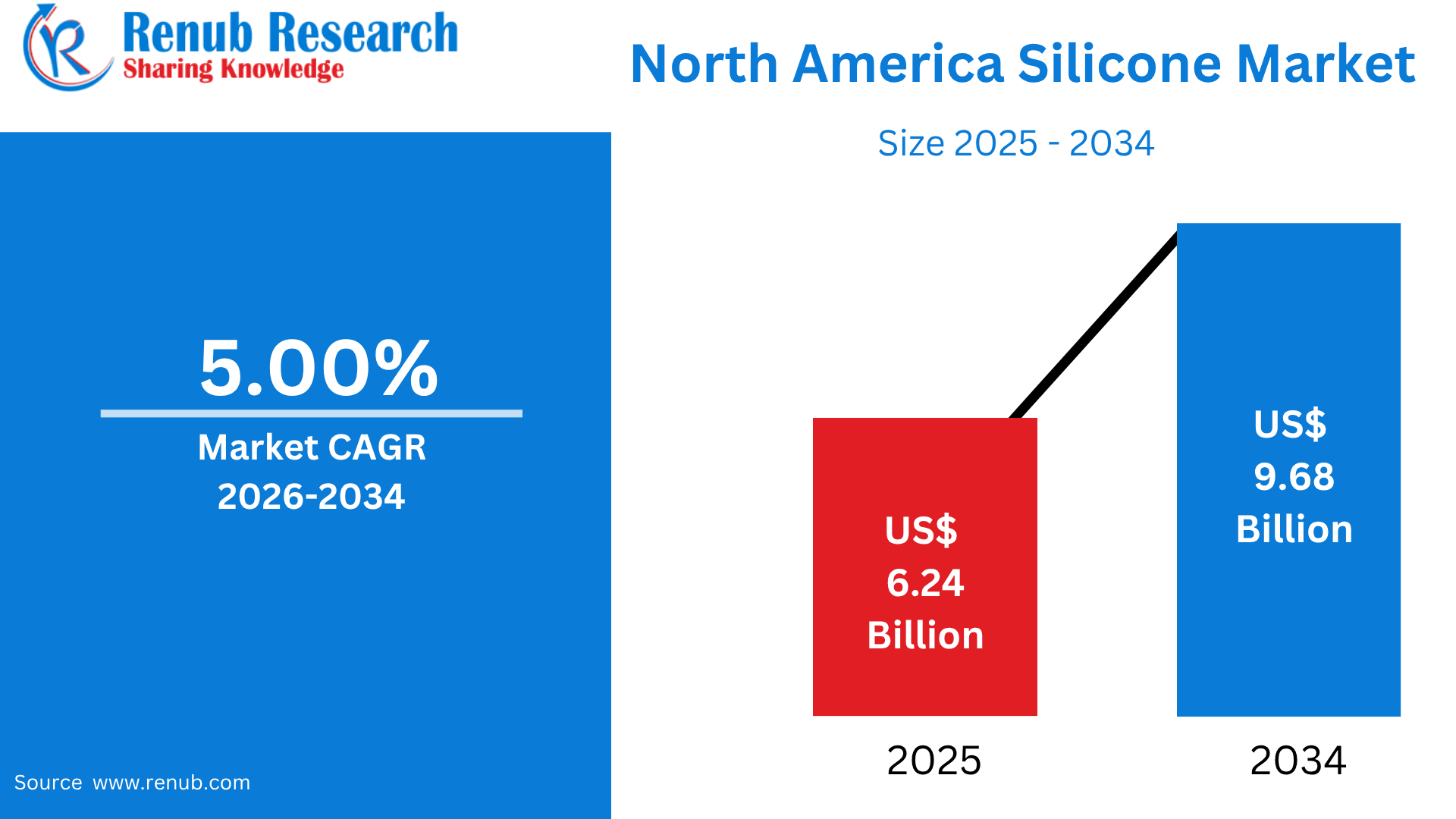
North America Silicone Market is anticipated to grow from US$ 6.24 billion in 2025 to US$ 9.68 billion by 2034, registering a CAGR of 5.00% during 2026–2034. Market expansion is being driven by the increasing adoption of silicone materials across automotive, construction, healthcare, electronics, personal care, and other industrial applications. Silicone’s distinctive properties, including high-temperature resistance, flexibility, chemical stability, durability, and weather resistance, make it well-suited for demanding applications requiring long-term performance. Rising demand for lightweight automotive components, advanced medical products, electronic devices, sealants, adhesives, and high-performance elastomers is further supporting consumption across the region.
What is the North America Silicone Market? Uses & Popularity
Silicone is a family of synthetic polymers containing silicon and oxygen, with properties such as thermal stability, flexibility, chemical resistance, durability, and weather resistance. These characteristics make silicone an important material across North America, where it is used in automotive components, construction sealants, electronics, healthcare products, personal care formulations, adhesives, coatings, lubricants, and industrial applications. Silicone elastomers are used for gaskets, seals, tubing, insulation, and molded components, while silicone fluids and resins are used in cosmetics, coatings, processing aids, and specialty formulations. The material’s broad industrial base supports sustained regional demand. Silicone is particularly popular where products must withstand high temperatures, moisture, chemicals, or repeated mechanical stress. Its use in medical devices and biomedical products further benefits from silicone polymers’ flexibility and established applications in healthcare.
Growth Drivers of the North America Silicone Market
Expanding Automotive and Electric Vehicle Applications
The automotive industry is a major growth contributor for silicone because manufacturers use silicone-based materials in gaskets, seals, hoses, insulation, adhesives, lubricants, thermal-management components, and electronic systems. Silicone’s ability to withstand temperature fluctuations, vibration, moisture, and chemical exposure makes it suitable for demanding vehicle environments. The transition toward electric and electronically connected vehicles is creating additional opportunities for silicone in battery systems, charging components, sensors, wiring insulation, and thermal-management applications. Industry analysis identifies automotive and transportation among the major end-use sectors supporting North American silicone demand. The region also has a substantial vehicle manufacturing base. According to OICA data cited in industry research, the United States produced approximately 9.1 million vehicles in 2021, demonstrating the scale of the potential automotive application base. As automakers increase electronic content and develop EV platforms, demand for specialized silicone elastomers, adhesives, sealants, and insulation materials is expected to increase. Continued vehicle electrification and requirements for reliable thermal and electrical protection therefore provide important long-term growth opportunities.
Rising Demand from Electronics and High-Performance Technologies
Increasing electronics manufacturing and demand for advanced devices are creating significant opportunities for silicone materials in North America. Silicone is used for electrical insulation, encapsulation, adhesives, thermal management, connectors, cables, LEDs, and protection of sensitive electronic components because it offers flexibility, dielectric properties, temperature resistance, and long-term durability. Industry research identifies electronics as a major end-use sector for the North American silicone market. Semiconductor manufacturing is also receiving substantial investment in the United States. Industry sources reported that companies had announced more than US$50 billion in investments in American semiconductor production following the CHIPS and Science Act of 2022. Such investments can expand demand for specialty materials used throughout electronics manufacturing and equipment. Silicone is also increasingly relevant to electric vehicles, telecommunications equipment, LED systems, and other high-performance electronic applications. As devices become smaller, more powerful, and more thermally demanding, manufacturers require materials capable of providing reliable insulation and protection. This trend is expected to sustain demand for advanced silicone formulations across the region.
Growing Healthcare, Construction, and Consumer Applications
Silicone’s versatility across healthcare, construction, personal care, and consumer products provides an important diversification advantage for the North American market. In healthcare, silicone polymers are used in medical tubing, devices, wound-care products, implants, pharmaceutical applications, and blood-handling equipment, supported by properties such as flexibility and biocompatibility. In construction, silicone sealants, adhesives, coatings, and weatherproofing products are valued for durability and resistance to moisture and temperature changes. Industry estimates identify construction and healthcare among important North American end-use sectors. Personal care represents another established application area, with silicone ingredients used in products such as hair care, skin care, cosmetics, and antiperspirants. Canada’s government identifies silicone-related materials across personal care, pharmaceuticals, sealants, coatings, lubricants, and biomedical applications. This broad application base reduces reliance on a single industry. As healthcare consumption, construction activity, consumer-product innovation, and demand for durable specialty materials continue to develop, silicone manufacturers can benefit from multiple sources of regional demand.
Challenges of the North America Silicone Market
Environmental and Regulatory Scrutiny of Certain Siloxanes
Environmental regulation of specific siloxane substances represents an important challenge for silicone manufacturers and formulators. Regulatory attention is particularly focused on cyclic volatile methyl siloxanes such as D4, which are used as intermediates in silicone production and can occur in certain formulations. In Canada, D4 was added to the List of Toxic Substances under CEPA in 2011 because the government concluded that it could enter the environment at concentrations potentially harmful to the environment. In the United States, the EPA released a draft D4 risk evaluation in September 2025, preliminarily determining that certain conditions of use presented unreasonable risks to human health and the environment. The EPA subsequently released the final report of its Science Advisory Committee on Chemicals peer review in June 2026, indicating that the assessment process remains an active regulatory consideration. Such scrutiny can increase compliance requirements, testing costs, formulation changes, and documentation obligations. Manufacturers may therefore need to invest in lower-emission processes and alternative formulations while maintaining the performance characteristics expected from silicone materials.
Raw-Material Costs, Manufacturing Complexity, and Competition
The North American silicone market also faces challenges associated with raw-material economics, specialized manufacturing requirements, and competition from alternative materials. Silicone products can require specialized production processes and carefully controlled formulations to achieve properties such as heat resistance, flexibility, chemical stability, and durability. Fluctuations in the availability and cost of upstream chemical feedstocks can therefore influence manufacturers’ production costs and margins. Competition from polyurethane, acrylic, fluoropolymer, rubber, and other specialty materials can also limit silicone penetration where lower-cost or application-specific alternatives meet performance requirements. Industry analysis notes that the North American market is relatively mature, which can moderate growth opportunities in established applications. At the same time, manufacturers must continuously develop specialized grades for automotive electronics, medical devices, construction, and consumer products. Regulatory compliance can add another layer of complexity, particularly for products involving chemicals such as D4. Consequently, companies increasingly need to balance performance, cost efficiency, sustainability, regulatory compliance, and product innovation to maintain competitiveness across North American end-use industries.
Silicone Product Launches in North America
- Dow – Thermal Interface Silicone Materials (2024): Introduced advanced silicone-based thermal interface materials through collaboration with Carbice, targeting improved heat management and reliability in electronics, electric vehicles, and semiconductor applications.
- Dow – Silicone Recycling-Ready Polymers (2024): Advanced circular silicone production through a North American recycling facility in Kentucky, supporting the reuse of silicone materials and reducing the environmental footprint of production.
- WACKER – SILPURAN® 2124 Medical Silicone Gel (2024): Launched a high-performance silicone gel for medical adhesion applications, including wearable devices, wound care, and prosthetic products, with strong skin adhesion and convenient removal.
- Stratasys & Shin-Etsu – P3™ Silicone 25A (2025): Introduced a 3D-printable silicone material designed for industrial-scale additive manufacturing of flexible components for automotive, healthcare, and consumer applications.
- WACKER – High-Performance Silicone Sealants Expansion (2024–2025): Expanded production of alcohol-curing silicone sealants for construction, emphasizing lower emissions, sustainability, and improved processing performance.
- Momentive – Advanced Silicone Oil Grades (2024): Expanded specialty silicone oil formulations for laboratory, biotechnology, electronics cooling, and industrial applications, focusing on thermal stability and consistent performance.
- Dow – Next-Generation Silicone Elastomers for EV Systems: Expanded silicone elastomer solutions for electric-vehicle applications, including sealing, vibration management, electrical protection, and thermal resistance.
- Shin-Etsu – Advanced Silicone for Cosmetics & Personal Care (2024): Introduced amino-modified silicone oils designed to improve spreadability, texture, and sensory properties in skincare and cosmetic formulations.
- Elkem – North American Silicone Material Capacity Expansion (2024): Expanded silicone production capabilities for organofunctional silicone materials used in release coatings, adhesives, and personal-care applications.
- Momentive/KCC – Medical & Industrial Silicone Solutions: Continued development and supply of high-purity silicone materials for medical devices, industrial sealing, and other demanding applications across North American manufacturing.
Automotive and Industrial Applications Drive Demand
Silicone elastomers are increasingly used across North America because of their flexibility, resilience, thermal stability, chemical resistance, and long service life. Automotive applications include gaskets, seals, hoses, vibration dampers, connectors, and electrical insulation, where materials must withstand heat, vibration, moisture, and temperature fluctuations. The region’s large automotive manufacturing base provides an important demand foundation; the United States produced approximately 10.56 million motor vehicles in 2024, including more than 9.13 million commercial vehicles, according to OICA. The expansion of electric vehicles is creating additional opportunities for silicone elastomers in battery sealing, thermal-management systems, charging components, and high-voltage insulation. Beyond automotive, silicone elastomers are used in aerospace, electronics, industrial machinery, and healthcare. Medical tubing, seals, wearable components, and implantable products benefit from silicone’s flexibility and durability. Continued development of higher-strength, lower-compression-set, and application-specific formulations is supporting broader adoption across demanding North American industries.
Healthcare and Personal Care Applications Expand
Silicone gels are gaining traction in North America because they combine softness, flexibility, cushioning, thermal stability, and compatibility with sensitive applications. Healthcare remains a major area of use, particularly for scar-management products, wound-care applications, implant cushioning, prosthetic components, and medical-device interfaces. Silicone gels are also important in cosmetics and personal care, where they improve spreadability, skin feel, texture, and formulation performance. Premium skincare and haircare products increasingly use silicone-based ingredients to provide smooth, non-greasy sensory characteristics. Electronics represents another opportunity, with silicone gels used for cushioning, encapsulation, insulation, and protection of sensitive components against vibration and environmental exposure. Growth in advanced medical-device manufacturing is strengthening demand for specialized silicone materials. For example, DuPont launched its Liveo™ C6-8XX liquid silicone rubber series in February 2026, a USP Class VI medical-grade, two-part silicone elastomer designed for medical-device fabrication, including certain short-term implant applications. Such innovations are expanding the addressable market for high-performance silicone materials.
Infrastructure and Energy-Efficient Buildings Support Adoption
Construction silicone is widely used throughout North America for structural glazing, weather sealing, expansion joints, adhesives, window and door systems, and waterproofing. Its resistance to ultraviolet radiation, moisture, temperature fluctuations, and weathering makes it suitable for both new construction and renovation. In the United States, the Census Bureau’s Construction Spending program tracks construction activity across private and public projects, covering new structures and improvements to existing buildings. These trends support continued demand for durable sealants and adhesives. In addition, low-VOC formulations, longer-lasting weatherproofing systems, and materials compatible with energy-efficient building designs are gaining importance as developers increasingly emphasize building performance, durability, and environmental standards.
Medical Devices and Minimally Invasive Technologies Drive Growth
Healthcare silicone is an important material in North America because of its flexibility, durability, biocompatibility, and ability to tolerate sterilization and demanding medical environments. Applications include catheters, tubing, drainage systems, seals, wound-care products, prosthetic components, implants, and wearable medical devices. Demand is supported by healthcare spending, an aging population, increasing chronic-disease management, and the development of minimally invasive technologies. Silicone’s ability to maintain performance while remaining soft and flexible is particularly valuable in products that come into prolonged contact with patients. Product innovation is also expanding the range of medical-grade formulations available to manufacturers. In February 2026, DuPont introduced Liveo™ C6-8XX LSR, a new USP Class VI series designed for medical-device applications, with improved rheology, lower viscosity, and processing flexibility for automated manufacturing. These characteristics can support higher production efficiency while maintaining stringent material requirements. Continued innovation in medical-grade silicone is therefore expected to create opportunities across hospitals, medical-device manufacturers, diagnostics, and specialized healthcare applications.
Diverse End-Use Industries Sustain United States Silicone Market Expansion
United States represents a major silicone-consuming market in North America, supported by extensive automotive, construction, healthcare, electronics, aerospace, and personal-care industries. Silicone materials are used in automotive seals, gaskets, hoses, electrical insulation, thermal-management systems, construction sealants, medical devices, and electronic components. The scale of U.S. manufacturing provides a substantial demand base; OICA reports that the country produced approximately 10.56 million motor vehicles in 2024. Construction also remains a major end-use sector, with the U.S. Census Bureau continuously measuring private and public construction activity across residential and non-residential projects. Medical applications are another important growth area because silicone can provide flexibility and biocompatibility for demanding device designs. A notable recent development was DuPont’s February 2026 launch of Liveo™ C6-8XX Liquid Silicone Rubber, a USP Class VI medical-grade silicone elastomer series for medical-device manufacturing. At the same time, manufacturers are focusing on material efficiency, sustainability, advanced formulations, and processing improvements to address evolving market requirements.
Construction and Healthcare Applications Strengthen Canada Silicone Demand
Canada’s silicone market is supported by construction, healthcare, automotive, electronics, and industrial applications. Silicone is used in sealants, adhesives, insulation, gaskets, medical tubing, implants, and protective components because of its durability, flexibility, temperature resistance, and weatherability. Construction represents a particularly important demand opportunity. According to Statistics Canada, total investment in building construction reached C$272.1 billion in 2025, increasing 8.5% year over year, while residential building investment reached C$178.0 billion. Residential investment also supported more than 1.2 million jobs associated with housing production during 2025. These levels of construction activity create opportunities for silicone-based weatherproofing, glazing, bonding, and sealing products. Healthcare is another significant application area, particularly for medical devices and implantable products. Canada’s market is also influenced by demand for durable and sustainable materials, encouraging manufacturers to develop longer-lasting formulations and improve production efficiency. Innovation in medical-grade silicone and construction products is expected to support continued market development.
Automotive Manufacturing and Construction Create New Mexico Silicone Opportunities
Mexico’s silicone market is expanding alongside its automotive manufacturing, construction, electronics, healthcare, and industrial sectors. Silicone elastomers and sealants are used in vehicle gaskets, hoses, electrical protection, adhesives, weatherproofing systems, and industrial components because they can withstand elevated temperatures, moisture, vibration, and environmental exposure. Mexico’s integration into North American automotive supply chains provides an important demand base for specialized silicone materials, particularly as manufacturers expand electric-vehicle and advanced-electronics capabilities. Construction is another major application area, where silicone products are used for glazing, sealing, waterproofing, and bonding. Healthcare applications include tubing, seals, medical devices, and implant-related products that require flexible and biocompatible materials. Electronics manufacturing also creates opportunities for silicone encapsulation, insulation, and thermal-management applications. Increasing investment in higher-value manufacturing is encouraging demand for materials with consistent performance and reliability. In addition, sustainability considerations are prompting manufacturers to explore longer-lasting products, lower-emission formulations, and more resource-efficient production processes. These trends are supporting the gradual expansion of silicone consumption across Mexico’s industrial economy.
North America Silicone Market Segmentation
Type
- Elastomers
- Fluids
- Resins
- Gels
- Others
End Use
- Industrial Processes
- Construction
- Personal Care & Consumer Goods
- Transportation
- Electronics
- Healthcare
- Energy
- Others
Country
- United States
- Canada
- Mexico
- Rest of North America
All the Key players have been covered from 5 Viewpoints:
- Overviews
- Key Person
- Recent Developments
- SWOT Analysis
- Revenue Analysis
Company Analysis:
- Kaneka Corporation
- Shin-Etsu Chemical Co Ltd
- Dow Inc.
- Evonik Industries AG
- Wacker Chemie AG
- Kemira Oyj
- Illinois Tool Works Inc.
Report Details:
| Report Features | Details |
| Base Year |
2025 |
| Historical Period |
2022 - 2025 |
| Forecast Period |
2026 - 2034 |
| Market |
US$ Billion |
| Segment Covered |
Type, End User and Countries |
| Countries Covered |
|
| Companies Covered |
|
| Customization Scope |
20% Free Customization |
| Post-Sale Analyst Support |
1 Year (52 Weeks) |
| Delivery Format |
PDF and Excel through Email (We can also provide the editable version of the report in PPT/Word format on request) |
Customization Services available
- Analysis of Market Size and Its Segments
- More Company Profiles (Upto 10 without any additional cost):
- Additional Countries (Other than mentioned Countries):
- Region/Country Specific Reports:
- Market Entry Strategy:
- Region-Specific Market Dynamics:
- Regional Market Share Analysis:
- Trade Analysis:
- Production Insights:
- Others Customized Requests:
For more information contact our analysts.
Need More Assistance?
- Talk to our analysts to get more precious information on the current market trends.
- Include more countries and segments and customize the report based on the final requirement.
- Get a competitive advantage in your industry by knowing the report findings and making a positive impact on your revenues and operations.
- Our analysts are always ready to provide more help and pertinent information if you need any additional assistance.