North America Limestone Market Report by Application Type, Application, End Use, Countries and Companies Analysis 2026-2034
Buy NowNorth America Limestone Market Size & Forecast
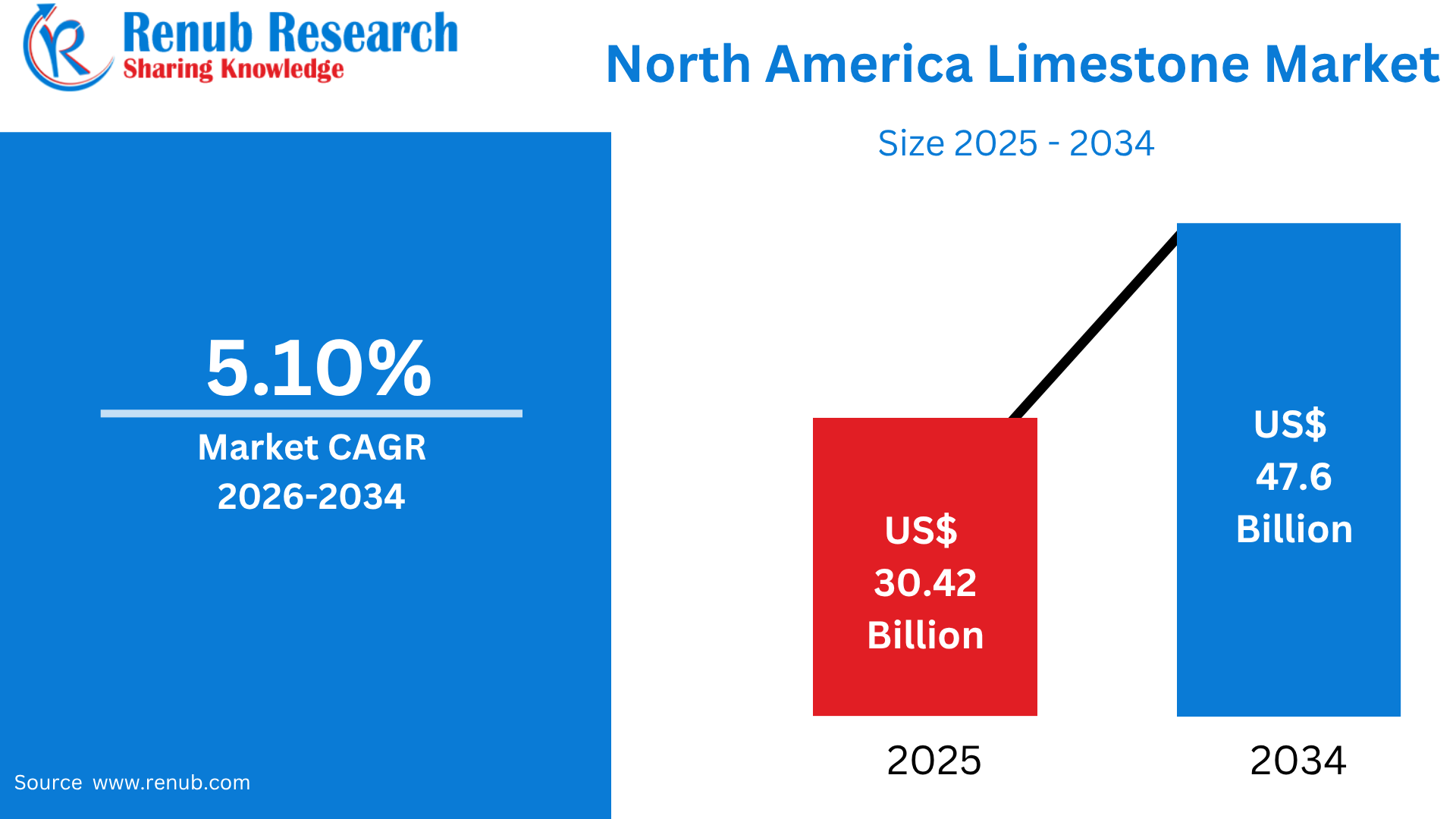
North America Limestone Market is projected to increase from US$ 30.42 Billion in 2025 to US$ 47.60 Billion by 2034, registering a CAGR of 5.10% during 2026–2034. Market growth is being supported by rising limestone consumption across construction, infrastructure development, steel manufacturing, and environmental applications. Limestone remains an important raw material for cement, concrete aggregates, lime production, and various industrial processes. Increasing investments in roads, bridges, residential and commercial construction, and urban infrastructure across the United States, Canada, and Mexico are expected to strengthen demand throughout the forecast period.
What is Limestone and Its Uses & Popularity in North America
Limestone is a naturally occurring sedimentary rock composed primarily of calcium carbonate (CaCO₃). It is formed over millions of years through the accumulation of marine organisms, shells, and mineral deposits and is widely valued for its availability, durability, and versatility. In North America, limestone is extensively used as a construction aggregate for roads, highways, bridges, buildings, and other infrastructure projects. It is also an important raw material for cement and lime manufacturing and has applications in steel production, agriculture, water treatment, glass, chemicals, and environmental management. The United States is a major consumer, with approximately 1.5 billion tons of crushed stone produced in 2024, of which about 70% consisted of limestone and dolomite. Around 72% of crushed stone consumption was used as construction aggregate, while 17% went into cement manufacturing and 6% into lime production. Its widespread availability and critical role in construction and industrial processes make limestone one of North America’s most important nonmetallic minerals.
Key Limestone Statistics in the United States
- Approximately 1.5 billion metric tons of crushed stone were produced in the United States in 2024, reinforcing the country’s position as one of the world’s major aggregate producers.
- Limestone and dolomite represented nearly 70% of total U.S. crushed stone production, underscoring limestone’s critical role in the nation’s aggregates industry.
- The U.S. crushed stone industry comprised approximately 1,400 companies operating around 3,500 quarries and more than 180 sales or distribution yards across all 50 states in 2024.
- Construction applications accounted for approximately 72% of crushed stone consumption, with major demand coming from roads, highways, maintenance, and other infrastructure projects.
- Cement manufacturing represented about 17% of crushed stone consumption, reflecting the importance of limestone as a principal raw material in cement production.
- Approximately 6% of crushed stone was used in lime manufacturing, supporting applications across steel production, chemical processing, environmental management, and related industries.
- The ten leading producing states—Texas, Florida, Pennsylvania, Missouri, Ohio, North Carolina, Georgia, Tennessee, Indiana, and Virginia—contributed approximately 55% of U.S. crushed stone production, demonstrating the concentration of aggregate production in major limestone-producing regions.
- U.S. dimension stone production totaled approximately 2.3 million metric tons in 2023, valued at around US$410 million, with limestone representing approximately 51% of production by volume.
- The Smackover Formation, extending across parts of Arkansas, Louisiana, Texas, Alabama, Mississippi, and Florida, has attracted attention beyond conventional limestone applications. A 2024 USGS assessment estimated that the formation could contain approximately 5–19 million tons of lithium resources, highlighting its emerging importance for critical-mineral exploration.
- Collectively, these indicators demonstrate that limestone remains a strategically important mineral in the United States, supporting construction aggregates, cement and lime production, industrial and environmental applications, while also contributing to emerging opportunities associated with critical-mineral resources.
Sources: U.S. Geological Survey Publications
Growth Drivers of the North America Limestone Market
Expanding Infrastructure and Construction Development
Increasing investment in transportation, urban development, residential construction, and commercial infrastructure is a major growth driver for the North America limestone market. Limestone is extensively processed into aggregates used for road bases, highways, bridges, airports, concrete, and other construction applications. The U.S. Geological Survey reports that approximately 72% of U.S. crushed stone consumption in 2024 was used as construction aggregate, demonstrating the strong relationship between infrastructure activity and demand for crushed stone materials. In addition, about 1.5 billion tons of crushed stone were produced in the United States in 2024, with limestone and dolomite accounting for approximately 70% of production. Government-supported infrastructure modernization, replacement of aging transportation assets, housing development, and expansion of commercial facilities are expected to sustain demand. Canada and Mexico are also investing in transportation networks, urban infrastructure, industrial facilities, and housing. As large-scale construction projects expand across North America, limestone suppliers are expected to benefit from consistent requirements for aggregates, cement, and other construction materials.
Rising Cement, Steel, and Industrial Applications
Growing consumption of limestone in cement, lime, steel, and chemical manufacturing is supporting market expansion across North America. Limestone is a critical raw material for cement production and is also used as a fluxing agent in steelmaking and as an input in lime manufacturing. In the United States, approximately 17% of crushed stone consumption in 2024 was used for cement manufacturing, while another 6% was used for lime manufacturing, highlighting the importance of industrial applications. U.S. cement production also remained substantial, reaching an estimated 82 million tons in 2025, while cement shipments were approximately 100 million tons, valued at around US$17 billion. Demand from ready-mixed concrete producers, which accounted for approximately 70%–75% of cement sales, creates an additional downstream requirement for limestone-based materials. Beyond construction, limestone is used in steelmaking, chemical processing, agriculture, paper manufacturing, and environmental applications. Continued industrial production and investment in domestic manufacturing capacity are therefore expected to create stable demand for different grades and processed forms of limestone.
Increasing Environmental and Water-Treatment Applications
The expanding use of limestone in environmental management, water treatment, and emissions-control applications is creating additional opportunities for the North America limestone market. Limestone and lime-based products are used to neutralize acidic water, adjust pH levels, treat industrial wastewater, and support pollution-control processes. These applications are becoming increasingly important as industries face stricter environmental standards and greater pressure to reduce emissions and improve resource efficiency. Limestone is also used in flue-gas desulfurization systems to remove sulfur dioxide from industrial emissions, particularly in applications involving power generation and heavy industry. In addition, agricultural limestone is widely used to improve soil conditions by neutralizing soil acidity. The U.S. crushed-stone industry allocated around 1% of consumption to agricultural applications in 2024, while other chemical, special, and miscellaneous uses represented approximately 4%. Increasing environmental compliance requirements, wastewater-treatment investment, industrial sustainability initiatives, and demand for agricultural soil amendments are expected to broaden limestone consumption beyond conventional construction applications.
Challenges of the North America Limestone Market
Environmental Regulations and Quarrying Constraints
Environmental regulations and permitting requirements represent a significant challenge for limestone producers across North America. Limestone extraction generally requires quarry development, drilling, blasting, crushing, transportation, and land management, activities that can generate dust, noise, vibration, emissions, and landscape disruption. As governments and communities place greater emphasis on environmental protection, obtaining permits for new quarries or expanding existing operations can become increasingly complex and time-consuming. Producers may also face requirements related to groundwater protection, habitat conservation, reclamation, air quality, and transportation impacts. These restrictions can limit access to high-quality deposits close to major consumption centers and increase operational costs. The challenge is particularly important because crushed stone is a high-volume, relatively low-value commodity, making transportation distances a significant factor in overall economics. USGS data show that the U.S. industry operated approximately 3,500 quarries and more than 180 sales or distribution yards in 2024, illustrating the extensive physical footprint of the sector. Balancing growing material requirements with environmental protection and community acceptance will remain an important industry challenge.
Transportation Costs and Construction-Cycle Volatility
High transportation costs and fluctuations in construction activity can constrain the profitability and demand outlook for limestone producers. Because limestone is relatively heavy and generally has a low value-to-weight ratio, transportation over long distances can substantially increase delivered costs. Consequently, quarries located near construction projects, cement plants, steel mills, and other major consumers have an important competitive advantage. Market demand is also closely linked to residential, commercial, industrial, and infrastructure construction cycles. USGS reported that U.S. crushed-stone production declined by approximately 6% in 2024 to about 1.5 billion tons, with consumption affected by significant weather events and weaker residential housing demand associated with elevated interest rates. The agency also identifies commercial and heavy-industrial construction, infrastructure funding, labor availability, housing starts, and weather as factors affecting production and consumption. Such fluctuations can create uncertainty for quarry operators and equipment investments. Producers therefore need efficient logistics, flexible production planning, and diversified end-use markets to manage changes in construction activity and maintain stable revenues.
Limestone Launches in North America
- Carmeuse High-Purity Limestone Powder Products – United States | March 2024
Carmeuse introduced a new line of high-purity limestone powder products targeting specialized agricultural and manufacturing applications. The products are designed to provide consistent calcium carbonate content for applications requiring controlled mineral performance. - Kentucky Fertilizer Mini-Lime Pellets – United States | October 2024
Kentucky Fertilizer launched mini-lime pellets specifically for the turf industry. The product is designed to support soil-health management and improve turf-growing conditions, expanding the use of processed limestone in specialized agricultural applications. - Kentucky Fertilizer Mini-Gypsum and Mini-Lime Product Line – United States | October 2024
The company introduced a combined range of mini-lime and mini-gypsum pellets for turf management. The launch reflects increasing demand for convenient, application-specific soil amendments based on mineral materials. - Carmeuse Ground Calcium Carbonate (GCC) Product Expansion – United States | 2025
Carmeuse expanded its marketed ground calcium carbonate portfolio for applications including soil fertility, animal feed, asphalt, and industrial products. Its GCC materials are produced at multiple U.S. operations, supporting diverse limestone-based applications. - LafargeHolcim Limestone Grinding Plant – United States | January 2024
LafargeHolcim announced a new limestone grinding plant in Missouri aimed at increasing limestone-processing capacity. The development was reported as capable of increasing the company’s limestone production capacity by approximately 50%, supporting construction-material demand. - United States Lime & Minerals Texas Vertical Kiln Project – United States | 2024
United States Lime & Minerals began construction of a new vertical kiln at its Texas Lime plant. The company estimated investment of approximately US$65 million for the kiln, equipment, and related infrastructure, strengthening its capacity for lime and limestone-derived products. - Portland-Limestone Cement Adoption Across the United States – United States | April 2024
Connecticut approved the use of Portland-limestone cement (PLC), completing adoption of PLC specifications across all 50 U.S. states and the District of Columbia. During the first eight months of 2024, blended cement represented approximately 58% of total U.S. cement shipments, with about 97% of blended shipments estimated to be PLC. - Carmeuse Limestone Filler for Lower-Carbon Concrete – North America | 2024–2025
Carmeuse promoted a limestone filler product designed to replace up to 20% of cement in concrete. The company reports that the filler can reduce average concrete-production CO₂ emissions by approximately 20%, positioning finely processed limestone as an important material for lower-carbon construction. - Northstar Clean Technologies Recovered Limestone Product Line – United States/Canada | September 2025
Northstar Clean Technologies added recovered limestone as a fourth product line through its asphalt-shingle recycling technology. The process recovers limestone from recycled roofing shingles, creating a secondary source of limestone while supporting circular-economy applications in construction materials. - CarbonRun Limestone-Based Carbon-Removal Project – Canada | September 2024
CarbonRun advanced a project in Nova Scotia that uses crushed limestone to improve the alkalinity of river water and enhance carbon-dioxide removal. The company anticipated approximately US$25.4 million in funding for projects involving crushed limestone in Canada and Scandinavia, demonstrating an emerging environmental application for limestone.
Growing Demand for Magnesium-Rich Industrial Minerals
Magnesian limestone, generally containing significant amounts of magnesium carbonate alongside calcium carbonate, is increasingly relevant to industrial applications across North America. Its properties make it useful in the production of lime, magnesium compounds, cement, refractories, and construction materials. The United States has a large and established mineral-processing industry, supporting demand for carbonate-based minerals. Magnesium compounds, particularly magnesium oxide, are widely used as refractory materials in furnace linings for iron and steel, nonferrous metals, glass, and cement production. They are also used in agriculture, chemicals, and construction. The USGS identifies dolomite, magnesite, brucite, carnallite, and olivine as commercially important magnesium-bearing minerals, with magnesium also recovered from seawater and brines. The broader U.S. crushed-stone industry produced approximately 1.5 billion metric tons annually in recent years, with limestone and dolomite accounting for about 70% of output. This established supply chain and diverse industrial demand provide a favorable foundation for magnesian limestone consumption in North America.
Expanding Industrial and Environmental Applications
Chemical-grade limestone is valued for its high calcium carbonate content and controlled chemical properties, making it suitable for applications beyond conventional construction. In North America, it is used in lime production, chemical processing, water treatment, environmental remediation, glass manufacturing, paper production, and other industrial processes. Limestone-derived lime has become particularly important in chemical and industrial applications; the USGS notes that more than 90% of lime consumed in the United States is currently used for chemical and industrial purposes, compared with more than 80% for construction applications at the beginning of the 20th century. Limestone is also used in environmental processes such as neutralizing acidic water and treating industrial emissions. The scale of the U.S. limestone and crushed-stone industry provides a substantial raw-material base, with limestone and dolomite representing roughly 70% of crushed-stone production. Growing wastewater-treatment requirements, environmental regulations, industrial manufacturing, and demand for high-purity mineral inputs are expected to support chemical limestone consumption throughout North America.
Rising Use of Limestone for Soil Management and Crop Productivity
Agricultural limestone plays an important role in North American farming by correcting acidic soils and improving conditions for crop growth. The material, commonly consisting of calcium carbonate or calcium-magnesium carbonate, raises soil pH while supplying calcium and, in dolomitic forms, magnesium. This makes agricultural limestone particularly valuable in regions where soil acidity can reduce nutrient availability and crop productivity. In the United States, agricultural applications represent a smaller share of total crushed-stone consumption than construction, cement, or lime manufacturing; however, the large scale of the aggregate industry provides significant mineral availability. USGS historical consumption data indicate that approximately 1%–2% of U.S. crushed stone consumption has been directed toward agricultural applications in recent years. Demand is supported by the need for soil amendments, pasture management, crop production, and long-term soil fertility improvement. Increasing emphasis on soil health and efficient fertilizer utilization is also creating opportunities for agricultural lime products. Across North America, adoption is expected to remain closely connected to agricultural acreage, soil conditions, crop economics, and farmers’ investment in productivity-enhancing inputs.
Steelmaking Requirements Supporting Consistent Limestone Consumption
The iron and steel industry represents an important industrial application for limestone and dolomite in North America. Limestone is primarily used as a fluxing agent in blast-furnace ironmaking, where it helps combine with impurities and form slag during the production process. Dolomite and other flux materials can also contribute calcium and magnesium to metallurgical processes. The continued presence of large steelmaking facilities across the United States, Canada, and Mexico creates a stable requirement for suitable-quality flux materials. The USGS explains that blast furnaces are charged with iron ore, fluxing agents—usually limestone and dolomite—and coke. U.S. raw steel production has historically remained above 80 million metric tons annually, illustrating the substantial scale of the domestic steel industry and its associated raw-material requirements. Limestone consumption is also linked to electric-arc-furnace operations and broader steel-processing activities through lime and other mineral products. Although shifts toward lower-carbon steelmaking and increased recycling may alter the mix of raw materials used, North America’s established steel industry and infrastructure investments are expected to maintain demand for limestone-based fluxes and related products.
Strong Construction Demand and Expanding Industrial Applications in USA
United States limestone market remains a critical component of the country’s construction, manufacturing, agriculture, and environmental sectors. Limestone and dolomite account for approximately 70% of U.S. crushed stone production, highlighting their importance as essential mineral resources. In 2025, the United States produced an estimated 1.5 billion metric tons of crushed stone valued at US$27 billion, supported by around 1,400 companies operating 3,500 quarries and more than 180 sales or distribution yards across all 50 states. Approximately 72% of crushed stone was consumed as construction aggregate, while 17% was used for cement manufacturing and 6% for lime production. Beyond construction, limestone is extensively utilized in cement, concrete, glass, chemicals, agriculture, water treatment, and emissions-control applications. Strategic interest is also increasing around limestone-bearing formations such as the Smackover Formation, which extends across several southern U.S. states and has been identified as containing significant lithium resources. This could enhance the strategic relevance of limestone-rich geological formations to future domestic battery and energy supply chains.
Infrastructure Development and Diverse Industrial Uses Supporting Canadian Demand
Canada’s limestone market represents an important part of the country’s non-metallic mineral industry, supplying construction, cement, agriculture, manufacturing, and environmental applications. Limestone is widely used for cement production, road aggregates, concrete, construction materials, soil conditioning, and industrial processing. Statistics Canada maintains annual production data covering more than 75 mineral products, reflecting the broad importance of non-metallic minerals within Canada’s mining industry. Limestone mining and quarrying is classified as a dedicated industry under Canadian NAICS, covering dimension limestone, crushed and broken limestone, agricultural limestone, dolomite, and related materials. Regional production also demonstrates the material’s diverse applications. For example, Nova Scotia produced approximately 289,286 tonnes of limestone in 2024, valued at about C$7.7 million. Around 59% was consumed as feedstock for Portland cement production, while approximately 36% supported combustion-gas emission management. Continued investment in transportation infrastructure, housing, industrial facilities, and agricultural productivity is expected to sustain limestone consumption. However, transportation expenses, environmental permitting, quarry-development constraints, and fluctuations in construction activity remain important market considerations.
Abundant Resources and Construction Expansion Creating Mexico Market Opportunities
Mexico’s limestone market plays a significant role in supporting the country’s construction, cement, infrastructure, agriculture, and industrial sectors. Limestone is an essential raw material for cement and concrete manufacturing, road construction, aggregates, lime production, and various chemical applications, making demand closely linked to urbanization and infrastructure development. Mexico also possesses substantial limestone resources that support large-scale quarrying and cement production. The scale of the resource base is illustrated by CEMEX’s 2025 limestone reserves of approximately 4.52 billion tons globally, with Mexico representing an important component of its raw-material operations. Limestone demand is further supported by residential construction, transportation projects, industrial facilities, and urban expansion. Agricultural applications also create opportunities through the use of limestone and dolomitic materials for soil conditioning and acidity management. At the same time, quarry operators face increasing requirements related to land use, biodiversity, water management, emissions, dust, and community impacts. Consequently, producers are placing greater emphasis on efficient extraction, resource management, environmental compliance, and sustainable quarrying practices. Mexico’s extensive geological resources and continuing construction and industrial activity are expected to provide a strong foundation for long-term limestone market development.
North America Limestone Market Segments
Type
- Magnesian Limestone
- High Calcium Limestone
Application
- Industry Lime
- Chemical Lime
- Construction Lime
- Refractory Lime
End Use
- Construction
- Iron & Steel
- Agriculture
- Chemical
- Others
Countries
- United States
- Canada
- Mexico
- Rest of North America
All the Key players have been covered from 5 Viewpoints:
- Overviews
- Key Person
- Recent Developments
- SWOT Analysis
- Revenue Analysis
Key Players Analysis
- United States Lime & Minerals Inc.
- Imerys SA
- The National Lime & Stone Company
- Carmeuse
- Holcim Limited
- Imerys
- CEMEX S.A.B. de C.V.
- Mineral Technologies Inc.
Report Details:
| Report Features | Details |
| Base Year |
2025 |
| Historical Period |
2022 - 2025 |
| Forecast Period |
2026 - 2034 |
| Market |
US$ Billion |
| Segment Covered |
Type, Application, End Use and Countries |
| Countries Covered |
|
| Companies Covered |
|
| Customization Scope |
20% Free Customization |
| Post-Sale Analyst Support |
1 Year (52 Weeks) |
| Delivery Format |
PDF and Excel through Email (We can also provide the editable version of the report in PPT/Word format on request) |
Customization Services available
- Analysis of Market Size and Its Segments
- More Company Profiles (Upto 10 without any additional cost):
- Additional Countries (Other than mentioned Countries):
- Region/Country Specific Reports:
- Market Entry Strategy:
- Region-Specific Market Dynamics:
- Regional Market Share Analysis:
- Trade Analysis:
- Production Insights:
- Others Customized Requests:
For more information contact our analysts.
Need More Assistance?
- Talk to our analysts to get more precious information on the current market trends.
- Include more countries and segments and customize the report based on the final requirement.
- Get a competitive advantage in your industry by knowing the report findings and making a positive impact on your revenues and operations.
- Our analysts are always ready to provide more help and pertinent information if you need any additional assistance.