North America Athletic Wear Market Report by Product, Price Range, Distribution Channel, Countries and Company Analysis 2026-2034
Buy NowNorth America Athletic Wear Market Size and Forecast
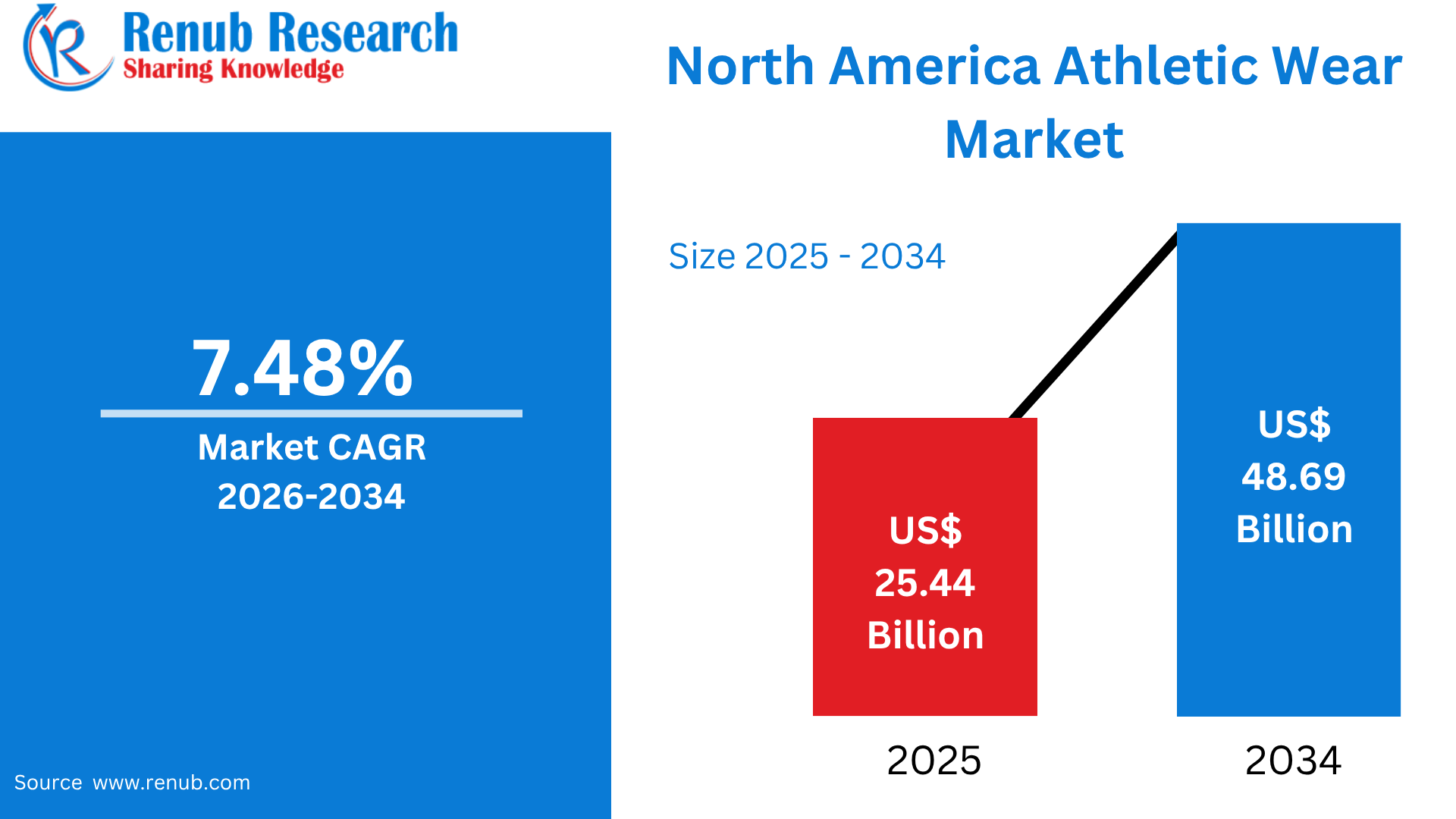
North America Athletic Wear Market is projected to grow from US$ 25.44 billion in 2025 to US$ 48.69 billion by 2034, registering a CAGR of 7.48% during 2026–2034. Market expansion is being driven by rising health and fitness awareness, increasing participation in sports and physical activities, and growing consumer preference for apparel that combines comfort, functionality, and style. The continued popularity of athleisure is further expanding the use of athletic wear beyond gyms and sports into everyday lifestyles. In addition, innovations in performance fabrics, moisture-management and breathable materials, sustainable textiles, and the rapid growth of e-commerce are creating new opportunities for market growth.
Athletic Wear: Uses and Growing Popularity Across North America
Athletic wear refers to clothing specifically designed for physical activities, sports, exercise, fitness training, and increasingly everyday lifestyles. Products include sports bras, leggings, shorts, tracksuits, T-shirts, sweatshirts, jackets, performance tops, and specialized footwear and accessories. In North America, athletic wear has expanded beyond traditional sports applications because consumers increasingly value comfort, flexibility, breathability, moisture management, and versatile styling. The popularity of athleisure has enabled consumers to wear performance-inspired clothing for commuting, shopping, travel, and casual social activities. The United States represents a particularly important demand center because 47.2% of adults aged 18 and older met federal aerobic physical-activity guidelines in 2024, while 54.0% of adults aged 18–34 met the guidelines. Rising participation in fitness, running, gym workouts, outdoor recreation, and organized sports, combined with strong brand innovation and e-commerce availability, continues to strengthen athletic-wear demand across the region.
Here is a polished, report-ready rephrasing. I’ve retained the U.S. figures, while wording Canada and Mexico more cautiously because comparable official 2025 participant totals are not directly available in the same methodology. For example, Canada reported 55% of people aged 15+ participating in sports in 2023, while Mexico’s official MOPRADEF 2025 survey measures sports/exercise participation among people aged 12+.
Number of Athletes / Sports Participants in North America by Country (2025)
- United States – The United States recorded approximately 250 million participants in at least one sport, fitness, or leisure activity during 2025, representing a record participation level. According to the Sports & Fitness Industry Association (SFIA), CORE participation reached 158.8 million, highlighting a substantial base of regular and highly engaged participants.
- Canada – Canada has a large and diverse sports participation base spanning hockey, soccer, swimming, running, skiing, fitness, and outdoor recreation. Statistics Canada reported that 55% of Canadians aged 15 years and older participated in sports in 2023, with participation reaching 62% among men and 49% among women. Physical health and fitness were cited by 82% of participants as a major motivation.
- Mexico – Mexico represents a significant sports and physical-activity market, supported by football, running, gym-based exercise, cycling, and other recreational activities. The country’s official MOPRADEF 2025 survey tracks sports and exercise participation among the population aged 12 years and older, providing updated national statistics on participation frequency, duration, intensity, and motivations. Mexico’s national sports policy also targets increased participation and reduced sedentary behavior through organized physical activity and sports programs.
Growth Drivers of the North America Athletic Wear Market
Rising Health, Fitness, and Physical Activity Participation
Increasing consumer emphasis on health and fitness is a major driver of the North America athletic wear market. Consumers are increasingly participating in gym workouts, running, cycling, yoga, organized sports, and outdoor recreational activities, creating sustained demand for functional and comfortable apparel. In the United States, 47.2% of adults aged 18 and older met federal aerobic physical-activity guidelines in 2024, according to the National Center for Health Statistics. Participation was particularly high among younger adults, with 54.0% of people aged 18–34 meeting the guidelines, compared with 49.8% among those aged 35–49. The CDC also reports that U.S. adults are recommended to undertake at least 150 minutes of moderate-intensity activity or 75 minutes of vigorous activity per week, alongside muscle-strengthening activities on at least two days. This continuing focus on active lifestyles supports demand for specialized sportswear that offers stretch, moisture control, breathability, durability, and freedom of movement, benefiting both performance-oriented and lifestyle athletic-wear categories.
Expansion of Athleisure and Lifestyle Fashion
The growing popularity of athleisure is transforming athletic wear from performance-specific clothing into everyday lifestyle apparel. Consumers increasingly seek garments that can transition between workouts, commuting, shopping, travel, and casual social occasions. This trend has expanded the addressable customer base beyond regular athletes and gym users. Athletic-wear brands are responding by introducing products that combine technical performance with fashion-oriented designs, including coordinated sets, premium leggings, versatile jackets, and casual performance tops. Consumers also increasingly value functional characteristics such as stretch, breathability, durability, and comfort alongside appearance. Celebrity collaborations, social-media exposure, fitness influencers, and changing workplace and leisurewear habits are further increasing visibility. The resulting convergence of sportswear and casual fashion is encouraging consumers to purchase athletic apparel more frequently and supports premiumization across the North American market.
E-Commerce Growth and Innovation in Performance Fabrics
The rapid expansion of e-commerce and continuous innovation in performance fabrics are creating additional growth opportunities for athletic wear brands across North America. Online platforms provide consumers with access to a broad selection of products, sizes, designs, brands, and price points while enabling manufacturers to reach customers beyond traditional physical retail networks. Digital shopping is particularly important among younger consumers, who are accustomed to mobile purchasing, personalized recommendations, online product reviews, and social-commerce campaigns. At the same time, manufacturers are investing in technical fabrics offering moisture-wicking, quick-drying, stretch, temperature regulation, odor control, lightweight construction, and improved durability. Sustainable materials, recycled fibers, and lower-impact manufacturing are also becoming increasingly important product-development areas. North America’s mature retail ecosystem combines brand-owned stores with sophisticated e-commerce platforms, while consumers demonstrate strong demand for both premium and mid-priced athleisure products. The combination of digital accessibility, product innovation, and increasingly sophisticated consumer expectations is therefore strengthening athletic-wear sales across the region.
Challenges of the North America Athletic Wear Market
Intense Competition and Changing Consumer Preferences
Intense competition among global sportswear companies, specialist athletic brands, fashion retailers, and emerging direct-to-consumer companies represents a major challenge for the North American athletic wear market. Consumers have access to a large number of brands competing across performance, lifestyle, premium, and value-oriented categories. Companies must continuously differentiate products through fabric technology, design, sustainability, brand identity, pricing, and digital marketing. Rapid changes in fashion and athleisure preferences can also shorten product life cycles and increase inventory-management risks. Social-media trends can quickly increase demand for particular styles while reducing interest in previously popular products. At the same time, consumers increasingly expect products to provide both technical performance and everyday versatility. This creates pressure on manufacturers to invest continuously in research, product development, marketing, and collaborations. Price competition is another concern because consumers can easily compare products across online marketplaces and brand websites. Maintaining brand loyalty while balancing innovation, affordability, quality, and sustainability is therefore increasingly important for athletic-wear companies operating in North America.
2. Supply-Chain Costs, Sustainability, and Pricing Pressure
Supply-chain volatility, manufacturing costs, and increasing sustainability expectations create ongoing challenges for athletic-wear manufacturers and retailers. Athletic apparel commonly depends on synthetic fibers and complex global supply chains involving textile production, garment manufacturing, transportation, warehousing, and retail distribution. Changes in raw-material prices, freight costs, tariffs, labor expenses, and currency movements can affect production costs and retail pricing. At the same time, consumers are increasingly interested in recycled materials, responsible sourcing, durable products, and environmentally conscious manufacturing. Meeting these expectations can require additional investment in sustainable materials, supply-chain transparency, certification, and production technologies. Companies must also manage the balance between sustainability initiatives and affordability because higher production costs can place pressure on margins or raise consumer prices. Meanwhile, excess inventory and frequent product launches can contribute to discounting and reduce profitability. Although North America’s large and mature market provides significant opportunities, athletic-wear companies must continuously improve supply-chain efficiency, manage inventory carefully, and develop more sustainable production practices while maintaining competitive prices and product quality.
Recent Developments
- April 2025 – Arc’teryx: Arc’teryx established a dedicated Footwear Business Unit to accelerate growth and innovation in mountain footwear. The move followed the expansion of its Spring 2025 footwear portfolio, including the Norvan LD 4, Vertex Speed, Konseal, and Norvan Nivalis, designed for different mountain-running and outdoor conditions.
- February 2025 – Nike and SKIMS: Nike and SKIMS announced NikeSKIMS, a new women’s fitness and activewear brand combining Nike’s sports science and performance technologies with SKIMS’ focus on body-inclusive design. The portfolio covers training apparel, footwear, and accessories, with the first U.S. collection planned for spring 2025 and broader international expansion thereafter.
- January 2025 – Under Armour: Under Armour expanded its running and training footwear portfolio with models including the Infinite Mega, Infinite Elite 2, and Sonic 7, focusing on cushioning, lightweight construction, comfort, and performance for runners and fitness users.
- 2025 – lululemon: lululemon continued expanding its performance and lifestyle apparel portfolio through collections and products including Daydrift, BeCalm, Glow Up, and Align. These offerings combine technical performance characteristics with versatile designs suited to training, yoga, travel, casual wear, and everyday use.
- 2025 – Patagonia: Patagonia continued emphasizing lower-impact materials across its apparel portfolio, including products incorporating recycled polyester. The company states that recycled polyester reduces reliance on petroleum-based raw materials while supporting the use of recycled waste in clothing production.
- July 2024 – lululemon: lululemon introduced the Breezethrough collection, featuring lightweight, quick-drying leggings and shorts designed for movement and comfort. The range included 25-inch and 28-inch leggings and 6-inch shorts, with a no-front-seam construction intended to reduce bunching and improve comfort during activity.
- May 2024 – The North Face: The North Face introduced the LIGHTRANGE collection, featuring lightweight outdoor apparel designed for warm-weather activities. The collection incorporated breathable construction and UPF 40+ ultraviolet protection, with products including short-sleeve shirts, lightweight hoodies, and hats.
- April 2024 – Nike: Nike introduced a new product cycle centered on athlete-inspired apparel and footwear for running and everyday movement. The company emphasized digital design, technological innovation, and performance features, including products incorporating its Air cushioning technology for sports and outdoor activities.
Rising Demand for High-Performance and Premium Activewear
North America premium athletic apparel market is benefiting from consumers’ increasing willingness to pay for products that combine performance, comfort, durability, and fashion. Consumers are increasingly seeking technical features such as moisture management, temperature regulation, odor control, compression, stretchability, and lightweight construction. Premium brands are also benefiting from the broader athleisure trend, which has expanded the use of performance apparel beyond gyms and sports activities into travel, work, and everyday lifestyles. Sustainability is another important differentiator, with brands incorporating recycled and bio-based materials into premium collections. Celebrity collaborations, athlete endorsements, limited-edition launches, and direct-to-consumer digital marketing are further strengthening brand engagement. The combination of technical innovation, premium materials, brand reputation, and lifestyle positioning is expected to sustain demand for high-value athletic apparel across North America.
Performance Fabrics and Athleisure Expand Top-Wear Demand
T-shirts, tank tops, sports bras, crop tops, training shirts, and other athletic tops represent a major product category within North America’s athletic apparel industry. Consumers increasingly prefer lightweight, breathable, stretchable, and moisture-wicking materials for running, gym workouts, yoga, outdoor activities, and casual wear. Product innovation increasingly incorporates quick-drying fabrics, UV protection, thermoregulation, seamless construction, and odor-management technologies. The popularity of oversized T-shirts, fitted crop tops, and athleisure-inspired designs is also broadening demand among younger consumers. Sustainability is becoming an additional purchasing consideration as manufacturers increase the use of recycled polyester, organic cotton, and other lower-impact materials. Growing participation in fitness activities, combined with the continued blending of athletic and casual fashion, is expected to support steady expansion of the North American T-shirts and tops segment.
Versatile Bottoms Gain Momentum Across Fitness and Lifestyle Uses
Leggings, yoga pants, joggers, sweatpants, compression pants, and track pants are important components of the North American athletic wear market because they combine functional performance with everyday versatility. Consumers increasingly seek high-rise designs, four-way stretch, compression, moisture-wicking properties, squat-resistant fabrics, and lightweight construction for activities such as yoga, Pilates, running, strength training, and gym workouts. Beyond exercise, joggers and sweatpants are increasingly used for travel, remote work, leisure, and everyday activities. Women’s activewear remains particularly important for leggings and yoga-oriented bottoms, while men’s demand is supported by training pants and performance joggers. Sustainable fibers and recycled materials are also being incorporated into new collections, allowing brands to address growing environmental awareness while maintaining technical performance.
Omnichannel Retailing Strengthens Physical Sporting Goods Stores
Sporting goods retailers remain an important distribution channel for athletic apparel across North America because consumers can compare multiple brands, assess fabric quality, evaluate fit, and receive product guidance before purchasing. Sporting goods retailers are increasingly adopting omnichannel strategies that combine physical stores with websites, mobile applications, click-and-collect services, loyalty programs, and personalized promotions. Retailers are also expanding private-label athletic apparel to compete with established international brands and provide lower- or mid-priced alternatives. Product demonstrations, seasonal campaigns, athlete partnerships, and in-store launches help strengthen consumer engagement. At the same time, digital inventory management and data analytics allow retailers to improve assortment planning and reduce stock-outs. The continued popularity of fitness, outdoor recreation, team sports, and athleisure is expected to maintain consumer traffic across sporting goods retail channels.
Digital Commerce and Personalized Shopping Accelerate Online Sales
Online retail is becoming increasingly important in North America’s athletic apparel industry as consumers prioritize convenience, broad product selection, competitive pricing, and access to exclusive collections. In the United States, online apparel sales were estimated although apparel e-commerce represented of total U.S. apparel sales, indicating substantial remaining room for digital expansion. Athletic apparel companies are strengthening direct-to-consumer websites, mobile commerce, social-media campaigns, influencer partnerships, and personalized recommendations. Virtual fitting, AI-supported product discovery, customer reviews, and flexible return policies are also improving the online purchasing experience. Younger consumers are particularly responsive to digital product launches and social-commerce campaigns, while demand for customized, sustainable, and premium athletic apparel is creating additional opportunities for online retailers.
United States Consumer Base and Strong Brand Ecosystem Support Market Leadership
United States represents the largest national market within North America’s athletic wear industry, supported by high consumer spending, extensive sports participation, established fitness culture, and the presence of leading international and domestic brands. The market benefits from strong demand for running, gym training, team sports, outdoor recreation, and athleisure apparel. Consumers increasingly expect products to deliver comfort and technical performance while also functioning as everyday clothing. Brands are investing in moisture-wicking materials, lightweight construction, compression, temperature regulation, sustainable textiles, and digitally connected shopping experiences. Direct-to-consumer channels and social media have further strengthened brand engagement. Athlete endorsements, celebrity collaborations, professional sports, and influencer marketing remain important mechanisms for product visibility. Continued innovation and broad consumer acceptance of athletic-inspired everyday clothing are expected to support the U.S. market.
Canada Outdoor Recreation and Seasonal Performance Drive Demand
Canada’s athletic wear market is supported by strong participation in sports, fitness, and outdoor recreation, creating demand for apparel designed for varied climatic conditions. Statistics Canada reported that 55% of Canadians aged 15 years and older participated in sports during the previous 12 months in 2023, including activities such as soccer, ice hockey, swimming, and running. Among participants, 82% identified physical health and fitness as a motivation for participating in sports. Canadian consumers require athletic apparel capable of adapting to seasonal conditions, supporting demand for thermal layers, insulated clothing, breathable fabrics, moisture management, and weather-resistant materials. Yoga, running, gym training, hiking, cycling, skiing, skating, and other outdoor activities create opportunities across different product categories. Athleisure has also expanded athletic wear into everyday wardrobes, while environmental awareness is encouraging demand for recycled polyester, organic cotton, and other lower-impact materials. Online retail is becoming increasingly significant, while specialized outdoor and sporting goods stores continue to provide important physical distribution channels.
Mexico Rising Fitness Participation and Urbanization Create New Opportunities
Mexico is emerging as an important growth market for athletic apparel in North America, supported by urbanization, changing lifestyles, increasing health awareness, and expanding interest in fitness and recreational activities. Demand is supported by gym workouts, running, football, cycling, training, and other recreational activities, particularly in major urban centers. Consumers increasingly seek athletic clothing that combines affordability, comfort, flexibility, durability, and contemporary styling. International and domestic brands are expanding through shopping centers, specialty stores, e-commerce platforms, and localized marketing campaigns. Social media, sports influencers, celebrities, and athlete partnerships are increasingly important for reaching younger consumers and strengthening brand recognition. Mexico’s official MOPRADEF 2025 survey tracks physical activity among people aged 12 years and older, while government data indicate that 44.5% of adults aged 18+ in urban areas engaged in leisure-time physical activity in 2025.
North America Athletic Wear Market Segments
Product
Top Wear
- T-shirts & Tops
- Hoodies & Sweatshirts
- Jackets
- Others
Bottom Wear
- Pants & Leggings
- Shorts & Skirts
Underwear/ Base Layers
Price Range
- Mass
- Premium
Distribution Channel
- Supermarkets & Hypermarkets
- Sporting Goods Retailers
- Exclusive Brand Outlets
- Online Stores
- Others
Countries
- Unites States
- Canada
- Mexico
- Rest of North America
All companies have been covered with 5 Viewpoints
- Overviews
- Key Person
- Recent Developments
- SWOT Analysis
- Revenue Analysis
Company Analysis
- NIKE, Inc.
- Under Armour, Inc.
- Lululemon Athletica Inc.
- Adidas Group
- Patagonia, Inc.
- The North Face, Inc.
- Alo, LLC
- PUMA SE
- Columbia Sportswear Company
- New Balance Athletics, Inc.
Report Details:
| Report Features | Details |
| Base Year |
2025 |
| Historical Period |
2022 - 2025 |
| Forecast Period |
2026 - 2034 |
| Market |
US$ Billion |
| Segment Covered |
Product, Price Range, Distribution Channel and Countries |
| Countries Covered |
|
| Companies Covered |
|
| Customization Scope |
20% Free Customization |
| Post-Sale Analyst Support |
1 Year (52 Weeks) |
| Delivery Format |
PDF and Excel through Email (We can also provide the editable version of the report in PPT/Word format on request) |
Key Questions Answered in This Report:
- What is the projected market size of the North America Athletic Wear Market by 2034?
- What is the expected growth rate (CAGR) of the market from 2026 to 2034?
- Which key factors are driving the growth of the athletic wear market in North America?
- How is the athleisure trend influencing the athletic wear industry?
- What are some of the challenges faced by the North America Athletic Wear Market?
- How are sustainable and eco-friendly materials impacting the athletic wear industry?
- Which distribution channels are most popular for athletic wear sales in North America?
- What are the top product segments in the North America Athletic Wear Market?
- Which companies are the leading players in the North America Athletic Wear Market?
- How do technological advancements in fabric design enhance the performance of athletic wear?
Customization Services available
- Analysis of Market Size and Its Segments
- More Company Profiles (Upto 10 without any additional cost):
- Additional Countries (Other than mentioned Countries):
- Region/Country Specific Reports:
- Market Entry Strategy:
- Region-Specific Market Dynamics:
- Regional Market Share Analysis:
- Trade Analysis:
- Production Insights:
- Others Customized Requests:
For more information contact our analysts.
Need More Assistance?
- Talk to our analysts to get more precious information on the current market trends.
- Include more countries and segments and customize the report based on the final requirement.
- Get a competitive advantage in your industry by knowing the report findings and making a positive impact on your revenues and operations.
- Our analysts are always ready to provide more help and pertinent information if you need any additional assistance.