Next Generation Sequencing (NGS) Market Size, Share, Trends, Growth and Forecast Report by Technology, Product, Application, End User and Company Analysis 2025–2033
Buy NowNext Generation Sequencing Market Size & Forecast 2025-2033
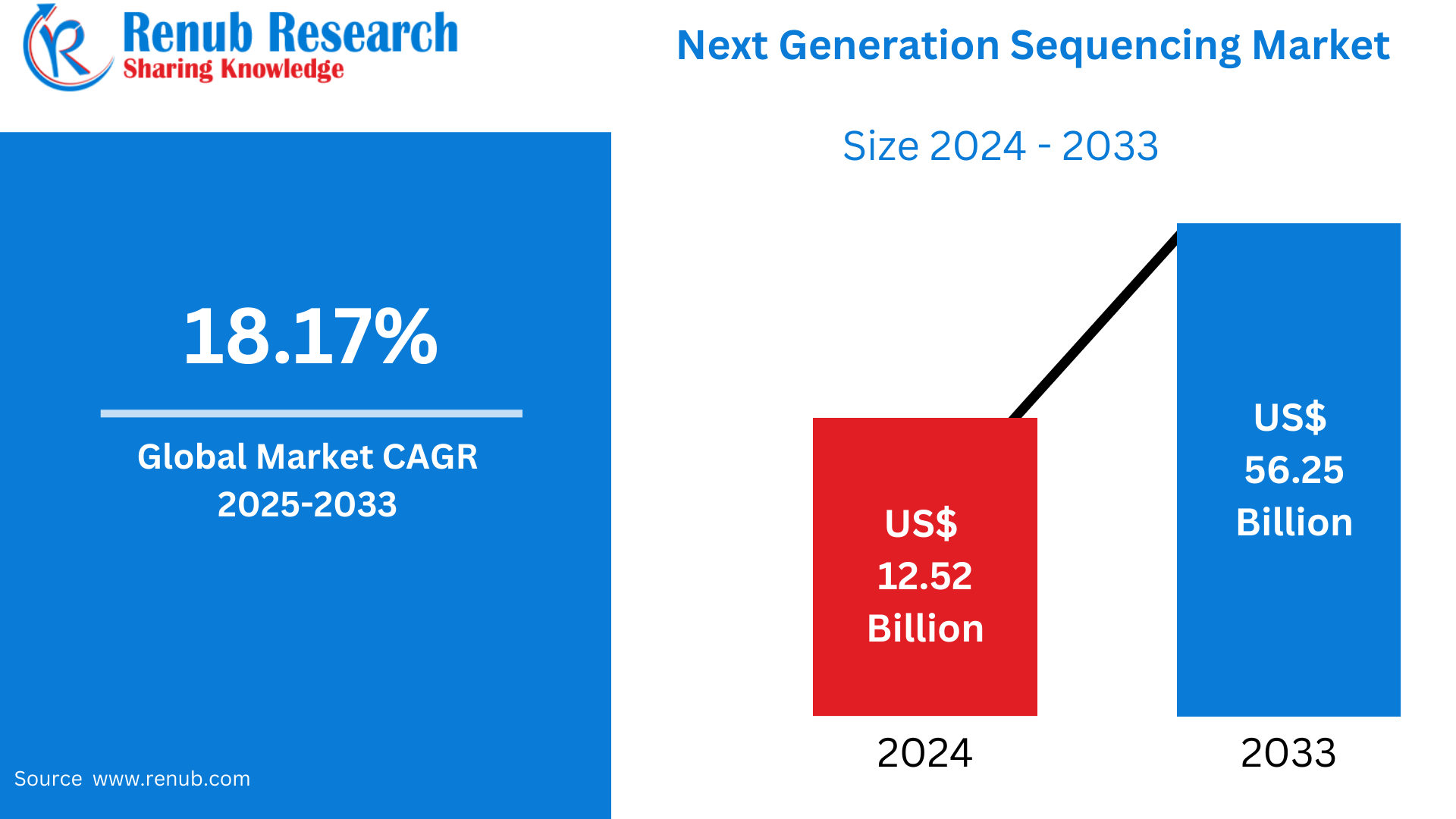
The NGS Market is expected to grow from US$ 12.52 Billion in 2024 to US$ 56.25 Billion by 2033, highlighting a solid Compound Annual Growth Rate (CAGR) of 18.17% during the forecast period from 2025 to 2033. The growth of the market is mainly driven by advancements in the sequencing process, an increase in applications related to genomics research and personalized medicine, and rising investments in biotechnology that are going to shape the future course of the industry.
Outlook of Next Generation Sequencing Market
NGS is one of the revolutionary DNA sequencing technologies that enables the rapid sequencing of entire genomes. In contrast to traditional approaches that could only sequence a few hundred base pairs at a time, NGS allows for the reading of millions of fragments simultaneously. This greatly reduces the time and cost involved in genomic analysis. Various applications have been opened up in the fields of genomics, transcriptomics, and epigenomics, all enabling new insights into many complex biological processes and disease mechanisms with unprecedented detail.
Because of its scalability and efficiency, the popularity of NGS has increased globally. Personalized medicine has NGS as an important tool in the use of genomic data to tailor treatments according to individual needs. NGS is also central in areas like research into cancer, where the technology identifies mutations driving tumor growth; likewise, in infectious disease monitoring, it provides speed in pathogen identification.
With decreasing cost and bioinformatic advancements, sequencing is becoming available for more laboratories and research institutes. Therefore, the application fields of NGS are expanding continuously, and it has established itself as a cornerstone in biological research.
Top 5 Companies in the Next-Generation Sequencing (NGS) Market by 2033
1. Thermo Fisher Scientific
Founded: 2006
Headquarters: United States of America
Websites: www.thermofisher.com
Thermo Fisher Scientific Inc is a leading supplier of a broad range of analytical instruments, life sciences solutions, and specialty diagnostics. The company's product portfolio comprises laboratory essentials, advanced instruments for clinical applications, chromatography and mass spectrometry systems, and molecular biology instruments. Thermo Fisher customers include pharmaceutical and biotechnology companies, research institutions, universities, and government agencies. The company markets its products under several brands: Thermo Scientific, Applied Biosystems, and Fisher Scientific, among others, through direct sales, customer service, e-commerce sites, and third-party distributors.
2. Pacific Biosciences
Founded: 2004
Headquarters: United States of America
Websites: https://www.pacb.com/
Pacific Biosciences of California Inc is a leading life science technology company that provides sequencing solutions for comprehensive genomic analysis. Key products include highly advanced sequencing instruments, Single Molecule, Real-Time (SMRT) Cells, and other reagents designed for use with SMRT sequencing technology. These products are used in various applications, such as human genetics, plant and animal sciences, infectious diseases, and oncology. Pacific Biosciences clients include academic and governmental institutions, commercial laboratories, genome centers, public health laboratories, hospitals, pharmaceutical companies, and agricultural companies.
3. Illumina Inc.
Founded: 1998
Headquarters: San Diego, CA
Websites: https://sapac.illumina.com/
Illumina Inc. is an American biotechnology company and one of the leading companies in the development of integrated systems for the analysis of genetic variation and biological functions. Its customers include pharmaceutical companies, genomic research centers, clinical research organizations, and other biotechnology companies. Over the years, Illumina has taken several strategic initiatives to enhance its product portfolio and increase its presence across geographies. It formed a partnership with aploX in December 2023 to manufacture sequencing instruments locally in China, enabling better access to advanced sequencing in the region.
4. Roche Ltd.
Founded: 1896
Headquarters: Basel Switzerland
Websites: https://www.roche.com
Roche is a leading Swiss-based multinational healthcare company with operations around the world in two key businesses: pharmaceuticals and diagnostics. Since its establishment, Roche has been committed to developing innovative medicines and diagnostic tools that make a significant difference to patients' lives. So far, it has produced specialized treatments in many medical fields, including infectious diseases, ophthalmology, immunology, and oncology. An outstanding achievement by Roche is that 30 of its medicines are on the World Health Organization's list of essential medicines, solving many health problems worldwide.
Next-Generation Sequencing (NGS) Product Launches
Bio-Rad Laboratories, Inc.
Bio-Rad Laboratories announced the release of the ddSEQ Single-Cell 3′ RNA-Seq Kit and the Omnition v1.1 analysis software in June 2024 to advance single-cell transcriptome research. This novel kit is designed specifically to function with Bio-Rad's droplet-based Cell Isolator, enabling researchers to efficiently create high-quality RNA-Seq libraries. With these tools, scientists can perform meticulous analyses of the expression and regulation of genes with increased ease and accuracy.
Takara Bio Inc.
In October 2025, Takara Bio Inc. announced major updates to its spatial biology product portfolio with the release of the Trekker™ Single-Cell Spatial Mapping Kits. One key improvement is that the kits can now be used with FFPE samples, increasing the availability of spatial single-cell analysis to more researchers. In addition, these kits have been optimized to work smoothly with various research workflows and third-party systems, such as single-cell library preparation platforms from industry leaders like 10x Genomics, BD Biosciences, Parse Biosciences, and Illumina.
SWOT Analysis of the NGS Company
Hamilton Company
Strengths - Wide-ranging experience in precision liquid handling and automation technology
Hamilton Company leads the NGS industry with expertise in precision liquid handling and laboratory automation. Advanced robotic platforms and pipetting systems are crucial for accuracy, reproducibility, and high throughput in all the NGS workflows-from sample preparation to the construction of the library-by ensuring seamless integration with sequencing instruments. In this way, Hamilton's systems minimize manual errors and ensure workflow efficiency in research and clinical laboratories. With a well-established reputation for reliability, customization, and engineering excellence, Hamilton is considered a trusted partner for genomic research institutions and biotech companies alike. This technological prowess enables Hamilton to provide consistent, high-quality automation solutions that not only improve data accuracy but also accelerate discoveries in the rapidly developing NGS market.
Geneious
Strength - Advanced Bioinformatics Platform Featuring an Intuitive User Interface
Geneious is one of the leading integrated bioinformatics platforms in NGS, housing powerful software for genomic data analysis and visualization. By combining advanced computational tools with an easy-to-use interface, it allows researchers of all skill levels to easily manage, assemble, and interpret complex sequencing datasets. The software can be used for a number of different sequencing technologies and data formats, which makes it compatible with various NGS workflows. Moreover, plug-in and automation features make Geneious highly customizable and allow for easier workflow automation in molecular biology, phylogenetics, and variant analysis. This blend of accessibility, analytical power, and flexibility positions Geneious as a leading provider of bioinformatics solutions, empowering academic, clinical, and commercial users to derive meaningful insights from genomic data efficiently and accurately.
Recent Development in Next-Generation Sequencing (NGS) Market
BioMérieux SA
June 2025 - bioMérieux, a world leader in in vitro diagnostics, is pleased to announce an agreement for the acquisition of Day Zero Diagnostics, a U.S.-based company specializing in infectious disease diagnostics using genome sequencing and machine learning. This strategic acquisition will strengthen bioMérieux's expertise in next-generation sequencing and rapid diagnostics to further support its commitment to the development of healthcare solutions and to foster better antimicrobial stewardship.
Agilent Technologies, Inc.
Agilent Technologies Inc. has announced, in March 2023, its acquisition of e-MSion, a company known for state-of-the-art electron capture dissociation, most notably the ExD cell. This compact device is designed for use with mass spectrometers and significantly improves the capability of biological researchers to accelerate the development of biotherapeutic products. The ExD cell enhances analysis of complex biomolecules by providing detailed structural information and thus enables faster research and development in the concerned field.
Sustainability Goal of NGS Company
PerkinElmer, Inc.
PerkinElmer, Inc. has set several important targets to address sustainability and ESG performance. These targets include net carbon neutrality by 2040, Scope 1 and 2 emissions reduced by 50.4% by 2032, and 100% renewable electricity by 2030. Regarding environmental goals, PerkinElmer aims to reduce non-hazardous and non-recyclable waste sent to the landfill by 15% by 2025. Water conservation is achieved using mechanisms such as rainwater harvesting and recycling systems. PerkinElmer designs its products to ensure the minimal generation of waste and enhancement of energy efficiency. On the social and governance aspects, PerkinElmer targets an increase in female leadership by up to 40% by 2025, ensuring high employee satisfaction with the company and reduced voluntary turnover. The company acts in accordance with ethical sourcing through partnerships with suppliers and upholds ethical standards with training and board oversight for its ESG strategy.
10x Genomics Inc.
At the heart of 10x Genomics' sustainability commitment is the integration of environmental responsibility, ethics in innovation, and long-term social impact into its scientific mission. In doing so, the company is committed to minimizing its environmental footprint through energy efficiency, minimal laboratory waste, and the design of products with sustainable manufacturing and packaging practices. This includes working with researchers to optimize reagent usage in operations and develop more efficient workflows that consume fewer resources in research facilities around the world. As part of its responsible sourcing, it also calls for full transparency throughout its supply chain, with the aim of ethical production. Outside of environmental objectives, 10x Genomics fosters workplace diversity, inclusion, and community outreach, recognizing that there can be no sustainable innovation without social equity. Through these, it positions itself to lead not only in genomic discovery but also in setting new standards for the industry in sustainability through balanced scientific progress, environmental stewardship, and global well-being.
Market Segmentation
Global Next Generation Sequencing Market
- Historical Trends
- Forecast Analysis
Market Share Analysis – Global Next Generation Sequencing Market
Illumina
Overview
- Company History and Mission
- Business Model and Operations
- Workforce
Key Persons
- Executive Leadership
- Operational Management
- Division Leaders
- Board Composition
Recent Development & Strategies
- Mergers & Acquisitions
- Partnerships
- Investments
Sustainability Analysis
- Renewable Energy Adoption
- Energy-Efficient Infrastructure
- Use of Sustainable Packaging Materials
- Water Usage and Conservation Strategies
- Waste Management and Circular Economy Initiatives
Product Analysis
- Product Profile
- Quality Standards
- Product Pipeline
- Product Benchmarking
Strategic Assessment: SWOT Analysis
- Strengths
- Weaknesses
- Opportunities
- Threats
Revenue Analysis
The above information will be available for all the following companies:
- Illumina
- Thermo Fisher Scientific
- Pacific Biosciences
- QIAGEN N.V.
- Roche
- Bio-Rad Laboratories, Inc.
- Takara Bio Inc.
- Hamilton Company
- Geneious
- BioMérieux SA
- Agilent Technologies, Inc.
- PerkinElmer, Inc.
- Oxford Nanopore Technologies plc
- BGI Group
- 10x Genomics, Inc.