Netherlands Watch Market Report by Type, Gender, Price Range, Distribution Channel, Cities and Company Analysis 2026-2034
Buy NowNetherlands Watch Market Size & Forecast
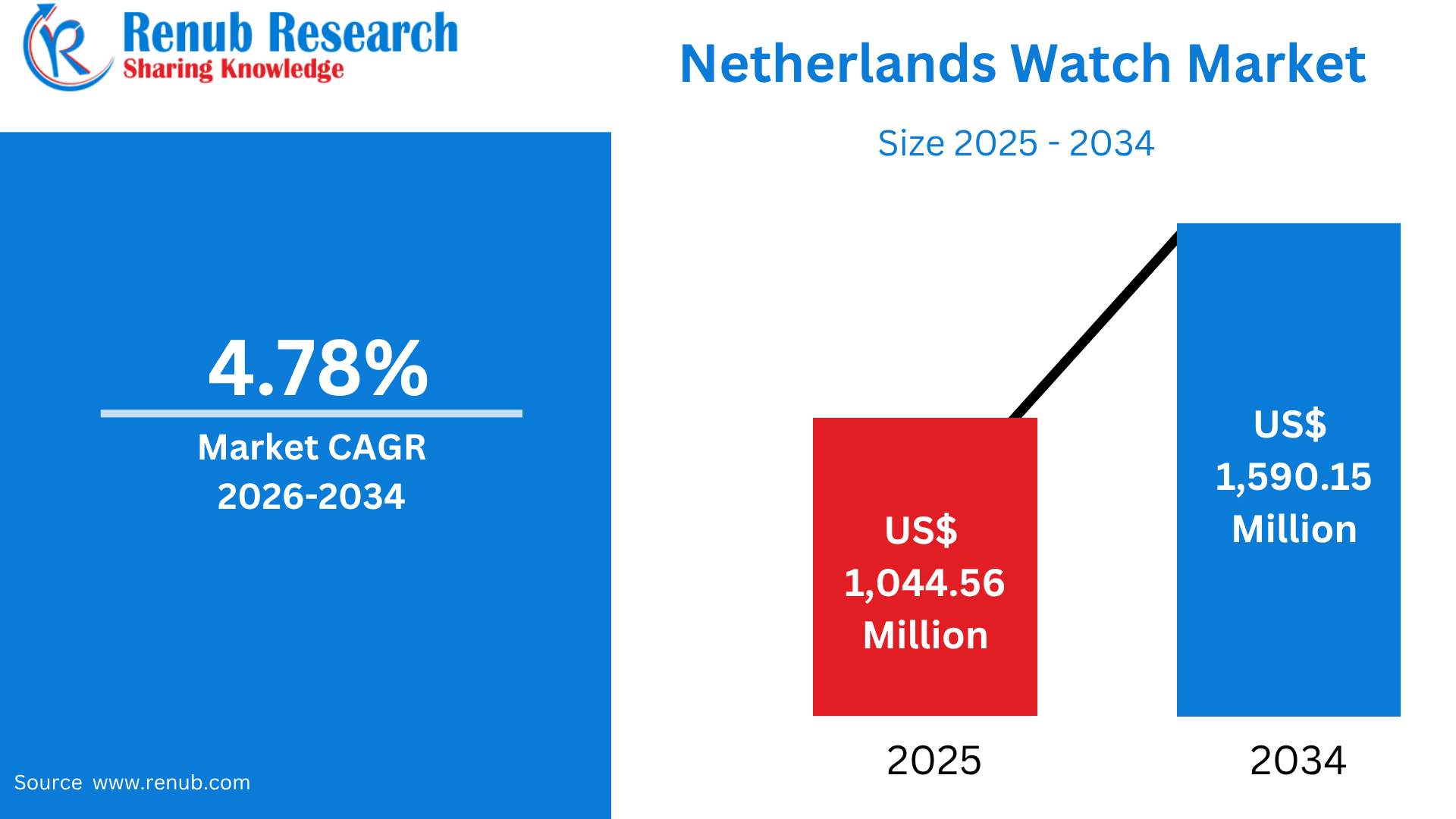
Netherlands watch market is projected to grow from US$ 1,044.56 million in 2025 to US$ 1,590.15 million by 2034, registering a CAGR of 4.78% during 2026–2034. Market expansion is supported by increasing fashion consciousness, rising consumer demand for stylish and functional accessories, and the growing popularity of premium and designer watches. In addition, the rapid expansion of e-commerce and online retail platforms is improving product accessibility, offering consumers a wider range of brands and models while strengthening digital engagement and purchasing convenience.
What Are Watches? Uses & Popularity Worldwide
Watches are portable timekeeping devices worn primarily on the wrist and are available in mechanical, quartz, digital, and smart formats. While their traditional function is to display time, modern watches have evolved into multifunctional accessories combining technology, fashion, convenience, and personal style. Watches are widely used in daily life, workplaces, sports, travel, and formal occasions. Mechanical and luxury watches are particularly valued for craftsmanship, heritage, precision, and exclusivity, while quartz watches are popular for their affordability, accuracy, and low maintenance. Smartwatches have expanded the functionality of the category by offering features such as fitness tracking, heart-rate monitoring, notifications, GPS navigation, sleep tracking, and mobile connectivity.
Worldwide popularity is supported by increasing fashion consciousness, rising disposable incomes, product innovation, and growing interest in premium accessories. Luxury watches have become important status and lifestyle products, particularly among consumers seeking branded and collectible items. At the same time, smartwatches are gaining popularity among technology-oriented consumers because of their health, communication, and fitness capabilities. E-commerce has further expanded global access to watches by enabling consumers to compare brands, designs, prices, and features conveniently. Consequently, watches continue to maintain strong demand across both developed and emerging markets.
Growth Drivers of the Global Watch Market
Rising Demand for Luxury, Premium, and Fashion Watches
Increasing consumer interest in luxury, premium, and fashion accessories is a key growth driver for the global watch market. Watches are increasingly viewed not only as timekeeping devices but also as symbols of status, craftsmanship, personal identity, and fashion. Luxury mechanical watches are particularly attractive to consumers because of their heritage, limited production, precision, and collectible value. Despite challenging market conditions, high-end products continued to demonstrate comparatively stronger demand in 2025. According to the Federation of the Swiss Watch Industry, Swiss watch exports totaled CHF 25.6 billion in 2025, with watches priced above CHF 3,000 accounting for the strongest-performing price segment relative to lower-priced categories. The United States represented 17% of Swiss watch exports, confirming the importance of premium watch consumption in major markets. (FHS) Rising disposable incomes in emerging economies, increasing luxury tourism, celebrity influence, and the popularity of watches as collectible assets are further supporting demand. Luxury brands are also expanding boutiques, limited editions, collaborations, and digital experiences to attract younger consumers. Consequently, premiumization remains an important long-term growth opportunity for the worldwide watch industry.
Growing Adoption of Smartwatches and Connected Wearables
The integration of advanced technology into wristwear is expanding the overall watch industry’s consumer base. Smartwatches combine traditional timekeeping with features such as fitness tracking, heart-rate monitoring, GPS, notifications, sleep monitoring, communication, and mobile connectivity. These multifunctional capabilities are particularly attractive to younger, technology-oriented consumers. Manufacturers are increasingly introducing improved health sensors, longer battery life, AI-enabled functions, sports features, and more sophisticated designs. The convergence of fashion and technology is therefore creating additional demand for connected watches while encouraging traditional watch companies to develop hybrid and technologically enhanced products.
Expansion of E-Commerce and Pre-Owned Watch Markets
The development of online retail and the growing popularity of pre-owned watches are creating new avenues for global market expansion. E-commerce platforms allow consumers to access a wider selection of international brands, compare prices and specifications, read reviews, and purchase watches without visiting physical stores. Digital channels are particularly important for younger consumers, who are increasingly comfortable researching and purchasing premium products online. At the same time, the pre-owned watch market is expanding the customer base by providing access to luxury models at potentially lower prices and creating opportunities for collectors and first-time buyers. Deloitte’s 2025 Swiss watch industry study reported that Generation Z is driving demand for pre-owned watches, while physical stores remain the industry’s primary sales channel. Online platforms are also improving authentication, warranties, financing, and resale services, increasing consumer confidence in second-hand purchases. Social media, influencer marketing, virtual product demonstrations, and digital brand communities further strengthen consumer engagement. As retailers increasingly adopt omnichannel strategies combining boutiques with online channels, improved accessibility and greater product discovery are expected to support continued watch-market growth worldwide.
Challenges of the Global Watch Market
Economic Uncertainty and Declining Demand in Major Markets
Economic uncertainty, inflation, currency fluctuations, and weaker consumer confidence represent significant challenges for the global watch industry, particularly in discretionary and luxury segments. Watches, especially premium mechanical models, are non-essential purchases and can therefore be affected when consumers reduce spending on luxury goods. The Federation of the Swiss Watch Industry reported that Swiss watch exports declined 1.7% in 2025 to CHF 25.6 billion, following a 2.8% decline in 2024. Export volumes also decreased 4.8% to 14.6 million watches in 2025. Major Asian markets experienced particularly significant pressure: Swiss watch exports to China fell 12.1% and Hong Kong declined 6.5% in 2025, while Japan decreased 5.8%. Higher gold prices and a stronger Swiss franc also increased production and purchasing costs for Swiss watches. Such conditions can reduce demand among aspirational consumers and create inventory pressures for retailers. Manufacturers therefore need to balance premium pricing with consumer affordability while strengthening regional diversification and product innovation to mitigate economic volatility.
Intense Competition from Smartwatches and Changing Consumer Preferences
Traditional watch manufacturers face increasing competition from smartwatches and rapidly changing consumer preferences. Smartwatches provide functions that conventional watches cannot offer, including health monitoring, fitness tracking, GPS, notifications, communications, and integration with smartphones. This multifunctionality can make smartwatches particularly attractive to younger consumers who prioritize technology and convenience. Traditional watchmakers must therefore compete not only on design and craftsmanship but also against rapidly evolving technology companies capable of introducing new digital features at frequent intervals. Additionally, younger consumers are increasingly interested in pre-owned watches, experiences, wellness products, and technology-enabled accessories, changing conventional luxury purchasing patterns. Watch companies are responding through hybrid watches, connected products, digital marketing, younger-oriented collections, and stronger sustainability initiatives. Nevertheless, maintaining relevance among younger technology-focused consumers remains a major challenge for traditional watch brands.
Watch Launches in the Netherlands
- TAG Heuer Formula 1 Solargraph Dutch Grand Prix Limited Editions (2026): TAG Heuer introduced two limited-edition Formula 1 Solargraph watches, WBY111H.FT8128 and WBY111L.BA0042, created to commemorate the final Dutch Grand Prix at Zandvoort. The models feature Dutch-inspired orange and red accents and are limited to 1,500 and 1,000 pieces, respectively.
- Swatch A PROMISE OF SUN (2026): Swatch launched the Amsterdam-inspired A PROMISE OF SUN watch as part of its Destination Art series, created in collaboration with Amsterdam-based artist Enzo Pérès Labourdette. The watch became available at selected Amsterdam stores from February 2026.
- Swatch PAINTED PARADISE Collection (2026): Swatch launched four colorful watches under its PAINTED PARADISE collection on March 21, 2026. The models are part of the SKIN line and feature tropical-inspired colors and ultra-thin designs.
- Swatch SCUBAQUA New Models (2026): Swatch introduced four new SCUBAQUA watches in aqua green, midnight blue, electric fuchsia, and solar orange. The aqua green and midnight blue versions include Swatch Pay, while all models feature Bioceramic and biosourced materials.
- Seiko 5 Sports x HUF SRPM09K1 (2026): Seiko launched the limited-edition Seiko 5 Sports x HUF SRPM09K1, combining Japanese watchmaking with HUF’s streetwear aesthetic. Production is limited to 7,000 pieces worldwide.
- Seiko 145th Anniversary Limited Editions SRPM06J1 & SSH186J1 (2026): Seiko introduced two limited-edition models to celebrate its 145th anniversary, combining traditional watchmaking with contemporary design and advanced functionality.
- Seiko Astron GPS Solar New Generation (2025): Seiko introduced four new Astron GPS Solar models—SSH180J1, SSH175J1, SSH177J1, and SSH179J1—combining GPS timekeeping, solar-powered technology, and premium styling.
- Citizen Promaster Aqualand JP2008-06E Limited Edition (2025): Citizen launched the Promaster Aqualand JP2008-06E, marking 40 years of the Aqualand diving-watch line. The limited edition builds on the collection’s established professional diving functionality.
- Ice-Watch Ice Smart 3.0 Round (2025): Ice-Watch introduced the Ice Smart 3.0 Round, combining a traditional round-watch appearance with smartwatch functionality, offering consumers a blend of technology and contemporary style.
- Sero Watch Company Signature (2026): Dutch watchmaker Sero Watch Company debuted its Signature dress watch in February 2026. Developed by two Dutch collectors, the model combines classical 1930s–1950s-inspired styling with a mechanical Sellita SW-210 movement.
Affordability, Accuracy, and Everyday Convenience in the Netherlands
Netherlands quartz watches market continues to benefit from strong consumer demand for accurate, affordable, and low-maintenance timepieces. Quartz watches use battery-powered movements and are generally easier to maintain than mechanical alternatives, making them suitable for everyday use. Their availability across entry-level, mid-range, and fashion-oriented price categories allows manufacturers to target a broad consumer base. In addition to functionality, Dutch consumers increasingly consider watches fashion accessories, encouraging brands to combine quartz technology with minimalist, contemporary, and versatile designs. Retailers are offering extensive quartz collections through department stores, specialty watch shops, brand outlets, and e-commerce platforms, improving product accessibility. Online retail is particularly important because consumers can compare specifications, prices, customer reviews, and designs before purchasing. The affordability of quartz watches also makes them attractive for consumers seeking multiple watches for different occasions. Although smartwatches and mechanical watches create competitive pressure, quartz models continue to maintain relevance because of their simplicity, dependable performance, long battery life, and relatively low ownership costs.
Craftsmanship and Premium Positioning Drive Mechanical Watches Demand in Netherlands
Netherlands mechanical watches market is supported by consumers who value traditional craftsmanship, precision engineering, heritage, and exclusivity. Unlike quartz models, mechanical watches operate through intricate mechanical movements, making them particularly appealing to collectors and enthusiasts interested in horology. Premium mechanical watches are frequently positioned as luxury accessories and can carry strong emotional and heritage value. Manufacturers differentiate their offerings through high-quality materials, sophisticated movements, limited editions, distinctive designs, and brand heritage. The growing interest in luxury accessories and collectible products is creating opportunities for premium mechanical watch brands in the Netherlands. Pre-owned luxury watches are also attracting consumers who want access to established brands and iconic models at potentially lower prices than new products. Specialty retailers and authorized boutiques remain important for providing personalized service, while e-commerce and digital platforms are expanding product discovery. Although mechanical watches typically appeal to a narrower consumer group than quartz watches, their premium positioning enables manufacturers to generate higher value per unit. Continued interest in craftsmanship, authenticity, and long-term ownership is expected to support the segment.
Fashion, Personalization, and Self-Expression Support Women Watches Growth in Netherlands
Netherlands women’s watches market is expanding as watches increasingly function as fashion accessories, lifestyle products, and expressions of personal identity. Consumers are seeking products that combine reliable timekeeping with attractive designs, comfort, versatility, and compatibility with different outfits and occasions. The segment includes minimalist watches, jewelry-inspired designs, fashion watches, premium timepieces, and smartwatches designed specifically or marketed toward women. Social media, fashion influencers, celebrity collaborations, and digital marketing are influencing purchasing decisions by increasing awareness of emerging styles and brands. Manufacturers are responding with lightweight materials, interchangeable straps, smaller case sizes, contemporary finishes, and customizable designs. Demand is also supported by consumers purchasing multiple watches for professional, casual, and formal occasions. Online retailers provide convenient access to a broad range of products, while specialty stores enable consumers to evaluate design, fit, and materials physically. Increasing emphasis on individuality and personal styling is encouraging brands to offer more diverse collections. As fashion and technology increasingly converge, connected watches with wellness, fitness, and communication features are also creating additional opportunities within the women’s watch segment.
Value-for-Money Products Attract a Broad Consumer Non-Luxury Watches Base in Netherlands
Netherlands non-luxury watches market serves consumers seeking affordable, practical, and dependable timepieces for everyday use. The segment encompasses quartz watches, fashion watches, basic digital models, sports-oriented products, and other affordable timekeeping solutions. Price remains an important purchasing consideration, encouraging manufacturers to focus on efficient production, durable materials, attractive designs, and competitive pricing. Consumers can choose from a wide range of styles suitable for work, leisure, sports, and casual occasions. The expansion of e-commerce has further increased accessibility by allowing shoppers to compare prices, features, customer ratings, and brands across multiple platforms. Physical retailers, department stores, specialty shops, and other mass-market channels continue to complement online sales. Product innovation is also helping non-luxury watches remain relevant, with manufacturers incorporating improved water resistance, durable straps, digital displays, chronograph functions, and contemporary designs. While premium mechanical watches and smartwatches compete for consumer attention, affordable watches continue to benefit from their straightforward functionality and lower purchase costs. Demand is therefore expected to remain relatively stable, supported by replacement purchases, gifting, fashion preferences, and everyday usage.
E-Commerce and Digital Shopping Transform Watch Retail
Netherlands online watches market is expanding as consumers increasingly use e-commerce platforms to research, compare, and purchase watches. High internet and digital-commerce adoption provides a favorable environment for online watch retailers and direct-to-consumer brands. Digital platforms enable consumers to access a much broader selection of luxury, premium, fashion, quartz, mechanical, and smartwatch products than may be available at individual physical stores. Price comparison, customer reviews, detailed specifications, product videos, and digital recommendations help consumers make more informed purchasing decisions. Social media platforms are also becoming important marketing channels, with brands using influencers, targeted advertising, and visual campaigns to showcase new collections and engage younger consumers. Secure digital payments, convenient delivery, easy returns, and improved authentication services are further strengthening consumer confidence in online purchases. Direct-to-consumer strategies allow manufacturers to communicate directly with customers while collecting insights into preferences and purchasing behavior. At the same time, established retailers are adopting omnichannel approaches that combine physical stores with websites and digital services. As consumers increasingly prioritize convenience and product choice, online channels are expected to represent an increasingly important component of the Netherlands' watch retail landscape.
Netherlands Watch Market Segments
Type
- Quatz Watches
- Electronic Watches
- Mechanical Watches
Gender
- Men
- Women
- Unisex
Price Range
- Luxury
- Non-Luxury
Distribution Channel
- Hyper Market/Super Market
- Convenience Stores
- Online
Cities
- Amsterdam
- Rotterdam
- The Hague
- Utrecht
- Eindhoven
- Groningen
- Tilburg
- Almere
- Breda
- Nijmegen
All companies have been covered with 5 Viewpoints
- Overviews
- Key Person
- Recent Developments
- SWOT Analysis
- Revenue Analysis
Key Players Analysis
- Seiko Holdings Corporation
- Casio Computer Co. Ltd
- Timex Group
- Rolex SA
- Compagnie Financière Richemont S.A
- The Swatch Group Ltd
- Citizen Watch Co. Ltd.
- Fossil Group Inc.
- Google LLC (Fitbit Inc.)
Report Details:
| Report Features | Details |
| Base Year |
2024 |
| Historical Period |
2021 - 2024 |
| Forecast Period |
2025 - 2033 |
| Market |
US$ Billion |
| Segment Covered |
By Type, By Gender, By Price Range and By Distribution Channel |
| Companies Covered |
|
| Customization Scope |
20% Free Customization |
| Post-Sale Analyst Support |
1 Year (52 Weeks) |
| Delivery Format |
PDF and Excel through Email (We can also provide the editable version of the report in PPT/Word format on request) |
Customization Services available
- Analysis of Market Size and Its Segments
- More Company Profiles (Upto 10 without any additional cost):
- Additional Countries (Other than mentioned Countries):
- Region/Country Specific Reports:
- Market Entry Strategy:
- Region-Specific Market Dynamics:
- Regional Market Share Analysis:
- Trade Analysis:
- Production Insights:
- Others Customized Requests:
For more information contact our analysts.
Need More Assistance?
- Talk to our analysts to get more precious information on the current market trends.
- Include more countries and segments and customize the report based on the final requirement.
- Get a competitive advantage in your industry by knowing the report findings and making a positive impact on your revenues and operations.
- Our analysts are always ready to provide more help and pertinent information if you need any additional assistance.