Netherlands Robotics Market Report by Industrial Robotics, Service Robotics, City and Company Analysis 2026-2034
Buy NowNetherlands Robotics Market Size and Forecast 2026-2034
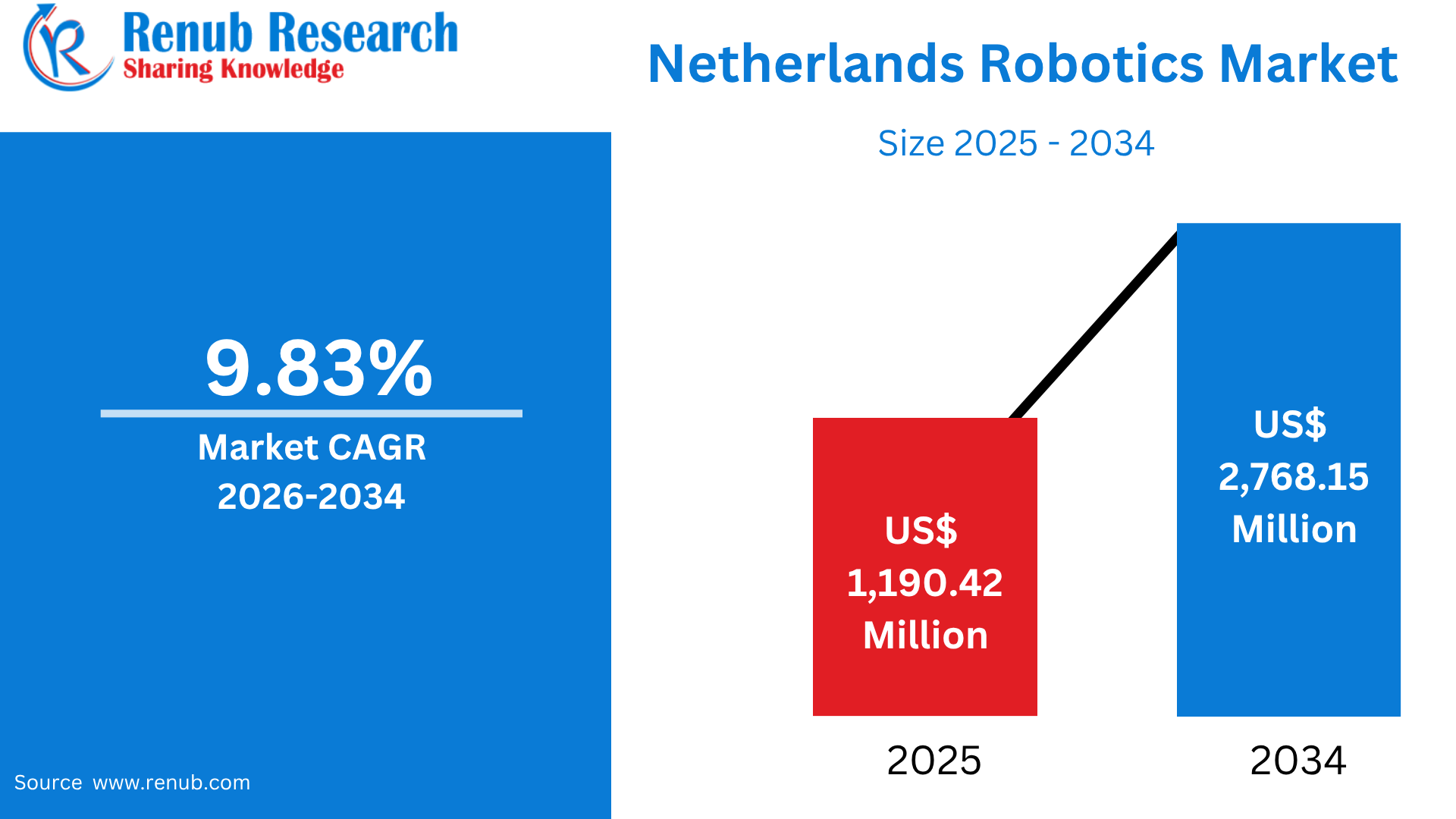
Netherlands Robotics Market is expected to reach US$ 2,768.15 million by 2034 from US$ 1,190.42 million in 2025, with a CAGR of 9.83% from 2026 to 2034. The Netherlands robotics market is expected to grow steadily, driven by increasing automation adoption, technological advancements, labor shortages, and rising demand across manufacturing, logistics, healthcare, and service industries.
Netherlands Robotics Industry Overview
The Netherlands robotics industry is emerging as a significant contributor to the country’s advanced technology landscape, supported by strong innovation capabilities and a well-developed industrial base. Robotics is increasingly being integrated across multiple sectors, including manufacturing, agriculture, healthcare, and logistics, to enhance efficiency, productivity, and precision. The country’s strategic focus on digital transformation and automation has accelerated the adoption of robotic systems, particularly in industries facing labor shortages and rising operational costs. The presence of research institutions, technology hubs, and collaborative ecosystems further strengthens the robotics sector in the Netherlands.
Technological advancements and innovation play a crucial role in shaping the robotics industry in the Netherlands. The development of artificial intelligence, machine learning, and advanced sensors has enabled the creation of more sophisticated and adaptable robotic solutions. Collaborative robots, also known as cobots, are gaining popularity due to their ability to work alongside humans safely and efficiently. Additionally, the logistics sector is increasingly adopting robotics for warehousing, sorting, and delivery operations, driven by the rapid growth of e-commerce. The agricultural sector is also leveraging robotics for precision farming, improving crop yield and resource efficiency.
Furthermore, the Netherlands robotics industry benefits from strong government support and favorable regulatory frameworks that encourage innovation and investment. Public and private sector collaborations are fostering the development and commercialization of advanced robotic technologies. Sustainability is also a key focus, with robotics being used to optimize energy consumption and reduce waste across industries. Despite challenges such as high initial investment costs and the need for skilled workforce, the industry continues to expand through continuous innovation and adoption. The growing demand for automation and smart technologies ensures long-term growth for the robotics market in the Netherlands.
Growth Drivers for the Netherlands Robotics Market
Increasing Adoption of Automation Across Industries
The rising adoption of automation across various industries is a major driver of the Netherlands robotics market. Companies are increasingly integrating robotic systems to improve efficiency, reduce operational costs, and enhance productivity. In manufacturing, robots are used for repetitive and precision tasks, ensuring consistent quality and faster production cycles. The logistics sector is also adopting automation to streamline warehousing and distribution processes. Additionally, industries facing labor shortages are turning to robotics as a reliable solution to maintain operations. The growing need for efficiency and competitiveness is encouraging businesses to invest in advanced robotic technologies. This widespread adoption of automation across sectors continues to support the growth of the robotics market in the Netherlands.
Technological Advancements in Robotics and AI
Technological advancements in robotics and artificial intelligence are significantly driving the growth of the Netherlands robotics market. Innovations in machine learning, computer vision, and sensor technologies have enabled the development of highly advanced robotic systems capable of performing complex tasks. Collaborative robots are gaining popularity due to their flexibility and ability to work alongside human workers. These advancements improve efficiency, safety, and adaptability in various applications, including manufacturing, healthcare, and agriculture. Continuous investment in research and development by both public and private sectors further accelerates innovation. As technology continues to evolve, the capabilities of robotic systems expand, making them more accessible and attractive to a wide range of industries.
Growing Demand in Logistics and E-commerce Sectors
The rapid growth of the logistics and e-commerce sectors is a key factor driving the Netherlands robotics market. Increasing online shopping activities have created a need for efficient warehousing, sorting, and delivery solutions. Robotics plays a crucial role in optimizing these processes by improving speed, accuracy, and operational efficiency. Automated guided vehicles, robotic arms, and sorting systems are widely used in distribution centers to handle large volumes of goods. Additionally, the need for faster delivery and improved customer service encourages companies to adopt advanced robotic solutions. The expansion of logistics infrastructure and the continuous growth of e-commerce further contribute to the increasing demand for robotics in the Netherlands.
Challenges in the Netherlands Robotics Market
High Initial Investment and Implementation Costs
One of the primary challenges in the Netherlands robotics market is the high initial investment required for implementing robotic systems. The cost of purchasing, installing, and maintaining advanced robotics solutions can be significant, particularly for small and medium-sized enterprises. Additionally, integrating robotics into existing operations may require infrastructure upgrades and employee training, further increasing expenses. While robotics can offer long-term cost savings and efficiency improvements, the upfront financial burden can be a barrier to adoption. Companies must carefully evaluate return on investment and develop strategic plans to justify these expenditures. Addressing cost-related challenges is essential to ensure broader adoption of robotics across industries in the Netherlands.
Shortage of Skilled Workforce and Technical Expertise
The shortage of skilled workforce and technical expertise is another major challenge for the Netherlands robotics market. The implementation and operation of advanced robotic systems require specialized knowledge in areas such as programming, engineering, and data analysis. However, there is a growing gap between the demand for skilled professionals and the available talent pool. This shortage can slow down the adoption of robotics and limit the ability of companies to fully utilize advanced technologies. Additionally, continuous technological advancements require ongoing training and skill development. To overcome this challenge, there is a need for increased investment in education, training programs, and collaboration between industry and academic institutions.
Amsterdam Robotics Market
The Amsterdam robotics market is a key hub for innovation and technology adoption in the Netherlands. The city’s strong startup ecosystem and presence of research institutions support the development of advanced robotic solutions. Robotics is widely used in sectors such as logistics, healthcare, and service industries. The growth of e-commerce has increased demand for automation in warehousing and distribution centers. Additionally, Amsterdam’s focus on smart city initiatives encourages the integration of robotics in urban infrastructure and public services. Collaboration between technology companies and academic institutions further drives innovation. The availability of skilled talent and access to funding also support market growth. These factors make Amsterdam a leading center for robotics development and adoption in the Netherlands.
Rotterdam Robotics Market
The Rotterdam robotics market is driven by the city’s strong industrial base and status as a major logistics hub. Robotics is extensively used in port operations, manufacturing, and supply chain management to enhance efficiency and productivity. The Port of Rotterdam plays a crucial role in driving demand for automation technologies, including autonomous vehicles and robotic handling systems. Additionally, the presence of industrial companies and logistics providers supports the adoption of advanced robotics solutions. Investments in smart infrastructure and digital transformation further contribute to market growth. The city’s focus on innovation and sustainability encourages the use of robotics to optimize operations and reduce environmental impact. These factors position Rotterdam as a significant contributor to the Netherlands robotics market.
The Hague Robotics Market
The Hague robotics market is growing steadily, supported by increasing adoption of technology in public services, healthcare, and security sectors. The city’s focus on governance and international institutions creates demand for advanced solutions, including robotics for surveillance, safety, and administrative efficiency. Additionally, the healthcare sector is adopting robotic technologies for precision treatments and patient care. Collaboration between government bodies, research institutions, and private companies supports innovation and development in the robotics field. The presence of international organizations also encourages the use of advanced technologies to improve operational efficiency. With increasing investment in digital transformation and smart technologies, The Hague is emerging as an important market for robotics in the Netherlands.
Utrecht Robotics Market
The Utrecht robotics market is expanding due to the city’s strong focus on research, education, and innovation. The presence of leading universities and research institutions supports the development of advanced robotic technologies. Robotics is increasingly being used in healthcare, logistics, and service sectors, driven by the need for efficiency and precision. The city’s central location and well-developed infrastructure make it an important hub for logistics and distribution activities. Additionally, startups and technology companies in Utrecht are actively contributing to innovation in robotics. Collaboration between academia and industry fosters the development of new solutions and applications. These factors, combined with increasing investment in technology and automation, drive the growth of the robotics market in Utrecht.
Netherlands Robotics Market Segments
Industrial Robotics
- Automotive
- Electronics
- Metal and Machinery
- Food and Beverage
- Others
Service Robotics
- Transportation & Logistics
- Professional Cleaning
- Medical Robotics
- Hospitality
- Agriculture & Field
Cities
- Amsterdam
- Rotterdam
- The Hague
- Utrecht
- Eindhoven
- Groningen
- Tilburg
- Almere
- Breda
- Nijmegen
All companies have been covered with 5 Viewpoints
- Overviews
- Key Person
- Recent Developments
- SWOT Analysis
- Revenue Analysis
Key Players Analysis
- KUKA
- iRobot Corporation
- Intuitive Surgical, Inc.
- Panasonic Corporation
- Fanuc
- ABB Ltd
- Stryker Corporation
| Report Features | Details |
| Base Year |
2024 |
| Historical Period |
2020 - 2024 |
| Forecast Period |
2025 - 2033 |
| Market |
US$ Million |
| Segment Covered |
Automotive, Electronics, Metal and Machinery, Food and Beverage & Others |
| Regions Covered |
|
| Companies Covered |
|
| Customization Scope |
20% Free Customization |
| Post-Sale Analyst Support |
1 Year (52 Weeks) |
| Delivery Format |
PDF and Excel through Email (We can also provide the editable version of the report in PPT/Word format on request) |
Customization Services available
- Analysis of Market Size and Its Segments
- More Company Profiles (Upto 10 without any additional cost):
- Additional Countries (Other than mentioned Countries):
- Region/Country Specific Reports:
- Market Entry Strategy:
- Region-Specific Market Dynamics:
- Regional Market Share Analysis:
- Trade Analysis:
- Production Insights:
- Others Customized Requests:
For more information contact our analysts.
Need More Assistance?
- Talk to our analysts to get more precious information on the current market trends.
- Include more countries and segments and customize the report based on the final requirement.
- Get a competitive advantage in your industry by knowing the report findings and making a positive impact on your revenues and operations.
- Our analysts are always ready to provide more help and pertinent information if you need any additional assistance.