Modified Starch Market Report by Raw Material, Product, Form, Function, End-Use, Country and Company Analysis 2026-2034
Buy NowModified Starch Market Size & Forecast
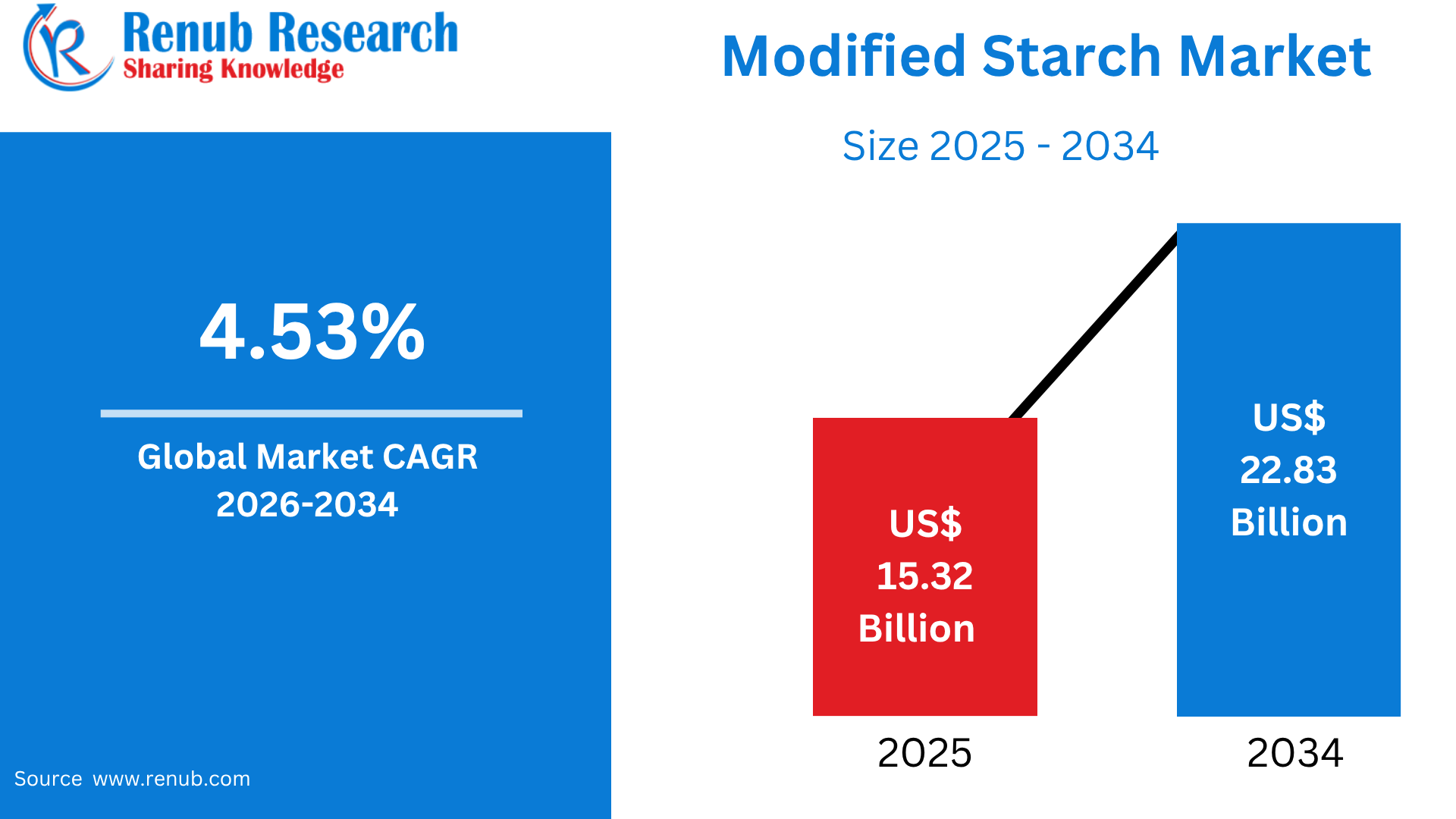
The global modified starch market is projected to expand from approximately US$ 15.32 billion in 2025 to US$ 22.83 billion by 2034, registering a CAGR of 4.53% during 2026–2034. Market growth is driven by rising demand from the food and beverage sector, where modified starch is widely used as a thickener, stabilizer, emulsifier, and texture enhancer. Its growing applications in pharmaceuticals, paper manufacturing, and other industrial sectors are further supporting market expansion. In addition, advancements in starch modification technologies are enabling the development of products with improved functionality and performance.
Modified Starch: What It Is, Uses & Global Popularity
Modified starch is a starch that has been physically, chemically, or enzymatically processed to improve its functional properties, such as stability, viscosity, texture, solubility, and resistance to heat or freezing. It is generally derived from natural starch sources, including corn, potato, wheat, cassava, and tapioca. Modified starch is widely used across food, pharmaceutical, paper, textile, and other industrial applications.
In the food and beverage industry, modified starch serves as a thickener, stabilizer, emulsifier, binder, and texture enhancer in products such as sauces, soups, bakery products, dairy items, instant foods, confectionery, and processed meats. In pharmaceuticals, it is used as a binder, disintegrant, and stabilizing ingredient in tablets and other formulations. The paper industry uses modified starch to improve paper strength, surface quality, and printability, while textile manufacturers utilize it for sizing and finishing processes.
The global popularity of modified starch is increasing due to rising consumption of processed and convenience foods, expanding pharmaceutical production, growing industrial applications, and continuous advancements in starch modification technologies. Its versatility, cost-effectiveness, and ability to improve product performance continue to support worldwide demand.
Growth Drivers of the Modified Starch Market
Rising Demand for Processed and Convenience Foods
The growing consumption of processed, ready-to-eat, frozen, and convenience foods is a major driver of the global modified starch market. Modified starch provides important functional properties, including thickening, stabilization, emulsification, texture enhancement, binding, and improved shelf life, making it highly valuable for modern food manufacturing. Modified starch is extensively incorporated into sauces, soups, bakery products, dairy foods, confectionery, instant meals, dressings, and beverages to maintain consistency and product quality during processing and storage. Changing lifestyles, urbanization, and increasing consumer preference for convenient meal solutions are encouraging food manufacturers to expand processed-food production. In addition, demand for low-calorie, clean-label, gluten-free, and functional food products is encouraging manufacturers to develop specialized starch formulations. These trends are expected to sustain demand for modified starch worldwide throughout the forecast period.
Expanding Pharmaceutical and Industrial Applications
The increasing use of modified starch beyond food applications is creating another significant growth opportunity for the market. Modified starch is used in pharmaceuticals as an excipient for tablet binding, disintegration, controlled drug release, and formulation stabilization, while industrial users apply it in paper, textiles, adhesives, packaging, and other manufacturing processes. Modified starch is also valuable in the paper and pulp industry because it improves paper strength, surface properties, and printability. Growing demand for sustainable packaging is creating additional opportunities because starch-based materials can contribute to biodegradable and bio-based packaging solutions. Meanwhile, expanding pharmaceutical manufacturing in emerging economies is increasing demand for reliable functional excipients. The combination of pharmaceutical, paper, textile, packaging, and adhesive applications is therefore reducing dependence on the food sector and broadening the overall addressable market for modified starch.
Technological Advancements and Growing Demand for Functional Starch Solutions
Advancements in physical, chemical, and enzymatic starch modification technologies are supporting market growth by enabling manufacturers to develop starches with more precise functional characteristics. Modern modification processes can improve properties such as viscosity, heat stability, freeze-thaw resistance, emulsification, film formation, binding, and texture. Manufacturers are increasingly developing specialty starches designed for clean-label, non-GMO, plant-based, and functional food formulations. Innovations in resistant starch, biodegradable materials, and customized food ingredients are further expanding potential applications. At the same time, improving processing and drying technologies is making modified starch easier to formulate, transport, store, and incorporate into industrial processes. These developments are expected to encourage product innovation and strengthen the competitive position of modified starch compared with conventional ingredients.
Challenges of the Modified Starch Market
Volatility in Raw Material Prices and Supply
Fluctuations in the prices and availability of raw materials such as corn, cassava, potato, wheat, and tapioca represent a major challenge for modified starch manufacturers. These agricultural commodities are influenced by weather conditions, crop yields, energy costs, transportation expenses, trade policies, and changes in global food demand. Corn is particularly important to the industry; maize accounted for more than half of the modified starch market by source in 2025. Consequently, significant changes in maize or other starch-crop prices can directly affect production costs and manufacturers’ profit margins. Agricultural disruptions caused by droughts, floods, extreme temperatures, and changing climatic conditions can further create uncertainty around raw-material availability. Producers may need to maintain larger inventories or establish multiple sourcing arrangements to manage supply risks, increasing operational expenses. In addition, competition between food, animal feed, biofuel, and industrial applications for agricultural commodities can place additional pressure on prices. These factors can make pricing unpredictable and create difficulties for manufacturers attempting to maintain stable product prices in highly competitive global markets.
Regulatory Requirements and Competition from Alternative Ingredients
Strict regulatory requirements and increasing competition from alternative functional ingredients can limit the expansion of the modified starch market. Modified starch products may be subject to different food, pharmaceutical, labeling, safety, and environmental regulations depending on the country and application. Manufacturers therefore need to invest in testing, certification, quality control, and regulatory compliance, which can increase development and operating costs. At the same time, consumers’ growing preference for clean-label and minimally processed ingredients is encouraging food manufacturers to explore alternative starches, hydrocolloids, gums, fibers, and other natural texturizing agents. Industry analysis identifies strict regulatory standards, raw-material price volatility, and competition from synthetic and alternative starch substitutes as important market challenges. Companies are consequently investing in physically and enzymatically modified starches, non-GMO products, and cleaner-label formulations to respond to changing consumer expectations. However, developing these specialized products requires significant research and development expenditure. Smaller manufacturers may face greater difficulty meeting regulatory requirements and competing with established multinational producers, potentially increasing market consolidation and competitive pressure.
Modified Starch Product Launches Worldwide
- CLEARAM® TR Tapioca-Based Starches – Roquette (France, 2024): Roquette expanded its texturizing portfolio with four tapioca-based cook-up starches under the CLEARAM® TR range for food applications.
- NOVATION® Indulge 2940 – Ingredion (United States, 2024): A corn-based starch developed to provide texture and stability in dairy and non-dairy products, supporting cleaner-label formulations. (Global Market Insights Inc.)
- LYCAGEL® Hydroxypropyl Pea Starch – Roquette (France, 2024): Roquette introduced a hydroxypropyl pea starch excipient for vegetarian and vegan softgel formulations and nutraceutical applications. (IMARC Group)
- Beauty by Roquette® ST 730 – Roquette (France, 2024): A hydroxypropyl starch developed for cosmetic applications, supporting sustainable ingredient solutions in beauty formulations. (Global Market Insights Inc.)
- Modified Starch for Healthier Bakery Products – SMS Corporation (Thailand, 2024): SMS Corporation highlighted a modified starch solution designed for bakery applications as part of its new product development portfolio. (SMS Corporation)
- Modified Starch for Indulgent Yogurt – SMS Corporation (Thailand, 2024): A specialty starch solution introduced for yogurt applications, targeting improved texture and formulation performance. (SMS Corporation)
- Natura® STN – SMS Corporation (Thailand, 2024): A starch solution positioned for clean-label bakery formulations, addressing demand for functional ingredients with improved processing performance. (SMS Corporation)
- Dent-Corn Modified Starch – Cargill (India/Global, 2025): Cargill highlighted a dent-corn modified starch designed to improve sauce color and texture while providing a cost-effective formulation option. (MarketsandMarkets)
- C*PolarTex® 057 Range – Cargill: A range of cook-up modified corn starches developed for ready meals, soups, sauces, dressings, dairy desserts, and fruit preparations, offering stability during hot and retort processing. (Cargill)
- C*Tex® 052 Range – Cargill: Modified corn starch solutions developed for ready meals, soups, sauces, dressings, processed cheese, dairy desserts, and yogurt, providing cost-effective texture and stability. (Cargill)
Abundant Corn Supply and Cost-Effective Raw Material in Corn Modified Starch
Corn modified starch represents an important product segment because corn is widely available, relatively economical, and suitable for large-scale starch production. The United States alone produced a record 17.0 billion bushels of corn in 2025, 14% higher than the previous year, demonstrating the strong availability of corn as an industrial raw material. Globally, corn production reached approximately 1.22 billion tonnes in 2024/25, with the United States, China, Brazil, the European Union, and Argentina among the leading producers. Corn modified starch is extensively used in soups, sauces, bakery products, dairy foods, confectionery, processed foods, and beverages because it provides effective thickening, stabilization, binding, and texture control. Its ability to maintain performance under different processing and storage conditions further increases its suitability for food manufacturing. Beyond food applications, it is used in paper, textiles, adhesives, and packaging. Rising processed-food consumption, expanding industrial production, and demand for bio-based ingredients are expected to support continued growth.
Gluten-Free and Natural Characteristics Strengthen Demand of Cassava
Cassava modified starch is gaining popularity because cassava is a naturally derived starch source with a neutral flavor, smooth texture, and naturally gluten-free characteristics. Cassava, commonly processed into tapioca starch, is particularly valuable for manufacturers developing gluten-free and allergen-conscious food products. Modified cassava starch can provide improved viscosity, stability, binding, and texture, making it suitable for sauces, soups, bakery products, noodles, dairy alternatives, confectionery, and ready-to-eat foods. Its functionality also allows manufacturers to improve consistency during heating, cooling, and storage. The growing preference for plant-based and naturally sourced ingredients is creating additional opportunities for cassava-based starch solutions. In non-food applications, modified cassava starch is used in paper manufacturing, textiles, adhesives, and packaging materials. The global paper and paperboard industry produced approximately 423 million tonnes in 2024, highlighting the substantial industrial base in which starch-based additives can be utilized. Increasing demand for clean-label, gluten-free, and sustainable products is expected to strengthen the adoption of cassava modified starch worldwide.
Growing Paper and Textile Applications
Cationic modified starch is primarily gaining demand from the paper, packaging, and textile industries because its positively charged structure enables it to interact effectively with negatively charged fibers and surfaces. In papermaking, cationic starch improves fiber retention, paper strength, surface properties, and printability, making it an important functional additive for manufacturers seeking higher-quality paper products. Global paper and paperboard production reached approximately 423 million tonnes in 2024, increasing by 4% compared with 2023 and demonstrating the scale of the potential application base. Cationic starch is also used in textile sizing and finishing processes, where it can improve yarn strength, handling, and surface performance during manufacturing. Demand is further supported by the expansion of packaging and paper-based products as companies seek alternatives to certain plastic-based materials. The renewable origin of starch also makes cationic modified starch attractive for manufacturers pursuing bio-based and environmentally preferable materials. Continued investment in paper quality, packaging production, and textile processing is therefore expected to support demand for cationic starch across major industrial markets.
Increasing Demand for Sustainable Binding Solutions
Modified starch binders are increasingly used across food processing, pharmaceuticals, paper manufacturing, adhesives, construction materials, and other industrial applications because of their effective binding and film-forming properties. In food processing, modified starch can help bind ingredients and improve structure in bakery products, processed meats, snacks, sauces, and prepared foods. Pharmaceutical manufacturers can also use starch-based materials as functional excipients, while industrial applications include paper coatings, corrugated packaging, adhesives, and construction formulations. The growing emphasis on biodegradable and renewable materials is creating opportunities for starch-based binders as manufacturers look to reduce dependence on petroleum-derived alternatives. The global paper and paperboard sector produced 423 million tonnes in 2024, while wood pulp production reached 189 million tonnes, providing a substantial industrial environment for starch-based additives and binders. Advances in starch modification are also improving binding strength, moisture resistance, stability, and processing performance. Consequently, the combination of cost efficiency, renewable sourcing, functional versatility, and sustainability is expected to encourage broader adoption of modified starch binders.
Rising Pharmaceutical Production and Demand for Functional Excipients
Modified starch plays an important role in pharmaceutical formulations, where it can function as a binder, disintegrant, filler, and stabilizing excipient. These properties help manufacturers achieve appropriate tablet strength while supporting disintegration and the effective release of active pharmaceutical ingredients. Demand for modified starch in pharmaceuticals is closely connected to the expansion of global medicine production and consumption. Global medicine spending is projected to reach approximately US$2.3 trillion by 2028, while medicine use is expected to increase by around 12% from 2023 levels through 2028. In addition, 65 novel active substances were launched globally in 2024, reflecting continued pharmaceutical innovation and formulation activity. Modified starch is attractive as a plant-derived and biocompatible excipient, particularly as pharmaceutical manufacturers explore functional excipients that can provide consistent formulation performance. Advances in drug-delivery systems, tablet technologies, and oral solid dosage formulations are creating additional application opportunities. Rising healthcare expenditure, expanding pharmaceutical manufacturing in emerging economies, and increasing medicine consumption are therefore expected to support the modified starch pharmaceutical segment.
Strong Food Processing Industry and Growing Demand for Functional Ingredients in USA
United States modified starch market is supported by strong demand from food processing, pharmaceuticals, paper, textiles, and other industrial sectors. The country’s extensive consumption of convenience, frozen, processed, and ready-to-eat foods creates substantial demand for modified starch as a thickener, stabilizer, binder, and texture enhancer. The United States produced approximately 17.0 billion bushels of corn in 2025, providing a substantial domestic raw-material base for corn-based starch production. In addition, the growing popularity of clean-label, plant-based, and functional food products is encouraging manufacturers to develop starch ingredients with improved performance and more recognizable sources. Modified starch is also increasingly relevant to sustainable packaging and paper applications as businesses seek renewable alternatives. Technological advances in starch processing and increasing investment in food manufacturing are further supporting market development. In March 2025, Cargill announced the opening of a new corn milling facility in the United States, strengthening its ability to supply starch-derived ingredients to sectors including dairy, confectionery, and infant nutrition. These developments are expected to support steady expansion of the US modified starch market.
Convenience Foods and Clean-Label Trends Support UK Market Expansion
United Kingdom modified starch market is expanding as food manufacturers respond to rising demand for convenience foods, ready meals, sauces, bakery products, and processed food products. Modified starch is widely used to improve viscosity, texture, stability, and shelf life, making it valuable for manufacturers seeking consistent product performance. The UK food industry generated approximately £98 billion in turnover in 2023, demonstrating the substantial scale of the domestic food manufacturing sector. Alongside conventional modified starches, demand for naturally sourced, clean-label, gluten-free, and specialty starch ingredients is increasing as consumers become more attentive to ingredient composition. Modified starch also has applications in pharmaceuticals, paper, adhesives, and other non-food industries, creating additional demand. Regulatory requirements concerning food additives, labeling, and ingredient transparency remain important considerations for manufacturers and can influence product development. In May 2025, Danish potato-starch producer KMC entered a distribution agreement with UK-based Daymer Ingredients, expanding access to specialty and clean-label starch products for British food manufacturers. Continued innovation and demand for functional ingredients are expected to support market growth.
Expanding Food, Pharmaceutical, Textile, and Industrial Applications in India
India represents a high-potential market for modified starch because of its expanding food processing, pharmaceutical, textile, paper, and packaging industries. Rapid urbanization, changing lifestyles, rising disposable incomes, and growing consumption of packaged and convenience foods are increasing demand for ingredients that improve texture, stability, consistency, and shelf life. India produced approximately 357.7 million tonnes of food grains in 2024–25, reflecting the country’s extensive agricultural raw-material base. Corn, cassava, and potato provide important sources for starch production, while the country’s large pharmaceutical sector creates additional demand for starch-based excipients. Modified starch is also used in textile sizing, paper manufacturing, adhesives, and packaging. Increasing consumer awareness of food quality and ingredient functionality is encouraging manufacturers to adopt specialized ingredients. However, price sensitivity, variations in raw-material availability, and uneven awareness among smaller food manufacturers can present challenges. In March 2025, Cargill expanded its starch-related presence in India through a new corn milling facility in Gwalior in collaboration with Satvik Agro Processors, supporting the supply of raw materials for starch derivatives. Continued industrialization is expected to strengthen market growth.
Food Manufacturing Expansion and Rising Processed-Food Consumption in Saudi Arabia
Saudi Arabia modified starch market is benefiting from the expansion of food processing, packaged foods, beverages, and industrial manufacturing. Changing lifestyles, urbanization, and increasing demand for convenient food products are encouraging manufacturers to use functional ingredients that improve texture, stability, viscosity, and shelf life. Saudi Arabia’s food and beverage manufacturing sector is also receiving increasing investment as the country seeks to strengthen domestic food production and reduce dependence on imported finished products. Under Saudi Vision 2030, food processing and manufacturing are among the sectors targeted for greater industrial development and investment. Modified starch is used in sauces, bakery products, dairy products, confectionery, processed foods, and beverages, while additional applications exist in paper, adhesives, pharmaceuticals, and packaging. The country relies partly on imports for starch raw materials and finished specialty ingredients, providing opportunities for international suppliers and distributors. At the same time, increasing investments in local food production are creating opportunities for domestic ingredient processing. As Saudi consumers increasingly purchase packaged and convenience foods and manufacturers expand production capabilities, demand for modified starch is expected to increase steadily across both food and non-food applications.
Market Segments
Raw Materials
- Corn
- Wheat
- Cassava
- Others
Products
- Starch Esters & Ethers
- Resistant
- Cationic
- Pre-Gelatinized
- Others
Form
- Dry
- Liquid
Function
- Thickeners
- Stabilizers
- Binders
- Emulsifiers
- Others
End-Use
- Food & Beverage
- Animal Feed
- Paper
- Pharmaceutical
- Textiles
- Others
Countries
North America
- United States
- Canada
Europe
- France
- Germany
- Italy
- Spain
- United Kingdom
- Belgium
- Netherlands
- Turkey
Asia Pacific
- China
- Japan
- India
- Australia
- South Korea
- Thailand
- Malaysia
- Indonesia
- New Zealand
Latin America
- Brazil
- Mexico
- Argentina
Middle East & Africa
- South Africa
- Saudi Arabia
- United Arab Emirates
All companies have been covered with 5 Viewpoints
- Overviews
- Key Person
- Recent Developments
- SWOT Analysis
- Revenue Analysis
Company Analysis:
- Cargill Inc.
- Ingredion Inc.
- Archer Daniels Midland Company
- Tate and Lyle
- Associated British Foods plc,
- Tereos Group
- Sudzucker AG
- Global Bio-Chem Technology Group Company Ltd.
Report Details:
| Report Features | Details |
| Base Year |
2025 |
| Historical Period |
2022 - 2025 |
| Forecast Period |
2026 - 2034 |
| Market |
US$ Billion |
| Segment Covered |
Raw Material, Product, Form, Function, End Use and Countries |
| Countries Covered |
|
| Companies Covered |
1. Cargill Inc. |
| Customization Scope |
20% Free Customization |
| Post-Sale Analyst Support |
1 Year (52 Weeks) |
| Delivery Format |
PDF and Excel through Email (We can also provide the editable version of the report in PPT/Word format on request) |
Customization Services available
- Analysis of Market Size and Its Segments
- More Company Profiles (Upto 10 without any additional cost):
- Additional Countries (Other than mentioned Countries):
- Region/Country Specific Reports:
- Market Entry Strategy:
- Region-Specific Market Dynamics:
- Regional Market Share Analysis:
- Trade Analysis:
- Production Insights:
- Others Customized Requests:
For more information contact our analysts.
Need More Assistance?
- Talk to our analysts to get more precious information on the current market trends.
- Include more countries and segments and customize the report based on the final requirement.
- Get a competitive advantage in your industry by knowing the report findings and making a positive impact on your revenues and operations.
- Our analysts are always ready to provide more help and pertinent information if you need any additional assistance.