Global Medical Adhesives Market Report by ResinType, Application, Technology, Countries and Company Analysis 2026-2034
Buy NowMedical Adhesives Market Size and Forecast
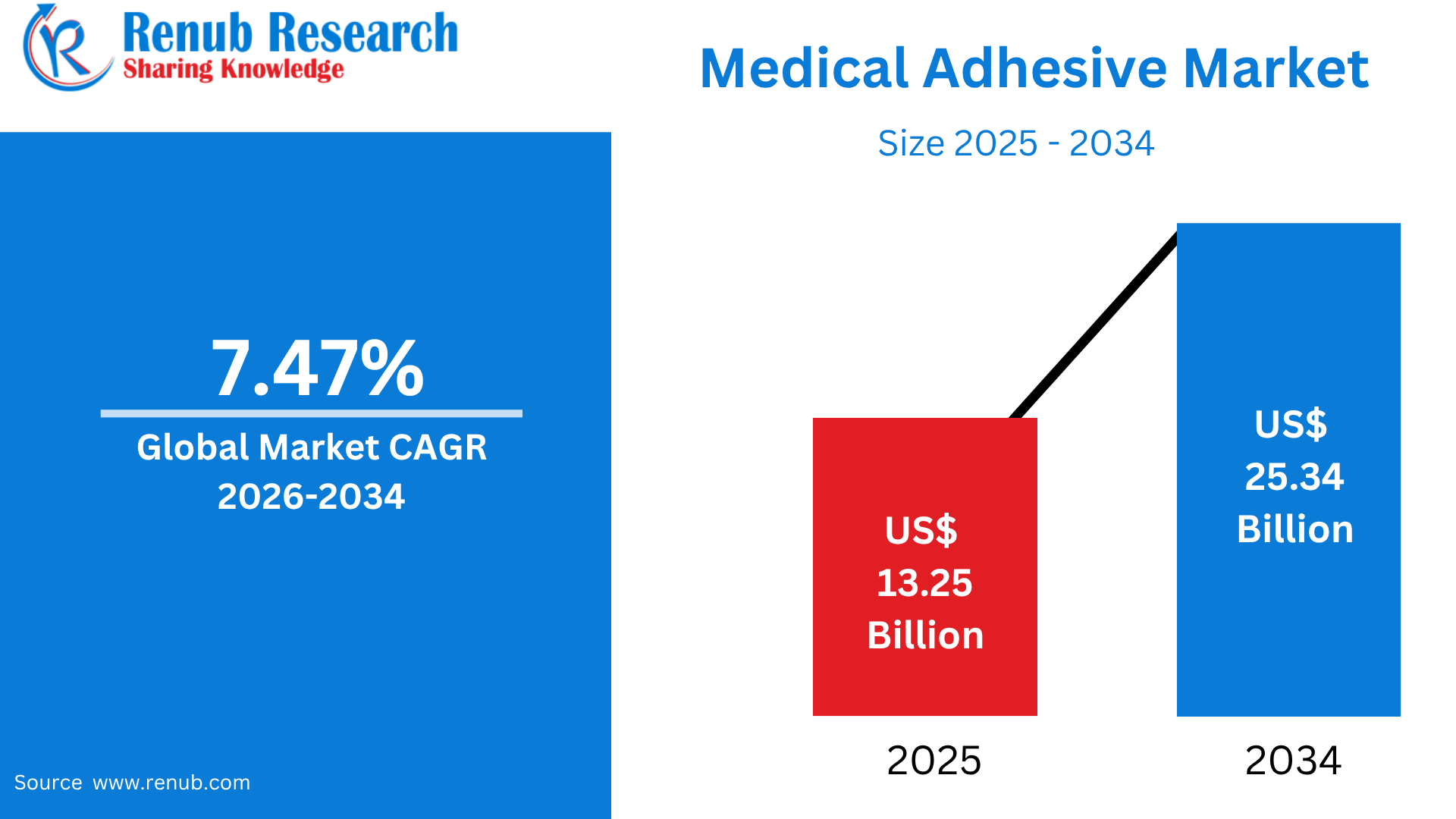
Medical Adhesives Market is projected to expand significantly, reaching US$ 25.34 billion by 2034, up from US$ 13.25 billion in 2025, registering a CAGR of 7.47% during 2026–2034. Market growth is being supported by the increasing adoption of minimally invasive surgical procedures, growing demand for advanced wound care products, and the expanding use of wearable healthcare devices that require safe and skin-compatible bonding solutions. In addition, the rising prevalence of chronic diseases and the growing global aging population are increasing the need for dependable, biocompatible, and high-performance medical adhesives across surgical, wound care, medical device, and healthcare applications.
What are Medical Adhesives? Uses & Popularity Worldwide
Medical adhesives are specialized bonding materials used to attach, secure, seal, or stabilize tissues, medical devices, wound dressings, and other healthcare components. They are formulated to provide strong adhesion while maintaining biocompatibility and minimizing irritation or damage to skin and tissue. Common types include acrylic, cyanoacrylate, silicone, polyurethane, epoxy, and hydrogel-based adhesives. Medical adhesives are widely used in surgical procedures, wound closure, transdermal patches, electrode attachment, ostomy products, wearable medical devices, and drug-delivery systems. Their ability to provide alternatives to conventional sutures and mechanical fixation has increased their importance in modern healthcare.
Demand is growing as healthcare systems increasingly adopt minimally invasive procedures and advanced wound management technologies. The global burden of chronic diseases also creates sustained demand for wound-care products and medical devices requiring reliable adhesive solutions. In addition, wearable healthcare devices such as continuous monitoring sensors, ECG electrodes, and drug-delivery patches require adhesives that can remain securely attached to the skin without causing significant irritation. Manufacturers are therefore developing skin-friendly, breathable, flexible, hypoallergenic, and residue-free adhesives, increasing their application across hospitals, clinics, home healthcare, and consumer medical products.
Top 5 Surgical Procedures Worldwide
(Absolute numbers and changes compared to 2023)
- Eyelid Surgery: 2,115,360 procedures
- Liposuction: 2,087,189 procedures
- Breast Augmentation: 1,658,615 procedures
- Scar Revision: 1,156,446 procedures
- Rhinoplasty: 1,083,631 procedures
Growth Drivers of the Medical Adhesives Market
Rising Adoption of Minimally Invasive and Surgical Procedures
The increasing adoption of minimally invasive surgeries is a major growth driver for the medical adhesives market. Healthcare providers are increasingly favoring procedures that involve smaller incisions, reduced tissue damage, shorter hospital stays, and faster recovery compared with conventional open surgery. Medical adhesives can be used for wound closure, tissue bonding, device fixation, and sealing applications, making them valuable across various surgical procedures. According to the World Health Organization (WHO), approximately 310 million major surgical procedures are performed each year globally, highlighting the enormous potential application base for surgical products and technologies. Medical adhesives can complement or replace sutures and staples in selected applications, particularly where rapid wound closure and improved cosmetic outcomes are important. Cyanoacrylate-based tissue adhesives, for example, can form a protective barrier over wounds while reducing the need for conventional mechanical closure. Increasing demand for outpatient and ambulatory surgical procedures is further supporting adoption because adhesive-based closure can simplify procedures and potentially reduce procedure time. Technological developments are also producing adhesives with improved flexibility, stronger bonding, and better tissue compatibility. As minimally invasive techniques continue to expand across general surgery, cardiovascular procedures, orthopedics, dermatology, and other specialties, demand for specialized medical adhesive solutions is expected to increase.
Growing Demand for Advanced Wound Care Products
The rising prevalence of chronic wounds and the increasing emphasis on advanced wound management are creating substantial opportunities for medical adhesive manufacturers. Chronic wounds can develop because of conditions such as diabetes, vascular disease, pressure injuries, and prolonged immobility. The International Diabetes Federation estimates that approximately 589 million adults aged 20–79 were living with diabetes in 2024, representing a significant population at risk of diabetes-related complications, including foot ulcers and difficult-to-heal wounds. Medical adhesives are used in wound dressings, fixation systems, skin barriers, closure products, and other wound-care applications. Compared with conventional fixation methods, adhesive-based solutions can provide flexibility, easier application, and improved patient comfort when appropriately designed. The expansion of home healthcare is another important factor because patients increasingly receive wound-management services outside traditional hospital settings. Easy-to-apply adhesive dressings and fixation products can support home-based treatment and reduce the complexity of wound care. Manufacturers are consequently investing in skin-friendly adhesives, antimicrobial formulations, hydrogel systems, silicone adhesives, and atraumatic removal technologies. Demand is particularly strong for products that can maintain adhesion in the presence of moisture while minimizing skin damage during removal. The combination of an aging population, chronic disease burden, and increasing use of advanced wound-care technologies is expected to sustain demand for medical adhesives.
Expansion of Wearable Medical Devices and Skin-Attached Healthcare Technologies
The rapid expansion of wearable medical devices is creating a new and increasingly important application area for medical adhesives. Devices such as continuous glucose monitors, ECG patches, wearable sensors, drug-delivery patches, temperature monitors, and other remote patient-monitoring technologies frequently require adhesives to remain securely attached to the skin. The growth of digital health and remote monitoring is consequently increasing demand for adhesives that can provide reliable attachment for extended periods while maintaining patient comfort. The International Diabetes Federation estimates that approximately 589 million adults worldwide were living with diabetes in 2024, supporting a large potential user base for glucose-monitoring technologies. Continuous glucose monitoring systems, for example, depend on secure skin attachment to ensure sensors remain positioned correctly during everyday activities. Medical adhesives used in these products must balance adhesion, flexibility, breathability, moisture resistance, and skin compatibility. Wearable technologies are also increasingly being used for cardiac monitoring, sports and fitness tracking, rehabilitation, elderly care, and remote patient monitoring. Manufacturers are therefore developing low-trauma, hypoallergenic, breathable, and long-wear adhesive technologies specifically for wearable applications. As healthcare moves toward personalized and home-based monitoring, the number and variety of skin-attached devices are expected to increase. This trend should create additional opportunities for medical adhesive suppliers, particularly those capable of meeting stringent biocompatibility and skin-contact requirements.
Challenges of the Medical Adhesives Market
Skin Irritation, Allergic Reactions, and Biocompatibility Requirements
Skin irritation and allergic reactions remain important challenges for medical adhesive manufacturers, particularly as adhesive products are increasingly used for prolonged periods. Medical adhesives can remain in direct contact with skin or tissue for hours, days, or even longer, depending on the application. Certain adhesive formulations may cause redness, irritation, dermatitis, or other adverse skin reactions in sensitive patients. The challenge is particularly relevant for elderly patients, infants, individuals with fragile skin, and people who require repeated application of adhesive medical products. The U.S. FDA regulates medical devices according to their intended use and associated risks, and manufacturers may need to provide appropriate testing and evidence of safety for products containing or relying on adhesive technologies. Developing formulations that combine strong adhesion, flexibility, moisture resistance, and low irritation can increase research, testing, and manufacturing costs. Consequently, companies face the ongoing challenge of developing high-performance adhesives that provide dependable fixation without compromising patient comfort or skin health.
Stringent Regulatory Requirements and Product Development Costs
Strict regulatory requirements represent another major challenge for the medical adhesives market. Because medical adhesives can come into direct contact with skin, wounds, tissue, or medical devices, manufacturers must demonstrate that their products meet applicable safety, performance, quality, and biocompatibility requirements. Regulatory expectations can vary depending on the adhesive’s intended application, duration of contact, formulation, and whether it functions as part of a medical device or as a standalone healthcare product. The ISO 10993 series provides internationally recognized biological-evaluation guidance for medical devices, including assessment considerations for materials that come into contact with the human body. Compliance with such requirements can increase technical complexity, especially for companies introducing new polymers, coatings, or adhesive chemistries. Smaller manufacturers may face greater difficulty absorbing testing and regulatory expenses than established multinational companies. As a result, regulatory complexity, product validation costs, and the need for continuous quality assurance can limit the speed of innovation and create barriers to entry in the medical adhesives industry.
Medical Adhesives Launches Worldwide
- LOCTITE AA 3951 / AA 3953 / AA 3961 / AA 3963 – Henkel (2025): Henkel launched a new range of flexible and rigid LED-curable medical adhesives for medical-device assembly. The products are designed for applications requiring reliable bonding, fast curing, and compatibility with advanced medical-device manufacturing.
- DELO PHOTOBOND MG4047 – DELO (2025): DELO introduced PHOTOBOND MG4047, an IBOA-free light-curing adhesive specifically developed for continuous glucose monitoring (CGM) sensors and other wearable medical devices. The adhesive is biocompatibility-tested and designed to improve skin compatibility.
- LOCTITE AA 3952 and LOCTITE SI 5057 – Henkel (2025): Henkel introduced two light-curable adhesives designed for bonding thermoplastic elastomers in medical-device assemblies. The formulations target applications using TPE materials and were developed to support reliable device manufacturing while meeting relevant medical requirements.
- Vitralit E-7041 T and Vitralit E-4050 – Hoenle Adhesives (2025): Hoenle launched a new range of TPO/CMR-free UV-curable medical adhesives. The products target applications including cannulas, catheters, syringes, diagnostic devices, and medical wearables, with several formulations also designed without IBOA.
- LOCTITE 4011S and LOCTITE 4061S – Henkel (2024): Henkel introduced two next-generation medical-grade cyanoacrylate adhesives formulated without CMR ingredients. Both products were tested according to ISO 10993 and developed for applications such as catheters, tube sets, surgical robots, and medical housings.
- 2487 Hi-Tack Silicone Tape – Solventum (2024): Solventum launched 2487 Hi-Tack Silicone Tape, a double-coated medical tape combining silicone and acrylate adhesive technologies. The product was developed for wearable medical devices and sensitive-skin applications, with repositionability and wear periods of up to seven days.
- Cutiva Topical Skin Adhesive & Cutiva PLUS Skin Closure System – Resivant Medical (2024): Resivant Medical received FDA 510(k) clearance for its Cutiva products, combining topical skin adhesive technology with a surgical mesh-based closure system. The solutions were designed to provide an alternative to conventional sutures and staples.
- LIQUIFIX FIX8 and LIQUIFIX Precision – TELA Bio (2024): TELA Bio commercially launched two liquid adhesive-based hernia mesh fixation devices in the U.S. LIQUIFIX FIX8 is designed for minimally invasive hernia repair, while LIQUIFIX Precision targets open procedures. The systems use liquid anchors to secure mesh without penetrating patient tissue.
- LOCTITE WT 3001 and LOCTITE WT 3003 – Henkel (2023): Henkel introduced two medical-grade light-cure adhesives for wearable medical devices. The formulations are free from IBOA and other known skin-sensitizing monomers and were tested under ISO 10993 standards for applications involving medical wearables.
- Medical Wearable UV Adhesives – Hoenle Adhesives (2025): Hoenle expanded its medical adhesive portfolio with CMR-free and IBOA-free UV-curable formulations for wearable medical devices. The products are designed to address skin compatibility and regulatory requirements while supporting applications requiring durable, biocompatible bonding.
Strong Bonding and Long-Term Skin Applications
Acrylic Medical Adhesive Market is benefiting from the extensive use of acrylic formulations in applications requiring strong, durable, and reliable adhesion. Acrylic adhesives offer good resistance to moisture, temperature variations, and environmental exposure, making them suitable for medical tapes, wound dressings, surgical products, transdermal patches, and wearable devices. Their ability to maintain adhesion over extended periods is particularly valuable for continuous glucose monitoring (CGM) systems, ECG patches, and other skin-worn medical technologies. The global diabetes population reached approximately 589 million adults aged 20–79 in 2024, according to the International Diabetes Federation, highlighting the expanding potential user base for wearable glucose-monitoring technologies. Manufacturers are increasingly developing acrylic pressure-sensitive adhesives with improved breathability, flexibility, hypoallergenic properties, and residue-free removal. Innovations that enable repositionability while maintaining reliable bonding are further expanding their use. Growing adoption of wearable healthcare technologies, advanced wound care, and home-based medical treatment is expected to support demand for acrylic adhesives across hospitals, ambulatory care centers, and home healthcare environments.
Rising Dental Restoration and Cosmetic Dentistry Demand
Dental Medical Adhesive Market is expanding as adhesives become increasingly important in restorative, preventive, orthodontic, and cosmetic dental procedures. Dental adhesives are used to bond crowns, bridges, veneers, fillings, orthodontic brackets, and composite restorative materials to tooth structures. Technological advances have improved bond strength, durability, moisture tolerance, and ease of application. Universal and self-etch adhesive systems are gaining popularity because they can simplify clinical procedures and reduce application steps. The market is also supported by the growing global burden of oral diseases. According to the World Health Organization (WHO), approximately 3.5 billion people worldwide are affected by oral diseases, demonstrating the substantial long-term demand for dental care and restorative treatments. An aging population is further increasing the need for crowns, bridges, dentures, and other dental restoration procedures. Manufacturers are focusing on adhesives with improved biocompatibility, lower postoperative sensitivity, stronger dentin bonding, and greater resistance to the challenging moisture-rich oral environment. Rising awareness of oral health and increasing demand for aesthetic dentistry are expected to create additional opportunities for advanced dental adhesive technologies.
Growing Demand for Low-VOC and Skin-Friendly Adhesives
Water-Based Medical Adhesive Market is gaining momentum as healthcare manufacturers increasingly seek safer, environmentally preferable, and low-emission adhesive technologies. Water-based adhesives use water as the primary carrier rather than traditional organic solvents, helping reduce exposure to volatile organic compounds (VOCs). They are increasingly utilized in medical tapes, wound dressings, surgical drapes, electrode fixation systems, and selected medical-device applications where skin compatibility and patient comfort are important. Their flexible and breathable characteristics make them particularly suitable for products intended for prolonged skin contact. The growing emphasis on sustainable manufacturing and tighter environmental requirements is encouraging manufacturers to develop solvent-free adhesive technologies. At the same time, advances in polymer chemistry are improving the bonding strength, moisture resistance, drying characteristics, and durability of water-based formulations. The increasing use of disposable healthcare products and home-based wound-care solutions is creating additional demand. Manufacturers are consequently focusing on formulations that combine strong adhesion with gentle removal, reduced skin irritation, and improved performance in humid conditions, supporting wider adoption across hospitals, clinics, and home healthcare settings.
Advanced Medical Devices and High Surgical Activity Support United States Demand
United States Medical Adhesives Market benefits from the country’s large healthcare system, advanced medical-device industry, and rapid adoption of innovative clinical technologies. Medical adhesives are widely incorporated into surgical closure products, wound dressings, catheter securement systems, transdermal patches, electrodes, wearable sensors, and medical-device assemblies. The growing use of minimally invasive procedures and wearable monitoring technologies is creating additional requirements for reliable and skin-compatible bonding solutions. According to the Centers for Disease Control and Prevention (CDC), approximately 41.9% of U.S. adults aged 20 and over were estimated to have obesity during 2021–2023, increasing the potential need for healthcare interventions and related medical products. The country also has a rapidly expanding wearable healthcare ecosystem, including continuous glucose monitoring and remote patient-monitoring devices. FDA regulatory activity supports continued commercialization of innovative medical technologies, although adhesive components must meet applicable safety, performance, and biocompatibility requirements. Manufacturers are therefore investing in hypoallergenic, breathable, high-strength, and long-wear formulations. Strong healthcare expenditure, medical-device innovation, and increasing demand for advanced wound care are expected to maintain the United States as a key market for medical adhesives.
High Surgical Volume and Advanced Medical Technology Drive Germany Adoption
Germany Medical Adhesives Market is supported by the country’s highly developed healthcare infrastructure, sophisticated medical-device sector, and extensive use of surgical and wound-care technologies. Medical adhesives are utilized in wound dressings, surgical closure systems, tissue sealing, catheter fixation, diagnostic devices, wearable sensors, and medical-device assembly. Germany’s large surgical volume creates a substantial application base for adhesive technologies. According to Destatis, German hospitals recorded approximately 16.8 million inpatient operations and procedures in 2023, demonstrating the scale of surgical activity in the country. Demand is further supported by Germany’s aging population and the need for chronic wound management, particularly for diabetic and pressure-related wounds. The country’s strong engineering and medical-technology ecosystem also encourages development of advanced biocompatible materials. Manufacturers are increasingly focusing on skin-friendly adhesives offering high adhesion, flexibility, moisture resistance, and atraumatic removal. The transition toward minimally invasive procedures and greater adoption of wearable and diagnostic technologies is creating additional applications. Consequently, Germany remains an important European market for innovative medical adhesive solutions.
Large Surgical Volume and Expanding Medical-Device Manufacturing in China
China Medical Adhesives Market is expanding rapidly due to the country’s large healthcare system, increasing surgical activity, rising chronic disease burden, and expanding domestic medical-device manufacturing. Medical adhesives are used across surgical wound closure, diabetic wound dressings, medical tapes, wearable monitors, catheters, infusion devices, and diagnostic equipment. China’s enormous healthcare infrastructure provides a substantial demand base for adhesive-enabled medical products. The National Health Commission of China has reported annual surgical volumes exceeding 70 million procedures, illustrating the significant scale of potential demand for surgical adhesives and adhesive-based consumables. In addition, the country’s aging population and increasing prevalence of chronic conditions are supporting demand for wound-care products and long-term medical devices. Government initiatives promoting domestic medical-device manufacturing are also encouraging local production of adhesive-integrated healthcare products. Manufacturers are increasingly investing in medical-grade acrylic, silicone, polyurethane, and other specialized formulations designed for skin contact and device assembly. As China continues to modernize healthcare infrastructure and strengthen domestic medical-technology capabilities, demand for high-performance medical adhesives is expected to increase across hospitals, clinics, and home healthcare settings.
Vision 2030 and Healthcare Modernization Create New Opportunities in Saudi Arabia
Saudi Arabia Medical Adhesives Market is benefiting from rapid healthcare infrastructure development, medical-device adoption, and modernization initiatives under Saudi Vision 2030. Medical adhesives are increasingly relevant to advanced wound dressings, surgical closure systems, medical tapes, wearable monitoring devices, catheter securement, and medical-device assembly. The country’s high prevalence of diabetes also creates significant opportunities for wound-care and wearable medical applications. According to the International Diabetes Federation, approximately 5.9 million adults aged 20–79 in Saudi Arabia were living with diabetes in 2024, representing a substantial patient population requiring ongoing monitoring and healthcare support. The Saudi Food and Drug Authority (SFDA) is also strengthening oversight and supporting the development of the country’s medical-device ecosystem. Increasing adoption of advanced medical technologies is encouraging demand for adhesives offering strong bonding, skin compatibility, flexibility, and long-term performance. Hospitals are increasingly incorporating sophisticated wound-care and minimally invasive technologies, while wearable monitoring devices are gaining importance in chronic disease management. Continued healthcare investment, localization of medical manufacturing, and Vision 2030 initiatives are expected to create further opportunities for medical adhesive suppliers in Saudi Arabia.
Medical Adhesives Market Segments
Resin Type
- Arcylic
- Silicone
- Polyurethane
- Epoxy
- Others
Application
- Dental
- Medical Device & Equipment
- External
- Internal
- Others
Technology
- Water-Based
- Solvent-Based
- Hot-Melt
- Reactive
- Others
Countries
North America
- United States
- Canada
Europe
- France
- Germany
- Italy
- Spain
- United Kingdom
- Belgium
- Netherlands
- Turkey
Asia Pacific
- China
- Japan
- India
- South Korea
- Thailand
- Malaysia
- Indonesia
- Australia
- New Zealand
Latin America
- Brazil
- Mexico
- Argentina
Middle East & Africa
- Saudi Arabia
- UAE
- South Africa
Rest of World
All companies have been covered with 5 Viewpoints
- Overviews
- Key Person
- Recent Developments
- SWOT Analysis
- Revenue Analysis
Key Players Analysis
- H.B. Fuller Company
- Henkel AG & Co. KGaA
- Avery Dennison Corporation
- Ashland Global Holdings Inc.
- The Dow Chemical Company
- 3M Co
- PPG Industries
- Dupoint De Nemours, Inc.
Report Details:
| Report Features | Details |
| Base Year |
2025 |
| Historical Period |
2022 - 2025 |
| Forecast Period |
2026 - 2034 |
| Market |
US$ Billion |
| Segment Covered |
ResinType, Application, Technology and Countries |
| Countries Covered |
|
| Companies Covered |
|
| Customization Scope |
20% Free Customization |
| Post-Sale Analyst Support |
1 Year (52 Weeks) |
| Delivery Format |
PDF and Excel through Email (We can also provide the editable version of the report in PPT/Word format on request) |
Customization Services available
- Analysis of Market Size and Its Segments
- More Company Profiles (Upto 10 without any additional cost):
- Additional Countries (Other than mentioned Countries):
- Region/Country Specific Reports:
- Market Entry Strategy:
- Region-Specific Market Dynamics:
- Regional Market Share Analysis:
- Trade Analysis:
- Production Insights:
- Others Customized Requests:
For more information contact our analysts.
Need More Assistance?
- Talk to our analysts to get more precious information on the current market trends.
- Include more countries and segments and customize the report based on the final requirement.
- Get a competitive advantage in your industry by knowing the report findings and making a positive impact on your revenues and operations.
- Our analysts are always ready to provide more help and pertinent information if you need any additional assistance.