Lead Acid Battery Market Size, Share, Growth Trends, Forecast by Product, Construction Method, Sales Channel, Application, Countries and Company Analysis 2026-2034
Buy NowLead Acid Battery Market Size
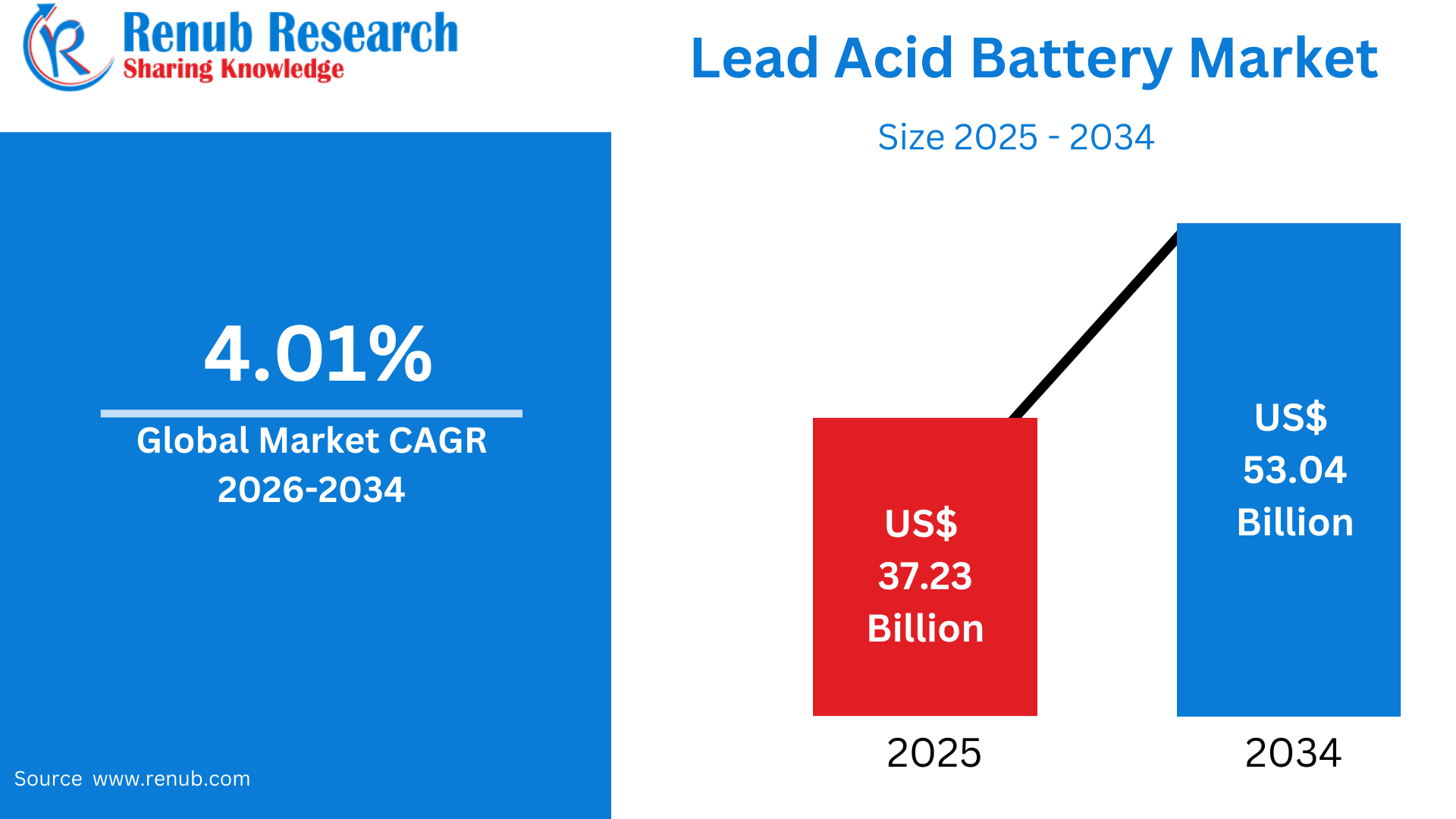
Lead Acid Battery Market, valued at US$ 37.23 billion in 2025, is projected to reach US$ 53.04 billion by 2034, expanding at a CAGR of 4.01% during the forecast period from 2026 to 2034. Market growth is primarily driven by sustained demand from the automotive sector, along with increasing adoption in industrial backup power systems and renewable energy storage applications. Ongoing advancements in battery technology, particularly in improving reliability, recyclability, and cost efficiency, are expected to further strengthen the market's long-term growth prospects.
Lead Acid Battery Market Outlooks
The lead acid battery is a secondary battery that uses lead dioxide as the positive electrode, sponge lead as the negative electrode, and sulfuric acid as the electrolyte. It has been among the oldest yet largest wide-used battery technologies in the world, noted for its dependability, simplicity, and low producing cost. Large surge currents may be provided by lead acid batteries, which makes them particularly fit for automotive starting, lighting, and ignition systems, uninterruptible power supplies, and industrial backup power.
Globally, lead acid batteries continue to enjoy immense popularity, in spite of the development of newer types of batteries. Lead acid batteries are used extensively in various such applications as cars, communication, data centers, storage cells of renewable power, and forklifts. In developing countries, lead acid batteries can be afforded and thus find favor in terms of energy storage and backup systems. In addition to this, they also find support due to continuous improvement in terms of design and efficiency.
What is a Lead Acid Battery and Its Uses & Popularity Worldwide?
A lead acid battery is a rechargeable electrochemical energy storage device that uses lead dioxide as the positive electrode, sponge lead as the negative electrode, and sulfuric acid as the electrolyte. Invented in 1859, it remains one of the most widely used battery technologies because of its proven reliability, low manufacturing cost, and nearly complete recyclability. Lead acid batteries are available in flooded, AGM (Absorbent Glass Mat), and gel variants, making them suitable for a broad range of applications. They are extensively used in automobiles for starting, lighting, and ignition (SLI), as well as in forklifts, telecommunications, uninterruptible power supply (UPS) systems, data centers, renewable energy storage, railway signaling, and backup power for hospitals and commercial buildings.
Worldwide, lead acid batteries continue to dominate the automotive replacement market, with more than 1.4 billion vehicles relying on 12V lead acid batteries for engine starting. Their recycling rate exceeds 95% in many developed countries, making them one of the world’s most recycled consumer products. Despite growing competition from lithium-ion batteries, lead acid batteries remain highly popular due to affordability, safety, established supply chains, and dependable performance in high-power and backup applications.
Battery Market Demand (2010–2030)
• Overall Battery Demand Growth
- Global battery demand is projected to increase from 330 GWh (2010) to 1,360 GWh (2030).
- Demand is expected to grow by more than 4 times over the two-decade period.
- Growth is driven by electric vehicles (EVs), renewable energy storage, consumer electronics, and industrial applications.
• Lead-Based Battery Demand
- 2010: 300 GWh
- 2015: 370 GWh
- 2020: 410 GWh
- 2025: 445 GWh
- 2030: 490 GWh
- Lead-based batteries remain one of the largest battery technologies due to their widespread use in automotive SLI, UPS systems, telecom infrastructure, and industrial backup power.
• Lithium-Ion Battery Demand
- 2010: ~20 GWh
- 2015: 75 GWh
- 2020: 230 GWh
- 2025: 490 GWh
- 2030: 860 GWh
- Lithium-ion batteries represent the fastest-growing battery segment, primarily fueled by EV adoption and renewable energy storage.
• NiMH Battery Demand
- Nickel-Metal Hydride (NiMH) batteries maintain a relatively small market share throughout the forecast period.
- Demand remains stable but is increasingly replaced by lithium-ion technology in consumer and automotive applications.
• NiCd Battery Demand
- Nickel-Cadmium (NiCd) batteries continue to decline in market importance.
- Environmental regulations and the shift toward cleaner battery technologies contribute to reduced adoption.
• Other Battery Technologies
- Other battery chemistries maintain a limited share of the global market.
- Growth is supported by niche industrial, aerospace, defense, and specialty applications.
Global Battery Market Value (2010–2030)
• Strong Market Value Expansion
- 2010: US$43 Billion
- 2015: US$65 Billion
- 2020: US$90 Billion
- 2025: US$120 Billion
- 2030: US$150 Billion
- The global battery market is projected to grow by approximately 3.5 times between 2010 and 2030.
• Lead-Based Battery Market Value
- 2010: US$26B
- 2015: US$33.9B
- 2020: US$37.5B
- 2025: US$40.5B
- 2030: US$49B
- Annual growth rate: +3.7%
• Lithium-Ion Batteries for Electric Vehicles
- 2015: US$9.48B
- 2020: US$25.6B
- 2025: US$47.0B
- 2030: US$68B
- Expected annual growth rate: +20%, making it the fastest-growing battery segment.
• Lithium-Ion Batteries for Other Applications
- 2015: US$10.6B
- 2020: US$12.5B
- 2025: US$18.6B
- 2030: US$23.2B
- Expected annual growth rate: +13%, supported by energy storage systems, power tools, and industrial applications.
• NiMH Battery Market
- Annual growth rate: +12%
- Continues serving hybrid vehicles and selected consumer electronics despite increasing competition from lithium-ion batteries.
• NiCd Battery Market
- Expected annual growth rate: –1%
- Declining demand due to environmental concerns and stricter regulations on cadmium-containing batteries.
• Lithium-Ion for Consumer Electronics
- Expected annual growth rate: –1%
- Growth slows as the consumer electronics market matures and device replacement cycles lengthen.
• Other Battery Technologies
- Expected annual growth rate: +7%
- Growth is driven by specialized industrial, aerospace, military, and emerging energy storage applications.
Source: Avicenne Energy
Growth Drivers of the Lead Acid Battery Market
Rising Global Automotive Production and Vehicle Parcels
The automotive sector remains the largest consumer of lead acid batteries, accounting for approximately 70–75% of global demand. Nearly every internal combustion engine (ICE) vehicle and the majority of hybrid vehicles require a 12V lead acid battery for starting, lighting, and ignition functions. According to the International Organization of Motor Vehicle Manufacturers (OICA), global vehicle production exceeded 93 million units in 2023, highlighting the continuous demand for automotive batteries. In addition, the global vehicle fleet has surpassed 1.4 billion vehicles, creating a substantial aftermarket for replacement batteries, as most lead acid batteries require replacement every three to five years. Even electric vehicles continue to incorporate auxiliary lead acid batteries for powering low-voltage systems, safety electronics, and backup functions. Rapid motorization in emerging economies across Asia-Pacific, Latin America, and Africa is further supporting market expansion. Growing sales of commercial vehicles, construction equipment, agricultural machinery, and two-wheelers also contribute significantly to battery demand. This extensive automotive ecosystem ensures stable, recurring revenue for battery manufacturers and remains one of the strongest long-term growth drivers for the lead acid battery market.
Growing Demand for Reliable Backup Power and Data Center Infrastructure
Increasing dependence on uninterrupted electricity has significantly boosted demand for lead acid batteries in backup power applications. UPS systems used in hospitals, financial institutions, telecom networks, airports, industrial facilities, and data centers predominantly rely on VRLA (Valve-Regulated Lead Acid) batteries because of their high reliability, mature technology, and cost-effectiveness. The rapid expansion of cloud computing and artificial intelligence has accelerated global data center construction. Industry estimates indicate that worldwide data center capacity continues to grow at double-digit annual rates, while telecom operators are expanding 5G infrastructure that requires dependable backup power solutions. Additionally, many developing nations continue to experience unstable power grids, increasing demand for battery-based backup systems in residential and commercial sectors. Lead acid batteries remain the preferred choice because they deliver high surge currents, require relatively low maintenance, and have well-established recycling networks. Their proven performance in critical infrastructure, combined with comparatively lower acquisition costs than alternative technologies, continues to support sustained demand across backup power and industrial applications worldwide.
Expansion of Renewable Energy Storage and High Recycling Efficiency
The increasing adoption of renewable energy systems has created additional opportunities for lead acid batteries in off-grid and hybrid energy storage installations. Solar photovoltaic systems deployed in rural electrification, telecommunications towers, microgrids, and residential backup applications frequently utilize lead acid batteries because of their affordability and easy availability. According to the International Energy Agency (IEA), global renewable electricity capacity additions reached record levels in recent years, significantly increasing demand for energy storage technologies. Lead acid batteries also benefit from one of the world’s most mature circular economies. More than 95–99% of lead battery materials—including lead, plastic, and electrolyte—can be recovered and reused in new battery production. This exceptionally high recycling rate lowers raw material dependence, reduces environmental impact, and stabilizes manufacturing costs compared with many competing battery chemistries. Continuous improvements in advanced AGM and gel battery technologies have further enhanced cycle life, charge acceptance, and operational reliability, enabling lead acid batteries to remain competitive across renewable energy, industrial storage, and backup power applications despite increasing lithium-ion adoption.
Challenges of the Lead Acid Battery Market
Rapid Adoption of Lithium-Ion Batteries Across Multiple Industries
One of the biggest challenges facing the lead acid battery market is the accelerating adoption of lithium-ion battery technology. Lithium-ion batteries offer significantly higher energy density, longer cycle life, lighter weight, faster charging, and lower maintenance requirements. Battery prices have also declined substantially over the past decade, making lithium-ion increasingly cost-competitive for electric vehicles, residential energy storage, and industrial equipment. According to BloombergNEF, lithium-ion battery pack prices have fallen by more than 80% since 2013, encouraging broader market adoption. Forklifts, warehouse automation systems, renewable energy storage installations, and electric mobility applications are increasingly transitioning toward lithium-ion solutions due to superior operational efficiency and longer service life. Although lead acid batteries remain less expensive initially, their shorter lifespan and lower energy density limit their competitiveness in many advanced applications. As industries prioritize energy efficiency and lifecycle costs, manufacturers of lead acid batteries face mounting pressure to innovate, improve performance, and identify niche applications where their cost advantage and reliability continue to provide meaningful value.
Environmental Regulations and Lead Handling Concerns
Although lead acid batteries are highly recyclable, the production, transportation, and disposal of lead remain subject to increasingly stringent environmental regulations worldwide. Lead is classified as a hazardous material, requiring strict compliance with occupational safety standards, emissions controls, and waste management regulations. Governments across North America, Europe, and parts of Asia have strengthened environmental policies aimed at reducing industrial pollution and improving recycling practices. Compliance with these regulations often requires significant investments in cleaner manufacturing technologies, emissions monitoring systems, wastewater treatment, and certified recycling facilities, increasing production costs for manufacturers. Furthermore, improper recycling in informal sectors, particularly in developing economies, continues to raise concerns about lead exposure and environmental contamination. International organizations continue to promote safer recycling infrastructure and stricter enforcement to reduce health risks. While the industry’s recycling rate exceeds 95%, regulatory compliance expenses and increasing sustainability expectations from governments, investors, and customers remain key challenges that could influence future profitability and market expansion.
Major Lead Acid Battery Launches Worldwide
- January 2023 – Clarios launched an expanded range of AGM (Absorbent Glass Mat) automotive batteries for start-stop passenger vehicles across North America and Europe, offering improved cycle life and enhanced fuel-efficiency support.
- June 2023 – GS Yuasa introduced next-generation ECO.R Revolution automotive lead acid batteries in Japan, featuring improved charge acceptance, longer service life, and enhanced cold-cranking performance for modern passenger vehicles.
- September 2023 – Exide Technologies expanded its Sprinter Pure Power AGM battery series for UPS systems and data centers, targeting mission-critical backup power applications with higher reliability and faster recharge capability.
- January 2024 – Ipower Batteries Pvt. Ltd. launched India’s first Graphene Series Lead Acid Batteries, incorporating graphene-enhanced plates to improve battery life, charging efficiency, and performance while reducing weight.
- January 2024 – Tesla Power India introduced the ReStore refurbished lead acid battery portfolio, utilizing its proprietary battery rejuvenation technology to extend the service life of inverter, UPS, and automotive lead acid batteries by up to two years.
- April 2024 – East Penn Manufacturing (Deka Battery) expanded its Intimidator AGM automotive battery lineup, introducing additional BCI group sizes designed for premium passenger vehicles, SUVs, and commercial fleets.
- August 2024 – EnerSys launched new NexSys Thin Plate Pure Lead (TPPL) batteries for warehouse equipment and industrial motive power applications, delivering faster charging and reduced maintenance for material handling operations.
- March 2025 – Exide Technologies expanded its Sprinter XP and Marathon backup battery portfolio for telecommunications, UPS, and data center applications, providing improved high-rate discharge capability and longer operational life for critical infrastructure.
- May 2025 – Amara Raja Energy & Mobility introduced an upgraded range of Amaron AGM and Enhanced Flooded Batteries (EFB) for passenger vehicles equipped with start-stop technology, offering higher cyclic durability and faster recharge acceptance.
- June 2026 – Exide Industries expanded its advanced lead acid battery portfolio, including new AGM and Enhanced Flooded Battery (EFB) solutions for passenger vehicles and OEM applications to support growing demand for advanced automotive electrical systems and start-stop technologies.
SLI Lead Acid Battery Strong Demand from the Global Automotive Industry
SLI (Starting, Lighting, and Ignition) lead acid battery segment represents the largest share of the global lead acid battery market, accounting for nearly 70–75% of total lead acid battery demand. These batteries are installed in virtually every internal combustion engine (ICE) vehicle and continue to serve as auxiliary power sources in many hybrid and battery electric vehicles. Globally, there are more than 1.4 billion vehicles in operation, each requiring an SLI battery that typically needs replacement every 3–5 years, creating a stable and recurring aftermarket. Annual global vehicle production exceeds 90 million units, ensuring continuous OEM demand for SLI batteries. Their ability to deliver high cranking current, dependable cold-start performance, and low manufacturing costs makes them the preferred choice for passenger cars, commercial vehicles, buses, and agricultural machinery. Continuous improvements in enhanced flooded batteries (EFB) and AGM technologies are also supporting compatibility with start-stop vehicle systems. Despite increasing vehicle electrification, SLI lead acid batteries remain indispensable because even electric vehicles require a low-voltage battery to power safety systems, lighting, and electronic controls.
Cost-Effective Technology with High Recycling Efficiency Driving Flooded Lead Acid Battery
Flooded lead acid batteries remain the most widely adopted battery type because of their affordability, robust performance, and established manufacturing ecosystem. This segment accounts for approximately 60–65% of global lead acid battery production, particularly across automotive, industrial, renewable energy, and material handling applications. Flooded batteries are preferred in regions where initial purchase cost is a key purchasing factor and maintenance can be easily performed. One of their greatest advantages is their exceptional recyclability, with over 95% of battery materials including lead, plastic, and electrolyte being recoverable for reuse. This recycling infrastructure significantly lowers raw material dependence and manufacturing costs compared with several alternative battery chemistries. Flooded batteries also deliver excellent surge current, making them ideal for engine starting and backup power systems. Growing industrialization, expanding commercial vehicle fleets, and increasing adoption across developing economies continue to support market demand. Technological advancements are further improving plate durability, charge acceptance, and operational lifespan, strengthening the long-term competitiveness of flooded lead acid batteries.
Continuous Vehicle Manufacturing Supports OEM Demand
OEM (Original Equipment Manufacturer) lead acid battery market is driven primarily by global automotive manufacturing and industrial equipment production. Every newly manufactured passenger vehicle, truck, bus, tractor, and construction machine requires an original battery before leaving the production line. Global automobile production currently exceeds 90 million vehicles annually, providing substantial demand for OEM-installed lead acid batteries. Passenger vehicles contribute the largest share, followed by commercial vehicles and off-highway equipment. Automobile manufacturers continue to rely on lead acid batteries because they offer dependable starting performance, mature production technology, competitive pricing, and global availability. Even many hybrid and electric vehicles utilize auxiliary lead acid batteries for low-voltage electrical systems, emergency backup, and electronic control units. OEM suppliers are increasingly developing advanced AGM and Enhanced Flooded Batteries (EFB) to support modern start-stop technologies and fuel efficiency regulations. Long-term relationships between battery manufacturers and automotive companies, combined with expanding vehicle production in Asia-Pacific and emerging economies, continue to provide consistent growth opportunities for the OEM lead acid battery market.
Expanding Global Vehicle Fleet Drives Automotive Market Growth
The automotive sector remains the dominant end-user of lead acid batteries, accounting for approximately 75% of worldwide lead acid battery consumption. More than 1.4 billion vehicles operate globally, generating enormous demand for both OEM installations and replacement batteries. Passenger cars, light commercial vehicles, heavy-duty trucks, buses, motorcycles, and agricultural machinery all utilize lead acid batteries for engine starting, lighting, ignition, and auxiliary electrical functions. Replacement demand remains particularly strong because automotive batteries generally require replacement every three to five years, creating a continuous aftermarket regardless of new vehicle sales fluctuations. Even with increasing adoption of electric vehicles, lead acid batteries continue to play an important role by powering low-voltage systems such as lighting, infotainment, braking electronics, and safety equipment. Expanding transportation infrastructure, rising disposable income in developing countries, increasing commercial vehicle sales, and fleet modernization programs continue to stimulate automotive battery demand. Continuous improvements in battery durability, vibration resistance, and charge acceptance are further enhancing the competitiveness of automotive lead acid batteries worldwide.
Rising Telecom Infrastructure and Backup Power Requirements
The telecom industry represents one of the most important industrial applications for lead acid batteries due to its dependence on uninterrupted power supply. Thousands of telecom towers, switching stations, fiber-optic networks, and communication centers require reliable battery backup to maintain network operations during power outages. Valve-Regulated Lead Acid (VRLA) batteries dominate this segment because they offer maintenance-free operation, dependable performance, and relatively low lifecycle costs. Globally, there are millions of telecom base stations, with continued expansion driven by 4G and 5G network deployment, particularly across Asia-Pacific, Africa, and Latin America. In many developing countries where grid reliability remains inconsistent, telecom operators rely heavily on lead acid battery backup systems to ensure uninterrupted voice and data services. The growing number of internet users, expanding mobile broadband subscriptions, increasing cloud connectivity, and rising digital transformation initiatives continue to support battery demand. Ongoing improvements in VRLA battery technology, including longer service life, improved thermal stability, and enhanced charge efficiency, are further strengthening the position of lead acid batteries within the global telecom infrastructure market.
Strong Automotive Aftermarket and Expanding Data Center Infrastructure in United States
United States represents one of the largest lead acid battery markets globally due to its extensive automotive fleet, mature industrial sector, and growing demand for reliable backup power systems. The country has more than 290 million registered vehicles, creating consistent replacement demand since automotive lead acid batteries generally require replacement every 3–5 years. SLI batteries continue to dominate the market, supported by passenger cars, commercial trucks, agricultural machinery, and recreational vehicles. The U.S. is also home to one of the world’s largest data center industries, accounting for nearly 40% of global hyperscale data centers, significantly boosting demand for VRLA batteries in UPS systems. Increasing investments in renewable energy projects, healthcare infrastructure, and telecommunication networks further contribute to battery consumption. Additionally, the United States has one of the world’s most developed lead recycling industries, with over 95% of lead acid batteries being recycled, reducing raw material dependency and supporting sustainable production. Continuous technological improvements in AGM and Enhanced Flooded Batteries (EFB) are expected to maintain the country’s leadership in the global lead acid battery market.
Vehicle Replacement Demand and Renewable Energy Integration Drive United Kingdom Growth
United Kingdom maintains a stable lead acid battery market, primarily supported by automotive replacement demand, industrial backup power applications, and renewable energy integration. The country operates a vehicle fleet exceeding 40 million registered vehicles, creating a steady aftermarket for SLI batteries as replacement cycles typically occur every four years. Despite rising electric vehicle adoption, most hybrid and electric vehicles continue to utilize auxiliary lead acid batteries for low-voltage electrical systems and emergency backup functions. The UK also has a highly developed telecommunications and financial services sector, increasing demand for uninterrupted power supply systems utilizing VRLA batteries. Growth in renewable energy installations, particularly solar and wind projects, has further supported demand for stationary energy storage applications. Environmental sustainability remains a major strength of the UK market, with battery recycling rates exceeding 95%, supported by strict waste management regulations and established collection infrastructure. Ongoing investments in transport electrification, digital infrastructure, and energy resilience continue to provide stable opportunities for lead acid battery manufacturers across the United Kingdom.
Rapid Vehicle Ownership and Infrastructure Development Fuel India Market Expansion
India is among the fastest-growing lead acid battery markets worldwide, driven by rapid urbanization, expanding automobile production, and rising electricity demand. The country manufactures more than 25 million vehicles annually, while the total vehicle population exceeds 350 million, generating substantial OEM and replacement battery demand. Two-wheelers, passenger cars, commercial vehicles, tractors, and construction equipment all rely heavily on lead acid batteries for starting and auxiliary power applications. In addition, India’s expanding telecom industry, with over 800,000 telecom towers, requires dependable battery backup to maintain uninterrupted network operations. Increasing investments in hospitals, banking infrastructure, railways, and data centers are also stimulating demand for industrial UPS batteries. Rural electrification and off-grid solar installations continue to create additional opportunities for lead acid batteries due to their affordability and widespread service network. India also possesses one of the largest lead recycling ecosystems in Asia, supporting domestic battery manufacturing. Continuous industrial growth, government infrastructure projects, and rising automotive ownership are expected to sustain strong long-term demand for lead acid batteries across the country.
Industrial Expansion and Reliable Backup Power Requirements Support Saudi Arabia Growth
Saudi Arabia’s lead acid battery market is expanding steadily due to industrial diversification, growing automotive ownership, and increasing investments in telecommunications and energy infrastructure. The Kingdom has more than 15 million registered vehicles, supporting strong demand for automotive SLI batteries in both OEM and replacement segments. Extreme climatic conditions, where summer temperatures frequently exceed 45°C, accelerate battery wear, resulting in relatively frequent replacement cycles and strengthening aftermarket demand. The country’s Vision 2030 economic diversification strategy has accelerated investments in manufacturing, logistics, healthcare, smart cities, and digital infrastructure, all of which require dependable backup power systems utilizing VRLA batteries. Saudi Arabia’s rapidly expanding telecom sector and large oil & gas industry also depend on uninterrupted power for remote operations, communication equipment, and control systems. Furthermore, increasing investments in solar energy projects and industrial automation are creating additional opportunities for stationary lead acid batteries. Continuous development of local manufacturing capabilities, expanding infrastructure projects, and strong transportation demand are expected to support sustainable growth of the Saudi Arabian lead acid battery market over the coming years.
Market Segmentation
Product
- SLI
- Stationary
- Motive
Construction Method
- Flooded
- Valve Regulated Sealed Lead–acid Battery (VRLA)
Sales Channel
- OEM
- Aftermarket
Application
- Automotive
- UPS
- Telecom
- Others
Countries
North America
- United States
- Canada
Europe
- France
- Germany
- Italy
- Spain
- United Kingdom
- Belgium
- Netherlands
- Turkey
Asia Pacific
- China
- Japan
- India
- Australia
- South Korea
- Thailand
- Malaysia
- Indonesia
- New Zealand
Latin America
- Brazil
- Mexico
- Argentina
Middle East & Africa
- South Africa
- Saudi Arabia
- United Arab Emirates
All companies have been covered with 5 Viewpoints
- Overview
- Key Persons
- Recent Development & Strategies
- Product Portfolio
- Financial Insights
Company Analysis
- EnerSys
- Exide Industries Limited
- GS Yuasa Corporation
- HBL Power Systems Limited
- Leoch International Technology Limited
- Panasonic Holdings Corporation
- Teledyne Technologies Incorporated
Report Details:
| Report Features | Details |
| Base Year |
2025 |
| Historical Period |
2022 - 2025 |
| Forecast Period |
2026 - 2034 |
| Market |
US$ Billion |
| Segment Covered |
Product, Construction Method, Sales Channel, Application and Countries |
| Countries Covered |
|
| Companies Covered |
|
| Customization Scope |
20% Free Customization |
| Post-Sale Analyst Support |
1 Year (52 Weeks) |
| Delivery Format |
PDF and Excel through Email (We can also provide the editable version of the report in PPT/Word format on request) |
Key Questions Answered in Report:
- How big is the Lead Acid Battery industry?
- What is the Lead Acid Battery growth rate?
- Who are the key players in Lead Acid Battery industry?
- What are the factors driving the Lead Acid Battery industry?
- Which Region held the largest market share in the Lead Acid Battery industry?
- What segments are covered in the Lead Acid Battery Market report?
Customization Services available
- Analysis of Market Size and Its Segments
- More Company Profiles (Upto 10 without any additional cost):
- Additional Countries (Other than mentioned Countries):
- Region/Country Specific Reports:
- Market Entry Strategy:
- Region-Specific Market Dynamics:
- Regional Market Share Analysis:
- Trade Analysis:
- Production Insights:
- Others Customized Requests:
For more information contact our analysts.
Need More Assistance?
- Talk to our analysts to get more precious information on the current market trends.
- Include more countries and segments and customize the report based on the final requirement.
- Get a competitive advantage in your industry by knowing the report findings and making a positive impact on your revenues and operations.
- Our analysts are always ready to provide more help and pertinent information if you need any additional assistance.