Japan In-Vitro Diagnostics Market Report by Test Type, Product, Usability, Application, End User, City and Company Analysis 2026-2034
Buy NowJapan In-Vitro Diagnostics Market Size and Forecast
Japan In-Vitro Diagnostics (IVD) Market is projected to grow from US$ 4.91 billion in 2025 to US$ 7.12 billion by 2034, registering a CAGR of 4.21% between 2026 and 2034. Market expansion is being supported by Japan’s rapidly aging population and the increasing prevalence of chronic and lifestyle-related diseases, which are driving demand for regular screening, monitoring, and early disease detection. Advances in molecular diagnostics, immunoassays, point-of-care testing, and other innovative diagnostic technologies are improving the accuracy and efficiency of disease identification.
What Is In-Vitro Diagnostics and Its Uses & Popularity Worldwide
In-vitro diagnostics (IVD) refers to medical tests performed on biological samples such as blood, urine, saliva, tissue, and other specimens outside the human body to detect, diagnose, monitor, or prevent diseases. IVD technologies include clinical chemistry, immunoassays, molecular diagnostics, hematology, microbiology, and point-of-care testing. These solutions are widely used in hospitals, diagnostic laboratories, clinics, research institutions, and increasingly in home-care settings. IVD plays an essential role in identifying infectious diseases, cancer, diabetes, cardiovascular conditions, genetic disorders, and other chronic or acute health conditions. It also supports treatment decisions by helping healthcare professionals monitor disease progression and evaluate patients’ responses to therapies. The global popularity of IVD is increasing because of growing healthcare awareness, rising chronic disease prevalence, aging populations, and the increasing importance of early and accurate diagnosis. Technological advances such as polymerase chain reaction (PCR), next-generation sequencing, automated analyzers, rapid diagnostic tests, and digital diagnostics are further expanding its applications. The growing adoption of personalized medicine and preventive healthcare is also strengthening demand for advanced IVD solutions worldwide.
Japan Aging Population by 2035
According to Japan’s National Institute of Population and Social Security Research (IPSS), people aged 65 years and above are projected to account for approximately 32.3% of Japan’s total population in 2035 under the medium-fertility, medium-mortality projection. This means roughly 1 in every 3 people in Japan will be aged 65 or older by 2035.
- 65+ population share in 2035: 32.3%
- Working-age population (15–64): 57.6%
- Children under 15: 10.0%
- Median age: approximately 53.1 years
- Old-age dependency ratio: approximately 56.1
This demographic shift is particularly important for healthcare and the in-vitro diagnostics (IVD) market, as an aging population generally increases the need for regular screening, chronic-disease monitoring, cancer diagnostics, and preventive healthcare.
Growth Drivers of the Japan In-Vitro Diagnostics Market
Aging Population and Rising Demand for Diagnostic Testing
Japan’s rapidly aging population is one of the strongest growth drivers for the in-vitro diagnostics market. According to Japan’s Cabinet Office, the country had 36.24 million people aged 65 and above in October 2024, representing 29.3% of the total population. The population aged 75 and above alone reached 20.78 million, or 16.8% of the population. Aging increases the need for regular health screening, disease monitoring, laboratory testing, and early diagnosis because older adults are more likely to experience multiple chronic and age-related conditions. Consequently, hospitals and diagnostic laboratories require reliable IVD solutions for monitoring glucose, cholesterol, kidney function, cardiovascular conditions, cancer biomarkers, and other health indicators. Japan’s aging rate is also expected to continue increasing, with people aged 65 and above projected to account for 33.3% of the population by 2040. This demographic shift is expected to create sustained demand for routine diagnostics, preventive testing, and monitoring technologies, supporting long-term expansion of the Japanese IVD industry.
Growing Burden of Cancer and Chronic Diseases
The increasing prevalence of cancer and other chronic conditions is creating substantial demand for diagnostic testing in Japan. The Ministry of Health, Labour and Welfare reported that 993,469 people were newly diagnosed with cancer in 2023, demonstrating the significant requirement for screening, diagnosis, disease staging, and treatment monitoring. Colorectal cancer accounted for approximately 154,000 cases, lung cancer for 124,000, stomach cancer for 105,000, breast cancer for 103,000, and prostate cancer for 102,000 cases. IVD technologies play an important role in identifying biomarkers, detecting infectious diseases, monitoring chronic conditions, and supporting cancer diagnosis and personalized treatment decisions. Growing awareness of preventive healthcare is also encouraging individuals and healthcare providers to undertake diagnostic testing at earlier stages of disease. In addition, Japan’s aging demographic increases the prevalence of multiple health conditions requiring continuous monitoring. Demand for immunoassays, clinical chemistry, molecular diagnostics, genetic testing, and oncology-related assays is therefore expected to increase. These factors are strengthening the importance of IVD solutions across hospitals, laboratories, clinics, and emerging decentralized healthcare settings.
Advances in Molecular Diagnostics, Automation, and Point-of-Care Testing
Technological innovation is significantly expanding the Japanese IVD market by improving diagnostic speed, accuracy, automation, and accessibility. Japan has sophisticated healthcare infrastructure and strong capabilities in molecular diagnostics, laboratory automation, precision medicine, and biotechnology. Molecular technologies such as PCR and other nucleic-acid-based tests are increasingly valuable for infectious-disease detection, oncology, genetic testing, and personalized medicine. Point-of-care testing is also gaining importance because it enables faster diagnostic decisions closer to patients, including physician offices and community-care settings. Increasing laboratory automation, artificial intelligence, high-throughput analyzers, and digital connectivity can further improve laboratory efficiency and support demand for next-generation IVD platforms.
Challenges
Stringent Regulatory Requirements and Lengthy Approval Processes
Strict regulatory requirements represent a major challenge for IVD manufacturers seeking to introduce innovative products in Japan. Diagnostic products must comply with Japan’s regulatory framework, with the Pharmaceuticals and Medical Devices Agency (PMDA) playing an important role in the evaluation and approval of medical products. Companion diagnostics, for example, are categorized as Class III IVDs and require PMDA review for marketing authorization. Regulatory compliance can require substantial documentation, clinical evidence, quality-control procedures, and resources, potentially increasing development costs and extending product launch timelines. Industry analysis also identifies Japan’s stringent regulatory framework as a barrier for international companies entering the market, particularly those unfamiliar with local requirements. Furthermore, Japan’s IVD regulatory system has historically treated IVD reagents as pharmaceutical products, creating a highly controlled environment. A 2024 academic review noted that IVDs face strong cost pressures because clinical laboratory testing represents a relatively small share of total healthcare expenditure. Manufacturers therefore need strong regulatory expertise and localization strategies to successfully commercialize advanced diagnostic technologies.
High Costs and Pricing Pressure for Advanced Diagnostic Technologies
The relatively high cost of sophisticated diagnostic technologies can limit adoption and create pricing pressure within Japan’s IVD market. Advanced molecular diagnostics, genetic tests, next-generation sequencing, automated analyzers, and specialized reagents often require significant investments in equipment, laboratory infrastructure, trained personnel, and maintenance. Industry research identifies the high expense of advanced diagnostic tests as a challenge, particularly for sophisticated molecular and genetic testing technologies. Japan’s universal healthcare system provides broad access to medical services, but the reimbursement environment can place pressure on diagnostic pricing and manufacturers’ margins. A 2024 Japanese review noted that clinical laboratory testing accounts for a relatively low proportion of total healthcare expenditure, resulting in strong cost-containment pressure during development and approval of IVD products. Healthcare providers may therefore be cautious about investing in expensive systems unless they demonstrate clear improvements in diagnostic accuracy, efficiency, or patient outcomes. Manufacturers must balance technological sophistication with affordability, reimbursement considerations, operational efficiency, and measurable clinical value to achieve broader adoption.
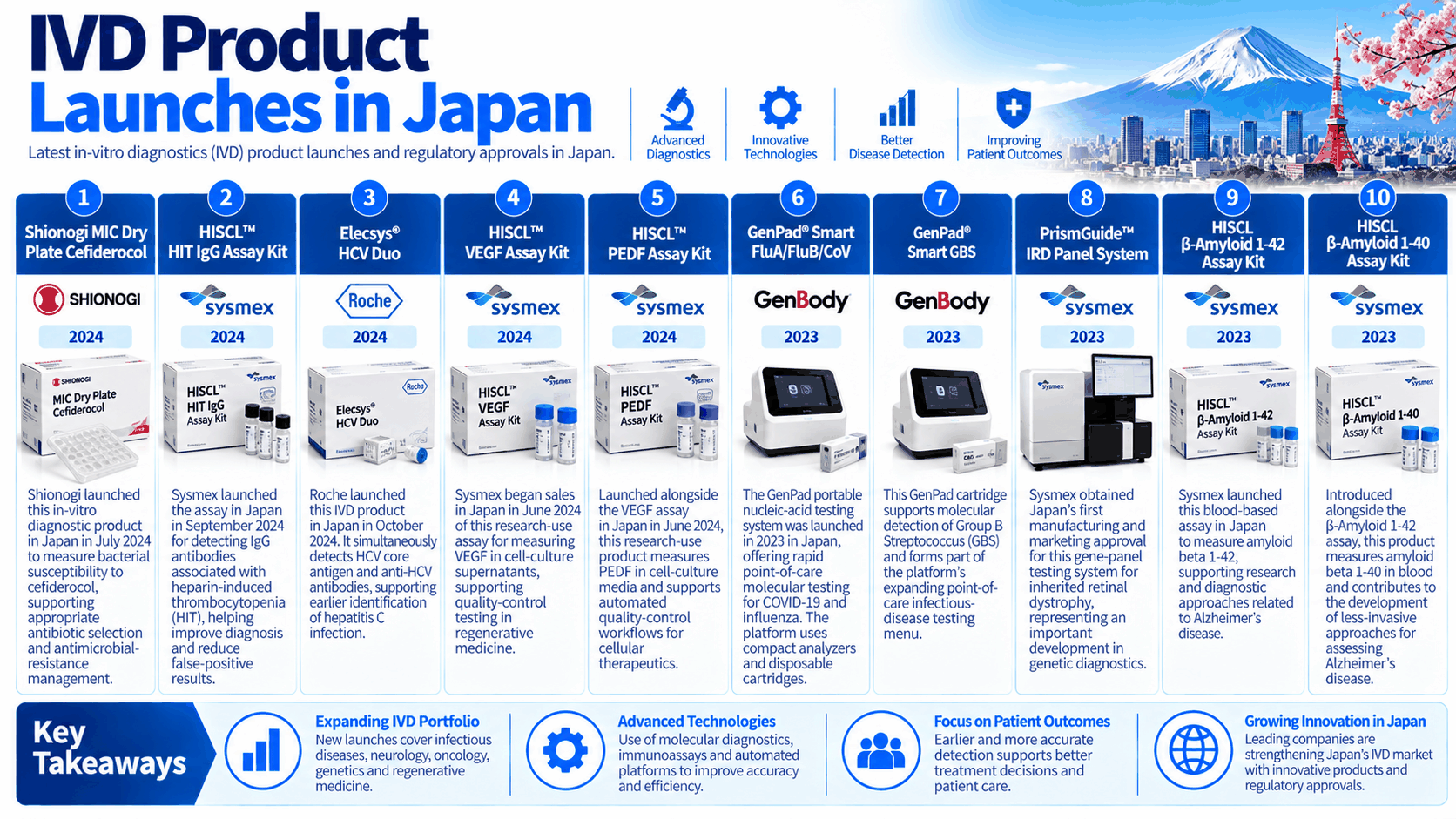
IVD Product Launches in Japan
- Shionogi MIC Dry Plate Cefiderocol – 2024: Shionogi launched this in-vitro diagnostic product in Japan in July 2024 to measure bacterial susceptibility to cefiderocol, supporting appropriate antibiotic selection and antimicrobial-resistance management.
- HISCL™ HIT IgG Assay Kit – 2024: Sysmex launched the assay in Japan in September 2024 for detecting IgG antibodies associated with heparin-induced thrombocytopenia (HIT), helping improve diagnosis and reduce false-positive results.
- Elecsys® HCV Duo – 2024: Roche launched this IVD product in Japan in October 2024. It simultaneously detects HCV core antigen and anti-HCV antibodies, supporting earlier identification of hepatitis C infection.
- HISCL™ VEGF Assay Kit – 2024: Sysmex began sales in Japan in June 2024 of this research-use assay for measuring VEGF in cell-culture supernatants, supporting quality-control testing in regenerative medicine.
- HISCL™ PEDF Assay Kit – 2024: Launched alongside the VEGF assay in Japan in June 2024, this research-use product measures PEDF in cell-culture media and supports automated quality-control workflows for cellular therapeutics.
- GenPad® Smart FluA/FluB/CoV – 2023: The GenPad portable nucleic-acid testing system was launched in 2023 in Japan, offering rapid point-of-care molecular testing for COVID-19 and influenza. The platform uses compact analyzers and disposable cartridges.
- GenPad® Smart GBS – 2023: This GenPad cartridge supports molecular detection of Group B Streptococcus (GBS) and forms part of the platform’s expanding point-of-care infectious-disease testing menu.
- PrismGuide™ IRD Panel System – 2023: Sysmex obtained Japan’s first manufacturing and marketing approval for this gene-panel testing system for inherited retinal dystrophy, representing an important development in genetic diagnostics.
- HISCL β-Amyloid 1-42 Assay Kit – 2023: Sysmex launched this blood-based assay in Japan to measure amyloid beta 1-42, supporting research and diagnostic approaches related to Alzheimer’s disease.
- HISCL β-Amyloid 1-40 Assay Kit – 2023: Introduced alongside the β-Amyloid 1-42 assay, this product measures amyloid beta 1-40 in blood and contributes to the development of less-invasive approaches for assessing Alzheimer’s disease.
Growing Demand for Routine Biochemical Testing Drives In-Vitro Diagnostics in Japan
Japan’s clinical chemistry IVD market is supported by the country’s aging population, high healthcare utilization, and widespread need for routine biochemical testing. Clinical chemistry diagnostics are extensively used to measure glucose, cholesterol, liver enzymes, kidney-function indicators, electrolytes, and other biomarkers for screening and monitoring diseases. Clinical chemistry remains an important component of this diagnostic ecosystem because chronic diseases require repeated laboratory monitoring. The country’s elderly population further increases testing frequency, as older adults are more likely to require regular assessment of metabolic, renal, cardiovascular, and liver conditions. Increasing laboratory automation is also improving testing efficiency and throughput. Automated chemistry analyzers can process large numbers of samples with consistent accuracy, supporting hospitals and diagnostic laboratories. As preventive healthcare and regular health screening become increasingly important, demand for clinical chemistry IVD products is expected to remain strong in Japan.
Rapid Adoption of PCR and Precision Diagnostic Technologies in Japan
Japan’s in-vitro molecular diagnostics market is experiencing strong growth because of increasing demand for highly accurate and rapid testing technologies. Molecular diagnostics are used to identify genetic material associated with infectious diseases, cancer, hereditary disorders, and other medical conditions. PCR, real-time PCR, DNA sequencing, hybridization, and other nucleic-acid technologies are increasingly being incorporated into diagnostic workflows. Japan’s aging population and rising cancer burden are creating additional demand for molecular testing and personalized medicine. Molecular diagnostics can help physicians identify disease at an earlier stage and select appropriate treatments based on individual biological characteristics. Continued investments in biotechnology, precision oncology, laboratory automation, and advanced genetic testing are expected to support significant expansion of this segment.
Single-Use Products Strengthen Infection Control and Testing Efficiency
Disposable IVD devices represent a major component of Japan’s diagnostic market because single-use products can reduce contamination risks, simplify laboratory workflows, and improve testing safety. Disposable products include sample-collection devices, reaction cartridges, test strips, microfluidic components, cuvettes, and other consumable diagnostic products. Demand is being supported by increased adoption of point-of-care testing, decentralized diagnostics, and automated laboratory systems. Single-use cartridges are particularly useful for rapid glucose, HbA1c, infectious-disease, and cardiac-marker testing because they allow healthcare providers to perform tests efficiently while limiting cross-contamination. Japan’s aging population and shortage of healthcare workers in some regions are also encouraging greater adoption of convenient diagnostic technologies. Manufacturers are increasingly developing compact and integrated disposable systems that require minimal sample preparation. Environmental considerations remain important, however, encouraging companies to explore recyclable materials and more sustainable manufacturing approaches for disposable diagnostic products.
Persistent Need for Rapid Detection and Disease Surveillance
Japan’s in-vitro infectious disease diagnostics market is supported by continued demand for rapid, accurate, and reliable detection of viral and bacterial infections. Diagnostic products are widely used for respiratory infections, influenza, COVID-19, hepatitis, HIV, tuberculosis, and other infectious diseases. Molecular assays, immunoassays, antigen tests, and automated laboratory platforms are increasingly important for achieving faster diagnosis and supporting appropriate treatment. Seasonal respiratory infections generate recurring demand for diagnostic testing, while Japan’s aging population increases the importance of early detection because older adults can face greater risks from infectious diseases. The growing availability of multiplex and point-of-care testing is also improving diagnostic accessibility. Continued disease surveillance, technological advancement, and demand for rapid testing are expected to sustain growth in Japan’s infectious-disease IVD segment.
Hospitals and Clinics Remain the Core End Users of IVD Products
Hospitals and clinics represent the most important end-user environment for Japan’s in-vitro diagnostics market because these facilities perform large volumes of diagnostic tests for screening, diagnosis, treatment planning, and patient monitoring. Japan had approximately 8,060 hospitals and 105,207 general clinics in 2024, providing a broad healthcare infrastructure for IVD adoption. Hospital-based laboratories accounted for approximately 45.25% of Japan’s IVD market in 2025, making them the largest end-user segment. Hospitals utilize clinical chemistry, hematology, immunodiagnostics, molecular diagnostics, microbiology, and other testing technologies across emergency, inpatient, outpatient, oncology, cardiology, and chronic-disease care. The aging population is increasing demand for repeated diagnostic monitoring, while healthcare providers are increasingly adopting automated analyzers and connected laboratory systems to improve efficiency. Point-of-care testing is also expanding beyond central laboratories into physician offices and community-based healthcare settings. Japan’s healthcare system and emphasis on early diagnosis further support consistent laboratory testing volumes. As hospitals invest in automation, digital laboratory management, high-throughput systems, and advanced diagnostic technologies, hospitals and clinics are expected to remain the dominant distribution and application channel for IVD products.
Advanced Healthcare Infrastructure Drives Tokyo IVD Leadership
Tokyo is Japan’s leading market for in-vitro diagnostics, supported by its concentration of hospitals, medical universities, research organizations, biotechnology companies, and sophisticated clinical laboratories. The Tokyo metropolitan area has a population of more than 14 million, creating substantial demand for disease screening, routine health assessments, and diagnostic monitoring. The city’s advanced healthcare ecosystem encourages early adoption of molecular diagnostics, automated laboratory systems, immunoassays, genetic testing, and digital diagnostic platforms. Tokyo also has a strong concentration of medical specialists and research institutions that contribute to the development and commercialization of innovative diagnostic technologies. The increasing prevalence of chronic diseases and the needs of an aging population are generating consistent demand for clinical chemistry, hematology, cancer diagnostics, and infectious-disease testing. In addition, Tokyo’s role as Japan’s economic and healthcare center attracts major domestic and international healthcare companies, strengthening the availability of advanced IVD products. The combination of high healthcare expenditure, technological innovation, specialist expertise, and extensive laboratory infrastructure is expected to maintain Tokyo’s position as the country’s most important IVD market.
Medical Research and Pharmaceutical Strength Support Osaka Growth
Osaka is one of Japan’s most important healthcare and pharmaceutical centers, creating favorable conditions for the expansion of its in-vitro diagnostics market. The prefecture has a population of approximately 8.8 million, generating substantial demand for laboratory testing, preventive screening, and chronic-disease monitoring. Osaka has a strong concentration of hospitals, universities, research institutes, pharmaceutical companies, and biotechnology organizations, supporting collaboration across healthcare and life sciences. The region has particular potential for molecular diagnostics, immunodiagnostics, infectious-disease testing, and laboratory automation. Its growing elderly population is also increasing demand for regular diagnostic assessments associated with diabetes, cardiovascular diseases, cancer, and other age-related conditions. Healthcare providers are increasingly adopting automated analyzers and digitally connected diagnostic systems to improve testing efficiency and reduce turnaround times. Osaka’s established pharmaceutical and biotechnology ecosystem further supports research and commercialization of advanced diagnostic technologies. Government-supported healthcare programs and preventive screening initiatives also contribute to testing volumes. The combination of medical infrastructure, research capabilities, industrial expertise, and demographic demand is expected to strengthen Osaka’s position in Japan’s IVD market.
Industrial Strength and Healthcare Modernization Fuel Aichi Expansion
Aichi is becoming an increasingly important regional market for in-vitro diagnostics, supported by its large population, industrial base, and expanding healthcare infrastructure. The prefecture has approximately 7.5 million residents, creating a substantial requirement for diagnostic screening, disease monitoring, and clinical testing. Aichi’s strong industrial ecosystem provides opportunities for healthcare technology development and investment, while hospitals and laboratories are increasingly adopting automated analyzers, molecular diagnostic platforms, digital laboratory systems, and point-of-care testing technologies. The prefecture’s aging population is another important factor driving demand for regular testing related to chronic and age-associated diseases. Clinical chemistry, hematology, immunoassays, infectious-disease diagnostics, and molecular testing are expected to remain important applications. Aichi also benefits from its central location and strong transportation infrastructure, enabling efficient distribution of medical products and equipment. Healthcare providers are increasingly focusing on improving diagnostic accuracy, laboratory productivity, and patient care through technology adoption. Continued investment in medical infrastructure, preventive healthcare, and digital transformation is expected to create additional opportunities for IVD manufacturers and diagnostic service providers throughout Aichi.
Proximity to Tokyo and Advanced Healthcare Support Kanagawa Demand
Kanagawa represents a significant regional market for in-vitro diagnostics because of its large population, developed healthcare infrastructure, and close connection with Tokyo. The prefecture has approximately 9.2 million residents, making it one of Japan’s most populous regions and creating considerable demand for diagnostic testing. Kanagawa is home to major hospitals, universities, research institutions, and technology-oriented medical facilities that support the adoption of advanced IVD technologies. Molecular diagnostics, clinical chemistry, immunoassays, genetic testing, and automated laboratory systems are increasingly important across healthcare facilities. The prefecture’s aging demographic and rising need for preventive healthcare are contributing to higher volumes of screening and routine diagnostic testing. Its geographical proximity to Tokyo also facilitates collaboration among researchers, healthcare providers, biotechnology companies, and medical-device manufacturers, accelerating access to innovative technologies. Hospitals are increasingly implementing digital laboratory management systems and automated testing platforms to improve efficiency and diagnostic accuracy. Furthermore, the expansion of community healthcare and preventive screening programs is supporting decentralized testing. With its strong healthcare ecosystem, technological capabilities, and large patient population, Kanagawa is expected to remain an important contributor to Japan’s IVD market.
Recent Developments in Japan In-Vitro Diagnostics Market
- February 2025: Roche introduced its Sequencing by Expansion technology in Japan, enabling whole-genome analysis with a turnaround time of less than six hours.
- January 2025: The PMDA released revised safety and self-inspection guidelines for influenza virus detection reagents, resulting in updated requirements for IVD labeling and compliance.
Japan IVD Market Segments
Test Type
- Clinical Chemistry
- Molecular Diagnostics
- Immuno Diagnostics
- Haematology
- Other Types
Product
- Instrument
- Reagent
- Others
Usability
- Disposable IVD Devices
- Reusable IVD Devices
Application
- Infectious Disease
- Diabetes
- Cancer/Oncology
- Cardiology
- Autoimmune Disease
- Nephrology
- Other Applications
End Users
- Diagnostic Laboratories
- Hospitals & Clinics
- Other End Users
Cities
- Tokyo
- Osaka
- Aichi
- Kanagawa
- Saitama
- Hyogo
- Chiba
- Hokkaido
- Fukuoka
- Shizuoka
All companies have been covered with 5 Viewpoints
- Overviews
- Key Person
- Recent Developments
- SWOT Analysis
- Revenue Analysis
Key Players Analysis
- Abbott Laboratories
- Danaher Corporation
- Biomerieux
- Roche Diagnostics
- Becton
- Sysmex Corporation
- Bio–Rad Laboratories, Inc.
- Thermofisher Scientific Inc.
Report Details:
| Report Features | Details |
| Base Year |
2024 |
| Historical Period |
2020 - 2024 |
| Forecast Period |
2025 - 2033 |
| Market |
US$ Billion |
| Segment Covered |
By Test Type, By Product, By Usability, By Application & By End Users |
| Regions Covered |
|
| Companies Covered |
|
| Customization Scope |
20% Free Customization |
| Post-Sale Analyst Support |
1 Year (52 Weeks) |
| Delivery Format |
PDF and Excel through Email (We can also provide the editable version of the report in PPT/Word format on request) |
Customization Services available
- Analysis of Market Size and Its Segments
- More Company Profiles (Upto 10 without any additional cost):
- Additional Countries (Other than mentioned Countries):
- Region/Country Specific Reports:
- Market Entry Strategy:
- Region-Specific Market Dynamics:
- Regional Market Share Analysis:
- Trade Analysis:
- Production Insights:
- Others Customized Requests:
For more information contact our analysts.
Need More Assistance?
- Talk to our analysts to get more precious information on the current market trends.
- Include more countries and segments and customize the report based on the final requirement.
- Get a competitive advantage in your industry by knowing the report findings and making a positive impact on your revenues and operations.
- Our analysts are always ready to provide more help and pertinent information if you need any additional assistance.