Intrauterine Devices Market Report by Type, End Use, Countries and Company Analysis 2026-2034
Buy NowGlobal Intrauterine Devices Market Size & Forecast, 2026-2034
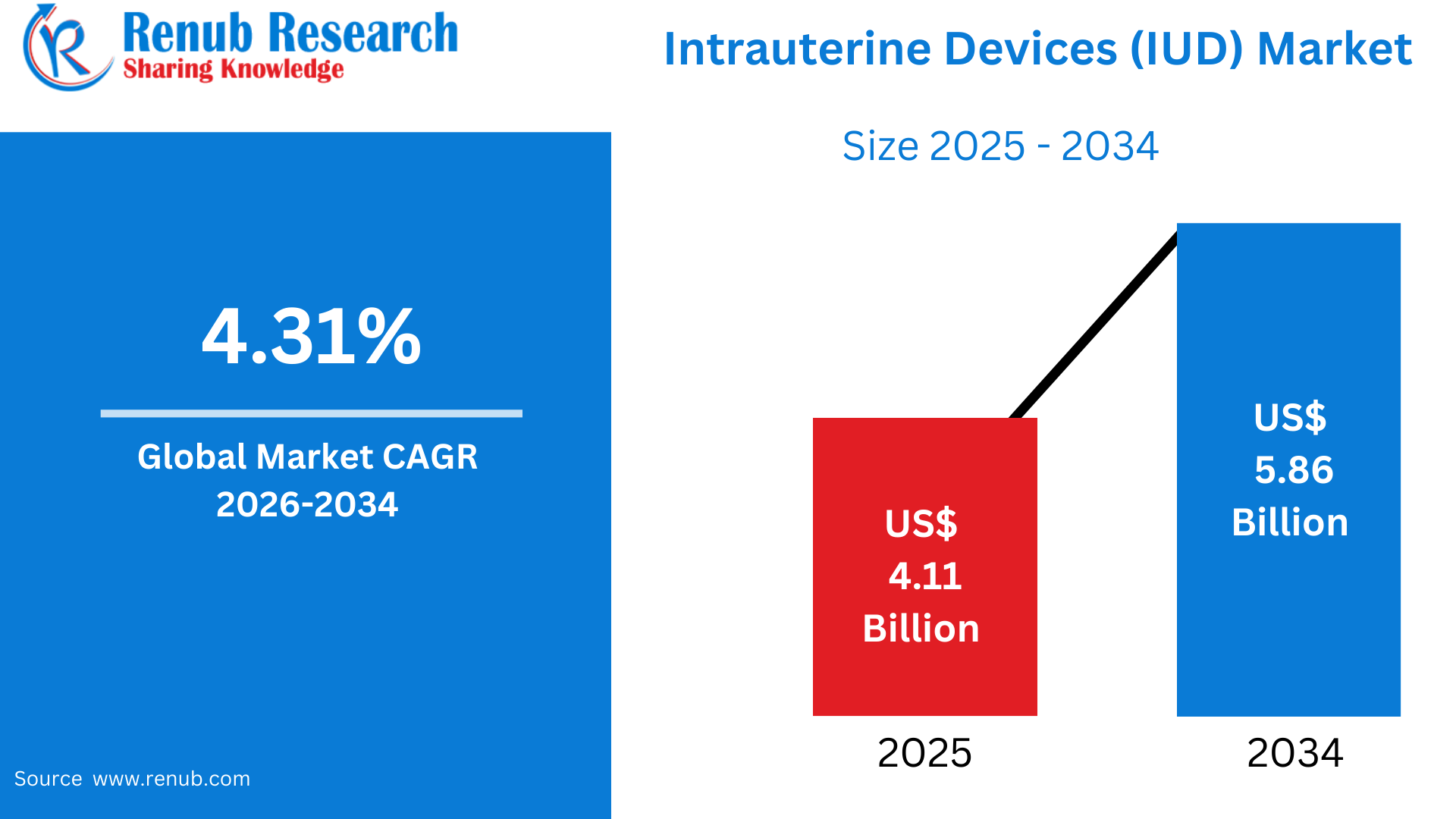
The market for Intrauterine Devices is predicted to witness a growth from US$ 4.11 Billion in the year 2025 to US$ 5.86 Billion in the year 2034, with a CAAGR of 4.02% from the year 2026 to 2034. The market is boosted by the growing consciousness about Long-Acting Reversible Contraception, followed by the preference for a more economical method of contraception, coupled with government initiatives. Innovations in technology, together with the development in Women’s Health Care Services, also contribute to boosting the market.
Intrauterine Devices Market Overview
Intrauterine devices are T-shaped instruments that are put inside the uterus to inhibit pregnancy. Intrauterine devices are known by the name long-acting reversible contraceptions. The time during which intrauterine devices provide their protection from pregnancy ranges from three years to ten years. Intrauterine devices are categorized on the basis of their components. Hormonal intrauterine devices are those that secrete progestin. Progestin prevents the fertilization process and makes the uterus mucus thin. Another variation of intrauterine devices is copper intrauterine devices. Intrauterine devices with copper are based on the spermicidal properties of copper. The use of copper in intrauterine devices prevents pregnancy.
Globally, the use of IUDs has been especially popular because of the high efficacy rate, long-acting manner, and cost-effectiveness of these devices. Awareness about family planning, easy access to reproductive health care, as well as support from health care initiatives, has further fueled the popularity of these devices. Moreover, the benefit of having a “set-and-forget” form of contraception has made IUDs a popular choice among women all over the world.
Growth Forces in the Intrauterine Devices Market
Growing Use of Long ActingReversible Contraception Methods
A major driving force in the growth of the intrauterine devices market is the “rising global preference for long-acting and reversible contraceptives.” IUDs are more reliable compared to short-acting methods like pills or injections because of their ability to provide highly effective pregnancy prevention for several years with less interaction. Women are also appreciative of the ‘set and forget’ approach, prolonged duration, and rapid reversibility of fertility post-removal. Healthcare professionals and health institutions also promote the use of IUDs because of their ‘safety and efficiency in family planning practices.’ This increasing acceptance of LARC techniques among women of ‘reproductive age’ leads to an increased demand for hormonal and Cu intrauterine devices globally. In August 2022, the FDA approved Bayer AG for a supplemental new drug application (sNDA) of the Mirena IUD, increasing its usage duration to ‘eight years.’ The move seeks to ensure that women have access to ‘contraceptives’ at different times of their ‘reproductive life’
State Government Support And Family Planning Programs
Government-sponsored family planning programs, along with reproductive healthcare programs, are contributing significantly to the development of the IUD market. Most national administrations are promoting IUDs in their population control programs due to the cost-effectiveness and added benefits they provide to the country’s reproductive healthcare. This has made improved accessibility to IUDs, especially in the developing nations, possible due to subsidized distribution, promotions, and IUD incorporation in the country’s healthcare systems. International agencies, along with NGOs, are also promoting the idea of IUD utilization in the reproductive healthcare of the population. Training sessions for healthcare professionals are being provided by these agencies, which helps to overcome the misconceptions associated with IUDs, thus increasing their utilization rates. June 2023, In the latest deal, Pregna International Limited, which offers reproductive healthcare products for women, has received its very first private equity funding of USD 16 million (₹130 crore) from India Life Sciences Fund III (ILSF III), sponsored by the private equity firm InvAscent. This funding would help Pregna International grow rapidly and enable them to serve the modern needs of women worldwide.
Development in IUD Devices and Awareness of Women’s Health
Technological advancements in the design of IUDs have led to improvements in safety, comfort, and user experience. This is expected to fuel the growth of the market. Technological advancements have enabled the development of small-size flexible devices and enhanced systems for the release of hormones. This makes the product safe and easy to insert. Furthermore, the rise in knowledge about the health and empowerment of women has led to educated decisions about contraceptives. This is expected to support the growth of the market. To increase the knowledge and use of the safe and effective contraceptive AVIBELA, the following partnership has been formed: January 2024, Medicines360, an international non-profit organization dedicated to the health of women globally, and DKT WomanCare, an international distributor of contraceptive products, partnered together to increase access to AVIBELA. AVIBELA is very effective, with an efficacy rate over 99%.
Market Challenges of Intrauterine Devices
Side Effects, Misconceptions, and Cultural Barriers
Despite the high efficacy of these contraceptives, there exist challenges associated with the side effects and misconceptions and cultural reluctance regarding the use of copper IUDs. There exist potential side effects experienced by the users after the procedure, such as pain, bleeding, and discomfort, and these limit the use of these contraceptives. There persist various misconceptions related to infertility and health problems connected with the use of copper IUDs in various cultures and regions worldwide.
Lack of Access to Specialized Medical Professionals
The insertion and removal process of IUDs cannot be performed by anyone but requires properly trained health care providers, making access another challenge, especially in resource-limited settings. Inequitable distribution of qualified health care providers and health care infrastructure as well as availability might hinder the use of IUDs, even if they can be easily afforded by users due to a shortage of health care providers who can provide insertion and removal services.
Hormonal Contraceptive Devices Market
The hormonal intrauterine devices market is growing at a considerable pace owing to the increasing demand for long-acting, reversible, and convenient contraceptive products and services. Progestins-releasing hormonal intrauterine devices thicken the mucus from the cervix, curb the growth of the endometrium, and also halt ovulation for some women. These devices are mainly used both as contraceptives and for treating abnormally heavy menstrual bleeding, dysmenorrhea, and some gynecological disorders. However, the ability to curb both menstrual pain and bleeding has been an added reason for the popularity of these devices among women demanding simultaneous contraceptives and medical therapies. Many healthcare providers prescribe these intrauterine devices because of their high efficacy and convenient use compared to other daily-used contraceptives, and this segment has been a primary contributor to the overall high growth of the hormonal intrauterine devices market.
Copper Intrauterine Devices Market
The copper intrauterine devices market is growing steadily because of an increasing need for non-hormonal contraceptive alternatives. The copper IUD works by creating a spermicidal environment inside the uterus through the release of copper ions. It is very effective and long-lasting, with the lifespan measured in ten years. Also, it is an alternative method for women who do not want to use non-hormonal methods. The copper IUDs are widely recognized and useful methods in providing emergency contraceptions. The copper IUD is very economical in terms of costs because it only requires one insertion. Moreover, it has a long lifespan. The increasing awareness among people about family planning and reproductive rights has increased the market for copper IUDs.
Intrauterine Devices Hospital Market
Hospitals are among the key user groups of intrauterine devices due to the availability of expert gynecological services. Insertion and removal of intrauterine devices are usually undertaken in hospitals, especially among first-time users, those with high risks, and those requiring special follow-up. Hospitals are also key when it comes to postpartum and post-abortion family planning services and, as such, they continue to drive the adoption of intrauterine devices. Hospitals possess the necessary diagnostic and operating services that boost the confidence of patients accessing intrauterine devices. Hospitals are among the key institutions that form the basis of family planning services offered by governments and, as such, their contribution to the adoption of intrauterine devices cannot be underestimated.
Intrauterine Devices Gynecology Clinics Market
Gynecologic clinics are an increasingly popular channel for the distribution of intrauterine devices because of personalized services and the concept of women’s health and preventive care. These clinics are known to be specialists in providing women with options and services pertaining to family planning and contraception in addition to routine gynecologic exams and other minimally invasive procedures, making it the most sought-after destination for women to undergo the procedure as well as get post-procedure check-ups and consultations with the most adept and skilled women’s health specialists–gynecologists. Many private women’s health and family planning clinics, especially in urban areas, are now spreading the prescription and usage of both Hormonal and Copper IUDs.
Intrauterine Device Market in the USA
The intrauterine devices market in the US is fueled by high awareness of long-acting reversible contraception and robust healthcare infrastructure. IUDs are widely prescribed by healthcare providers due to their efficacy, ease of use, and safety profile. Support from insurance, clinical guidelines, and widespread acceptance by younger females have fueled adoption rates. Simultaneously, rising promotion regarding women’s reproductive rights and enhanced accessibility of gynecologic care increasingly support this market’s growth. Both hormonal and copper IUDs are widely in use, fueling demand from hospital and private practices alike. Continuous innovation and patient education programs make the US IUD market outlook stronger by the day. May 2023 Sebela Pharmaceuticals released positive Phase 3 clinical trial results regarding its new Copper 175 mm² IUD. The new-generation, low-dose, hormone-free copper IUD boasts a ≥99 percent success rate in three years and carries a Pearl Index of only 0.96. The clinical trial, performed on 42 US centers, found that this new IUD had an excellent tolerability profile, boasting an astounding placement success rate of no less than 98.8 percent. Both healthcare professionals and test participants showed positive feedback on this IUD.
United Kingdom Intrauterine Devices Market
In the United Kingdom, the market for intrauterine devices is supported by extensive public support for its overall healthcare system. Intrauterine devices have become popular in the United Kingdom through government-run health services and women’s clinics for their cost-effective and long-lasting alternative for contraceptives. Public-funded initiatives in sexual health also encourage intrauterine devices and long-acting reversible contraceptives in order to limit unwanted pregnancies. Trust in the overall medical system and streamline procedures have also helped in the smooth initiation of intrauterine devices in the market. Growing attention towards women’s health awareness and preventative measures remains a major factor in fueling the market, thereby establishing the UK market as a mature market for intrauterine devices. June 2025 – ASPIVIX is delighted to announce the launch of its partnership with AGHealth for its MHRA-approved Carevix®, its non-traumatic suction cervical stabilizer in the United Kingdom. This is an important step towards advancements in women’s health in the UK, since this device provides a new and scientifically confirmed alternative for the outdated cervical tenaculum.
India Intrauterine Devices Market
The intrauterine devices market for the Indian region is growing at a steady pace, thanks to increased support from the government for family planning and population control measures. The use of intrauterine devices as a safe, affordable, and long-acting reversible method of contraception has been actively promoted as a means for family planning by community health centers, particularly within the rural and semi-urban communities. Copper intrauterine devices have been increasingly used through the support of government hospitals as well as other primary health care centers, thanks to their free or reduced distribution costs. Rising awareness regarding the reproductive health of women, increased accessibility to mother care, as well as training of health care professionals, has been providing further impetus to the use of intrauterine devices. The use of hormonal intrauterine devices continues to gain popularity within urban communities, thanks to support from private hospitals as well as gynecological centers. With enhanced development of the health care infrastructure within India, as well as further support for women’s health care empowerment, the use of intrauterine devices can be expected to continue on a steady growth curve within the public as well as private sector setups within India. Nov 2022, The Indian entity, India Medtronic Private Limited, has announced the launch of the TruClear system, a mechanical hysteroscopic tissue removal system, specifically used for the safe as well as effective management of intra uterine abnormalities (IUA). These could range from several common conditions such as fibroids, polyps, retained products of conception, adhesions, malignancies, as well as hyperplasias.
Saudi Arabian Intrauterine Devices Market
The Saudi Arabian intrauterine devices market is progressing steadily due to advancements in health care facilities and raising awareness regarding new methods of contraception. Initiatives taken by the government to improve health care facilities related to women are resulting in increased adoption of IUDs. Urbanization, increased health care expenditure, and establishment of more private health care centers have raised access to women health care centers, which prescribe IUDs as a standard method of gynecological health care. Hormonal IUDs are being increasingly adopted due to their usefulness as a more reliable method of contraception, along with their health care applications. Although culture plays an important part in influencing health care regarding reproductive health, rising levels of health care awareness are resulting in increased adoption of IUDs. Advances made by Saudi Arabia towards improving health care facilities can lead to steady growth in the IUDs market.
Market Segmentations
Type
- Hormonal IUD
- Copper IUD
End Use
- Hospital
- Gynecology Clinics
- Community Health Care Centers
- Others
Country
North America
- United States
- Canada
Europe
- France
- Germany
- Italy
- Spain
- United Kingdom
- Belgium
- Netherlands
- Turkey
Asia Pacific
- China
- Japan
- India
- South Korea
- Thailand
- Malaysia
- Indonesia
- Australia
- New Zealand
Latin America
- Brazil
- Mexico
- Argentina
Middle East & Africa
- Saudi Arabia
- UAE
- South Africa
All companies have been covered with 5 Viewpoints
- Overviews
- Key Person
- Recent Developments
- SWOT Analysis
- Revenue Analysis
Key Players Analysis
- AbbVie Inc.
- Bayer AG
- Teva Pharmaceuticals
- ANI Pharmaceuticals
- Mylan NV
- CooperSurgical Inc.
- DKT International
- Melbea AG
Report Details:
| Report Features | Details |
| Base Year |
2025 |
| Historical Period |
2022 - 2025 |
| Forecast Period |
2026 - 2034 |
| Market |
US$ Billion |
| Segment Covered |
Product Type, Application, Distribution Channel and Countries |
| Countries Covered |
|
| Companies Covered |
|
| Customization Scope |
20% Free Customization |
| Post-Sale Analyst Support |
1 Year (52 Weeks) |
| Delivery Format |
PDF and Excel through Email (We can also provide the editable version of the report in PPT/Word format on request) |
Customization Services available
- Analysis of Market Size and Its Segments
- More Company Profiles (Upto 10 without any additional cost):
- Additional Countries (Other than mentioned Countries):
- Region/Country Specific Reports:
- Market Entry Strategy:
- Region-Specific Market Dynamics:
- Regional Market Share Analysis:
- Trade Analysis:
- Production Insights:
- Others Customized Requests:
For more information contact our analysts.
Need More Assistance?
- Talk to our analysts to get more precious information on the current market trends.
- Include more countries and segments and customize the report based on the final requirement.
- Get a competitive advantage in your industry by knowing the report findings and making a positive impact on your revenues and operations.
- Our analysts are always ready to provide more help and pertinent information if you need any additional assistance.