India Watch Market Report by Type, Gender, Price Range, Distribution Channel, States and Company Analysis 2026-2034
Buy NowIndia Watch Market Size and Forecast
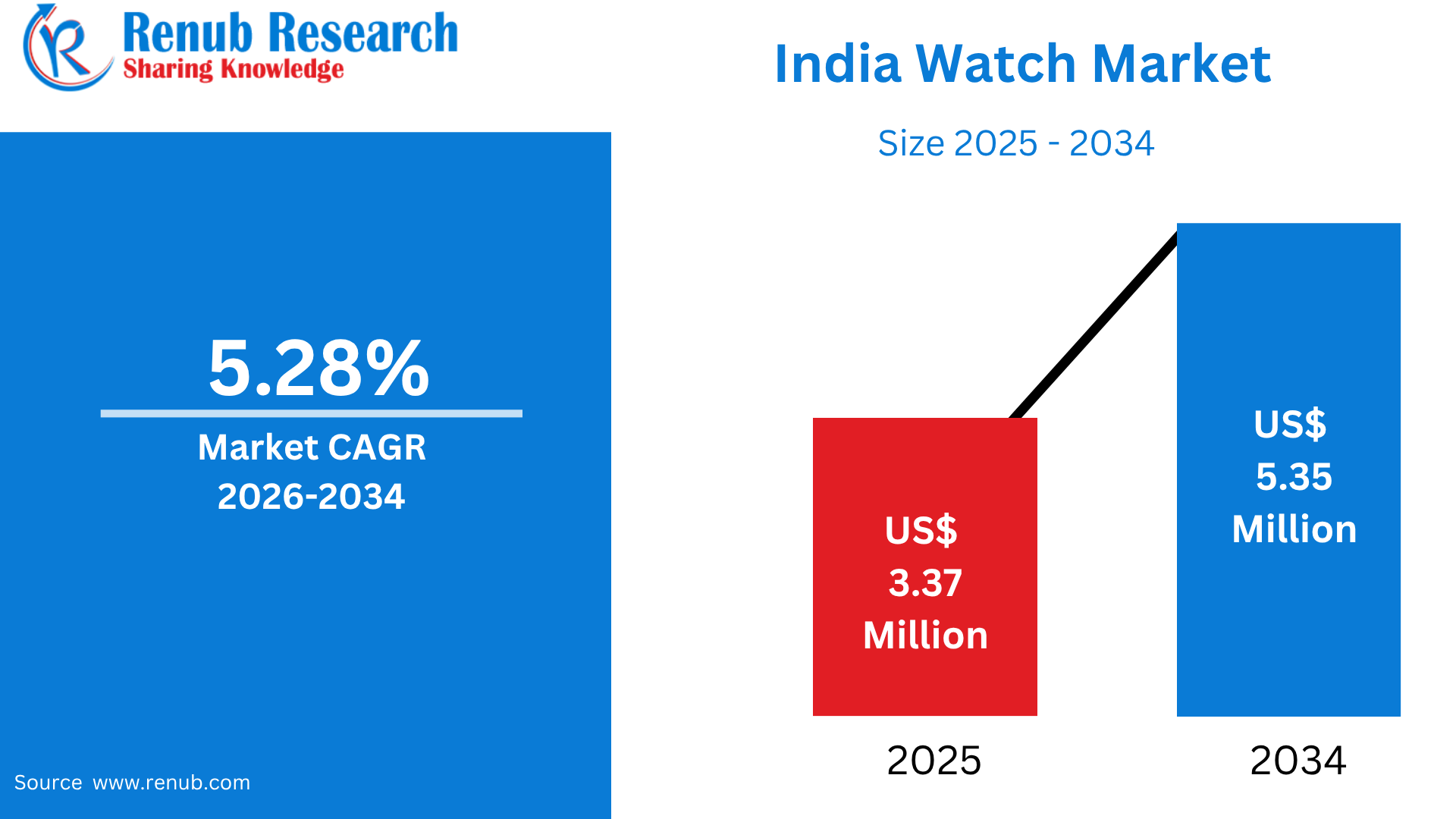
India Watch Market is poised for steady expansion, with the market projected to increase from US$ 3.37 billion in 2025 to US$ 5.35 billion by 2034, registering a CAGR of 5.28% during 2026–2034. Growth is being supported by rising consumer interest in luxury and smartwatches, increasing disposable incomes, expanding e-commerce penetration, and growing fashion consciousness. The increasing preference for technologically advanced, stylish, and premium timepieces is further creating opportunities for both international and domestic watch brands.
What is a Watch? Uses & Popularity in India
A watch is a timekeeping device worn on the wrist that lets users track time while increasingly serving as a fashion, lifestyle, and technology accessory. Watches are broadly categorized into analog, digital, quartz, mechanical, automatic, and smartwatches. Traditional watches remain popular for their craftsmanship, durability, styling, and symbolic value, while smartwatches combine timekeeping with features such as fitness tracking, heart-rate monitoring, notifications, GPS, sleep monitoring, and communication capabilities.
In India, watches are widely used for everyday timekeeping, professional wear, fashion, gifting, sports, and personal wellness monitoring. The market is becoming increasingly diversified, ranging from affordable mass-market watches to premium mechanical and luxury timepieces. Smartwatch adoption has created a strong technology-driven category, although shipments declined 17.6% to 28.9 million units in 2025, according to IDC. Growing fashion consciousness, rising disposable incomes, premiumization, digital lifestyles, and expanding e-commerce continue to shape India’s watch industry.
Top India Watch Market Statistics
Based on the Johnson & Co. article updated August 2026
- US$3.87 billion: Estimated size of India’s overall watch market.
- 11–12%: Estimated annual growth rate of India’s luxury-watch market.
- 70%: Share of luxury and high-end watches in India’s watch sales in FY2025, up from 48% in FY2020.
- ₹2.04 lakh: Average selling price of watches in FY2025, more than double the approximately ₹84,000 recorded in FY2020.
- 85,698: Number of Indian high-net-worth individuals (HNWIs) with assets exceeding US$10 million in 2024, representing 6% year-on-year growth.
- 93,753: Projected number of Indian HNWIs by 2028.
- ₹3,500 crore: Approximate value of Swiss watch imports into India in 2025.
- 200,000: Approximate number of Swiss watches imported by India during H1 2026.
- 37%: Year-on-year increase in the number of Swiss watches imported into India during H1 2026.
- CHF 168.7 million: Value of India’s Swiss watch imports during H1 2026, representing growth of more than 31% YoY.
- 1.7×: Potential increase in India’s luxury-watch market by 2030 if the estimated 11–12% annual growth rate continues from FY2025.
- 40%: Share of Indian consumers planning to purchase a watch who intended to buy it as a gift, compared with 27% globally.
- US$30 billion: Estimated size of India’s broader luxury-goods market by 2030, according to research cited in the article.
Key Market Takeaway
The statistics indicate a clear premiumization trend in India’s watch industry. The strongest opportunity is shifting from pure volume growth toward higher-value watches, particularly luxury and mechanical timepieces. Rising HNWI numbers, a higher average selling price, rapidly increasing Swiss-watch imports, and a growing international-brand presence are positioning India as an increasingly important market for global watchmakers through 2030. (Johnson & Co)
Read the full Johnson & Co. analysis
Growth Drivers of the India Watch Market
1. Rising Affluence and Premiumization of Watches
Increasing disposable income and the expansion of India’s affluent consumer base are supporting demand for premium and luxury watches. Watches are increasingly viewed not only as functional timekeeping products but also as fashion accessories, status symbols, collectibles, and gifting products. This trend is particularly visible among younger affluent consumers in metropolitan and Tier-II cities. Premiumization is also reflected in changing purchasing patterns. According to recent industry reporting, luxury and high-end watches accounted for around 70% of sales in FY2025, compared with 48% in FY2020, demonstrating a significant shift toward higher-value products. Younger consumers are increasingly interested in mechanical watches, limited editions, heritage brands, and luxury timepieces. India’s growing high-net-worth population and expanding organized luxury retail network are further increasing access to premium brands. Consequently, manufacturers are introducing premium collections, mechanical movements, personalized products, and exclusive retail experiences to capitalize on rising aspirational demand.
Growing Demand for Smartwatches and Connected Wearables
The integration of technology into wristwear has transformed watches from conventional timekeeping products into multifunctional personal devices. Smartwatches provide health and fitness monitoring, notifications, GPS navigation, sleep tracking, heart-rate monitoring, communication capabilities, and integration with smartphones. These features have attracted technology-oriented consumers, fitness enthusiasts, professionals, and younger buyers across India. India’s wearable-device ecosystem has developed rapidly, creating a substantial consumer base for connected watches. IDC reported that India’s overall wearable-device market reached 114.2 million units in 2025. Smartwatch shipments stood at 28.9 million units, representing 25.3% of the overall wearable market. Smartwatch average selling prices increased 11.7% in 2025 to US$26.5, indicating growing consumer interest in higher-value devices. Counterpoint also reported that India’s premium smartwatch segment priced at ₹15,000–₹30,000 doubled in shipments in Q4 2025, highlighting stronger demand for feature-rich models. Continued improvements in health sensors, displays, battery life, AI-enabled features, and ecosystem integration are expected to create new opportunities.
Expansion of E-Commerce and Digital Consumer Engagement
The rapid expansion of e-commerce and digital discovery is transforming how Indian consumers research and purchase watches. Online platforms allow customers to compare brands, specifications, prices, reviews, designs, and features before making purchasing decisions. This is particularly beneficial for younger consumers who are comfortable researching products through smartphones, social media, brand websites, and online marketplaces. The online channel is expected to remain an important growth avenue for India’s watch industry. Digital platforms are also helping brands reach consumers beyond major metropolitan areas, including emerging Tier-II and Tier-III cities. Social media marketing, influencer collaborations, livestream shopping, personalized recommendations, and online-exclusive collections are strengthening digital engagement. At the same time, established brands are combining e-commerce with physical boutiques and authorized retail networks to provide consumers with omnichannel purchasing experiences. As internet connectivity and digital payment adoption continue to expand, online channels should become increasingly important for affordable, fashion, premium, and smartwatches in India.
Challenges of the India Watch Market
Saturation and Slowing Demand in the Budget Smartwatch Segment
One of the major challenges facing India’s watch market is increasing saturation in the low-cost smartwatch segment. After rapid adoption during the early stages of the smartwatch boom, consumers are now demanding stronger differentiation, better health features, improved quality, and longer product lifecycles. IDC reported that smartwatch shipments declined 17.6% year over year to 28.9 million units in 2025, marking the second consecutive annual decline. Counterpoint attributed the slowdown partly to limited innovation in entry-level products, inventory rationalization, and longer replacement cycles. Budget models face particularly strong competition because numerous brands offer similar specifications, displays, health sensors, and connectivity features at comparable prices. This reduces product differentiation and puts pressure on margins. Counterpoint also reported that the ₹1,000–₹3,500 price segment continued to lead shipments in Q4 2025, while premium segments performed better. Manufacturers therefore need to continuously improve technology, design, software, health monitoring, durability, and ecosystem integration. Companies unable to differentiate their products may face declining sales, higher inventory levels, and increased promotional spending.
Intense Competition and Price Sensitivity
High competition and consumer price sensitivity represent another significant challenge for India’s watch market. Domestic brands compete aggressively on affordability, design, features, and distribution, while international companies increasingly target India’s expanding premium and luxury consumer base. This creates pressure across both traditional and smartwatches. In the mass-market segment, consumers often compare products primarily on price and features, making it difficult for brands to maintain premium pricing. The market remains heavily concentrated in affordable products. The smartwatch market faces similar pricing pressure, particularly in entry-level categories. As a result, manufacturers must balance competitive pricing with investments in product development, marketing, retail expansion, and after-sales service. For premium and luxury brands, challenges also include import costs, taxation, currency fluctuations, and the need to build consumer trust and authorized distribution networks. Increasing competition from established domestic brands, global technology companies, and fashion labels is therefore expected to remain a key challenge for companies operating in India’s watch market.
Watch Launches in India
- Titan Celestor Swift – Titan (2026): Titan launched the Celestor Swift GPS smartwatch in India at ₹9,499, featuring an advanced badminton mode, zone-based training, AI brief, and Titan Q functionality.
- Samsung Galaxy Watch Ultra 2 – Samsung (2026): Samsung introduced the Galaxy Watch Ultra 2 in India as a premium outdoor smartwatch, featuring a titanium case, sapphire crystal display, advanced health features, GPS, AI capabilities, and 10 ATM water resistance.
- Titan Celestor 2.0 – Titan (2026): Titan expanded its premium smartwatch portfolio with Celestor 2.0, featuring a 1.43-inch AMOLED display, dual-band GPS, Titan Q, training-load monitoring, and readiness tracking.
- Titan Smart 4.0 – Titan (2026): Titan introduced Smart 4.0 with a 1.93-inch AMOLED display, AI watch faces, AI voice assistant, and smart hydration features, targeting consumers seeking technology-focused everyday wearables.
- Titan Heritage Premium Smartwatch – Titan (2026): Titan launched its Heritage Premium smartwatch with an all-stainless-steel construction, AMOLED display, Bluetooth calling, advanced chipset, and Titan Health features, combining traditional watch aesthetics with connected functionality.
- Titan AiRA Women Smartwatch – Titan (2025): Titan introduced the AiRA women’s smartwatch featuring a 1.70-inch AMOLED display, AI chat, functional crown, 24/7 health monitoring, and Luna Wellness features, targeting women seeking fashion and health-focused technology.
- Fastrack Noir Pro – Fastrack (2026): Fastrack expanded its women’s smartwatch range with the Noir Pro, featuring a 3.0 cm Super AMOLED display with 390 × 390 resolution, targeting fashion-conscious consumers.
- Titan Zeal – Titan (2026): Titan launched the Zeal smartwatch with a 4.69 cm AMOLED display, always-on display capability, and a functional crown, combining contemporary styling with smartwatch functionality.
- Fastrack Astor FR2 Pro – Fastrack (2026): Fastrack introduced the Astor FR2 Pro with a 3.63 cm AMOLED display, 466 × 466 resolution, and AI voice assistant, targeting consumers seeking affordable smartwatches with advanced features.
- Titan Stellar 3.0 – Titan (2025): Titan unveiled the Stellar 3.0, a limited-edition premium mechanical timepiece featuring Titan’s first in-house automatic movement and the “Wandering Hours” concept, strengthening the company’s premium mechanical-watch portfolio.
Growing Interest in Craftsmanship and Collectible Timepieces
India Mechanical Watches Market is gaining momentum as affluent and aspirational consumers increasingly view mechanical watches as symbols of craftsmanship, heritage, exclusivity, and status rather than simply timekeeping devices. Demand is particularly strong for automatic and luxury mechanical watches featuring sophisticated movements, limited editions, heritage designs, and high-quality materials. Rising disposable incomes among urban professionals and increasing exposure to international watch brands are also encouraging consumers to upgrade from conventional quartz watches. Mechanical watches are increasingly purchased for weddings, anniversaries, corporate gifting, and milestone occasions, strengthening their cultural and aspirational value. The expansion of authorized luxury boutiques and premium retail outlets is further improving access to international and domestic mechanical watch brands.
Fashion Consciousness and Rising Female Consumer Participation
India Women’s Watches Market is expanding as watches increasingly become fashion, lifestyle, and professional accessories for women. Women are increasingly purchasing watches based on design, brand reputation, versatility, and compatibility with professional and casual outfits. Demand is expanding across traditional analog watches, fashion watches, premium timepieces, and smartwatches. Increasing female workforce participation, higher purchasing power, fashion consciousness, and greater influence over household purchasing decisions are supporting this growth. Brands are responding with slimmer cases, jewelry-inspired designs, interchangeable straps, smaller smartwatches, and collections featuring premium materials. E-commerce and social media are also making it easier for women to discover and compare designs. The growing emphasis on personalization and fashion-led product positioning is expected to further strengthen the segment.
Affordable Pricing and Mass-Market Demand Support Expansion
India Non-Luxury Watches Market remains the foundation of the country’s watch industry because of its affordability, broad consumer reach, and extensive retail availability. These watches are widely purchased for everyday use, gifting, school and college use, professional wear, and fashion purposes. Quartz and analog watches continue to dominate this category because of their relatively low prices, durability, ease of maintenance, and broad design selection. Manufacturers are increasingly introducing products that combine affordability with fashionable designs, lightweight cases, durable straps, water resistance, and improved finishing. Strong distribution through traditional retailers, department stores, multi-brand outlets, and e-commerce platforms allows brands to reach consumers across metropolitan, Tier-II, and Tier-III cities. However, intense competition and price sensitivity require manufacturers to balance product quality with competitive pricing. Continued urbanization, rising brand awareness, and fashion consciousness are expected to sustain demand for non-luxury watches.
E-Commerce and Digital Discovery Transform Watch Purchasing
India Online Watches Market is expanding as consumers increasingly use e-commerce platforms to discover, compare, and purchase watches. Online channels provide access to a wide range of affordable, fashion, premium, mechanical, and smartwatch products while enabling consumers to compare prices, specifications, reviews, and designs before purchasing. Growth is being supported by increasing smartphone usage, digital payments, improved logistics, promotional discounts, and greater consumer confidence in online shopping. Social media platforms are also influencing watch discovery, particularly among younger consumers, through influencer marketing, celebrity endorsements, product reviews, and short-form video content. Brands are increasingly adopting omnichannel strategies that combine online stores with physical boutiques and authorized retailers. Online-exclusive launches, personalized recommendations, easy returns, and financing options can further encourage purchases. As e-commerce penetration expands beyond major metropolitan areas into Tier-II and Tier-III cities, online retail is expected to become increasingly important to India’s watch industry.
Urbanization, Purchasing Power, and Premium Maharashtra Demand
Maharashtra Watch Market represents one of India’s most significant state-level markets, supported by high urbanization, strong consumer purchasing power, and the economic importance of cities such as Mumbai and Pune. The state’s large professional and corporate workforce generates consistent demand for formal, fashion, premium, and smartwatches. Consumers increasingly view watches as both functional accessories and expressions of personal style and status, supporting demand for established domestic and international brands. Maharashtra also benefits from a well-developed organized retail ecosystem comprising shopping malls, department stores, multi-brand outlets, and exclusive brand stores, improving access to products across price categories. High digital adoption and widespread e-commerce usage are further enabling consumers to compare brands, features, prices, and designs conveniently. Younger consumers are showing increasing interest in smartwatches offering fitness tracking, notifications, health monitoring, and connectivity features. Meanwhile, affluent consumers continue to support premium and luxury watch demand. The combination of urban lifestyles, relatively high disposable incomes, sophisticated retail infrastructure, and strong digital penetration positions Maharashtra as a key contributor to India’s overall watch industry.
Industrial Growth and Increasing Smartwatch Adoption in Tamil Nadu
Tamil Nadu Watch Market is supported by its large urban population, expanding industrial economy, and growing technology-oriented consumer base. Chennai serves as a major demand center, supported by its extensive IT, automotive, manufacturing, education, and services sectors. The state’s large working population creates consistent demand for traditional analog watches, formal timepieces, fashion watches, and smartwatches. Consumers generally value durability, functionality, affordability, and brand reputation when purchasing watches, while younger consumers are increasingly attracted to connected and fitness-oriented products. The presence of universities, technology companies, and a growing digital workforce is encouraging adoption of smartwatches equipped with health monitoring, activity tracking, notifications, and other connected features. Retail development across major cities is improving access to products in different price categories, while e-commerce platforms are extending product availability to smaller towns and semi-urban areas. Watches also remain popular gifting products during festivals, weddings, birthdays, and other family celebrations. The combination of economic development, expanding urbanization, digital adoption, and changing consumer preferences is expected to support continued growth of the watch market across Tamil Nadu.
Bengaluru’s Technology Ecosystem Drives Smartwatch and Premium Demand
Karnataka Watch Market is strongly influenced by Bengaluru, one of India’s leading technology and startup hubs. The city’s young, digitally connected, and relatively affluent population creates strong demand for smartwatches, premium timepieces, fitness-oriented products, and fashion-focused watches. Consumers are increasingly looking for products that combine stylish design with multifunctional capabilities such as health monitoring, activity tracking, GPS, smartphone notifications, and communication features. Karnataka’s extensive technology sector and large corporate workforce also support demand for formal and premium watches suitable for professional environments. Growing awareness of personal health and fitness is further encouraging consumers to adopt smartwatches and wearable devices capable of monitoring daily activity, exercise, sleep, and other wellness indicators. E-commerce is an important purchasing channel, providing consumers with extensive product variety and convenient price comparisons. At the same time, premium shopping centers and branded retail outlets offer consumers opportunities to experience higher-end products. The state’s expanding startup ecosystem, strong digital infrastructure, rising disposable incomes, and technology-oriented lifestyle make Karnataka an important market for both smart and premium watch manufacturers.
Business Culture, Premiumization, and Digital Retail Support Growth
Gujarat Watch Market is benefiting from strong economic activity, expanding urban centers, and a large business-oriented consumer population. Ahmedabad and Surat are important demand centers, generating sales across affordable, mid-range, premium, and smartwatches. Watches are frequently associated with professional appearance, personal style, status, and success, supporting demand for branded and well-designed products. Traditional analog watches continue to maintain a significant consumer base, while younger buyers are increasingly shifting toward smartwatches offering fitness tracking, health monitoring, connectivity, and other digital functions. Gujarat’s strong retail infrastructure and growing e-commerce penetration are improving access to both domestic and international watch brands. Watches also have an important role in gifting, particularly during weddings, festivals, anniversaries, and corporate occasions, creating recurring seasonal demand. Manufacturers and retailers are responding by offering products across different price points, designs, and technology levels. The state’s combination of entrepreneurial culture, urbanization, rising consumer aspirations, expanding organized retail, and increasing digital shopping adoption is expected to support sustained development of the Gujarat watch market.
Recent Developments in Watch Market
- August 2025: Casio India introduced a new range of locally manufactured watches, expanding distribution across the country. This launch represents a strategic move to strengthen its footprint in India by emphasizing local production and aligning products with regional consumer preferences.
- July 2025: CMF launched its latest smartwatch, the Watch 3 Pro, featuring a 1.43-inch AMOLED display. The product was introduced across multiple markets, including India, the UK, and Europe. It offers advanced functionalities such as dual-band GPS, AI-powered workout insights, and integrated ChatGPT support, typically seen in premium devices.
- July 2025: Samsung announced the Galaxy Watch 8, featuring a more durable design and enhanced capabilities powered by Galaxy AI. The smartwatch is available in two variants: a 44mm model with a 1.47-inch Super AMOLED display and a 40mm version with a 1.34-inch screen.
- September 2024: Apple launched the Apple Watch Series 10 along with the Apple Watch SE. These models include advanced features such as sleep apnea detection, faster charging, water depth and temperature tracking, and improved health analytics supported by watchOS 11.
India Watch Market Segments
Type
- Quatz Watches
- Electronic Watches
- Mechanical Watches
Gender
- Men
- Women
- Unisex
Price Range
- Luxury
- Non-Luxury
Distribution Channel
- Hyper Market/Super Market
- Convenience Stores
- Online
Top States
- Maharashtra
- Tamil Nadu
- Karnataka
- Gujarat
- Uttar Pradesh
- West Bengal
- Rajasthan
- Telangana
- Andhra Pradesh
- Madhya Pradesh
All companies have been covered with 5 Viewpoints
- Overviews
- Key Person
- Recent Developments
- SWOT Analysis
- Revenue Analysis
Key Players Analysis
- Seiko Holdings Corporation
- Casio Computer Co. Ltd
- Timex Group
- Rolex SA
- Compagnie Financière Richemont S.A
- The Swatch Group Ltd
- Citizen Watch Co. Ltd.
- Fossil Group Inc.
- Google LLC (Fitbit Inc.)
Report Details:
| Report Features | Details |
| Base Year |
2024 |
| Historical Period |
2021 - 2024 |
| Forecast Period |
2025 - 2033 |
| Market |
US$ Billion |
| Segment Covered |
By Type, By Gender, By Price Range and By Distribution Channel |
| Companies Covered |
|
| Customization Scope |
20% Free Customization |
| Post-Sale Analyst Support |
1 Year (52 Weeks) |
| Delivery Format |
PDF and Excel through Email (We can also provide the editable version of the report in PPT/Word format on request) |
Key Questions Answered in This Report:
-
What is the projected market size of the Indian watch industry by 2033?
-
What is the expected CAGR of the Indian watch market from 2025 to 2033?
-
Which factors are driving the growth of the Indian watch market?
-
How is the rise in disposable income influencing the luxury watch segment in India?
-
What role do smartwatches play in shaping the Indian watch market?
-
Which brands dominate the smartwatch segment in India?
-
How has e-commerce contributed to the growth of the Indian watch market?
-
What challenges does the Indian watch industry face, particularly regarding counterfeit products?
-
Why are quartz watches still popular among Indian consumers despite the rise of smartwatches?
-
Which distribution channels are most effective for selling watches in India?
Customization Services available
- Analysis of Market Size and Its Segments
- More Company Profiles (Upto 10 without any additional cost):
- Additional Countries (Other than mentioned Countries):
- Region/Country Specific Reports:
- Market Entry Strategy:
- Region-Specific Market Dynamics:
- Regional Market Share Analysis:
- Trade Analysis:
- Production Insights:
- Others Customized Requests:
For more information contact our analysts.
Need More Assistance?
- Talk to our analysts to get more precious information on the current market trends.
- Include more countries and segments and customize the report based on the final requirement.
- Get a competitive advantage in your industry by knowing the report findings and making a positive impact on your revenues and operations.
- Our analysts are always ready to provide more help and pertinent information if you need any additional assistance.