India Cashew Market Report by Cashew Production Market - By States (Maharashtra, Andhra Pradesh, Orissa, Karnataka, Tamil Nadu, Kerala, Others), Cashew Export Market – By Countries (UAE, Netherland, Japan, Saudi Arabia, Vietnam, Others) and Companies Analysis 2026-2034
Buy NowIndia Cashew Market Size and Forecast
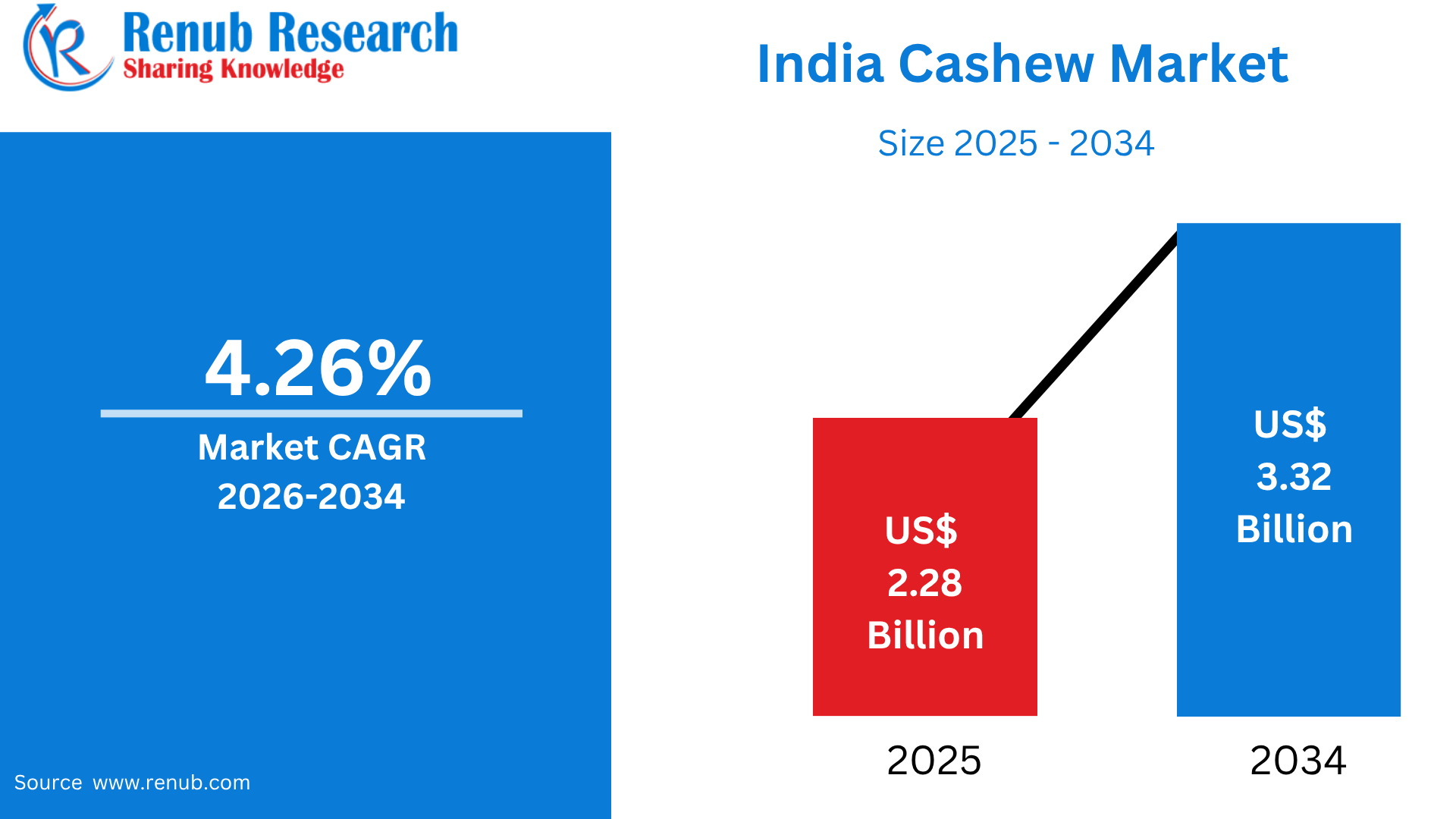
India Cashew Market is projected to reach US$ 3.32 Billion by 2034, rising from US$ 2.28 Billion in 2025, at a CAGR of 4.26% during 2026–2034. The market is expected to witness steady expansion, supported by increasing health consciousness, rising disposable incomes, and sustained domestic and international demand for cashew products. Consumers are increasingly shifting toward nutrient-dense and plant-based snacks, strengthening demand for cashews as a convenient source of healthy fats, minerals, and other nutrients.
What is Cashew and Its Uses & Popularity in India
Cashew is a nutrient-rich tree nut obtained from the cashew tree (Anacardium occidentale), widely cultivated in India and valued for its distinctive taste, creamy texture, and nutritional properties. India is one of the world’s major cashew processing and consumption centers, with production increasing from approximately 794 thousand tonnes in 2023–24 to 802 thousand tonnes in 2024–25, according to APEDA. Cashews are consumed as roasted, salted, flavored, and coated snacks and are increasingly incorporated into premium and health-oriented food products. They are widely used in Indian sweets, desserts, bakery products, confectionery, curries, gravies, snacks, and festive foods. Cashew kernels are also processed into cashew butter, powder, beverages, and other value-added products, creating opportunities for food manufacturers. Beyond food applications, cashew processing generates by-products such as cashew nut shell liquid (CNSL), which has industrial applications. India exported 32,998.91 tonnes of cashew kernels worth US$265.08 million in FY2025–26, demonstrating the importance of cashews to the country’s agricultural processing and export economy.
Cashew Export Statistics – FY 2025–26
- Cashew Kernels
- Export Volume: 32,998.91 MT
- Export Value: US$265.08 million
- Cashew Nuts – Fresh/Dried In-Shell
- Export Volume: 77,806.41 MT
- Export Value: US$114.12 million
- Cashew Nuts – Roasted/Value Added
- Export Volume: 3,001.82 MT
- Export Value: US$24.62 million
- Cashew Shell Liquid (CNSL)
- Export Volume: 38,648.74 MT
- Export Value: US$26.76 million
- Major Export Destinations (2025–26):
- Vietnam
- UAE
- Netherlands
- Japan
- Spain
Source: DGCI&S / APEDA
Growth Drivers of the India Cashew Market
Rising Health Consciousness and Demand for Nutrient-Rich Snacks
Increasing health awareness among Indian consumers is supporting demand for cashews as a convenient, nutrient-dense snack. Cashews provide healthy fats, plant-based protein, minerals, and other nutrients, making them attractive to consumers shifting toward healthier alternatives to conventional snacks. The growth of organized retail, premium dry-fruit brands, and online grocery platforms is making packaged cashews more accessible to urban and semi-urban consumers. Demand is also expanding beyond traditional whole kernels toward roasted, flavored, spiced, and portion-controlled products. APEDA reports that Indian cashew kernels are available in several value-added forms, including roasted, salted, flavored, spiced, honey-coated, powdered, and butter-based products. This diversification enables manufacturers to address different consumer preferences and price segments. The growing popularity of plant-based and nutrient-rich foods further supports cashew consumption in breakfast products, snack bars, confectionery, bakery items, and dairy alternatives. As consumers increasingly associate nuts with healthier snacking and premium nutrition, cashews are gaining a stronger position within India’s expanding packaged-food ecosystem.
Strong Processing Industry and Expanding Value-Added Products
India’s established cashew-processing ecosystem is a major growth engine because the country combines large-scale processing capabilities with significant domestic consumption. APEDA states that India produced approximately 802 thousand tonnes of cashews in 2024–25, up from 794 thousand tonnes in 2023–24. The processing industry converts raw cashews into kernels and a growing range of higher-value products, including roasted and flavored kernels, cashew powder, cashew butter, and cashew beverages. ICAR’s Directorate of Cashew Research has also developed high-yielding and climate-resilient varieties, high-density planting technologies, integrated nutrient and pest management practices, and farmer-oriented mechanization to improve productivity and reduce labor costs. These developments can strengthen raw-material availability and processing efficiency. In addition, greater utilization of processing by-products creates opportunities for additional revenue streams. Cashew apple is being processed into juices, pectin, syrups, jams, and other products, while CNSL has industrial applications. Such value-chain diversification can improve profitability and encourage further investment in India’s cashew-processing industry.
Growing Export Demand and India’s Global Processing Position
International demand remains an important growth driver for India’s cashew industry, supported by the country’s established processing infrastructure, skilled workforce, and access to global markets. APEDA reports that India ranked fourth globally in 2024 for exports of fresh/dried shelled cashew nuts, with a 6.60% global market share. During FY2025–26, India exported approximately 32,999 tonnes of cashew kernels valued at US$265.08 million, while exports of roasted and value-added cashew products reached 3,001.82 tonnes worth US$24.62 million. Major destinations for Indian cashew products include Vietnam, the UAE, the Netherlands, Japan, and Spain. Export opportunities are supported by demand for premium kernels, processed snacks, and value-added nut products in international markets. India’s processing expertise also allows domestic companies to add value before exporting, rather than relying solely on raw agricultural output. Continued improvements in quality, processing technology, packaging, traceability, and supply-chain infrastructure can help Indian exporters strengthen their international competitiveness and capture additional demand from developed and emerging markets.
Challenges of the India Cashew Market
Dependence on Imported Raw Cashew Nuts
One of the major challenges facing India’s cashew industry is its dependence on imported raw cashew nuts to satisfy the requirements of domestic processors. Although India produced around 802 thousand tonnes of cashews in 2024–25, APEDA identifies reliance on imported raw cashews as a continuing industry challenge. This dependence exposes processors to fluctuations in international raw-cashew prices, currency movements, freight costs, import policies, and supply disruptions. Changes in global production, particularly in major producing regions, can therefore influence the cost and availability of raw material for Indian processors. Higher input costs can compress processing margins or result in increased prices for finished kernels. Expanding domestic cultivation, improving orchard productivity, adopting high-yielding and climate-resilient varieties, and increasing mechanization can help reduce this vulnerability over the long term. Government initiatives under programs such as the Mission for Integrated Development of Horticulture (MIDH) and Rashtriya Krishi Vikas Yojana (RKVY) are intended to support cultivation expansion and improved varieties. Strengthening domestic raw-material production remains important for building a more resilient and competitive cashew value chain.
Climate Risks, Productivity Constraints, and Processing Costs
Climate variability and productivity constraints pose additional challenges to India’s cashew market. Cashew is relatively resilient and can adapt to poorer soils, but fluctuations in rainfall, temperature, drought conditions, pests, and diseases can affect flowering, nut formation, yields, and quality. These risks become particularly important as processors require consistent volumes of high-quality raw nuts throughout the year. India’s fragmented cultivation structure and differences in farm-level productivity can further complicate raw-material procurement. Processing is also relatively labor-intensive, creating pressure to adopt mechanization while maintaining kernel quality and minimizing breakage. ICAR-DCR has highlighted the importance of high-yielding and climate-resilient varieties, high-density planting, integrated pest and nutrient management, and farmer-friendly mechanization for improving productivity and reducing labor costs. At the same time, investments in modern processing, quality control, packaging, cold-chain and logistics infrastructure can increase operating costs, particularly for smaller processors. Addressing these agricultural and processing constraints will be essential for India to improve supply reliability, maintain competitive pricing, and expand its position in domestic and international cashew markets.
- 2023 – Hershey India Cashew Butterscotch Ice Cream Milkshake: Hershey India introduced a cashew butterscotch ice cream milkshake under its “Slurp Up the Fun” campaign, combining cashew with a popular dessert flavor.
- 2024 – MILMA Cashew Vita Powder: In October 2024, MILMA introduced Cashew Vita Powder, a cashew-based health drink developed with the Kerala State Cashew Development Corporation and CFTRI. It was offered in pista, chocolate, and vanilla flavors.
- 2024 – Premium Imported Cashew Nut Range by NFP Sampoorna Foods: NFP Sampoorna Foods announced a premium imported cashew nut range, targeting consumers seeking higher-quality and differentiated cashew products.
- 2025 – Pala-G Biscoff Cashews: Pala-G introduced Biscoff-flavored cashews, combining W320 whole cashews with a caramelized biscuit-style flavor, targeting premium snacking and gifting occasions.
- 2025 – Pala-G Tiramisu Cashews: The brand expanded flavored cashews with Tiramisu Cashews, combining coffee, cocoa, and mascarpone-inspired flavors with premium whole cashews.
- 2025 – Pala-G Korean Chilli Kaju: Korean Chilli Kaju was introduced as a spicy, internationally inspired cashew snack using Korean-style seasoning, reflecting growing interest in global flavors among Indian consumers.
- 2025 – Pala-G Rasmalai Cashews: Pala-G also developed Rasmalai Cashews, applying a traditional Indian dessert-inspired flavor to premium cashews and strengthening the fusion-snacking segment.
- 2025 – Cashew Processing Automation: ICAR introduced automated cashew-nut separation tools in November 2025, representing an important processing innovation aimed at improving throughput and reducing labor requirements.
- 2025 – Cashew Procurement E-Tender System: In February 2025, the Cashew Board of India launched an e-tender system for procuring raw cashew nuts from producing states, supporting modernization of the industry’s raw-material procurement process.
- 2026 – Expanded Flavored Cashew Portfolio: Indian specialty cashew brands continued expanding into dessert, spicy, and international-inspired flavors, including Biscoff, Tiramisu, Korean chilli, and other premium variants, reflecting the shift from conventional roasted/salted cashews toward differentiated value-added snacks.
Strong Production Base and Konkan-Centric Cultivation in Maharashtra
Maharashtra is one of India’s leading cashew-producing states, supported by the favourable agro-climatic conditions of the Konkan region. Recent estimates indicate that the state produced approximately 182,790 tonnes of cashew in 2025–26, while earlier 2025 estimates placed production at nearly 199,700 tonnes. The major cultivation areas include Sindhudurg, Ratnagiri, Raigad, and Palghar, with South Konkan accounting for the majority of the state’s cashew acreage. The coastal climate, adequate rainfall, and lateritic soils provide suitable conditions for cashew cultivation. Maharashtra also has a well-established processing ecosystem, particularly in Ratnagiri and Sindhudurg, where approximately 800 cashew-processing units have historically operated. Government initiatives focusing on orchard rejuvenation, improved planting material, productivity enhancement, and farmer support are helping strengthen the sector. Nevertheless, ageing plantations, monsoon variability, labour availability, and productivity management remain important concerns. Expanding mechanization, modern processing, and value-added products can further increase farmer incomes and strengthen Maharashtra’s position in domestic and export-oriented cashew markets.
Tamil Nadu Expanding Cultivation and Institutional Support
Tamil Nadu is an established cashew-producing state with a substantial cultivation base and an important role in India’s cashew value chain. According to Ministry of Agriculture data, the state covered approximately 176.44 thousand hectares under cashew cultivation and produced 86.2 thousand metric tonnes during 2025–26. Cashew cultivation is particularly important in several districts and supports farming communities, processors, traders, and related businesses. The state is also strengthening institutional support for the industry, with initiatives aimed at improving cultivation practices, pest management, farmer training, processing capabilities, and marketing. Tamil Nadu’s established processing and trading ecosystem provides opportunities to expand domestic consumption as well as export-oriented value-added products. Increasing productivity is particularly important because improving yields from existing plantations can raise farmer returns without requiring proportional expansion of cultivated land. The adoption of improved planting material, better orchard management, mechanization, and organized procurement can further strengthen the sector. With consumers increasingly demanding roasted, flavored, packaged, and premium cashew products, Tamil Nadu is positioned to benefit from the growing value-added segment while improving the efficiency and competitiveness of its overall cashew industry.
Karnataka Coastal Production and Processing Ecosystem
Karnataka is an important cashew-producing state, with cultivation concentrated mainly along its western coastal belt. Udupi, Dakshina Kannada, and Uttara Kannada are among the state’s principal cashew-producing regions, benefiting from suitable rainfall, humidity, coastal conditions, and lateritic soils. Recent estimates indicate that Karnataka produced approximately 65,820 tonnes of cashew in 2025–26, while the state’s coastal processing industry has a considerably larger role in the national value chain. Dakshina Kannada and Udupi together are reported to process nearly 5 lakh tonnes of cashew annually, equivalent to around one-fourth of India’s total cashew-processing capacity, although much of this raw material is sourced beyond the state. This extensive processing base creates opportunities for kernel production, roasting, grading, packaging, and export-oriented products. However, Karnataka’s growers face challenges associated with ageing plantations, pests and diseases, labour availability, and maintaining consistent productivity. Government and agricultural research initiatives supporting improved varieties, scientific orchard management, technology adoption, and farmer incentives can help address these constraints. Greater mechanization and value addition could further improve farm profitability and strengthen Karnataka’s position within India’s cashew-processing industry.
Large Cultivation Base and Rural Livelihood Opportunities in Odisha
Odisha is a major cashew-producing state with a large cultivation area and significant potential for expanding production and value addition. More recent Ministry of Agriculture-based data indicate that Odisha had approximately 223.45 thousand hectares under cashew cultivation and produced 131.8 thousand tonnes in 2025–26. Important production areas include Ganjam, Koraput, Rayagada, and other coastal and southern districts, where agro-climatic conditions support cashew cultivation. The crop also plays an important role in rural and tribal livelihoods, particularly in areas where cashew plantations provide income and employment opportunities. Odisha has developed institutional infrastructure through the Odisha State Cashew Development Corporation (OSCDC), which manages hundreds of plantations across multiple districts and supports cashew cultivation and expansion. Despite its production potential, the sector faces challenges involving plantation productivity, availability of quality planting material, harvesting and post-harvest practices, processing infrastructure, and market linkages. Strengthening farmer-producer organizations, improving nursery and extension services, reducing post-harvest losses, and developing local processing facilities can increase value retention within the state. Greater production of roasted, flavored, graded, and other value-added cashew products could further enhance farmer incomes and Odisha’s competitiveness.
Coastal Cultivation and Processing Expansion in Andhra Pradesh
Andhra Pradesh is an important contributor to India’s cashew industry, particularly through cultivation across its coastal and northern districts. Srikakulam and Visakhapatnam are among the key production areas, benefiting from suitable coastal agro-climatic conditions, including adequate humidity and soils conducive to cashew cultivation. The state’s cashew sector supports both agricultural livelihoods and processing activities, creating opportunities across cultivation, procurement, kernel processing, packaging, and trade. Andhra Pradesh also benefits from its proximity to important domestic markets and coastal logistics infrastructure, which can facilitate the movement of raw nuts and processed kernels. However, productivity and quality can be affected by inconsistent raw-nut characteristics, inadequate post-harvest handling, drying limitations, ageing plantations, and fragmented supply chains. Improving orchard management, introducing higher-yielding varieties, strengthening farmer training, and expanding mechanized processing can help address these constraints. Investments in grading, drying, storage, quality testing, and modern packaging are particularly important for producing export-quality kernels. As demand increases for premium, roasted, flavored, and packaged cashew products, strengthening organized procurement and value-added processing could allow Andhra Pradesh to capture a greater share of the growing domestic and international cashew value chain.
India Cashew Export to UAE Market
UAE is one of the most important destinations for Indian cashew exports, supported by strong demand for premium nuts, established Indian-origin food distribution networks, and the UAE’s role as a regional trading hub. In 2024, India exported cashew nuts worth approximately US$83.99 million to the UAE, with export volume reaching 11,454 tonnes, making the UAE India’s largest destination among the selected major markets. In 2023, exports were even higher at approximately US$108.26 million and 15,804 tonnes, demonstrating the market’s significant capacity despite year-to-year fluctuations. The UAE’s large expatriate population, growing health-conscious consumer base, and strong retail and hospitality sectors support demand for packaged and processed cashews. Indian exporters benefit from the UAE’s sophisticated supermarket, hypermarket, wholesale, foodservice, and re-export infrastructure. Demand is also supported by the popularity of nuts during Ramadan, festivals, gifting occasions, and everyday snacking. Continued growth in premium roasted, flavored, salted, and value-added cashew products can provide additional opportunities for Indian exporters in the UAE market.
European Distribution Hub Supports Indian Cashew Exports
Netherlands represents an important European destination for Indian cashews and provides access to broader European markets through its advanced logistics and distribution infrastructure. India exported approximately US$35.54 million worth of cashew nuts to the Netherlands in 2024, corresponding to around 4,914 tonnes. In 2023, exports stood at approximately US$32.99 million and 4,963 tonnes, indicating relatively stable demand in the market. The Netherlands is particularly important because Rotterdam and other logistics hubs facilitate the movement of food products into European countries. Indian cashews are used across retail, foodservice, bakery, confectionery, snack, and ingredient applications. European consumers are increasingly interested in plant-based, nutrient-rich, and convenient foods, creating opportunities for cashew kernels and value-added products. However, exporters must meet stringent European requirements related to food safety, pesticide residues, traceability, packaging, and quality. Indian companies that emphasize premium grading, sustainable sourcing, transparent supply chains, and certified processing can strengthen their competitiveness. Growing demand for plant-based ingredients and healthy snacks could further support India’s cashew exports to the Netherlands.
India Cashew Export to Japan Market
Japan is a valuable destination for Indian cashew exporters because of its strong consumer preference for high-quality packaged foods, nuts, and healthy snacks. India exported approximately US$34.94 million worth of cashew nuts to Japan in 2024, representing around 5,043 tonnes. In 2023, exports were approximately US$44.93 million, with shipments of about 6,279 tonnes, highlighting Japan’s established demand for Indian cashews. Japanese consumers typically place considerable emphasis on product quality, food safety, appearance, consistency, and packaging, creating opportunities for exporters capable of supplying premium-grade kernels. Cashews are increasingly used in snack mixes, confectionery, bakery products, prepared foods, and health-oriented products. The country’s ageing population and growing interest in convenient nutrient-rich foods also support the long-term potential for nuts as part of balanced diets. Nevertheless, Indian exporters must maintain strict quality control and comply with Japan’s food safety, residue, labeling, and import requirements. Opportunities are particularly strong for high-grade whole kernels, roasted and lightly flavored products, and convenient retail packs designed around Japan’s premium food culture.
Growing Middle Eastern Demand and Premium Snacking Opportunities
Saudi Arabia is another significant destination for Indian cashew exports, supported by increasing demand for premium dry fruits, nuts, snacks, and foodservice ingredients. India exported approximately US$29.31 million worth of cashew nuts to Saudi Arabia in 2024, with shipments totaling around 3,864 tonnes. In 2023, exports were higher at approximately US$33.40 million and 4,614 tonnes, demonstrating an established bilateral trade relationship. Cashews are widely consumed in Saudi Arabia as snacks and are also used in confectionery, desserts, bakery products, traditional dishes, and gift assortments. Demand receives additional seasonal support during Ramadan, Eid, weddings, and other celebrations, when premium nuts and dried fruits are frequently purchased. Saudi Arabia’s modern retail expansion, growing foodservice sector, and increasing availability of imported packaged foods create opportunities for Indian suppliers. At the same time, competition from Vietnam, Brazil, Africa, and other exporting countries requires Indian companies to remain competitive on price, quality, consistency, and delivery. Premium roasted, salted, flavored, and attractively packaged Indian cashews could capture additional demand among health-conscious and affluent consumers.
India Cashew Market Segmentation
Cashew Production Market
- Maharashtra
- Andhra Pradesh
- Orissa
- Karnataka
- Tamil Nadu
- Kerala
- Others
Cashew Export Market
- UAE
- Netherland
- Japan
- Saudi Arabia
- Vietnam
- Others
All companies have been covered with 5 Viewpoints
- Overviews
- Key Person
- Recent Developments
- SWOT Analysis
- Revenue Analysis
Company Analysis:
- Wonderland Foods
- Kalbavi Cashews
- Britannia Industries Limited
- Haldirams
Report Details:
| Report Features | Details |
| Base Year |
2025 |
| Historical Period |
2022 - 2025 |
| Forecast Period |
2026 - 2034 |
| Market |
US$ Billion |
| Segment Covered |
Production by States and Export by Countries |
| Countries Covered |
|
| Companies Covered |
|
| Customization Scope |
20% Free Customization |
| Post-Sale Analyst Support |
1 Year (52 Weeks) |
| Delivery Format |
PDF and Excel through Email (We can also provide the editable version of the report in PPT/Word format on request) |
Customization Services available
- Analysis of Market Size and Its Segments
- More Company Profiles (Upto 10 without any additional cost):
- Additional Countries (Other than mentioned Countries):
- Region/Country Specific Reports:
- Market Entry Strategy:
- Region-Specific Market Dynamics:
- Regional Market Share Analysis:
- Trade Analysis:
- Production Insights:
- Others Customized Requests:
For more information contact our analysts.
Need More Assistance?
- Talk to our analysts to get more precious information on the current market trends.
- Include more countries and segments and customize the report based on the final requirement.
- Get a competitive advantage in your industry by knowing the report findings and making a positive impact on your revenues and operations.
- Our analysts are always ready to provide more help and pertinent information if you need any additional assistance.