Hair Care Products Market Report by Product Type, Distribution Channel, Countries and Companies Analysis 2026-2034
Buy NowHair Care Products Market Size and Forecast
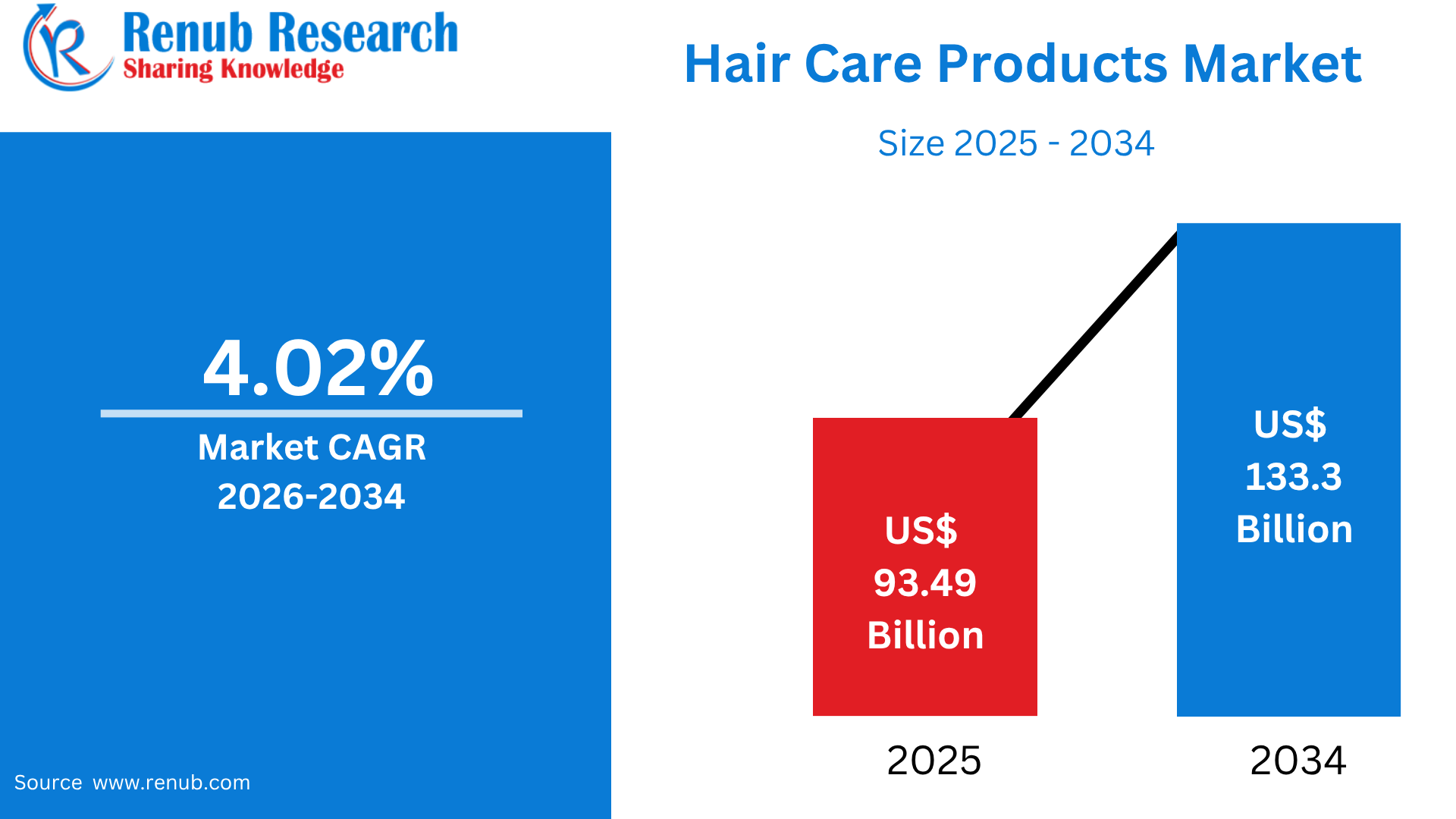
Hair Care Products Market is projected to grow from US$ 93.49 billion in 2025 to US$ 133.3 billion by 2034, registering a CAGR of 4.02% during 2026–2034. The market is anticipated to maintain steady growth throughout the forecast period, supported by rising awareness of personal grooming and increasing consumer focus on hair health and appearance. Continuous product innovation, including specialized, natural, and premium hair care formulations, is further contributing to market expansion. In addition, the growing trend toward premiumization is encouraging consumers to spend more on high-quality and specialized hair care products.
What are Hair Care Products and Their Uses & Popularity Worldwide
Hair care products are personal care formulations designed to cleanse, condition, nourish, protect, style, and improve the appearance and overall health of the hair and scalp. The category includes shampoos, conditioners, hair oils, serums, masks, styling products, hair colorants, treatments, and specialized solutions for concerns such as dandruff, hair damage, thinning, and hair loss. These products are widely used across age groups and genders as part of daily grooming and personal wellness routines. Shampoos and conditioners remain particularly popular, with a consumer study reporting that 99% of respondents purchased traditional shampoo and 96% purchased conditioners. Hair care is also becoming increasingly focused on scalp health, targeted treatments, natural ingredients, and personalized solutions. Euromonitor found that 17% of global consumers were influenced by ingredient formulations when purchasing hair care in 2022, compared with 15% in 2019. The growing emphasis on personal appearance, preventive hair care, wellness, clean formulations, and at-home beauty routines continues to strengthen the worldwide popularity of hair care products.
Hair Loss Statistics
- Hair Loss Increases With Age: By age 65, approximately 53% of men and 37% of women are expected to experience baldness.
- Hair Loss Is Common Among Older Adults: Hair follicles naturally become less active with age, and some eventually stop producing hair altogether.
- Average Hair Count: Healthy adults typically have approximately 80,000–120,000 strands of hair on their scalp.
- Normal Daily Shedding: Losing around 50–100 hairs per day is generally considered normal for healthy adults.
- Androgenetic Alopecia Is Most Common: Hereditary pattern hair loss is identified by NCOA as the most common cause of hair loss in both men and women, affecting about half of each group at some point.
- Smoking and Hair Loss: NCOA cites research showing hair loss among 85% of smokers compared with 40% of non-smokers, indicating a notable association between smoking and hair loss.
- US Hair-Loss Product Spending: Americans are projected to spend approximately US$2.22 billion on hair-loss products in 2025, highlighting substantial consumer demand for hair-loss solutions.
- Hair Loss in American Men by Age 35: Approximately two-thirds of American men experience some noticeable hair loss by age 35.
- Hair Thinning by Age 50: Around 85% of American men are estimated to have significantly thinning hair by age 50.
- Lifetime Hair Loss Among Men and Women: NCOA reports that approximately 85% of men and 33% of women experience some form of hair loss during their lifetime.
- Early Hair Loss in Men: About 25% of men begin experiencing hair loss by age 30, compared with approximately 12% of women.
- Hair Loss in China: Approximately 250 million people in China, or about one in six people, are reported to experience hair loss.
- Hair Loss Among Indian Men: Nearly 63% of Indian men aged 21–61 are reported to experience hair loss, demonstrating substantial demand for hair and scalp care solutions in India.
- Hair Loss in the United Kingdom: The NCOA article reports that approximately 8 million women and 6.5 million men in the UK experience hair loss.
- Global Hair-Loss Product Market: Consumer research cited by NCOA projects that global revenue from hair-loss products could reach US$16.72 billion by 2030, reflecting increasing demand for prevention, treatment, and hair-restoration solutions.
Growth Drivers of the Hair Care Products Market
1Rising Personal Grooming and Hair Health Awareness
Increasing awareness of personal grooming, hair appearance, and scalp health is a major factor supporting the global hair care products market. Consumers are increasingly treating hair care as an important component of daily wellness rather than simply a cosmetic activity. Demand is expanding beyond basic cleansing toward products that address specific concerns such as dryness, frizz, hair damage, thinning, scalp conditions, and aging-related hair changes. Euromonitor reports that hair volume is a concern for almost one-third of global consumers, while demand for hair-loss treatment products is increasing across age groups. Similarly, a consumer survey found that 97% of respondents look for specific benefit statements on shampoos and conditioners addressing their current hair concerns. This growing emphasis on efficacy is encouraging manufacturers to develop specialized shampoos, conditioners, serums, masks, oils, and scalp treatments. Rising grooming expenditure among both men and women, combined with greater beauty awareness and social-media exposure, is therefore expanding the consumer base and encouraging more frequent use of hair care products worldwide.
Growing Demand for Natural, Clean-Label, and Premium Products
The shift toward natural, clean-label, sustainable, and premium hair care products is creating significant opportunities for manufacturers. Consumers are increasingly examining product formulations and seeking botanical extracts, plant-based ingredients, essential oils, vitamins, proteins, and other perceived wellness-oriented components. Euromonitor found that 17% of global respondents were influenced by ingredient formulations when purchasing hair care products in 2022, up from 15% in 2019. In addition, a 2024 consumer survey reported that 30% of hair care consumers preferred all-natural ingredients and 22% prioritized ingredient transparency. Premiumization is further encouraging consumers to purchase specialized and higher-value formulations, including scalp serums, hair masks, repair treatments, and customized solutions.
Expansion of E-Commerce and Digital Beauty Retail
The rapid expansion of e-commerce, social media, digital marketing, and online beauty platforms is improving the accessibility and visibility of hair care products worldwide. Online channels enable consumers to compare formulations, prices, reviews, product claims, and specialized solutions while providing brands with direct access to targeted customer segments. Euromonitor’s 2024 consumer research indicates that 14% of consumers were digital hair care shoppers, meaning they purchased through online retailers and were influenced by digital or user-generated content when shopping for or using hair care products. Traditional retail remains important, with 40% of consumers purchasing hair care products through supermarkets or hypermarkets, while online platforms continue to gain relevance. Social media is also accelerating product discovery by exposing consumers to tutorials, influencer recommendations, ingredient education, and before-and-after content. The growth of direct-to-consumer brands, beauty marketplaces, subscription models, and personalized online recommendations is consequently broadening distribution and supporting sales of both mass-market and premium hair care products.
Challenges of the Hair Care Products Market
Regulatory Complexity and Ingredient Safety Concerns
Regulatory requirements concerning cosmetic ingredients, product safety, labeling, environmental claims, and marketing statements present an ongoing challenge for hair care manufacturers. Companies operating internationally must comply with different requirements across markets, increasing product-development costs and making global product launches more complex. Consumer expectations are also becoming more demanding regarding ingredient transparency, sustainability, and product efficacy. Euromonitor’s research shows that 22% of hair care consumers prioritized ingredient transparency in 2024, highlighting the growing importance of clearly communicating formulations and sourcing practices. Certain ingredients may also face restrictions or changing regulatory requirements. For example, zinc pyrithione, historically used in anti-dandruff products, is banned in the UK and EU, demonstrating how regulatory changes can require manufacturers to reformulate products. Companies must therefore invest in research, testing, regulatory compliance, documentation, and reformulation to maintain market access. These requirements can particularly affect smaller brands with limited research and regulatory resources.
Intense Competition and Price Sensitivity
The global hair care products market is highly competitive, with multinational beauty companies, established personal care brands, specialist manufacturers, salon brands, and emerging direct-to-consumer companies competing across numerous product categories. This competitive environment increases pressure on companies to differentiate products through innovation, ingredients, packaging, efficacy, sustainability, and brand positioning. At the same time, consumers remain sensitive to product prices, particularly in mass-market categories where shampoos and conditioners are frequently purchased. A consumer study found that 47% of respondents spent less than US$30 per month on hair and scalp care products, while 16% spent US$31–45 and 24% spent more than US$65 monthly. Manufacturers therefore face the challenge of balancing premium product development with affordability. Rising costs of raw materials, packaging, transportation, marketing, and regulatory compliance can further pressure margins. In addition, rapidly changing consumer preferences require companies to continuously introduce new formulations and product formats to remain relevant in an increasingly crowded marketplace.
Hair Care Product Launches Worldwide
- Prose – Custom Scalp Serum, United States (2025): Prose introduced its Custom Scalp Serum, a personalized treatment formulated using more than 85 individual factors to address different scalp needs and environmental conditions. The formula contains 99% naturally derived ingredients and is positioned as microbiome-friendly, reflecting the growing trend toward personalized and scalp-focused hair care.
- L’Oréal Paris – Elvive Hyaluron + Pure Collection, United States (February 2024): L’Oréal Paris launched the Elvive Hyaluron + Pure collection exclusively through Walmart, comprising a shampoo, conditioner, and Oil Erasing Scalp Serum. The range combines hyaluronic-acid-based hydration with scalp-focused care and was designed to attract younger consumers, including Gen Z and Millennials.
- Fenty Hair – The Water Boi Reparative Leave-In Conditioner Spray, United States (2025): Fenty Hair expanded its portfolio with The Water Boi Reparative Leave-In Conditioner Spray, a lightweight leave-in product designed to support hydration, manageability, and hair repair. The launch formed part of the brand’s broader 2025 product expansion and reflects increasing demand for convenient leave-in treatments.
- TRESemmé – Lamellar Gloss Cream Serum, Global Markets (2025): TRESemmé introduced the Lamellar Gloss Cream Serum, a multifunctional product that can be used as a pre-shampoo treatment, rinse-off treatment, or pre-styling product. Its lamellar technology is designed to hydrate, detangle, and enhance shine, highlighting the industry’s movement toward multifunctional hair care.
- Lolavie – Peptide Plumping Volume Spray, United States (2025): Lolavie launched its Peptide Plumping Volume Spray, formulated with pea peptides and B-Pro3 bond technology to provide volume while maintaining softness. The product illustrates the growing convergence between hair repair and styling, with consumers increasingly seeking products that provide both cosmetic and conditioning benefits.
- The Rootist – Biobrew Fermented Leave-In Repair Serum, United States (2025): The Rootist expanded its offering with a larger-format Biobrew Fermented Leave-In Repair Serum, providing multiple benefits including hair repair, scalp hydration, frizz reduction, heat protection, and shine. The product delivers heat protection up to 450°F, reflecting demand for multifunctional treatments combining styling protection and hair health.
- Vollie – Five-Product Hair Care Collection, United States (February 2025): Hairstylist Heba Maksad launched Vollie with a five-product collection, including the Super Soft hair mask, Dream Defender hair oil, So Glazed hair gloss, comb, and shower shelf. The range was developed over approximately three years and more than 100 iterations, emphasizing salon-quality performance and at-home styling.
- Neutrogena – Hair Restore Range, Global/United States (2025): Neutrogena entered the hair care category with a five-product Hair Restore range developed with dermatologists. Products include the Triple Action Scalp Detox Cleanser, Advanced Growth Support Serum, and Pro-Collagen Peptide Supplement, combining topical scalp care with an inside-out approach to hair health.
- Amika – Hydro Rush Intense Moisture Leave-In Conditioner, United States (2025): Amika launched the Hydro Rush Intense Moisture Leave-In Conditioner, designed to provide hydration for up to 72 hours. The formula incorporates hyaluronic acid and coconut water, while being silicone-free and suitable for color-treated hair, demonstrating the growing influence of skincare-inspired ingredients in hair care.
- L’Oréal – Gloss Absolu by Kérastase, Global Markets (2025): Kérastase launched Gloss Absolu as part of its premium hair care portfolio. L’Oréal reported that the new franchise had made a strong start in the first quarter of 2025, alongside continued momentum from established professional hair care franchises. The launch reflects continued premiumization and innovation in salon-oriented hair care.
United States Personalized and Premium Hair Care Driving Demand
United States hair care products market is supported by strong consumer demand for innovative, premium, and specialized solutions focused on hair and scalp health. Consumers are increasingly moving beyond basic cleansing toward products designed for hair repair, hydration, scalp treatment, styling, and individualized care. The market benefits from extensive distribution through supermarkets, specialty beauty retailers, salons, pharmacies, and e-commerce platforms. Digital channels are particularly important for product discovery, with brands using social media, influencer marketing, online consultations, and educational content to reach consumers. Personalization is also gaining momentum as brands use questionnaires and data-driven recommendations to develop individualized routines. In May 2025, Prose introduced a customized scalp serum, reflecting the industry’s shift toward diagnostic-driven hair care. Platforms such as Prose and Function of Beauty use personalized assessments to recommend tailored regimens. Meanwhile, growing interest in clean-label ingredients, professional-quality products, sustainability, and self-care is encouraging premiumization. These trends are expected to support continued innovation and expansion in the US hair care market.
United Kingdom Sustainability and Specialized Hair Wellness Shape the Market
United Kingdom hair care products market is characterized by growing consumer interest in hair wellness, grooming, product efficacy, and environmentally responsible beauty. Consumers increasingly seek specialized solutions for concerns such as hair damage, dryness, scalp health, frizz, thinning, and color protection. The market includes mass-market products alongside premium, professional, natural, vegan, and specialized formulations, allowing manufacturers to target diverse consumer segments. Sustainability is becoming increasingly relevant, with consumers paying greater attention to recyclable packaging, ethical sourcing, ingredient transparency, and environmentally conscious production. Digital retail is also strengthening market accessibility, as consumers increasingly use e-commerce websites, social media, reviews, and influencer content to discover and evaluate products. According to Statista, the UK hair care market is projected to generate more than US$2 billion in revenue in 2025, demonstrating the substantial size of the category. In addition, continued product innovation around clean formulations, scalp treatments, and customized solutions is helping brands differentiate themselves. These trends are expected to sustain demand across the UK through the forecast period.
India Rising Grooming Awareness and Male Hair Care Create New Opportunities
India’s hair care products market is expanding as rising disposable incomes, urbanization, digital commerce, and increasing awareness of hair and scalp health influence consumer purchasing behavior. Demand is growing for shampoos, conditioners, hair oils, serums, masks, styling products, and specialized treatments addressing hair fall, dandruff, dryness, pollution-related damage, and scalp concerns. Traditional practices involving oils and herbal ingredients continue to influence preferences, while modern consumers increasingly combine traditional routines with premium and science-based formulations. India’s large young population is also creating opportunities for targeted grooming products. According to Traya research, among Indian men under 25 experiencing hair loss, 65% identified dandruff, 60% stress, 37% gut-health issues, and 30% irregular sleep patterns as contributing factors. This creates opportunities for specialized men’s hair and scalp solutions. Direct-to-consumer brands are also expanding, with companies such as Dapr offering pomades, setting clays, and heat-protection sprays. Social media, workplace grooming expectations, and rising incomes in Tier-1 and Tier-2 cities are further supporting premiumization and specialized hair care adoption.
United Arab Emirates Premium Beauty Culture and Climate-Specific Products Support Growth
UAE hair care products market is supported by a well-established beauty and personal care culture, high consumer awareness, premium purchasing behavior, and demand for specialized grooming solutions. The country’s hot and dry climate creates demand for products focused on hydration, moisture retention, scalp care, frizz control, and protection against environmental stressors. Consumers have access to a broad range of international and regional brands through luxury retailers, supermarkets, pharmacies, professional salons, specialty beauty stores, and e-commerce platforms. Premium and professional-quality products are particularly relevant as consumers increasingly seek salon-like results at home. Digital commerce is strengthening product accessibility, while social media and beauty influencers play an important role in product discovery and consumer engagement. According to Statista, the UAE hair care market is expected to generate hundreds of millions of US dollars in annual revenue, reflecting its established consumer base and strong beauty spending environment. Manufacturers are increasingly emphasizing premium formulations, ingredient transparency, natural ingredients, and targeted performance. Growing self-care awareness and continued beauty-sector development are expected to support market expansion.
Recent Developments in Hair Care Products Market
- In February 2025: Beyoncé Knowles-Carter founded the hair care brand Cécred, which began exclusive distribution through Ulta Beauty, the biggest beauty retailer in the US. The items were made accessible in over 1,400 Ulta Beauty stores as well as online, making it the company's biggest exclusive hair care product launch to date.
- In January 2025, JVN added three hair care products to their lineup: Reparative Bond Gloss, Shampoo, and Conditioner. These products enhanced shine and restored damaged keratin connections in hair. The products were sold on Sephora.com and JVNhair.com.
- In January 2025, Clairol introduced ColorStrong, a new line of hair colors that blended vivid hues with strengthening qualities. The product range provided customers with both hair-strengthening advantages and stunning color results.
Hair Care Products Market Segments
Product Type
- Hair Oil
- Shampoo
- Conditioner
- Hair Colorants
- Hair Styling Products
- Other
Distribution Channel
- Supermarkets/Hypermarkets
- Specialty Stores
- Drug Stores
- Online Stores
- Other Distribution Channel
Countries
North America
- United States
- Canada
Europe
- France
- Germany
- Italy
- Spain
- United Kingdom
- Belgium
- Netherlands
- Turkey
Asia Pacific
- China
- Japan
- India
- Australia
- South Korea
- Thailand
- Malaysia
- Indonesia
- New Zealand
Latin America
- Brazil
- Mexico
- Argentina
Middle East & Africa
- South Africa
- Saudi Arabia
- United Arab Emirates
All companies have been covered with 5 Viewpoints
- Overviews
- Key Person
- Recent Developments
- SWOT Analysis
- Revenue Analysis
Key Players Analysis
- Unilever PLC
- Procter & Gamble Company
- L'oreal S.A.
- Johnson & Johnson
- Dabur India Ltd
- Natura & Co.
- Shiseido Company, Limited
- Oriflame Holding AG
- Kao Corporation
- Himalaya Global Holdings Ltd.
Report Details:
| Report Features | Details |
| Base Year |
2025 |
| Historical Period |
2022 - 2025 |
| Forecast Period |
2026 - 2034 |
| Market |
US$ Billion |
| Segment Covered |
Product Type, Distribution Channel and Countries |
| Countries Covered |
|
| Companies Covered |
|
| Customization Scope |
20% Free Customization |
| Post-Sale Analyst Support |
1 Year (52 Weeks) |
| Delivery Format |
PDF and Excel through Email (We can also provide the editable version of the report in PPT/Word format on request) |
Customization Services available
- Analysis of Market Size and Its Segments
- More Company Profiles (Upto 10 without any additional cost):
- Additional Countries (Other than mentioned Countries):
- Region/Country Specific Reports:
- Market Entry Strategy:
- Region-Specific Market Dynamics:
- Regional Market Share Analysis:
- Trade Analysis:
- Production Insights:
- Others Customized Requests:
For more information contact our analysts.
Need More Assistance?
- Talk to our analysts to get more precious information on the current market trends.
- Include more countries and segments and customize the report based on the final requirement.
- Get a competitive advantage in your industry by knowing the report findings and making a positive impact on your revenues and operations.
- Our analysts are always ready to provide more help and pertinent information if you need any additional assistance.