Food Processing Market Report by Technology, Application, Distribution Channel, Country and Company Analysis 2026-2034
Buy NowFood Processing Market Size and Forecast
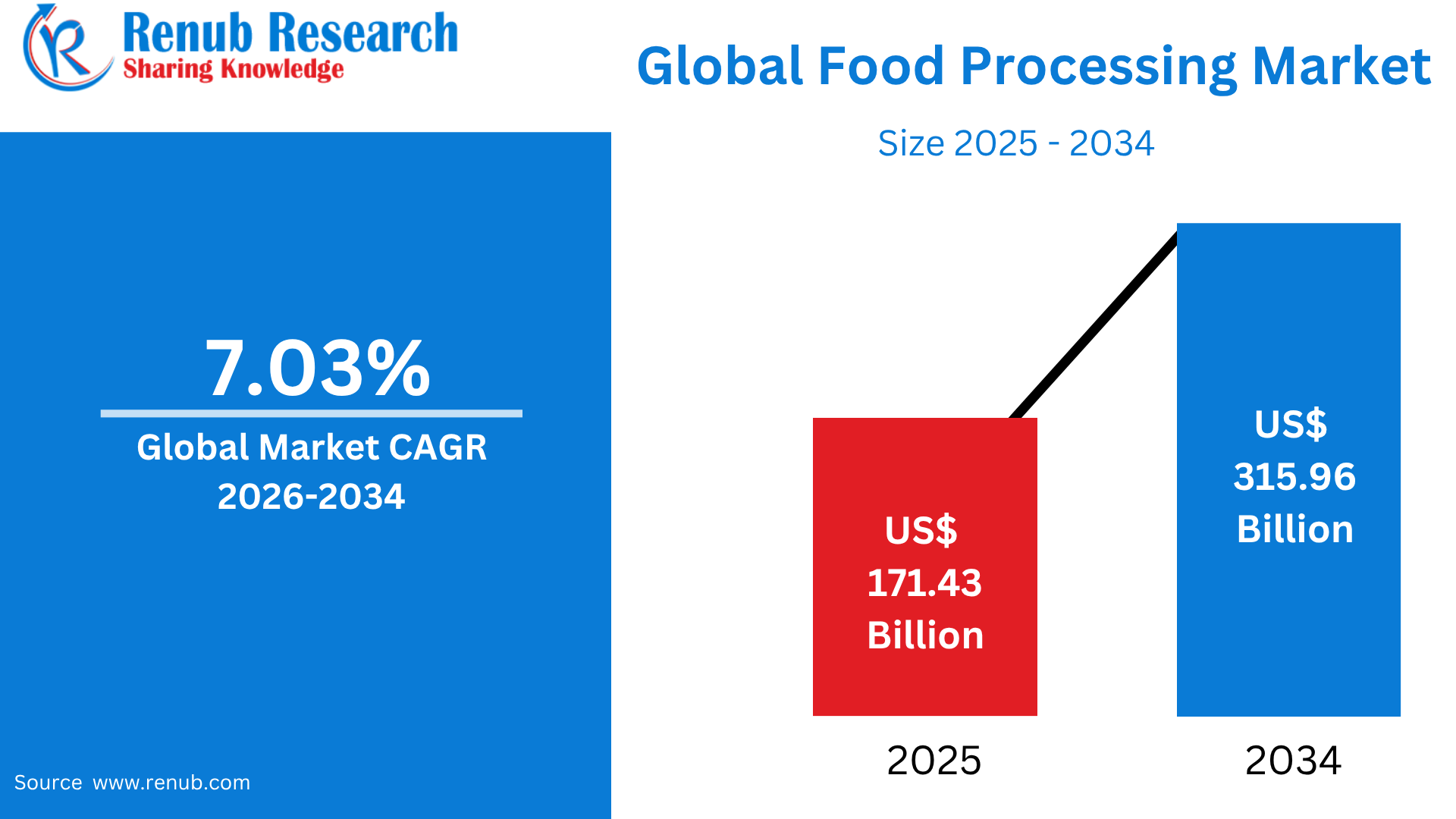
The Food Processing Market is projected to grow from US$ 171.43 billion in 2025 to US$ 315.96 billion by 2034, registering a CAGR of 7.03% during 2026–2034. Market expansion is being supported by increasing consumer demand for convenient and ready-to-eat food products, rapid urbanization, evolving dietary preferences, and advancements in food processing technologies. Growing emphasis on food safety, quality, preservation, and extended shelf life is also encouraging manufacturers to adopt modern processing and packaging solutions.
What is Food Processing and Its Uses & Popularity Worldwide
Food processing refers to the transformation of raw agricultural ingredients into food products that are safer, more convenient, nutritious, and suitable for longer storage. It includes a wide range of activities such as cleaning, sorting, grinding, milling, cooking, freezing, drying, fermentation, pasteurization, canning, and packaging. Food processing is used for products including dairy items, meat and seafood, fruits and vegetables, grains, bakery products, beverages, frozen foods, snacks, and ready-to-eat meals.
Food processing plays an important role in extending shelf life, improving food safety, reducing wastage, maintaining quality, and increasing convenience for consumers. Modern processing technologies also help manufacturers develop products with improved nutritional profiles, controlled ingredients, and specialized dietary characteristics.
The popularity of processed foods is increasing worldwide due to urbanization, changing lifestyles, rising disposable incomes, busy work schedules, and growing demand for convenient meals. Ready-to-eat and ready-to-cook products are particularly popular among urban consumers. Technological developments in automation, preservation, packaging, and cold-chain systems are further strengthening the global food processing industry.
Indian Government Food Processing Initiatives
- Production Linked Incentive Scheme for Food Processing Industries (PLISFPI): As of December 2025, 168 applications had been approved under PLISFPI, attracting more than US$1.04 billion (Rs. 9,200 crore) in investments. The scheme has created approximately 34–35 lakh MT per year of processing capacity and generated around 3.29 lakh direct and indirect jobs. Exports of products supported by the scheme have increased at an estimated 7.4% CAGR since its inception.
- PM Formalisation of Micro Food Processing Enterprises (PMFME): The FY26 Union Budget allocated US$226.31 million (Rs. 2,000 crore) to PMFME. The initiative focuses on strengthening micro food-processing businesses, formalizing enterprises, improving technology adoption, and developing rural food-processing value chains.
- Food Processing Sector Budget Allocation: For FY27, the Government of India allocated approximately US$459.88 million (Rs. 4,064 crore) to the Ministry of Food Processing Industries (MoFPI). This represents an increase of around 13.79% compared with the FY26 revised estimate of US$404.14 million (Rs. 3,571.57 crore).
- Animal Husbandry Infrastructure Development Fund (AHIDF): The AHIDF promotes private investment in animal-husbandry infrastructure through an overall outlay of US$3.5 billion (Rs. 29,610 crore) and provides a 3% interest subvention. By December 2025, approximately 465 projects worth US$2.55 billion (Rs. 21,563 crore) had been approved.
- Enhancing Global Competitiveness: PLISFPI has a total outlay of approximately US$1.23 billion (Rs. 10,900 crore). The scheme has attracted more than US$1.04 billion (Rs. 9,200 crore) in investments, created around 35 lakh MT of processing capacity, and supported approximately 3.3 lakh jobs, helping Indian food brands strengthen their global competitiveness.
- Turmeric Export Promotion: India is supporting turmeric exports through the SPICED scheme, which emphasizes quality certification, value addition, post-harvest infrastructure, and domestic and international market linkages. The initiative is complemented by the National Turmeric Board, which focuses on strengthening the turmeric value chain and export opportunities.
- Pradhan Mantri Kisan SAMPADA Yojana (PMKSY): Around 1,607–1,618 food-processing and preservation projects had been approved under PMKSY by late 2025/early 2026, with approximately 1,185–1,196 projects completed and operationalized. These projects have benefited an estimated 36–51 lakh farmers across India.
- APEDA BHARATI Initiative: APEDA introduced Bharat’s Hub for Agritech, Resilience, Advancement and Incubation for Export Enablement (BHARATI) to support 100 agri-food and agri-tech startups. The initiative aims to encourage innovation, strengthen export readiness, and contribute toward India’s target of approximately Rs. 4,28,450 crore (US$50 billion) in agri-food exports of scheduled products by 2030.
- PMKSY Farm-to-Retail Infrastructure: PMKSY, administered by MoFPI, aims to develop modern food-processing infrastructure and improve supply-chain management from farm to retail. Its objectives include improving farmer returns, reducing agricultural wastage, generating rural employment, increasing food-processing levels, and supporting processed-food exports.
- Agro Processing Cluster Scheme: The Agro Processing Cluster component of PMKSY promotes modern infrastructure and common facilities through a cluster-based approach. Clusters connect farmers and producers with processors and markets and can include roads, water, electricity, drainage, ETPs, warehouses, cold storage, IQF, Tetra Pak facilities, sorting, and grading infrastructure. Each cluster requires at least 5 food-processing units, a minimum investment of Rs. 25 crore (approximately US$3 million), and at least 10 acres of land arranged through purchase or a lease of at least 50 years.
- Integrated Cold Chain and Value Addition Infrastructure: This PMKSY component aims to establish an uninterrupted cold chain from farm to consumer, covering pre-cooling, temperature-controlled storage, packing, transportation, and distribution. The infrastructure supports products including horticulture, dairy, meat, and other perishables.
- Cold Chain Capacity: As of October 2023, 372 completed cold-chain projects had created approximately 10.3 lakh MT of cold storage/CA/MA storage and deep-freezer capacity. The projects also included around 335 MT per hour of IQF capacity, 175.8 lakh litres per day of milk processing/storage capacity, and 1,860 reefer vehicles.
- Growing Milk Production: India’s milk production increased from 146.31 million tonnes in 2014–15 to 247.87 million tonnes in 2024–25, representing a CAGR of approximately 5.41% over 11 years. This expansion strengthens the country’s dairy-processing and value-addition potential.
- Mega Food Park Scheme: The Mega Food Park scheme was introduced under PMKSY to connect agricultural production with processors, retailers, and consumers. The parks use a cluster-based model incorporating collection centres, processing facilities, cold-chain infrastructure, and developed plots for food-processing businesses. Of 41 approved projects, 24 were operational as of December 2023.
- PMFME Scheme: MoFPI implemented the PM Formalisation of Micro Food Processing Enterprises Scheme nationwide to provide micro food-processing businesses with financial, technical, and business support. The scheme aims to help enterprises upgrade facilities, improve production capabilities, formalize operations, and strengthen market access.
- One District One Product (ODOP): The ODOP component under PMFME promotes economies of scale in the procurement of inputs, use of common infrastructure, and marketing of processed food products. ODOP had been approved for 713 districts across 35 States/UTs, covering 137 unique products, supporting localized value chains and regional food specialties.
- Branding and Marketing Support: The branding and marketing component provides a 50% financial grant to eligible groups of Farmer Producer Organizations (FPOs), Self-Help Groups (SHGs), and cooperatives. The support helps these groups promote existing or proposed brands and expand the market reach of processed food products.
- Tax Incentives for Food Processing: Eligible food-processing units can receive 100% profit deduction for the first five years, followed by a 25% deduction for the subsequent five years, with the rate reaching 30% for qualifying companies. A 100% deduction on capital expenditure is also permitted for specified cold-chain and warehouse investments.
- Priority Sector Lending: Loans provided to food and agro-based processing units, as well as cold-chain infrastructure, are classified under agriculture-related activities for Priority Sector Lending (PSL). This classification improves financing opportunities for eligible businesses involved in food processing and associated infrastructure.
- Foreign Direct Investment (FDI): India permits 100% Foreign Direct Investment (FDI) in the food-processing sector under the automatic route, enabling foreign investors to enter the sector without requiring prior government approval, subject to applicable regulations.
Growth Drivers of the Food Processing Market
Rising Demand for Convenience and Ready-to-Eat Foods
The growing preference for convenient, ready-to-eat, frozen, packaged, and minimally prepared foods is a major driver of the food processing market. Urbanization, longer working hours, and changing household structures are encouraging consumers to choose products that reduce cooking and preparation time. According to the United Nations, around 56% of the world’s population lived in urban areas in 2023, and this share is projected to approach 70% by 2050, supporting demand for convenient food products. Processed foods also offer longer shelf life, easier transportation, and consistent quality. Manufacturers are responding by introducing microwaveable meals, frozen foods, packaged snacks, processed meat, sauces, and convenience beverages. Rising disposable incomes in emerging economies are further increasing consumers’ willingness to pay for convenience and premium processed products. Retail expansion through supermarkets, convenience stores, and e-commerce platforms is improving product accessibility. As consumers increasingly prioritize convenience without compromising taste, nutrition, and safety, demand for technologically advanced food processing solutions is expected to remain strong worldwide.
Technological Advancements and Automation
Rapid technological development is transforming food processing operations by improving productivity, efficiency, quality, and food safety. Automation, robotics, artificial intelligence, Internet of Things (IoT) systems, advanced packaging, and digital monitoring are increasingly being incorporated into processing facilities. The International Federation of Robotics reported that approximately 541,000 industrial robots were installed worldwide in 2023, demonstrating the broader expansion of automation across industries, including food manufacturing. Advanced processing technologies such as high-pressure processing, aseptic processing, freeze-drying, and membrane filtration are helping manufacturers extend shelf life while maintaining nutritional quality and sensory characteristics. Automated inspection systems can also identify foreign materials, packaging defects, and inconsistencies more efficiently than conventional manual processes. In addition, predictive maintenance and real-time production monitoring help reduce downtime and operating costs. Food manufacturers are investing in these technologies to address labor shortages, improve consistency, and meet increasingly stringent safety requirements. Continued innovation in smart factories and digital processing systems is therefore expected to support long-term market expansion.
Growing Population and Changing Food Consumption Patterns
Population growth and changing dietary preferences are creating sustained demand for processed food products across both developed and emerging economies. The United Nations estimates that the global population reached approximately 8.2 billion in 2024, creating a larger consumer base for food manufacturers. Rising middle-class populations in Asia, Africa, and Latin America are also increasing consumption of packaged, processed, and higher-value food products. Consumers are increasingly seeking products with additional nutritional benefits, including high-protein, fortified, organic, plant-based, low-sugar, and functional foods. At the same time, changing lifestyles are encouraging greater consumption of snacks, beverages, frozen meals, processed grains, and prepared foods. Manufacturers are adapting their portfolios to accommodate regional tastes, dietary preferences, and nutritional requirements. Food processing also helps convert agricultural products into stable and transportable products, reducing seasonal limitations and supporting wider distribution. As population growth, urbanization, income growth, and evolving dietary habits continue, food manufacturers are expected to expand production capacity and introduce more diversified processed food products.
Challenges of the Food Processing Market
Rising Raw Material and Energy Costs
Volatility in the prices of agricultural commodities, energy, packaging materials, and transportation represents a major challenge for food processors. Prices of wheat, corn, sugar, edible oils, dairy ingredients, meat, and other agricultural inputs can fluctuate because of weather conditions, geopolitical disruptions, supply-chain constraints, and changes in global demand. Energy-intensive activities such as refrigeration, freezing, drying, baking, and thermal processing also expose manufacturers to rising electricity and fuel costs. The World Bank’s commodity outlook has repeatedly highlighted the sensitivity of food prices to weather, energy markets, and geopolitical developments. Higher input costs can reduce manufacturers’ profit margins and force companies to increase retail prices. Smaller processors are particularly vulnerable because they generally have less purchasing power and limited ability to absorb cost increases. Companies are therefore investing in energy-efficient machinery, local sourcing, waste reduction, and improved supply-chain management to control expenses. However, maintaining competitive prices while protecting product quality and profitability remains a continuing challenge for the global food processing industry.
Stringent Food Safety Regulations and Environmental Concerns
Food processors face increasingly strict regulations related to food safety, labeling, additives, traceability, packaging, hygiene, and environmental sustainability. Governments and regulatory authorities are strengthening standards to reduce contamination risks and protect consumers. According to the World Health Organization, approximately 600 million people worldwide become ill after consuming contaminated food each year, highlighting the importance of effective food safety systems. Manufacturers must therefore invest heavily in testing, quality control, sanitation, traceability, and compliance infrastructure. At the same time, environmental concerns surrounding plastic packaging, food waste, water consumption, and greenhouse-gas emissions are increasing pressure on processors to adopt sustainable production methods. The UN Environment Programme estimates that around 1.05 billion tonnes of food waste were generated in 2022, demonstrating the scale of inefficiency across food systems. Companies are responding through recyclable packaging, resource-efficient processing, renewable energy, and waste-reduction initiatives. Nevertheless, implementing these measures can increase operating and capital costs, creating challenges particularly for small and medium-sized food processors.
Food Processing Launches Worldwide
- JBT Marel Efficient Agitation (EA) Retort – United States
- Launched as a preservation solution for food processors.
- Supports pouches, tubs, cups, glass containers, and other packaging formats.
- Designed to improve sterilization efficiency and reduce processing time.
- PPM Technologies BatchWright™ Frying System – United States
- Introduced in June 2025.
- Designed for kettle-style potato chips and root-vegetable snacks.
- Focuses on improving frying consistency and production efficiency.
- PPM Technologies CookWright™ Continuous Frying System – Worldwide
- Introduced in March 2025.
- Designed for continuous frying applications in snack-food processing.
- Supports automated and consistent production operations.
- Key Technology & PPM Fully Integrated Nut Processing Line – United States
- Introduced in April 2025.
- Integrates grading, sorting, oil roasting, seasoning, and related processing operations.
- Designed for almonds, walnuts, pistachios, peanuts, cashews, and other nuts.
- Guanfeng GFD-200S Freeze Dryer – China
- Launched in October 2025.
- Developed for large-scale freeze-drying of fruits, vegetables, mushrooms, meat, and other foods.
- Features modular construction and intelligent control systems.
- JBT Marel A&B Process Systems CIPure Cleaning System – Worldwide
- Introduced as a digitally controlled clean-in-place solution.
- Designed for food, dairy, beverage, and pharmaceutical processing facilities.
- Focuses on reducing water, chemical, and steam consumption while minimizing downtime.
- Emerson AVENTICS DS1 Dewpoint Sensor – Worldwide
- Launched in 2025 for food-processing plant applications.
- Measures dew point, temperature, and humidity in compressed air and other gases in real time.
- Helps identify excess moisture and protect processing equipment.
- Heron Innovators Suspended Air Flotation (SAF) System – United States
- Introduced for food, dairy, and animal-product processing industries.
- Designed to improve solid-liquid separation and produce cleaner effluent.
- Its compact design supports higher hydraulic-flow and solids-loading capacity.
- Ross PFA-Coated Ribbon Blender – United States
- Introduced for sensitive and challenging food-processing applications.
- Features a PFA-coated interior to help prevent contamination and corrosion.
- The coating also supports easier material release and cleaning.
- Fortifi Food Processing Solutions Platform – Global
- Launched in March 2024 as a global food-processing automation platform.
- Operates across 15+ countries and five continents.
- Provides technologies for protein, dairy, fruits and vegetables, and other food-processing applications.
High-Efficiency Filtration for Food Safety
HEPA filtration is becoming increasingly relevant in food processing environments where controlling airborne particles, microorganisms, and contaminants is important for maintaining hygiene. HEPA filters are generally designed to capture at least 99.97% of particles measuring 0.3 microns under standard test conditions, making them useful in controlled production areas. Food manufacturers use HEPA filtration in processing rooms, packaging areas, cold rooms, laboratories, and other hygiene-sensitive zones. The growing emphasis on food safety, contamination prevention, and controlled manufacturing environments is supporting demand for advanced air filtration. HEPA systems can also complement existing ventilation and clean-air systems by reducing airborne particulate loads. Their application is particularly valuable in facilities producing ready-to-eat foods, dairy products, beverages, pharmaceuticals-linked foods, and other sensitive products. Increasing automation and modernization of food factories are encouraging manufacturers to integrate filtration technologies into production infrastructure. Although HEPA systems require periodic inspection, cleaning, or replacement, their ability to support controlled air quality makes them an important technology for modern food-processing facilities.
Efficient Removal of Airborne Grease and Particles
Electrostatic precipitators are gaining attention in food-processing and commercial kitchen environments because they can remove airborne grease, smoke, oil aerosols, and fine particulate matter from exhaust air. These systems use an electrical charge to capture particles as contaminated air passes through the filtration unit. Electrostatic precipitators can achieve high particle-collection efficiency while creating relatively low resistance to airflow compared with some conventional filtration arrangements. In food-related facilities, they can be used in cooking operations, food manufacturing plants, institutional kitchens, and processing areas where airborne emissions need to be controlled. Commercial kitchen applications represent an important area, with industry estimates indicating that commercial kitchens accounted for approximately 70% of the application share in 2024 for kitchen electrostatic precipitators. Their popularity is also supported by growing attention to ventilation, indoor air quality, and emissions management. Regular cleaning and maintenance remain important because grease accumulation can reduce performance. As food facilities modernize ventilation systems, electrostatic technology can provide an efficient option for particulate and aerosol control.
Expanding Demand from Commercial and Industrial Facilities
Commercial food processing represents a major application area for modern processing, filtration, ventilation, and hygiene technologies. Food manufacturers increasingly require equipment capable of maintaining consistent production quality while meeting stringent sanitation and workplace requirements. Commercial facilities include food factories, bakeries, beverage plants, meat and seafood processing units, dairy facilities, catering operations, and large institutional kitchens. Automation is becoming increasingly important, with manufacturers using advanced equipment to improve throughput, reduce manual handling, and maintain consistent product quality. In India, the food-processing sector includes a large and diverse base of registered and unincorporated enterprises, highlighting the importance of processing activities across the broader food economy. Commercial facilities also increasingly focus on energy efficiency, air quality, waste reduction, and production optimization. Modern ventilation and filtration systems help facilities manage airborne contaminants, heat, moisture, and processing emissions. As urban populations expand and demand for packaged, processed, ready-to-eat, and convenience foods increases, commercial processing facilities are expected to continue investing in improved production and environmental-control technologies.
Growing Adoption of Convenient Food-Preparation Equipment
The residential food-processing segment is supported by increasing consumer interest in convenient, faster, and more efficient food preparation. Household food-processing equipment includes food processors, mixers, grinders, blenders, slicers, juicers, and other appliances that reduce preparation time. Busy lifestyles, dual-income households, urbanization, and growing interest in home cooking are encouraging consumers to use multifunctional kitchen appliances. Demand is also influenced by changing dietary preferences, including increased preparation of fresh foods, smoothies, plant-based meals, sauces, and homemade snacks. Product innovation is improving convenience through compact designs, multiple attachments, automated settings, and easier cleaning. Energy efficiency is another consideration as households increasingly evaluate appliance operating costs. Unlike large commercial facilities, residential users generally prioritize affordability, ease of operation, compactness, and multifunctionality. E-commerce has also expanded consumer access to food-processing appliances by providing broader product choices and enabling price comparisons. As households continue seeking convenient ways to prepare fresh and customized meals, residential food-processing equipment is likely to maintain steady demand.
Physical Retail Channels Remain Important
The offline food-processing market refers to the sale and distribution of food-processing equipment and related products through physical retail stores, appliance outlets, supermarkets, specialty stores, distributors, and other conventional channels. Despite the expansion of e-commerce, offline channels remain important because customers can physically inspect equipment, compare product sizes, evaluate build quality, and receive assistance from sales representatives. This is particularly relevant for expensive commercial food-processing machinery, where buyers may require demonstrations, technical consultations, installation support, and after-sales service. Offline distributors also play an important role in supplying equipment to restaurants, hotels, bakeries, food manufacturers, and institutional kitchens. Physical retail remains particularly valuable in markets where consumers prefer purchasing appliances after seeing the product in person. Service networks and local distributors can further strengthen offline sales by providing maintenance, spare parts, and technical support. The channel is therefore expected to remain relevant alongside online sales, particularly for commercial and industrial equipment where professional consultation and installation services influence purchasing decisions.
Advanced Infrastructure and Strong Consumer Demand in the USA
United States food processing market is well established, supported by advanced manufacturing infrastructure, sophisticated distribution networks, and a large consumer base. Demand is strongly influenced by the popularity of convenience foods, ready-to-eat meals, packaged foods, and processed beverages, particularly among consumers with busy lifestyles. Food manufacturers are increasingly investing in automation, advanced processing equipment, and quality-control technologies to improve efficiency and consistency. Consumer preferences are also shifting toward organic, clean-label, functional, and nutritionally improved products, encouraging manufacturers to reformulate existing offerings. Strict food safety requirements further support investment in modern processing, testing, traceability, and packaging systems. The continued expansion of e-commerce and online grocery platforms is improving access to processed food products and allowing manufacturers to reach consumers through additional distribution channels. Sustainability is another important consideration, with companies increasingly focusing on recyclable packaging, waste reduction, and energy-efficient production. Together, technological innovation, changing dietary preferences, strong retail infrastructure, and demand for convenience are supporting continued development of the U.S. food processing industry.
Convenience, Health, and Product Reformulation in UK
United Kingdom food processing market is supported by strong consumer demand for packaged, convenient, and ready-to-eat food products. Busy lifestyles and urban living have increased the importance of products that require limited preparation time. At the same time, consumers are becoming more attentive to nutrition, encouraging manufacturers to introduce organic, natural, sustainably sourced, and clean-label products. Food companies are increasingly reformulating products to reduce sugar, salt, and saturated fat, while developing alternatives with higher nutritional value. The UK’s established food safety and labeling requirements also encourage manufacturers to maintain consistent quality and strengthen traceability throughout the production process. Private-label products offered by supermarkets contribute significantly to competition, giving consumers a broad range of affordable alternatives. Online grocery shopping and home-delivery services have further expanded access to processed food products. Manufacturers are also adopting automation, improved packaging, and resource-efficient processing technologies to control costs and meet sustainability expectations. These factors, combined with evolving dietary preferences and strong modern retail infrastructure, continue to shape the UK’s food processing industry.
Urbanization and Expanding Demand for Convenient Foods in China
China’s food processing market is expanding as urbanization, rising household incomes, and changing dietary habits reshape food consumption patterns. Consumers in major cities increasingly prefer packaged, processed, frozen, and ready-to-eat products because of increasingly busy lifestyles and greater demand for convenience. The expansion of the middle-income population is also supporting demand for premium, nutritious, and specialized food products. Food manufacturers are investing in modern processing technologies, automation, cold-chain infrastructure, and quality-control systems to improve production efficiency and product safety. Food safety remains a major consideration, encouraging stronger regulatory oversight, traceability, and manufacturing standards. The development of e-commerce and digital retail platforms has significantly broadened access to processed food products, particularly among younger consumers. Domestic manufacturers and international companies are also introducing products tailored to regional tastes and changing nutritional preferences. Improvements in logistics and distribution infrastructure are strengthening the connection between processing facilities and consumers. As urban populations continue to expand and convenience becomes increasingly important, China’s food processing sector is positioned for continued development.
Food Security, Imports, and Premium Consumption in UAE
UAE food processing market is developing steadily, supported by strong demand for packaged, convenience, ready-to-eat, and premium food products. The country’s dependence on food imports, combined with its highly diverse population, creates demand for a broad range of processed foods from different cuisines and regions. Rising disposable incomes and modern lifestyles are encouraging consumers to purchase convenient and higher-value food products. Government initiatives focused on food security and strengthening domestic food production are also encouraging investment in local processing capacity and related infrastructure. Modern supermarkets, hypermarkets, convenience stores, hotels, restaurants, and foodservice businesses provide extensive distribution opportunities for processed food manufacturers. The UAE’s advanced logistics infrastructure further supports the movement of raw materials and finished products. Food processors are increasingly adopting modern technologies to improve production efficiency, food safety, packaging, and shelf life. Consumer interest in healthier, premium, and sustainably produced foods is also influencing product development. Together, government food-security initiatives, strong retail infrastructure, diverse consumer demand, and technological development are supporting the continued expansion of food processing activities in the UAE.
Food Processing Market Segments
Technology – Market breakup in 5 viewpoints:
- HEPA (High Efficiency Particulate Air)
- Activated Carbon
- Ionic Filters
- Electrostatic Precipitator
- Others
Application– Market breakup in 3 viewpoints:
- Commercial
- Industrial
- Residential
Distribution Channel– Market breakup in 2 viewpoints
- Offline
- Online
Countries– Market breakup in 25 Countries:
North America
- United States
- Canada
Europe
- France
- Germany
- Italy
- Spain
- United Kingdom
- Belgium
- Netherlands
- Turkey
Asia Pacific
- China
- Japan
- India
- Australia
- South Korea
- Thailand
- Malaysia
- Indonesia
- New Zealand
Latin America
- Brazil
- Mexico
- Argentina
Middle East & Africa
- South Africa
- Saudi Arabia
- UAE
All the Key players have been covered from 4 Viewpoints:
- Overview
- Key Person
- Recent Development
- Revenue
Key Company Covered
- Marel
- GEA Group AG
- The Bühler Holding AG
- JBT Corporation
- Alfa Laval AB
- TNA Solution Pty Ltd
- Bucher Industries AG
- Equipamientos Cárnicos, S.L.
- SPX Flow
- Krones AG
Report Details:
| Report Features | Details |
| Base Year |
2024 |
| Historical Period |
2020 - 2024 |
| Forecast Period |
2025 - 2033 |
| Market |
US$ Billion |
| Segment Covered |
By Type, By Category, By Application and By Countries |
| Countries Covered |
|
| Companies Covered |
|
| Customization Scope |
20% Free Customization |
| Post-Sale Analyst Support |
1 Year (52 Weeks) |
| Delivery Format |
PDF and Excel through Email (We can also provide the editable version of the report in PPT/Word format on request) |
- -Analysis of Market Size and Its Segments
- More Company Profiles (Upto 10 without any additional cost):
- Additional Countries (Other than mentioned Countries):
- Region/Country Specific Reports:
- Market Entry Strategy:
- Region-Specific Market Dynamics:
- Regional Market Share Analysis:
- Trade Analysis:
- Production Insights:
- Others Customized Requests:
For more information contact our analysts.
Need More Assistance?
- Talk to our analysts to get more precious information on the current market trends.
- Include more countries and segments and customize the report based on the final requirement.
- Get a competitive advantage in your industry by knowing the report findings and making a positive impact on your revenues and operations.
- Our analysts are always ready to provide more help and pertinent information if you need any additional assistance.