Global Eyewear Market Report by Product, End User, Distribution Channel, Countries and Company Analysis 2026-2034
Buy NowGlobal Eyewear Market Size & Forecast
The global eyewear market is projected to grow from US$ 174.52 billion in 2025 to US$ 279.68 billion by 2034, registering a CAGR of 5.38% during 2026–2034. Market expansion is being supported by the rising prevalence of vision-related disorders, increasing exposure to digital screens, and growing consumer interest in fashionable and premium eyewear products. Technological advancements in lens materials and designs, combined with the expanding availability of daily disposable products, are further improving consumer convenience and adoption.
What is Eyewear and Its Uses & Popularity Worldwide
Eyewear refers to optical and protective products worn on or around the eyes to improve vision, protect the eyes, or enhance personal appearance. Major categories include prescription eyeglasses, sunglasses, contact lenses, reading glasses, and specialty protective eyewear. Prescription glasses and contact lenses are primarily used to correct refractive errors such as myopia, hyperopia, astigmatism, and presbyopia, while sunglasses help protect the eyes from ultraviolet (UV) radiation and reduce glare. Protective eyewear is widely used in industrial, healthcare, sports, and other environments where eye protection is required.
Eyewear has become increasingly popular worldwide because of the growing prevalence of vision problems, greater awareness of eye health, and rising exposure to computers, smartphones, and other digital devices. In addition to their functional role, glasses and sunglasses have become important fashion accessories, with consumers increasingly choosing branded, designer, lightweight, and customized products. Online optical retailers and digital eye-care services have also improved accessibility. Rising disposable incomes, product innovation, and expanding optical retail networks are supporting continued demand for eyewear across developed and emerging markets.
Key facts
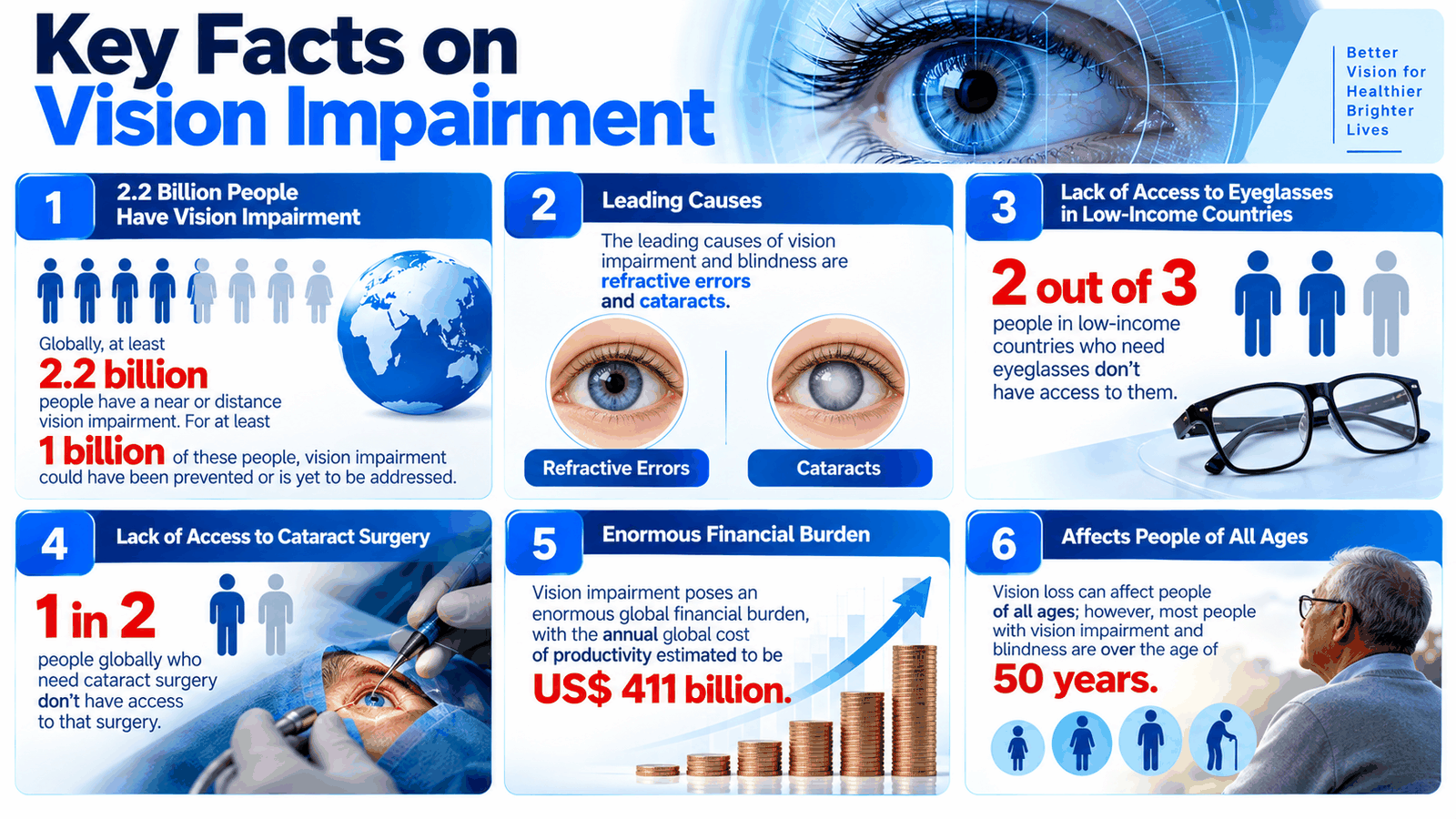
- Globally, at least 2.2 billion people have a near or distance vision impairment. For at least 1 billion of these people, vision impairment could have been prevented or is yet to be addressed.
- The leading causes of vision impairment and blindness are refractive errors and cataracts.
- It is estimated that 2 out of 3 people in low-income countries who need eyeglasses don’t have access to them.
- In addition, 1 in 2 people globally who need cataract surgery don’t have access to that surgery.
- Vision impairment poses an enormous global financial burden, with the annual global cost of productivity estimated to be US$ 411 billion.
- Vision loss can affect people of all ages; however, most people with vision impairment and blindness are over the age of 50 years.
Blindness – A Preventable Tragedy
The global burden of vision loss is expected to increase significantly due to population growth, ageing, and changing lifestyles. Without adequate investment in eye-care services, projections indicate that 1.76 billion people could experience vision loss by 2050. This growing burden highlights the need to make eye health a greater priority within global public health and sustainable development efforts.
However, approximately 90% of vision loss is preventable or treatable, demonstrating that effective interventions are already available. Routine eye examinations, access to appropriate eyeglasses, and cataract surgery can address a large proportion of avoidable vision impairment. Improving access to these basic services can therefore make a substantial difference, particularly among underserved populations.
The Organization for the Prevention of Blindness (OPC) focuses on strengthening eye-health systems and promoting the right to sight among vulnerable communities in Francophone Africa. These populations face additional challenges because the region receives considerably less financial support for quality eye-care services compared with Anglophone Africa, increasing their vulnerability to preventable vision loss.
Myopia is a common cause of correctable vision loss, with uncorrected myopia remaining the leading cause of distance vision impairment globally. Individual studies show variations in the prevalence of myopia and high myopia across regions and ethnic groups. A recent landmark publication estimates that by 2050, half the world population will have myopia.
Market Growth
Rising Prevalence of Vision Disorders
The increasing global burden of vision impairment is a major growth driver for the eyewear market. According to the World Health Organization (WHO), at least 2.2 billion people worldwide live with near or distance vision impairment, while at least 1 billion cases could have been prevented or remain unaddressed. Uncorrected refractive errors are an important contributor, creating sustained demand for prescription eyeglasses, contact lenses, and other corrective eyewear. Presbyopia is another significant opportunity, with WHO estimating that the number of people affected could increase from 1.8 billion in 2015 to 2.1 billion by 2030. Population ageing is expected to further increase demand for reading glasses and multifocal or progressive lenses. In addition, growing awareness of regular eye examinations is encouraging consumers to seek corrective solutions earlier. Emerging economies represent particularly strong opportunities because around 90% of people with vision impairment or blindness live in low- and middle-income countries. These trends are expanding the addressable consumer base and supporting long-term global eyewear demand.
Increasing Digital Screen Exposure and Changing Lifestyles
Increasing dependence on smartphones, computers, tablets, and other digital devices is strengthening demand for eyewear and specialized lens solutions. Modern lifestyles involve prolonged screen exposure for work, education, entertainment, and communication, encouraging greater attention to visual comfort and eye health. Consumers are increasingly interested in products such as blue-light filtering lenses, anti-reflective coatings, photochromic lenses, and computer glasses. At the same time, urbanization and changing lifestyles are contributing to a greater need for vision correction. WHO identifies changing lifestyles, urbanization, population growth, and ageing among important factors associated with the increasing global burden of eye conditions and vision impairment. The economic consequences are also substantial: WHO estimates that unaddressed vision impairment results in approximately US$410.7 billion in annual global productivity losses. This creates an economic incentive for individuals and employers to address vision problems and improve access to corrective eyewear. Consequently, increasing digital dependence and growing awareness of visual health are encouraging consumers to purchase functional, protective, and prescription eyewear.
Premiumization, Fashion Trends, and Product Innovation
Eyewear is increasingly shifting from being purely a vision-correction product to a combination of healthcare, lifestyle, and fashion accessory, creating opportunities for premium and designer products. Consumers are increasingly purchasing multiple pairs of eyeglasses and sunglasses for different occasions, including work, sports, travel, and fashion. Manufacturers are responding with lightweight frames, advanced lens coatings, photochromic technology, progressive lenses, customized designs, and premium materials. The expansion of digital retail is also allowing consumers to compare products, access a broader range of brands, and purchase eyewear through online channels. In addition, innovation in contact lenses, including daily disposable and specialized lenses, is expanding consumer choice beyond traditional spectacles. Rising disposable incomes in developing economies are supporting greater spending on branded and higher-quality optical products. Meanwhile, established markets benefit from replacement demand as consumers update frames and lenses as prescriptions, preferences, and fashion trends change. This combination of healthcare necessity and lifestyle consumption strengthens the value proposition of eyewear and supports continued market expansion globally.
Challenge
High Cost and Limited Access to Eye-Care Services
The high cost of quality eyewear and limited access to eye-care services remain significant challenges, particularly in low- and middle-income countries. Although spectacles are among the most straightforward solutions for many refractive errors, consumers may face expenses related to eye examinations, frames, lenses, contact lenses, and follow-up care. WHO estimates that at least 1 billion people have vision impairment that could have been prevented or has yet to be addressed, demonstrating the scale of unmet demand. The challenge is particularly severe in underserved rural and low-income communities, where optical retailers, trained eye-care professionals, and diagnostic services may be limited. WHO reports that the prevalence of distance vision impairment in low- and middle-income regions is estimated to be four times higher than in high-income regions. Affordability and accessibility therefore restrict the conversion of potential demand into actual eyewear purchases. Expanding affordable products, insurance coverage, mobile eye-care services, and retail networks could help reduce this gap, but disparities in healthcare infrastructure remain a constraint on market penetration.
Counterfeit Products and Quality Concerns
Counterfeit and low-quality eyewear can negatively affect consumer confidence, brand reputation, and market revenues. Unregulated products may be sold through informal retailers and online marketplaces at significantly lower prices than branded or professionally supplied eyewear. This creates pricing pressure for established manufacturers while potentially exposing consumers to products that do not meet appropriate optical, material, UV-protection, or safety standards. The issue is particularly relevant to sunglasses and fashion eyewear, where consumers may prioritize appearance and price over certified eye protection. At the same time, the rapid expansion of online eyewear sales can make it more difficult for consumers to distinguish authorized products from counterfeit merchandise. Quality concerns can also arise when prescription eyewear is purchased without adequate professional examination or fitting. The industry therefore needs stronger authentication systems, regulatory enforcement, professional dispensing, and consumer education. Manufacturers are increasingly emphasizing certified materials, traceable supply chains, branded technologies, and digital authentication to differentiate legitimate products. Addressing these concerns is important for maintaining consumer trust while supporting sustainable growth in the global eyewear market.
Eyewear Launches Worldwide
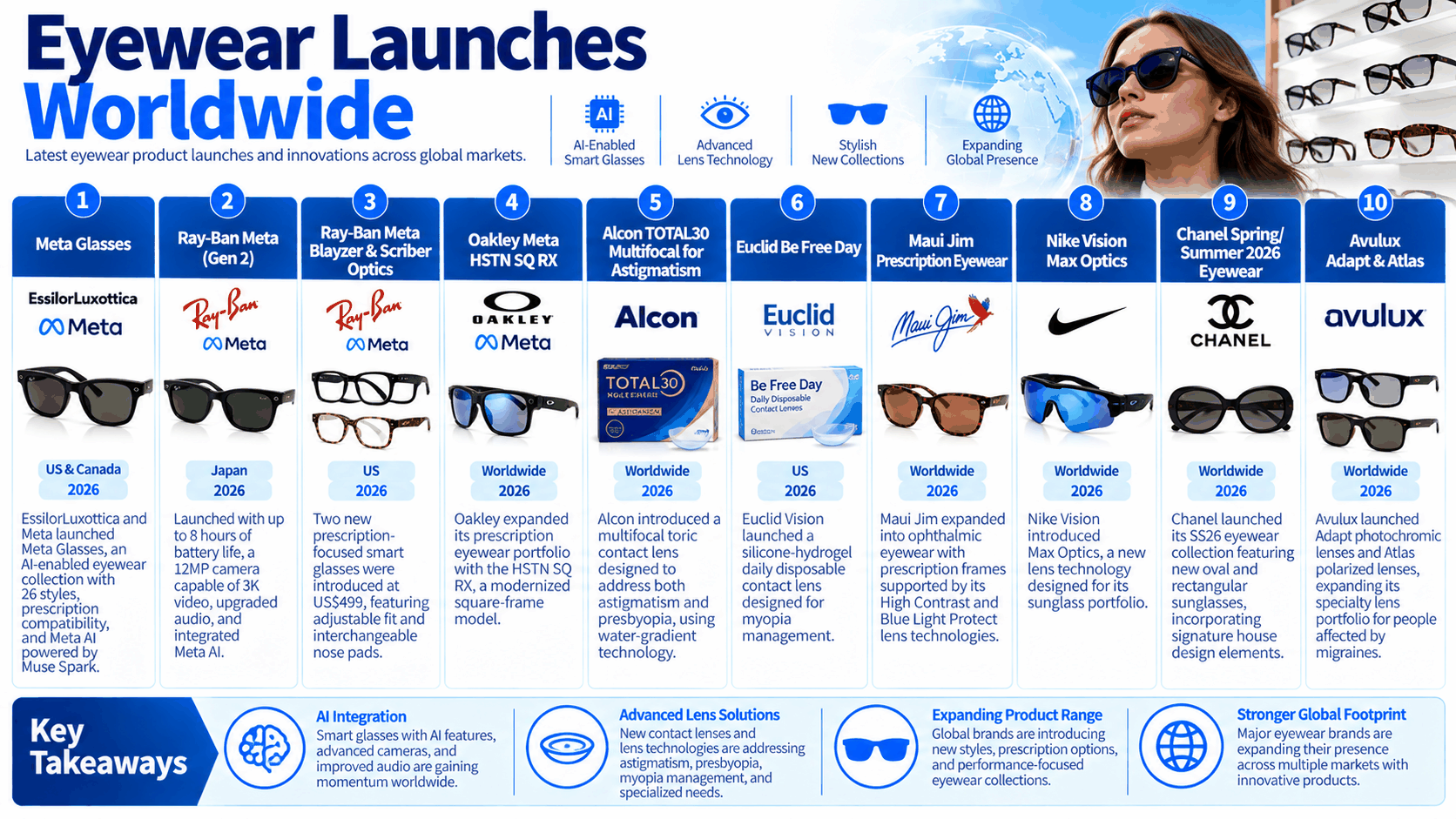
- Meta Glasses – US & Canada (2026): EssilorLuxottica and Meta launched Meta Glasses, an AI-enabled eyewear collection with 26 styles, prescription compatibility, and Meta AI powered by Muse Spark.
- Ray-Ban Meta (Gen 2) – Japan (2026): Launched with up to 8 hours of battery life, a 12MP camera capable of 3K video, upgraded audio, and integrated Meta AI.
- Ray-Ban Meta Blayzer & Scriber Optics – US (2026): Two new prescription-focused smart glasses were introduced at US$499, featuring adjustable fit and interchangeable nose pads.
- Oakley Meta HSTN SQ RX – Worldwide (2026): Oakley expanded its prescription eyewear portfolio with the HSTN SQ RX, a modernized square-frame model.
- Alcon TOTAL30 Multifocal for Astigmatism – Worldwide (2026): Alcon introduced a multifocal toric contact lens designed to address both astigmatism and presbyopia, using water-gradient technology.
- Euclid Be Free Day – US (2026): Euclid Vision launched a silicone-hydrogel daily disposable contact lens designed for myopia management.
- Maui Jim Prescription Eyewear – Worldwide (2026): Maui Jim expanded into ophthalmic eyewear with prescription frames supported by its High Contrast and Blue Light Protect lens technologies.
- Nike Vision Max Optics – Worldwide (2026): Nike Vision introduced Max Optics, a new lens technology designed for its sunglass portfolio.
- Chanel Spring/Summer 2026 Eyewear – Worldwide: Chanel launched its SS26 eyewear collection featuring new oval and rectangular sunglasses, incorporating signature house design elements.
- Avulux Adapt & Atlas – Worldwide (2026): Avulux launched Adapt photochromic lenses and Atlas polarized lenses, expanding its specialty lens portfolio for people affected by migraines.
High Global Need for Vision Correction
The spectacles segment remains a fundamental part of the global eyewear industry because refractive errors create a large and recurring need for vision correction. The WHO estimates that at least 2.2 billion people worldwide have near or distance vision impairment, with at least 1 billion cases preventable or yet to be addressed. Refractive error accounts for approximately 88.4 million cases of distance vision impairment, while unaddressed presbyopia affects around 826 million people. Eyeglasses are among the most cost-effective interventions for correcting these conditions. However, access remains uneven: approximately two out of three people in low-income countries who need eyeglasses do not have access to them. This substantial unmet need creates considerable growth opportunities, particularly in developing economies. Product innovation involving lightweight frames, progressive lenses, photochromic lenses, blue-light filtering, and customized designs is also supporting consumer demand. Increasing awareness of eye examinations, population ageing, and greater screen exposure are further contributing to spectacle adoption worldwide.
Convenience, Cosmetic Appeal, and Lifestyle Adoption
Contact lenses represent an important alternative to traditional spectacles, offering consumers vision correction without placing frames on the face. They are particularly attractive to younger consumers, professionals, athletes, and individuals seeking cosmetic flexibility. Contact lenses can correct common refractive errors, while specialized products can address conditions such as astigmatism and presbyopia. The WHO recognizes contact lenses alongside eyeglasses as an important intervention for refractive error correction. Demand is supported by innovations in daily disposable lenses, silicone-hydrogel materials, multifocal lenses, and lenses designed for improved comfort and oxygen permeability. Daily disposable products are particularly attractive because they reduce the need for cleaning and storage compared with reusable lenses. Growing interest in appearance and fashion is another factor supporting adoption, including cosmetic lenses in markets where they are appropriately regulated. However, professional fitting and proper hygiene remain important because inappropriate use can cause eye complications. Expanding optical services, consumer education, and improvements in lens materials are expected to support the long-term development of the contact lens segment.
Growing Demand for Fashionable and Functional Eyewear for Women
The women’s eyewear segment combines vision correction with fashion, lifestyle, and personal appearance, creating demand across spectacles, sunglasses, and contact lenses. Women increasingly view eyewear as an accessory that can complement clothing, professional appearance, and personal style, encouraging purchases of multiple frames and designs. At the same time, women have a significant unmet need for vision correction in many parts of the world. WHO’s 2025 data highlights that women are consistently less likely to receive the vision correction they need, alongside older adults and populations in low-income settings. This creates both a healthcare opportunity and a market opportunity for affordable and accessible women-focused eyewear. Manufacturers are responding with lightweight frames, customized shapes, premium materials, UV-protective sunglasses, photochromic lenses, and fashion-oriented designs. Color, frame shape, comfort, and brand positioning influence purchasing decisions, while online platforms allow consumers to access broader product selections. Increasing female participation in professional and urban lifestyles, greater awareness of eye health, and expanding disposable income are supporting demand for both corrective and fashion eyewear.
Professional Eye Care and Personalized Services
Optical stores remain an important distribution channel because they combine product availability with professional eye-care services. Consumers can receive vision examinations, prescription recommendations, frame fitting, lens selection, adjustments, and after-sales services through optical retailers. The importance of these stores is reinforced by the substantial global need for corrective eyewear. WHO estimates that at least 1 billion people have vision impairment that could have been prevented or remains unaddressed, creating significant potential for optical retailers to expand access. Optical stores are also increasingly adopting digital tools, including computerized eye examinations, digital measurements, virtual frame selection, and automated inventory systems. Organized optical chains are expanding their presence in emerging markets, while independent opticians continue serving local communities. Premium stores are focusing on designer frames, advanced lenses, and personalized consultations, whereas value-oriented outlets emphasize affordability. Optical retailers therefore benefit from both replacement demand and new customers requiring their first pair of corrective eyewear. Expansion into underserved cities and rural areas, combined with improved professional services, can further strengthen this distribution segment.
Digital Shopping and Expanding Consumer Accessibility
Online eyewear stores are gaining importance as consumers increasingly use digital platforms to research, compare, and purchase spectacles, sunglasses, and contact lenses. E-commerce provides access to a broader product selection and allows consumers to compare prices, frame designs, brands, and lens options without visiting multiple physical stores. Virtual try-on technology, facial measurements, prescription uploads, home delivery, and digital customer support are making online eyewear purchasing more convenient. The segment also has significant potential in regions where access to traditional optical stores is limited. WHO data shows that two out of three people in low-income countries who need eyeglasses do not have access to them, highlighting the importance of alternative distribution channels. Online platforms can help address accessibility through wider geographic coverage and affordable product ranges. However, prescription accuracy, product fitting, returns, and consumer trust remain important considerations. Companies are therefore integrating online platforms with physical stores, professional consultations, and home-based measurement services. Increasing smartphone penetration, digital payments, and consumer familiarity with e-commerce are expected to support continued growth of online eyewear retail.
Strong Demand for Advanced Vision-Correction Products in USA
United States eyewear market is highly developed, supported by strong awareness of eye health, high purchasing power, and widespread access to optometrists, ophthalmologists, and optical retailers. Increasing use of smartphones, computers, and other digital devices is strengthening demand for prescription glasses and specialized lens products. Consumers are showing growing interest in daily disposable contact lenses, blue-light-filtering glasses, and advanced lens technologies designed to improve comfort and visual performance. Rising cases of refractive conditions, including myopia and presbyopia, are creating sustained demand for corrective eyewear. The market also benefits from extensive retail networks and the rapid expansion of online optical platforms, which provide consumers with greater product choice and convenience. Fashion trends are another important factor, with designer frames, luxury eyewear, and customized styles attracting younger and premium consumers. Continuous product innovation, including silicone hydrogel lenses and advanced coatings, is further supporting adoption. Together, strong healthcare infrastructure, technological innovation, consumer awareness, and premium product demand position the United States as a major global eyewear market.
Premium Quality, Optical Expertise, and Sustainability in Germany
Germany has a mature eyewear market supported by advanced optical services, skilled professionals, and strong demand for high-quality vision products. Consumers generally place considerable emphasis on durability, precise lens engineering, advanced coatings, and comfortable frame materials. The country’s ageing population is supporting demand for progressive and multifocal lenses, while increasing digital-device exposure is encouraging interest in blue-light-filtering and computer eyewear. Germany also has a strong position in optical technology and manufacturing, supporting continued innovation in lenses, frames, and diagnostic equipment. Sustainability is becoming increasingly important, with consumers showing greater interest in recyclable materials, environmentally responsible manufacturing, and durable products. Optical stores and specialized retailers remain important distribution channels, providing professional fitting and personalized lens recommendations. At the same time, premium and designer eyewear continues to attract consumers seeking a combination of functionality and fashion. The presence of established optical companies, advanced healthcare services, and strong consumer purchasing power provides a stable foundation for the German eyewear market. These factors are expected to support continued demand for technologically advanced and sustainable eyewear products.
Myopia Burden and Rapid Digitalization Drive China Demand
China represents one of the world’s most dynamic eyewear markets, supported by widespread vision problems, rapid urbanization, rising household incomes, and increasing awareness of eye health. High exposure to smartphones, computers, tablets, and other digital devices is contributing to strong demand for prescription eyewear and products designed for visual comfort. Younger consumers are increasingly interested in daily disposable contact lenses, cosmetic lenses, blue-light-filtering glasses, and fashionable frames. The country’s expanding middle class is also increasing demand for premium and branded optical products. Improvements in optometry services and greater availability of professional eye examinations are helping consumers access appropriate vision-correction solutions. At the same time, domestic and international manufacturers are strengthening local production, research, and distribution capabilities to serve the large consumer base. E-commerce has become an important sales channel, allowing consumers to compare products and access affordable eyewear across different regions. Fashion-oriented designs and youth-focused marketing are further supporting demand. With its large population, high prevalence of myopia, expanding optical infrastructure, and rapidly developing digital retail ecosystem, China offers substantial long-term opportunities for eyewear manufacturers.
Young Consumers and Healthcare Modernization Support Saudi Arabia Expansion
Saudi Arabia’s eyewear market is developing steadily as awareness of vision care increases and consumers become more attentive to eye health and personal appearance. Growing exposure to smartphones, computers, and other digital devices is supporting demand for prescription glasses and specialized eyewear. The country’s relatively young population is also contributing to demand for contact lenses, sunglasses, fashionable frames, and cosmetic eyewear. Urban consumers are increasingly interested in premium products such as polarized sunglasses, designer frames, and daily disposable contact lenses. Expansion of optical retail networks and greater availability of professional eye-care services are improving consumer access to vision examinations and corrective products. Healthcare modernization under Saudi Vision 2030 is also supporting improvements in healthcare infrastructure and specialized medical services. International optical brands and retailers are strengthening their presence, while online channels are providing additional purchasing options. Rising disposable incomes and evolving lifestyle preferences are encouraging consumers to spend more on premium and fashion-oriented eyewear. As eye-health awareness, digital-device exposure, healthcare accessibility, and consumer purchasing power continue to increase, Saudi Arabia is expected to remain an important developing eyewear market in the Middle East.
Recent Developments in Global Eyewear Market
- February 2025 – EssilorLuxottica revealed plans to scale its smart-glasses output to 10 million units per year by 2026, supported by expanded manufacturing operations in China and Southeast Asia. The initiative aims to deepen its partnership with Meta and integrate more third-party brands into its smart eyewear ecosystem. Since the debut of Ray-Ban Meta smart glasses in September 2023, the company has sold over 2 million units, driven by rising user adoption and functionality upgrades.
- February 2025 – Innovative Eyewear introduced the Reebok Smart Eyewear collection at MIDO 2025 in Milan, featuring sport-oriented designs equipped with open-ear audio, voice-assistant compatibility, and customizable lenses. The models incorporate enhanced hi-fi speakers and improved amplification to deliver a richer audio experience for active consumers. The company also showcased upcoming innovations across its Lucyd, Nautica, and Eddie Bauer product lines.
- August 2024 – Innovative Eyewear partnered with Geenee Inc. to elevate the smart-eyewear shopping experience using advanced augmented-reality tools. The collaboration introduced the Lucyd Kiosk, a 5-foot-tall, 32-inch touchscreen system that provides virtual try-on, audio previews, and social-media-style content for retail environments. The firms also plan to offer an upgraded virtual try-on feature on Lucyd.co, along with personalized online ads that allow consumers to test eyewear virtually as they browse.
Global Eyewear Market Segments
Product
- Spectacles
- Sunglasses
- Contact Lenses
End User
- Men
- Women
- Children
Distribution Channel
- Optical Stores
- Independent Brand Showrooms
- Online Stores
- Retail Stores
Country
North America
- United States
- Canada
Europe
- France
- Germany
- Italy
- Spain
- United Kingdom
- Belgium
- Netherlands
- Turkey
Asia Pacific
- China
- Japan
- India
- Australia
- South Korea
- Thailand
- Malaysia
- Indonesia
- New Zealand
Latin America
- Brazil
- Mexico
- Argentina
Middle East & Africa
- South Africa
- Saudi Arabia
- United Arab Emirates
All companies have been covered with 5 Viewpoints
- Overviews
- Key Person
- Recent Developments
- SWOT Analysis
- Revenue Analysis
Company Analysis:
- Burberry Group
- Essilor Luxottica
- Hoya Corporation
- Carl Zeiss Group's
- Prada
- Tesco
- Louis Vuitton
- Cooper Vision
Report Details:
| Report Features | Details |
| Base Year |
2024 |
| Historical Period |
2020 - 2024 |
| Forecast Period |
2025 - 2033 |
| Market |
US$ Billion |
| Segment Covered |
By Product, By End User, By Distribution Channel and By Country |
| Countries Covered |
|
| Companies Covered |
|
| Customization Scope |
20% Free Customization |
| Post-Sale Analyst Support |
1 Year (52 Weeks) |
| Delivery Format |
PDF and Excel through Email (We can also provide the editable version of the report in PPT/Word format on request) |
Customization Services available
- Analysis of Market Size and Its Segments
- More Company Profiles (Upto 10 without any additional cost):
- Additional Countries (Other than mentioned Countries):
- Region/Country Specific Reports:
- Market Entry Strategy:
- Region-Specific Market Dynamics:
- Regional Market Share Analysis:
- Trade Analysis:
- Production Insights:
- Others Customized Requests:
For more information contact our analysts.
Need More Assistance?
- Talk to our analysts to get more precious information on the current market trends.
- Include more countries and segments and customize the report based on the final requirement.
- Get a competitive advantage in your industry by knowing the report findings and making a positive impact on your revenues and operations.
- Our analysts are always ready to provide more help and pertinent information if you need any additional assistance.