Evaporative Cooler Market Size, Share, Growth & Forecast by Type, Application, Distribution Channel, Country and Company Analysis, 2026–2034
Buy NowEvaporative Cooler Market Size and Forecast
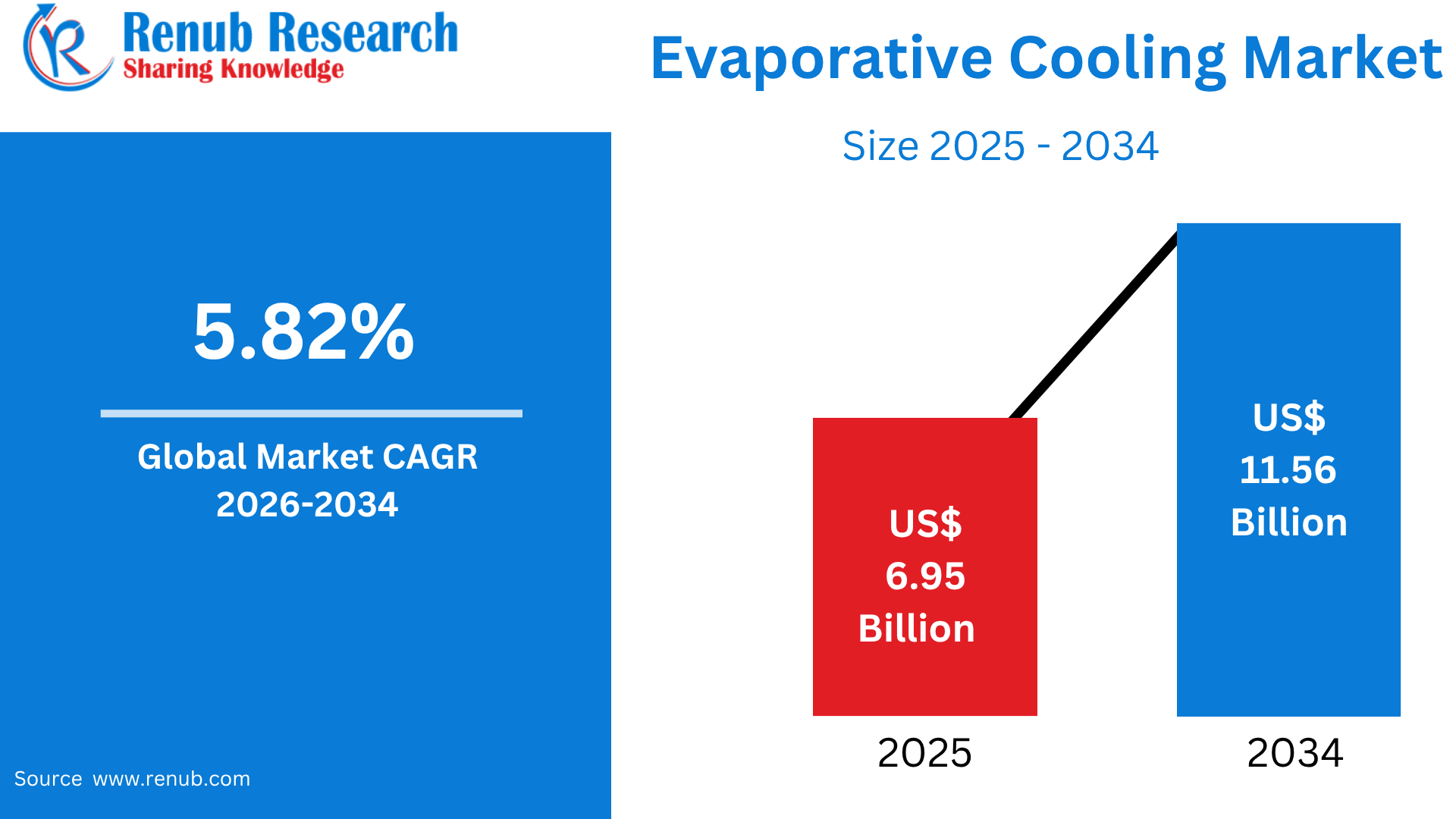
Evaporative Cooler Market is projected to expand from US$ 6.95 billion in 2025 to US$ 11.56 billion by 2034, registering a CAGR of 5.82% during 2026–2034. Market growth is supported by increasing demand for energy-efficient and cost-effective cooling solutions, particularly in regions experiencing rising temperatures. Growing concerns regarding climate change and higher cooling requirements are encouraging consumers and businesses to explore alternatives to conventional air-conditioning systems. Evaporative coolers offer an important advantage through their lower energy consumption, making them an attractive option for users seeking to reduce electricity expenses and environmental impact.
What is an Evaporative Cooler and Its Uses & Popularity Worldwide
An evaporative cooler, also known as a swamp cooler, is a cooling device that lowers air temperature by passing warm air through water-moistened cooling pads. As water evaporates, it absorbs heat from the surrounding air, producing cooler and more humidified airflow. Unlike conventional air conditioners, evaporative coolers generally use less electricity because they primarily operate fans, water pumps, and control systems rather than energy-intensive compressors.
Evaporative coolers are widely used in homes, offices, warehouses, factories, workshops, restaurants, agricultural facilities, and outdoor commercial spaces. They are particularly effective in hot and dry climates where low humidity allows water to evaporate efficiently. Portable models are popular for residential and small commercial applications, while larger systems are used for industrial and agricultural cooling.
Their popularity is increasing worldwide because of rising temperatures, higher electricity costs, energy-efficiency requirements, and growing interest in environmentally friendly cooling technologies. In developing markets, their relatively lower purchase and operating costs make them an attractive alternative to conventional air-conditioning systems. Growing climate concerns and demand for sustainable cooling solutions are expected to support continued adoption globally.
Top 5 Upcoming Data Center Projects in India 2025
- AdaniConnexX and Google AI Data Center Campus
- Capacity: 1 GW
- Developer: Adani Enterprises & Google (AdaniConnex JV)
- Location: Visakhapatnam, Andhra Pradesh
- Reliance Jamnagar Data Center
- Capacity: 1 GW
- Developer: Reliance Industries
- Location: Jamnagar, Gujarat
- CtrlS Chandan Valley Campus
- Capacity: 612 MW
- Developer: CtrlS Datacenters
- Location: Chandana Valley Industrial Park, Hyderabad
- CtrlS Kolkata Data Center
- Capacity: 60 MW
- Developer: CtrlS Datacenters
- Location: New Town, Kolkata, West Bengal
- Sify Data Center in Vizag
- Capacity: 50 MW
- Developer: Sify Infinit Spaces Limited
- Location: Rushikonda Madhurawada IT Park, Visakhapatnam, Andhra Pradesh
Growth Drivers of the Evaporative Cooler Market
Rising Global Temperatures and Increasing Cooling Demand
The increasing frequency of heatwaves and rising average temperatures are creating strong demand for affordable and energy-efficient cooling solutions. The global shift toward warmer climatic conditions is encouraging households, commercial establishments, warehouses, workshops, and industrial facilities to adopt cooling equipment. Evaporative coolers are particularly attractive in hot and dry regions because they use the natural process of water evaporation to reduce air temperature. Compared with conventional air-conditioning systems, they generally require less electricity because they do not depend on energy-intensive refrigeration compressors. This advantage becomes increasingly important as electricity prices and cooling requirements rise. Growing cooling requirements in residential and commercial spaces are therefore expected to remain a major market driver. Demand is particularly strong across regions experiencing prolonged summers and low-humidity conditions.
Growing Demand for Energy-Efficient and Sustainable Cooling
Increasing awareness of energy consumption and environmental sustainability is encouraging consumers and businesses to consider alternatives to conventional air-conditioning systems. Evaporative coolers can provide cooling with comparatively lower electricity consumption, making them attractive for applications where reducing operating costs is important. Their use of water evaporation rather than conventional refrigerant-based cooling also supports the broader movement toward environmentally conscious technologies. Commercial buildings, factories, warehouses, agricultural facilities, and large open spaces can benefit from efficient air circulation and localized cooling. In addition, governments and organizations are increasingly emphasizing energy efficiency in buildings and industrial operations. This trend encourages the adoption of cooling equipment with lower energy requirements. As businesses seek to manage electricity expenses while meeting sustainability objectives, energy-efficient evaporative cooling systems are expected to gain wider acceptance.
Cost Advantages and Expansion in Residential and Commercial Applications
The comparatively simple operating mechanism and lower energy requirements of evaporative coolers make them an attractive option for cost-conscious consumers and businesses. They are available in portable, residential, commercial, and industrial configurations, allowing manufacturers to address a broad range of applications. Residential users can employ portable units for bedrooms, living spaces, garages, and outdoor areas, while commercial users can deploy larger systems in warehouses, workshops, restaurants, factories, and agricultural facilities. The expansion of commercial and industrial infrastructure in emerging economies is creating additional opportunities for affordable cooling equipment. Product improvements such as stronger airflow, improved cooling pads, automated controls, portable designs, and improved water-management systems are further enhancing usability. As consumers increasingly seek economical cooling solutions with manageable operating costs, evaporative coolers are expected to see broader adoption worldwide.
Challenges of the Evaporative Cooler Market
Dependence on Climate and Humidity Conditions
One of the major limitations of evaporative coolers is their dependence on climatic conditions. These systems perform most effectively in hot and relatively dry environments because evaporation occurs more efficiently when humidity is low. In areas with high humidity, the air has less capacity to absorb additional moisture, reducing the cooling effectiveness of evaporative systems. This restricts their suitability in humid coastal regions and tropical climates. Conventional air-conditioning systems can provide both cooling and dehumidification, giving them an advantage in such locations. Consequently, evaporative coolers cannot serve as a universal replacement for compressor-based air-conditioning equipment. Market expansion therefore depends heavily on regional climate conditions and application requirements. Manufacturers are attempting to overcome this limitation through hybrid cooling technologies, improved airflow systems, and advanced cooling-pad designs.
Water Consumption and Maintenance Requirements
Water dependence represents another important challenge for the evaporative cooler market. Unlike many conventional cooling technologies, evaporative coolers require a continuous or periodic water supply to maintain cooling performance. This can become problematic in regions experiencing water shortages, drought conditions, or restrictions on water consumption. Regular maintenance is also necessary because mineral deposits, dust, algae, and microbial growth can accumulate in water tanks, pumps, and cooling pads. If cleaning and replacement are neglected, cooling efficiency can decline and indoor air quality may be affected. These maintenance requirements can increase the total cost of ownership and discourage some consumers from adopting evaporative cooling systems. Manufacturers are therefore developing improved water-management technologies, washable or longer-lasting cooling pads, automatic drainage systems, and smart maintenance controls. The challenge becomes particularly significant for commercial and industrial users operating systems for extended periods.
Evaporative Cooler Launches Worldwide
- Honeywell CO25AE Portable Evaporative Cooler – United States, 2024
Honeywell introduced the CO25AE portable evaporative cooler with honeycomb cooling pads and smart-control features, including Wi-Fi connectivity for remote operation. - Symphony Desert Storm Series – India, 2024
Symphony launched its Desert Storm series with improved motor efficiency, reduced operating noise, antimicrobial cooling pads, and automatic water-level indicators. - Cool Boss CB-16 – United States, 2024
Cool Boss introduced the CB-16 high-velocity evaporative cooler for indoor and outdoor applications. It features a portable design, large water reservoir, and optional ducting kit. - Cool Boss CB-28HV Desert Storm – United States, 2024
The CB-28HV was launched for large industrial, warehouse, government, and military environments, delivering airflow of nearly 18,000 cubic feet per minute. - Orient Electric Smartchill, Avante, Titan & Maxochill – India, 2024
Orient Electric introduced a new range of high-capacity coolers featuring Aero Fan technology, Auto Fill functionality, IoT compatibility, and air throw of up to 60 feet. - Coolee CL-50R Portable Air Cooler Ice Chest – United States, 2024
Cool Boss launched the CL-50R, combining a portable air cooler with a 50-quart ice chest, Bluetooth speaker, and power bank for outdoor applications. - Vector Climate AERO Pro – United States, 2025
Vector Climate unveiled the AERO Pro residential evaporative cooling system for premium outdoor spaces, featuring expanded airflow and 180-degree cooling capability. Consumer availability was planned for June 2025. - Cool Boss CB-19SL – United States, 2025
Cool Boss introduced the compact CB-19SL portable evaporative air cooler for residential and commercial spaces of up to 1,076 square feet, with airflow reaching 6,840 CFM. - Crompton Aura, Avancer & Jedi Series – India, 2025
Crompton launched its Aura, Avancer, and Jedi air-cooler ranges, focusing on powerful airflow, convenience, and cooling performance for Indian summer conditions. - Elista Snowstorm Series – India, 2026
Elista launched the Snowstorm range with four desert-cooler models offering capacities from 50L to 110L. Features include honeycomb pads, inverter compatibility, and ice chambers.
Efficient Cooling Through Water Evaporation
The direct evaporative cooler market focuses on systems that cool air by passing warm outdoor air through water-saturated pads. As the air moves through the wet media, water evaporates and absorbs heat, lowering the temperature before a fan distributes the cooled air into the surrounding space. This process is particularly effective in hot and dry climates, where low humidity allows faster evaporation. Direct evaporative coolers are commonly used in homes, workshops, warehouses, garages, agricultural buildings, and other spaces requiring continuous air movement. Compared with compressor-based air-conditioning, these systems generally have simpler mechanical designs and can operate with lower electricity requirements. Their operation primarily involves a fan, water pump, and water circulation system. Cooling performance depends on factors such as outdoor temperature, relative humidity, airflow, and pad efficiency. Increasing temperatures and the need for economical cooling are encouraging greater interest in direct evaporative systems, particularly where affordable and energy-conscious cooling is required.
Affordable Cooling for Homes and Apartments
The residential evaporative cooler market is supported by growing demand for economical cooling solutions in regions experiencing hot and relatively dry summers. These systems can be installed in living rooms, bedrooms, apartments, garages, and other residential areas. Available configurations include portable, window-mounted, tower-style, and larger fixed systems, allowing consumers to select equipment according to room size and ventilation requirements. A typical residential unit combines a water tank or supply connection, cooling pads, a pump, and a fan to circulate cooled air. Unlike sealed air-conditioning systems, evaporative coolers introduce fresh outdoor air into the room, making adequate ventilation important for effective operation. Their comparatively simple installation and maintenance requirements can make them attractive to households seeking lower-cost cooling. Energy consumption varies according to fan speed, motor capacity, operating hours, and model design. As households increasingly consider electricity costs and environmentally conscious appliances, residential evaporative coolers are gaining attention as an alternative cooling option in suitable climates.
Cooling Large Spaces With Lower Operating Requirements
The commercial evaporative cooler market includes systems designed for offices, retail stores, restaurants, warehouses, workshops, factories, event venues, and semi-open commercial areas. These environments often require continuous air circulation over large floor areas, making airflow capacity an important consideration when selecting cooling equipment. Commercial evaporative coolers generally use larger fans, bigger water reservoirs, stronger pumps, and expanded cooling-pad surfaces than residential models. Their open-air cooling approach can be particularly useful in warehouses and industrial facilities where doors remain open and conventional refrigerated air-conditioning may be less practical. Businesses also consider factors such as installation requirements, water availability, maintenance frequency, airflow coverage, and operating costs when selecting these systems. In suitable dry climates, evaporative cooling can provide substantial temperature reduction while consuming less electricity than many compressor-based cooling systems. Growing commercial construction, expansion of warehouses and industrial facilities, and increasing attention to energy efficiency are supporting interest in evaporative cooling solutions for large and semi-open spaces.
Professional Installation and Maintenance Services
HVAC contractors evaporative cooler market covers professional services associated with the selection, installation, commissioning, inspection, repair, and maintenance of evaporative cooling systems. HVAC contractors evaluate factors such as building size, climate, ventilation, airflow requirements, water availability, and intended operating conditions before recommending an appropriate system. Proper installation is important because evaporative coolers require sufficient outdoor-air intake and suitable exhaust or ventilation pathways for effective performance. Contractors also install ductwork, electrical connections, water lines, pumps, thermostats, and control systems where required. Routine maintenance can include cleaning cooling pads, inspecting pumps, checking water distribution, removing mineral deposits, and ensuring adequate airflow. Maintenance frequency depends on water quality, operating hours, environmental conditions, and system design. As residential, commercial, and industrial users seek more efficient cooling solutions, professional expertise becomes increasingly important for achieving reliable performance. HVAC contractors can therefore support adoption by providing installation guidance, preventive maintenance, troubleshooting, and system upgrades.
Wider Consumer Access Through Large Retail Networks
The big-box retailer segment represents the distribution of evaporative coolers through large-format retail stores, home-improvement centers, appliance outlets, and their online platforms. These retailers typically provide several product categories, including portable coolers, personal air coolers, window-mounted units, and larger residential or commercial models. Product availability through major retail networks allows consumers to compare specifications such as airflow capacity, water-tank size, power consumption, cooling-pad design, portability, and operating modes. Many portable models are designed for relatively simple setup, while larger systems may require professional installation. Retailers also support purchasing decisions by providing product demonstrations, user reviews, warranty options, replacement parts, and seasonal promotions. The growing availability of energy-conscious home appliances is encouraging retailers to expand their cooling-product portfolios. Seasonal temperatures strongly influence purchasing patterns, with demand generally increasing during warmer months. As consumers become more focused on cooling costs and electricity efficiency, big-box retailers can play an important role in making evaporative coolers more accessible to residential and small-business customers.
Growing Demand in Hot and Dry United States Regions
United States evaporative cooler market is supported by demand from regions with hot and dry climates, particularly across western and southwestern states. These systems provide cooling by using water evaporation and are generally more energy-efficient than conventional refrigerated air-conditioning under suitable climate conditions. Residential users can employ evaporative coolers to reduce cooling expenses during hot periods, while businesses and industrial facilities use larger systems for workshops, warehouses, manufacturing areas, and other spaces. The relatively simple operating mechanism and lower electricity requirements make evaporative cooling attractive for users seeking economical climate-control solutions. Growing interest in energy efficiency and environmentally responsible technologies is also encouraging adoption. In March 2024, Seeley International announced a next-generation indirect evaporative cooling solution for industrial and data-center applications, designed to improve cooling performance while minimizing water use. Such product development is expanding the potential application of evaporative cooling beyond traditional residential uses. However, effectiveness remains strongly dependent on local humidity and ventilation conditions.
Rising Interest During Warmer Summers in the UK
The United Kingdom evaporative cooler market is gradually developing as rising summer temperatures and periodic heatwaves increase the need for temporary and supplemental cooling. Although the UK generally has a moderate climate, businesses, offices, retail locations, and households may require additional cooling during periods of unusually high temperatures. Portable evaporative coolers are particularly attractive because they can be moved between rooms and generally require less complex installation than permanent air-conditioning systems. Their operation combines airflow and water evaporation to provide localized cooling while also adding moisture to the air. However, performance can vary significantly with humidity, making these systems more suitable for particular indoor conditions. Energy efficiency and lower operating requirements are also becoming increasingly important considerations for UK consumers and businesses. A Honeywell 7.5L portable evaporative air cooler available in the UK market offers fan, humidification, and evaporative cooling functions, along with features such as a 12-hour timer and auto-oscillation. Such multifunctional products are helping broaden consumer awareness of evaporative cooling.
Affordable Cooling for a Hot Climate in India
India represents an important market for evaporative cooling because of its extensive hot-weather conditions and strong demand for affordable cooling technologies. Evaporative coolers are widely used in residential properties, offices, shops, workshops, and small commercial establishments, particularly in regions characterized by hot and relatively dry conditions. Compared with conventional air-conditioning systems, these coolers can provide a more economical cooling option because their basic operation relies on water evaporation and fan-driven airflow rather than compressor-based refrigeration. Lower equipment and operating requirements can make evaporative coolers suitable for households and businesses seeking to manage electricity expenses. Product availability across portable, window, tower, and larger desert-cooler formats also allows users to select systems according to room size and cooling requirements. Manufacturers are additionally incorporating technologies aimed at improving energy efficiency and airflow performance. In April 2023, Symphony Ltd launched a range of air coolers using BLDC technology, emphasizing improved energy efficiency. Continued urbanization, rising summer temperatures, and demand for economical cooling solutions are expected to support adoption across suitable Indian regions.
Saudi Arabia Alternative Cooling for Semi-Open and Industrial Spaces
Saudi Arabia evaporative cooler market is gaining attention because of the country’s extremely hot climate and the need for efficient cooling across commercial and industrial environments. While conventional air-conditioning remains essential for many enclosed buildings, evaporative coolers can provide useful supplemental cooling in workshops, warehouses, outdoor areas, factories, and semi-open spaces. These systems draw warm air through water-saturated cooling media, reducing air temperature through evaporation before distributing the cooled air through fans. Their ability to continuously introduce fresh air can be beneficial in locations where ventilation and airflow are important. Energy efficiency is another consideration for businesses seeking to control cooling-related operating expenses, particularly during periods of high temperatures. However, the suitability of evaporative cooling depends on local humidity and the specific application. Growing investment in modern infrastructure, industrial facilities, and energy-efficient technologies is creating opportunities for alternative cooling systems. As businesses increasingly evaluate operating costs and sustainability alongside cooling performance, evaporative coolers can find greater use in applications where their climatic and operational advantages are most suitable.
Market Segments
Type of Cooling
- Direct Evaporative
- Indirect Evaporative
- Two-stage Evaporative
Application
- Residential
- Commercial
- Industrial
- Confinement Farming
- Others
Distribution Channel
- Big-box Retailers
- HVAC Contractors and Distributors
- Others
Countries – Market breakup in 25 Countries:
North America
- United States
- Canada
Europe
- France
- Germany
- Italy
- Spain
- United Kingdom
- Belgium
- Netherlands
- Turkey
Asia Pacific
- China
- Japan
- India
- Australia
- South Korea
- Thailand
- Malaysia
- Indonesia
- New Zealand
Latin America
- Brazil
- Mexico
- Argentina
Middle East & Africa
- South Africa
- Saudi Arabia
- United Arab Emirates
All companies have been covered with 5 Viewpoints
- Overviews
- Key Person
- Recent Developments
- SWOT Analysis
- Revenue Analysis
Key Company Covered
- Honeywell International Inc.
- Munters Group
- Phoenix Manufacturing Inc.
- Bonaire Heating & Cooling
- Celsius Design Limited
- Colt Group Limited
- Condair Group AG
Report Details:
| Report Features | Details |
| Base Year |
2024 |
| Historical Period |
2020 - 2024 |
| Forecast Period |
2025 - 2033 |
| Market |
US$ Billion |
| Segment Covered |
Type of Cooling, Application, Distribution Channel and Countries |
| Countries Covered |
|
| Companies Covered |
|
| Customization Scope |
20% Free Customization |
| Post-Sale Analyst Support |
1 Year (52 Weeks) |
| Delivery Format |
PDF and Excel through Email (We can also provide the editable version of the report in PPT/Word format on request) |
Customization Services available
- Analysis of Market Size and Its Segments
- More Company Profiles (Upto 10 without any additional cost):
- Additional Countries (Other than mentioned Countries):
- Region/Country Specific Reports:
- Market Entry Strategy:
- Region-Specific Market Dynamics:
- Regional Market Share Analysis:
- Trade Analysis:
- Production Insights:
- Others Customized Requests:
For more information contact our analysts.
Need More Assistance?
- Talk to our analysts to get more precious information on the current market trends.
- Include more countries and segments and customize the report based on the final requirement.
- Get a competitive advantage in your industry by knowing the report findings and making a positive impact on your revenues and operations.
- Our analysts are always ready to provide more help and pertinent information if you need any additional assistance.