Europe Sports Technology Market Size, Share, Trends, Growth Analysis and Forecast Report 2026–2034
Buy NowEurope Sports Technology Market Size
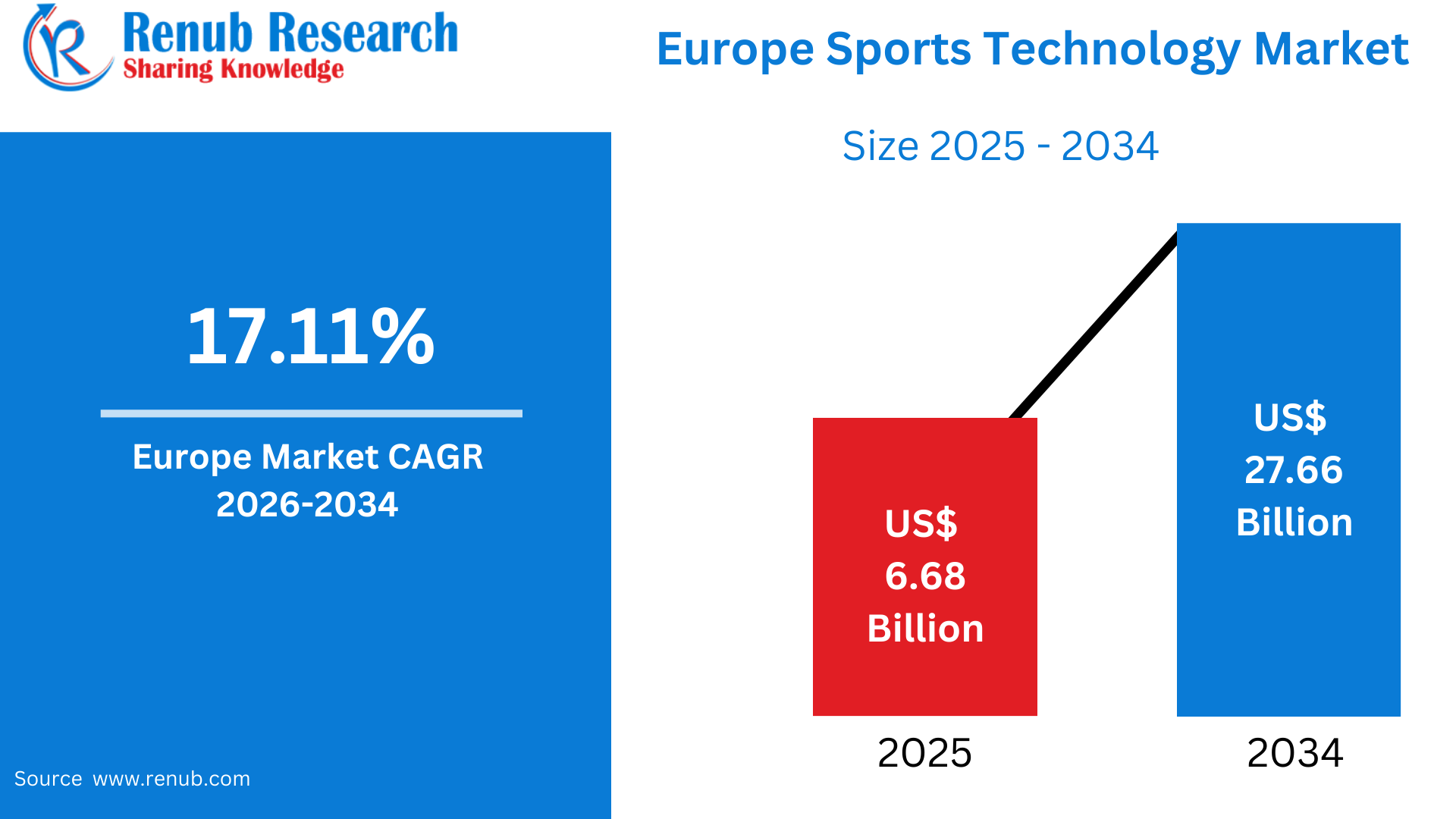
Europe sports technology market is projected to grow from US$ 6.68 billion in 2025 to US$ 27.66 billion by 2034, reflecting strong momentum driven by the increasing adoption of advanced digital technologies across professional sports, fitness, and fan engagement. The market is anticipated to register a CAGR of 17.11% during 2026–2034, supported by growing investments in data analytics, wearable technologies, smart stadium infrastructure, athlete performance monitoring, and the ongoing digital transformation of the European sports and fitness industry.
Europe Sports Technology Industry Analysis
Sports technology refers to the application of advanced technologies such as artificial intelligence (AI), wearable devices, data analytics, the Internet of Things (IoT), virtual reality (VR), and cloud computing to improve athletic performance, enhance fan experiences, and optimize sports management. It enables athletes and coaches to monitor performance metrics, prevent injuries, analyze game strategies, and make data-driven decisions. Sports technology is also widely used in smart stadiums, digital ticketing, sports broadcasting, fitness applications, and fan engagement platforms.
In Europe, sports technology has gained significant popularity due to the region's strong sporting culture, widespread digital adoption, and substantial investments in sports innovation. Leading football leagues, professional clubs, and sports organizations increasingly rely on performance tracking systems, video analytics, and wearable sensors to improve player development and competitive performance. The growing popularity of fitness technology, connected devices, and e-sports has further accelerated market adoption. Additionally, government support for digital transformation, the expansion of smart stadium infrastructure, and rising consumer demand for personalized fitness and immersive sports experiences continue to drive the widespread use of sports technology across Europe.
Total sport employment in the European Union
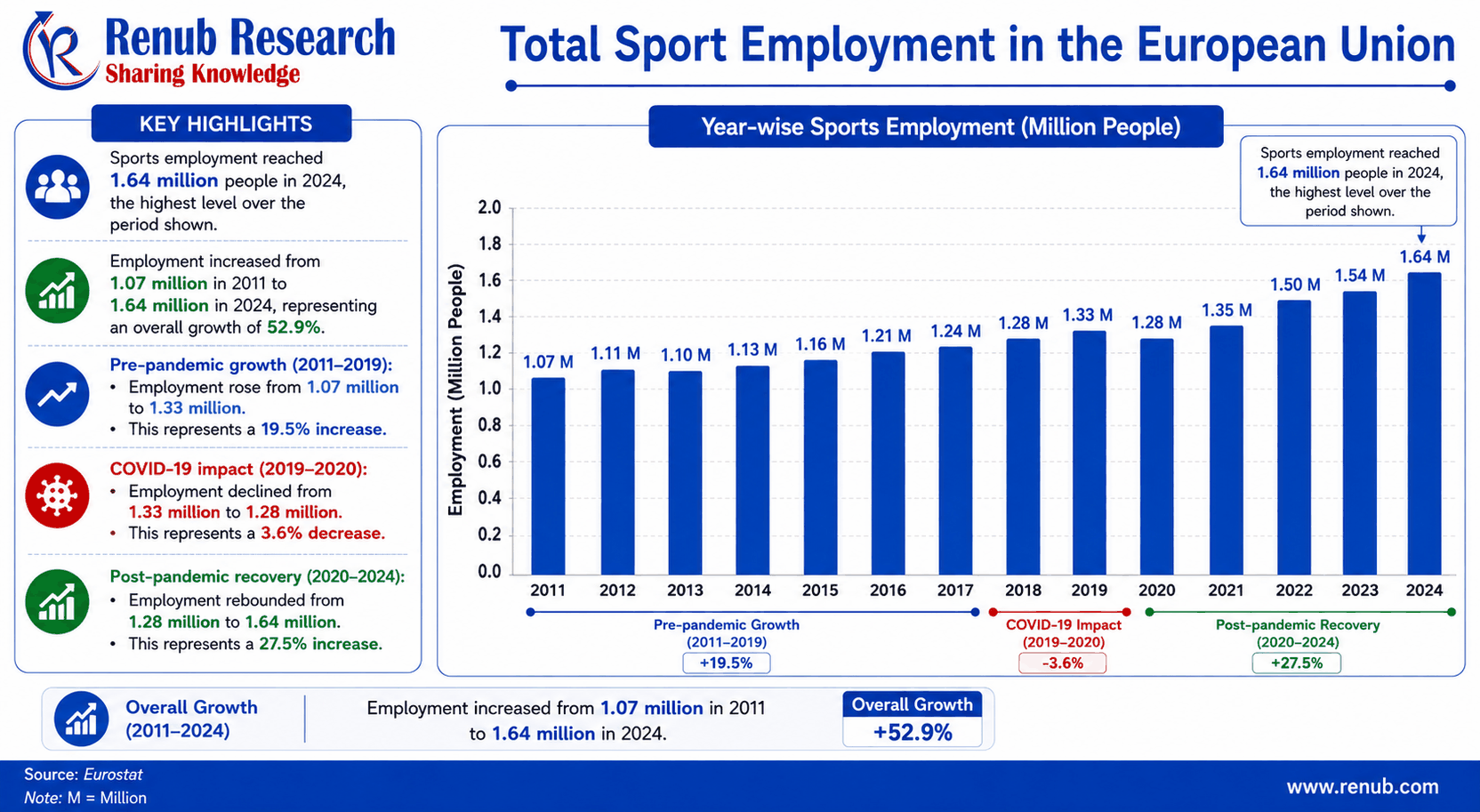
- Sports employment reached 1.64 million people in 2024, the highest level over the period shown.
- Employment increased from 1.07 million in 2011 to 1.64 million in 2024, representing an overall growth of 52.9%.
- Pre-pandemic growth (2011–2019):
- Employment rose from 1.07 million to 1.33 million.
- This represents a 19.5% increase.
- COVID-19 impact (2019–2020):
- Employment declined from 1.33 million to 1.28 million.
- This represents a 3.6% decrease.
- Post-pandemic recovery (2020–2024):
- Employment rebounded from 1.28 million to 1.64 million.
- This represents a 27.5% increase.
- Year-wise sports employment (million people):
- 2011: 1.07 M
- 2012: 1.11 M
- 2013: 1.10 M
- 2014: 1.13 M
- 2015: 1.16 M
- 2016: 1.21 M
- 2017: 1.24 M
- 2018: 1.28 M
- 2019: 1.33 M
- 2020: 1.28 M
- 2021: 1.35 M
- 2022: 1.50 M
- 2023: 1.54 M
- 2024: 1.64 M
Market Catalysts
Professionalization of Sports & Performance Optimization
July 2024, Washington Spirit, Olympique Lyonnais Féminin and London City Lionesses owner and innovator announced the official launch of Kynisca Sports International, Ltd., the first multi-team global organization dedicated to women's football, bringing unprecedented investment to the sport at a scale to drive lasting change. Inspired by Cynisca of Sparta, the first woman to be crowned in the ancient Olympics, Kynisca will usher in a new era for female athletic potential and the professionalization of women's sports. A key growth driver in Europe's sports technology market is the increasing professionalization of sports on all levels. Elite clubs, national teams, and academies invest heavily in tools that optimize player performance, reduce injuries, and extend careers. Wearable sensors, GPS trackers, biomechanical analysis, and video analytics provide detailed insights into workload, technique, and tactical behavior. Coaches use dashboards to track training intensity, recovery, and match readiness in real time. As the stakes rise in football, rugby, basketball, athletics, and other sports, the margin between winning and losing is often determined by data-driven decisions. Clubs view technology as a competitive differentiator and are willing to invest in hardware, software, and sports science staff.
Digital Fan Engagement, Media Innovation & Commercialization
July 2024, MACH-powered content, data & marketing technology provider, Cortex launches to the sports market. Cortex offers quick-to-deploy technologies that connect data, content and commercial inventory, elevating the fan experience and generating new multi-channel revenue opportunities, unlocking the real value of digital sports marketing. Another huge driver is the changing nature of fan engagement and sports media. Leagues and clubs in Europe seek to reach increasingly global audiences through digital platforms, monetize content, and reinforce loyalty. Sports tech now enables live data overlays, advanced graphics, second-screen experiences, fantasy sports integrations, and personalized content. With mobile apps, social media, and OTT streaming services, fans now can follow teams from anywhere, driving a need for real-time statistics, interactive features, and immersive highlights. Smart stadium technologies like digital ticketing, in-seat ordering, AR experiences, and high-density connectivity improve matchday satisfaction while generating valuable behavioral data.
Growth of Fitness, Wellness & Connected Consumer Devices
In 2024, Sportradar integrated optical tracking feeds from UEFA competitions into its BetVision platform, which allows dynamic in-play odds modeling. Besides this, it launched an AI-powered broadcast analytics suite, which delivers second-screen content like win probability and player impact scores, securing its double presence in commercial and media technology segments across Europe. Beyond professional sports, Europe's increasing interest in health, fitness, and wellness provides substantial support for sports technology adoption. More people are using smartwatches, fitness bands, connected gym equipment, and mobile applications to track their steps, heart rate, sleep, and calories, along with their training programs. Home fitness platforms, virtual coaching, and gamified workouts blend entertainment with exercise, attracting a broad demographic. Sports technology bridges the gap between recreational and performance training, enabling everyday users to access metrics once reserved for elite athletes. Gyms, clubs, and personal trainers integrate connected devices and apps into their work of monitoring progress and providing personalized programs. This consumer-driven demand drives a big installed base of IoT devices and subscription services, thus encouraging further innovation. Sportradar is a Swiss-based global sports technology company that has played a pivotal role in Europe through its integration of integrity services, official data distribution, and fan engagement analytics. It delivers real-time data to more than 900 sports federations and betting operators, maintaining strong coverage in football, basketball, and tennis.
Sports Technology Launches in Europe
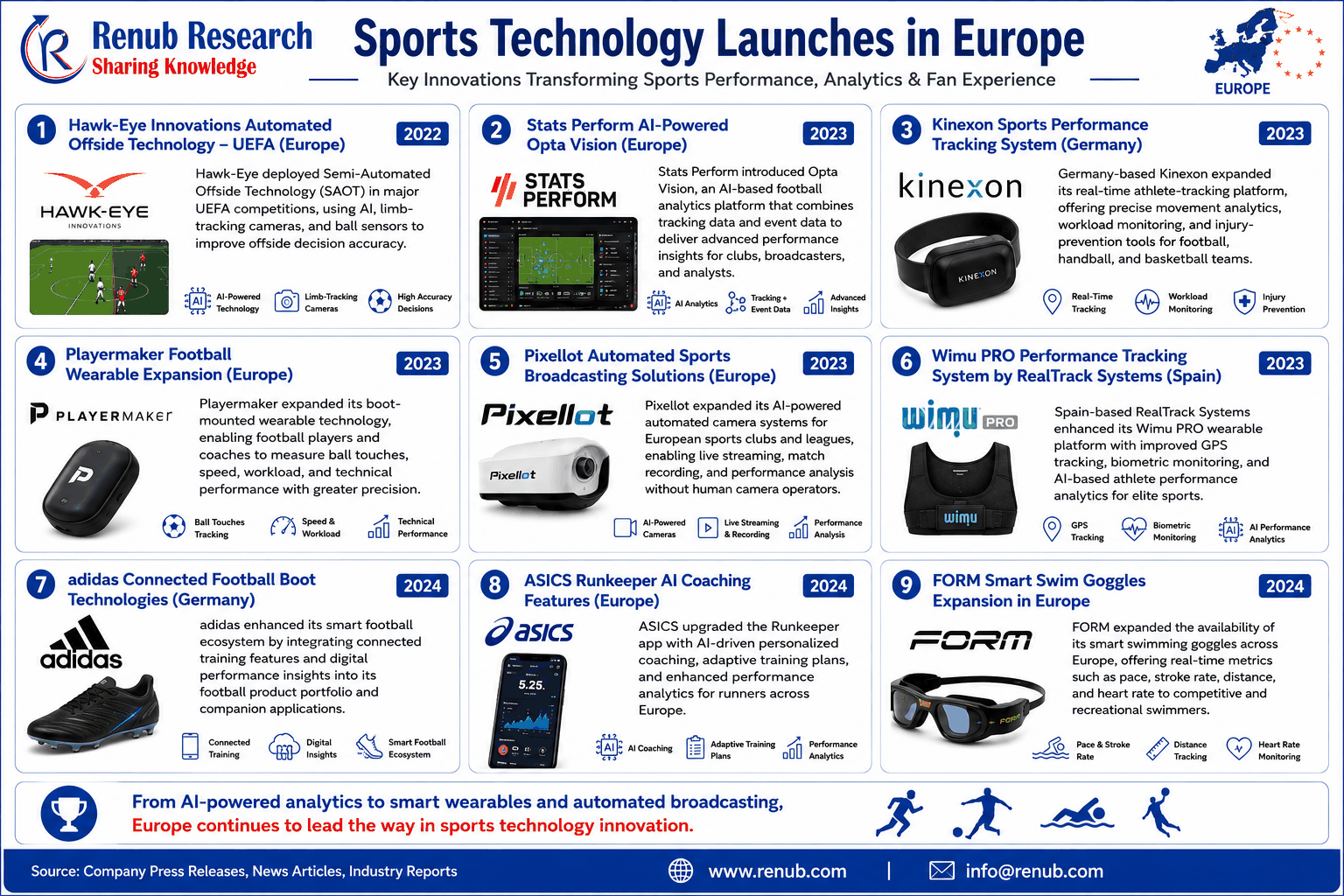
- Hawk-Eye Innovations Automated Offside Technology – UEFA (Europe) – 2022
- Hawk-Eye deployed Semi-Automated Offside Technology (SAOT) in major UEFA competitions, using AI, limb-tracking cameras, and ball sensors to improve offside decision accuracy.
- Stats Perform AI-Powered Opta Vision (Europe) – 2023
- Stats Perform introduced Opta Vision, an AI-based football analytics platform that combines tracking data and event data to deliver advanced performance insights for clubs, broadcasters, and analysts.
- Kinexon Sports Performance Tracking System (Germany) – 2023
- Germany-based Kinexon expanded its real-time athlete-tracking platform, offering precise movement analytics, workload monitoring, and injury-prevention tools for football, handball, and basketball teams.
- Playermaker Football Wearable Expansion (Europe) – 2023
- Playermaker expanded its boot-mounted wearable technology, enabling football players and coaches to measure ball touches, speed, workload, and technical performance with greater precision.
- Pixellot Automated Sports Broadcasting Solutions (Europe) – 2023
- Pixellot expanded its AI-powered automated camera systems for European sports clubs and leagues, enabling live streaming, match recording, and performance analysis without human camera operators.
- Wimu PRO Performance Tracking System by RealTrack Systems (Spain) – 2023
- Spain-based RealTrack Systems enhanced its Wimu PRO wearable platform with improved GPS tracking, biometric monitoring, and AI-based athlete performance analytics for elite sports.
- adidas Connected Football Boot Technologies (Germany) – 2024
- adidas enhanced its smart football ecosystem by integrating connected training features and digital performance insights into its football product portfolio and companion applications.
- ASICS Runkeeper AI Coaching Features (Europe) – 2024
- ASICS upgraded the Runkeeper app with AI-driven personalized coaching, adaptive training plans, and enhanced performance analytics for runners across Europe.
- FORM Smart Swim Goggles Expansion in Europe – 2024
- FORM expanded the availability of its smart swimming goggles across Europe, offering real-time metrics such as pace, stroke rate, distance, and heart rate to competitive and recreational swimmers.
Challenges occurs in the Sports Technology Industry in Europe
High Costs, ROI Uncertainty & Budget Constraints
The cost of advanced sports technology can be highly prohibitive for smaller clubs, amateur organizations, and local federations. High-end systems, such as tracking cameras, VR simulators, and integrated analytics platforms, require heavy upfront investment, ongoing maintenance, and specialist staff. It is tough for many organizations to accurately quantify return on investment, at times even in areas like injury prevention or youth development. Budget limitations within lower leagues and grassroots sports prevent them from embracing technologies that may be commonly used in elite clubs. In professional settings, too, priorities such as player salaries, infrastructure, and operations tend to slow down investment decisions. Vendors must provide flexible pricing models and clear outcome metrics to overcome skepticism.
Data Privacy, Integration Complexity & Skills Gap
Sports technology produces massive volumes of sensitive data on athletes, fans, and operations. Data privacy, cybersecurity, and regulatory compliance are increasingly problematic, particularly related to the handling of biometric data or youth athletes. Integration of multiple systems-wearables, video platforms, ticketing, CRM, and analytics tools-into one cohesive ecosystem is cumbersome and often very technical and expensive. Many clubs lack internal expertise in the management of data pipelines, analytics, and IT infrastructure. Coaches and staff may feel overwhelmed by dashboards and statistics if not properly trained, leading to underuse of tools. There is also a cultural gap: some traditional coaches distrust technology or fear it will replace intuition.
Component Insights
Software accounts for the majority of the market share
The software segment is central to Europe's sports technology market, turning raw data into actionable insights. Performance analytics platforms aggregate data from GPS trackers, wearables, video systems, and match events to provide dashboards for coaches, analysts, and medical teams. These solutions support tactical analysis, load management, scouting, recruitment, and rehabilitation monitoring. On the commercial side, CRM systems, fan apps, and digital engagement platforms manage ticketing, memberships, content, and marketing campaigns. A variety of cloud-based solutions exist that make collaboration across locations and devices possible. Broadcasters and media companies rely on software for real-time graphics, statistics, and replay tools.
Services Market
It encompasses consulting, systems integration, data analysis, sports science support, and managed operations. A large number of clubs, federations, and fitness organizations need specialist help in choosing, implementing, and optimizing technology solutions. Service providers support the design of data strategies, integrate hardware and software, and ensure compatibility with the existing infrastructure. Sports scientists and performance consultants take the data and provide training recommendations and injury-prevention strategies. Analytics services support scouting, recruitment, and opposition analysis-again, often crucial for clubs who don't have significant in-house departments. On the commercial side, agencies and tech partners manage fan data, personalization strategies, and digital campaigns. Training and education services help coaches, athletes, and staff understand and use new tools.
Technology Insights
IoT Sports Technology
The IoT segment includes wearables, smart equipment, connected gym machines, stadium sensors, and networked training environments. Teams in Europe use GPS vests, heart-rate monitors, inertial sensors, and smart insoles to capture movement, workload, and physiological responses in real time. Smart balls, rackets, and bikes provide detailed feedback on performance. Connected gym machines log workouts and automatically set resistance. IoT sensors monitor crowd flows, environmental conditions, and asset performance inside stadiums. This continuous flow of data enables personalized training, better load management, and enhanced safety. For consumers, everyday engagement with health and sport is encouraged through wearable fitness devices and connected apps. Reliable connectivity, battery life, comfort, and secure handling of data are critical for the success of IoT sports technologies.
Sports Insights
Soccer Sports Technology in Europe
Soccer, or football as it is known in Europe, is the dominant sport on the continent, and also one of the biggest drivers of sports technology adoption. Leading clubs and national sides invest millions annually in player tracking systems, video analytics, sports science platforms, and scouting databases. Data from matches and training are brought together to develop optimal tactics, manage physical load, and prevent overuse injuries. All manner of video tools provide granular analysis of team shape, pressing, set pieces, and opponent patterns. Recruitment departments use data-driven scouting to uncover undervalued talent from around the world. Fan-facing technology, including interactive applications, AR experiences, and sophisticated broadcast graphics, boosts engagement and spreads global brand reach. With its highly competitive domestic leagues and European competitions, soccer organizations embrace technology as a key strategic asset.
Cricket Technology in Europe
Cricket technology in Europe is more niche compared to football, growing steadily in countries where the sport has a strong following: the UK, Ireland, and parts of continental Europe with developing leagues. The technologies would thus range from ball-tracking systems and high-performance cameras to performance analysis software and training tools for batting, bowling, and fielding. Video breakdowns help clubs and national teams refine technique and strategy, while wearable sensors monitor workload for bowlers to prevent injury. Viewers, especially for shorter formats like T20, get a better understanding and increase their enjoyment with broadcast innovations like predictive graphics, field maps, and real-time statistics. Grassroots and amateur clubs are increasingly experimenting with simple scoring apps, live-streaming tools, and coaching software.
Application Insights
Analytics and Statistics Sports Technology
Analytics and statistics form the backbone of modern sports decision-making in Europe. Event data, tracking metrics, and contextual information are fed into performance analytics systems to assess players, tactics, and game plans. Recruitment teams use statistical models to surface undervalued talent and assess transfer targets. Coaches have tailored metrics to ensure playing style aligns with club philosophy. On the business side, analytics drive ticket pricing, fan segmentation, sponsorship valuation, and content strategy. Clubs and leagues-particularly those with more progressive leadership-build out data science and analyst teams, often with finance or tech backgrounds, to develop models and tools. Vendors offer both pre-built dashboards and customizable analytics platforms.
Sports Training Technology
Sports technology training in Europe is focused on the enhancement of skill acquisition, techniques, and tactical understanding. The tools used include video coaching platforms, motion capture systems, shooting and passing machines, VR/AR training simulators, and active training walls. These solutions give athletes the opportunity to practice certain scenarios over and over again, get instant feedback, and visualize the corrections. Coaches can tailor individual programs given the player profile and their goals for development. Youth academies use training technology to speed up learning and make sure methodologies are constant. In racket sports, golf, and athletics, technology supports detailed biomechanical analysis and helps refine technique while reducing injury risk. In team sports, tactical simulators and video sessions deepen game intelligence.
Countries Insights
France
France's sports technology market is influenced by strong traditions in football, rugby, cycling, and Olympic sports. Professional clubs and national teams use tracking systems, video analysis, and sports science tools to remain competitive in both domestic and international competitions. Rugby clubs use GPS and impact data to manage physical load within a high-contact sport. Cycling teams are significant users of performance metrics and aerodynamics modeling. Elite training centers and national institutes invest in biomechanics, physiology labs, and analytics for the support of Olympic programs. On the fan side, digital platforms and mobile apps and enhanced broadcast graphics are in wide use for the purpose of engaging supporters. May 2025: Decathlon teams up with Bambuser to extend Visio Store-a service that allows customers to book an appointment with sales associates via video conference to get advice on how to choose their sports equipment. After a test period in its e-bike category, Decathlon has expanded its video service to ten more product categories, including fitness, mountaineering, and golf, exclusively for the French market.
United Kingdom
The United Kingdom is one of the most developed sports technology markets in Europe, driven by major football leagues, strong cricket structures, rugby, tennis, and Olympic programs. Top-flight and Premier League clubs invest heavily in performance analytics, tracking systems, injury prevention tools, and scouting databases. Cricket is using ball-tracking, video analysis, and broadcast innovations that very often set world standards. Sports science departments are closely entwined with club operations, linking laboratories and training grounds. The UK is also a fertile ground for sports tech start-ups in analytics, wearables, fan engagement, e-sports, and coaching platforms. November 2025 -- IBM and Web Summit today announced a new global sports-tech competition proposal. The Sports Tech Startup Challenge will put the spotlight on startups using AI to revolutionize sports-from athlete performance and stadium operations to fan engagement-regional events are planned for Qatar, Vancouver, and Rio before culminating with the selection of global winners during Web Summit Lisbon 2026.
Germany
This aids Germany's sports technology market, with its rich engineering heritage, structured leagues, and powerful industrial base. There is early adoption of tracking systems, tactical analysis, and sports science integration amongst Bundesliga football clubs. Technology assists in optimizing load management, recovery, and youth development in training centers. Besides football, handball, winter sports, athletics, and motorsport draw on the strengths of accurate measurement and engineering-led innovation. Partnerships between clubs, universities, and technology companies allow the development of sensors, software, and analytics tailored to German performance philosophies. Sept 2025, Apple Sports is now also available in Germany and Austria. Until now, Apple's sports results app had only been available for the USA, the UK, and Canada. It appeared there quite unexpectedly in February 2024. For a long time, it remained unclear whether and when it would be released for other countries. The iPhone manufacturer has now released it for eight more countries and expanded the sports results service to include local leagues.
Market Segmentations
Component
- Software
- Wearable Devices and Sports Equipment
- Services
Technology
- Artificial Intelligence/Machine Learning (AI/ML)
- Internet of Things (IoT)
- Augmented Reality/Virtual Reality (AR/VR)
Sports
- Soccer
- Baseball
- Basketball
- Ice Hockey
- American Football/Rugby
- Tennis
- Cricket
- Golf
- E-sports
- Others
Application
Tracking
- Decision Making and Team Analysis and Management
- Analytics and Statistics
- Tactics and Simulation
- Training
- Game Performance Analysis and Injury and Health Analysis
End User
- Coaches
- Clubs
- Leagues
- Sports Associations
- Others
Countries
- France
- Germany
- Italy
- Spain
- United Kingdom
- Belgium
- Netherlands
- Russia
- Poland
- Greece
- Norway
- Romania
- Portugal
- Rest of Europe
All companies have been covered with 5 Viewpoints
- Overviews
- Key Person
- Recent Developments
- SWOT Analysis
- Revenue Analysis
Company Analysis:
- Catapult Group International Ltd.
- Garmin Ltd.
- Infosys Limited
- International Business Machines Corporation
- Oracle Corporation
- Pixellot Ltd.
- SAP SE
- Stats Perform
- Zebra Technologies Corporation
Report Details:
| Report Features | Details |
| Base Year |
2025 |
| Historical Period |
2021 - 2025 |
| Forecast Period |
2026 - 2034 |
| Market |
US$ Billion |
| Segment Covered |
Component, Technology, Sports, Application, End User and Countries |
| Countries Covered |
|
| Companies Covered |
|
| Customization Scope |
20% Free Customization |
| Post-Sale Analyst Support |
1 Year (52 Weeks) |
| Delivery Format |
PDF and Excel through Email (We can also provide the editable version of the report in PPT/Word format on request) |
Customization Services available
- Analysis of Market Size and Its Segments
- More Company Profiles (Upto 10 without any additional cost):
- Additional Countries (Other than mentioned Countries):
- Region/Country Specific Reports:
- Market Entry Strategy:
- Region-Specific Market Dynamics:
- Regional Market Share Analysis:
- Trade Analysis:
- Production Insights:
- Others Customized Requests:
For more information contact our analysts.
Need More Assistance?
- Talk to our analysts to get more precious information on the current market trends.
- Include more countries and segments and customize the report based on the final requirement.
- Get a competitive advantage in your industry by knowing the report findings and making a positive impact on your revenues and operations.
- Our analysts are always ready to provide more help and pertinent information if you need any additional assistance.