Europe Polypropylene Market Size, Share, Trends, Growth Analysis and Forecast Report 2026–2034
Buy NowEurope Polypropylene Market Trends
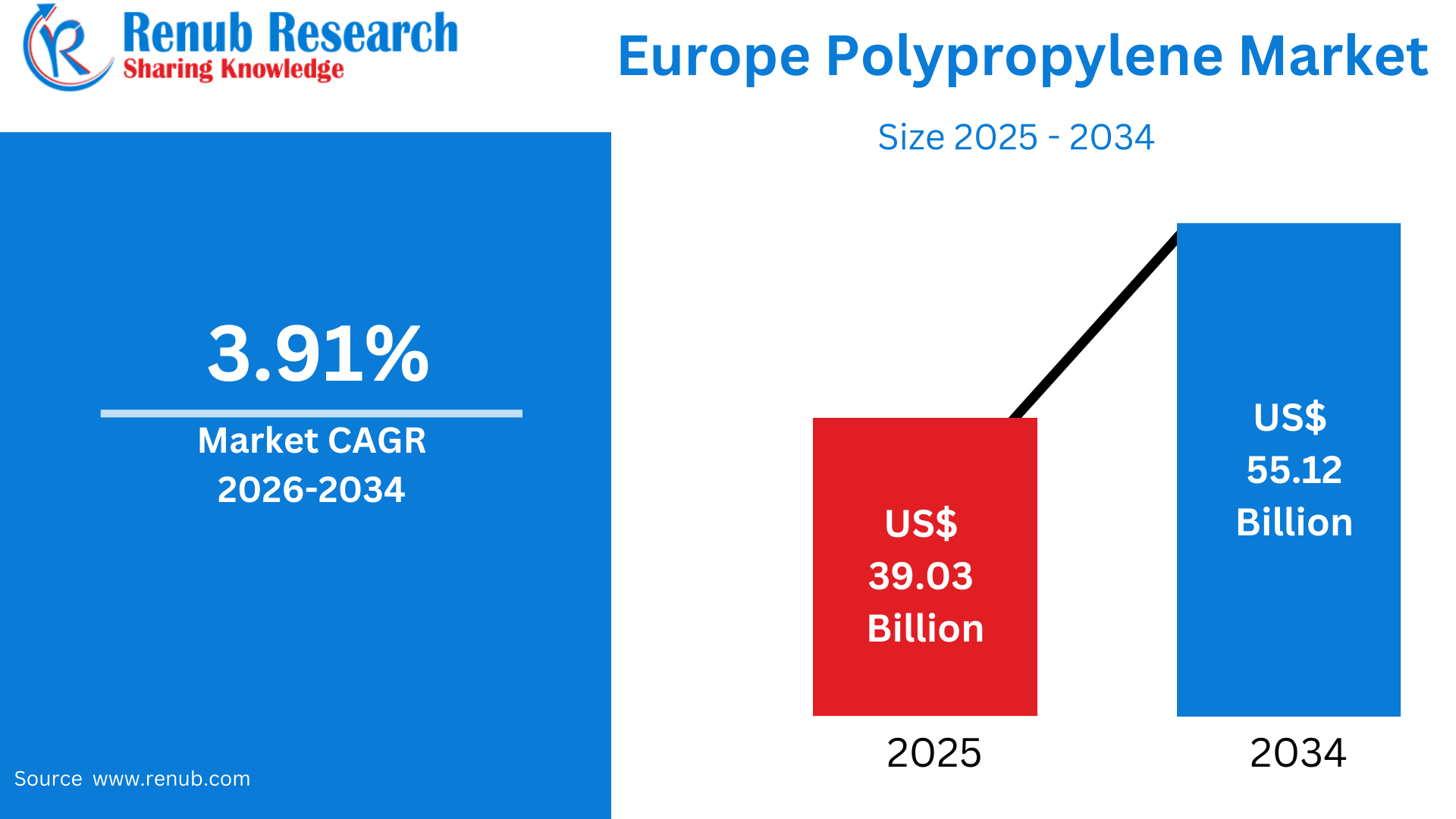
Europe polypropylene market is projected to grow from US$ 39.03 billion in 2025 to US$ 55.12 billion by 2034, registering a CAGR of 3.91% during 2026–2034. Market expansion is being driven by robust demand from the packaging, automotive, construction, healthcare, and consumer goods industries. The increasing adoption of lightweight materials, rising use of recyclable plastics, growing demand for food packaging, and continuous innovation in sustainable and high-performance polypropylene solutions are expected to support market growth across Europe throughout the forecast period.
What is Polypropylene and its demands in Europe?
Polypropylene (PP) is a versatile thermoplastic polymer produced through the polymerization of propylene monomers. Known for its lightweight nature, excellent chemical resistance, high durability, and mechanical strength, polypropylene is widely used across numerous industrial and consumer applications. It offers outstanding resistance to moisture, chemicals, fatigue, and impact, making it suitable for both rigid and flexible products. Common applications include food packaging, films, containers, automotive components, medical devices, textiles, household products, pipes, industrial equipment, and consumer packaging. Its ease of processing through injection molding, extrusion, blow molding, and thermoforming, combined with its cost-effectiveness and recyclability, has made polypropylene one of the most widely used plastics globally.
Europe remains a major market for polypropylene, supported by its diversified manufacturing base and strong focus on sustainable materials. The packaging industry accounts for a significant share of polypropylene consumption, utilizing the material for lightweight, hygienic, and moisture-resistant food and beverage packaging that helps extend product shelf life while reducing packaging weight. In the automotive sector, polypropylene is increasingly used for interior trims, bumpers, dashboards, battery housings, and other lightweight components that contribute to improved fuel efficiency and lower vehicle emissions.
The region’s commitment to the circular economy and stricter environmental regulations is accelerating the adoption of recyclable and recycled polypropylene materials. Manufacturers are investing in advanced recycling technologies and developing bio-based polypropylene to reduce environmental impact while meeting sustainability targets. In addition, rising demand for medical supplies, hygiene products, electrical components, and e-commerce packaging continues to support polypropylene consumption. Ongoing technological advancements in polymer engineering and the growing emphasis on resource efficiency are expected to reinforce polypropylene’s position as one of Europe’s most important industrial plastics over the coming years.
European Plastics Production in 2024
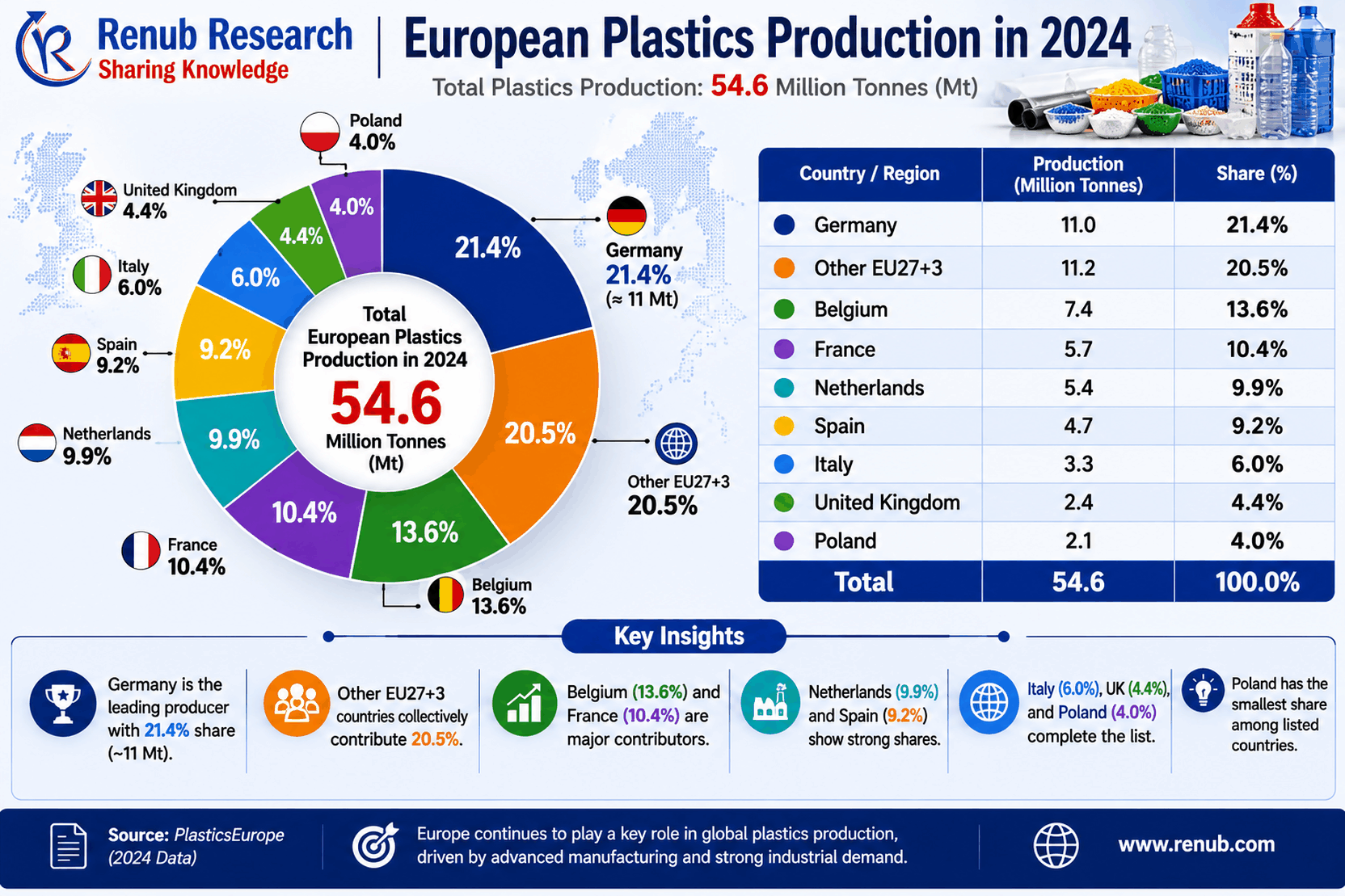
- Total European plastics production: 54.6 million tonnes (Mt).
- Germany is the largest producer, contributing 21.4% (about 11 Mt).
- Other EU27+3 countries collectively produce 20.5%, making them the second-largest group.
- Belgium contributes 13.6%.
- France accounts for 10.4%.
- The Netherlands produces 9.9%.
- Spain contributes 9.2%.
- Italy accounts for 6.0%.
- The United Kingdom produces 4.4%.
- Poland contributes 4.0%.
- Germany is the leading individual country in plastics production, while Poland has the smallest share among the countries listed.
Key Growth Pillars
Volume Escalation in High-Throughput FMCG and Sustainable Packaging
The primary catalyst for polypropylene (PP) volume growth in Europe is its extensive application across both rigid and flexible packaging formats within the fast-moving consumer goods (FMCG) sector. Polypropylene provides an optimal balance of low density, structural rigidity, and excellent moisture barrier properties, making it the preferred polymer for consumer containers, caps, closures, orientation films, and barrier layers. To meet shifting consumer expectations and stringent compliance mandates, the industry is increasingly transitioning to circular alternatives. Highlighting this shift, packaging innovator GEKA commercialized a primary cosmetic packaging line manufactured from post-consumer recycled polypropylene (PCR-PP) utilizing at least 95% recycled content. This formulation matches virgin-grade color brilliance and processability while reducing carbon emissions by 75%, demonstrating the commercial viability of high-purity recycled polymers in premium consumer applications.
Structural Light-Weighting and E-Mobility Fleet Transitions
The European automotive and mass transport sectors remain dominant consumers of specialized polypropylene compounds for interior, exterior, and under-the-hood sub-assemblies. This demand is structurally reinforced by European fleet emission caps and the rapid manufacturing scale-up of electric vehicles (EVs), where minimizing curb weight is essential to maximizing battery range. Polypropylene’s low specific gravity, mechanical impact strength, and design flexibility make it an ideal replacement for heavier engineering plastics and metals in bumpers, dashboards, door cards, center consoles, and battery enclosures. Compounding innovations utilizing performance fillers and reinforcing fibers have also enhanced PP’s noise-damping and chemical resistance profiles. For instance, Cooper Standard expanded its automotive portfolio with the FlexiCore Thermoplastic Body Seal, providing a lightweight, fully recyclable alternative to legacy metal-carrier doorframe seals, illustrating the ongoing automotive shift toward sustainable polymer components.
Catalytic Process Innovations and Circular Infrastructure Investment
Advanced R&D in catalyst technologies, polymerization processes, and custom compounding is significantly enhancing the performance threshold and sustainability profile of European polypropylene. Modern premium grades deliver improved optical clarity, low-temperature impact strength, and thermal stability, allowing PP to systematically displace more expensive technical polymers in specialized applications. Concurrently, Europe’s regulatory shift toward a circular economy is driving significant capital expenditure into both mechanical and advanced chemical recycling infrastructure. This ecosystem transition is supported by the development of mono-material packaging architectures designed to maximize material recovery rates. Reflecting this focus on process optimization, Polyvel introduced a novel resin modifier for nonwoven polypropylene applications that enables the utilization of standard commodity PP resins in place of specialized meltblown grades, driving down production overheads and improving supply chain resilience across the nonwovens sector.
Polypropylene Product launches in Europe
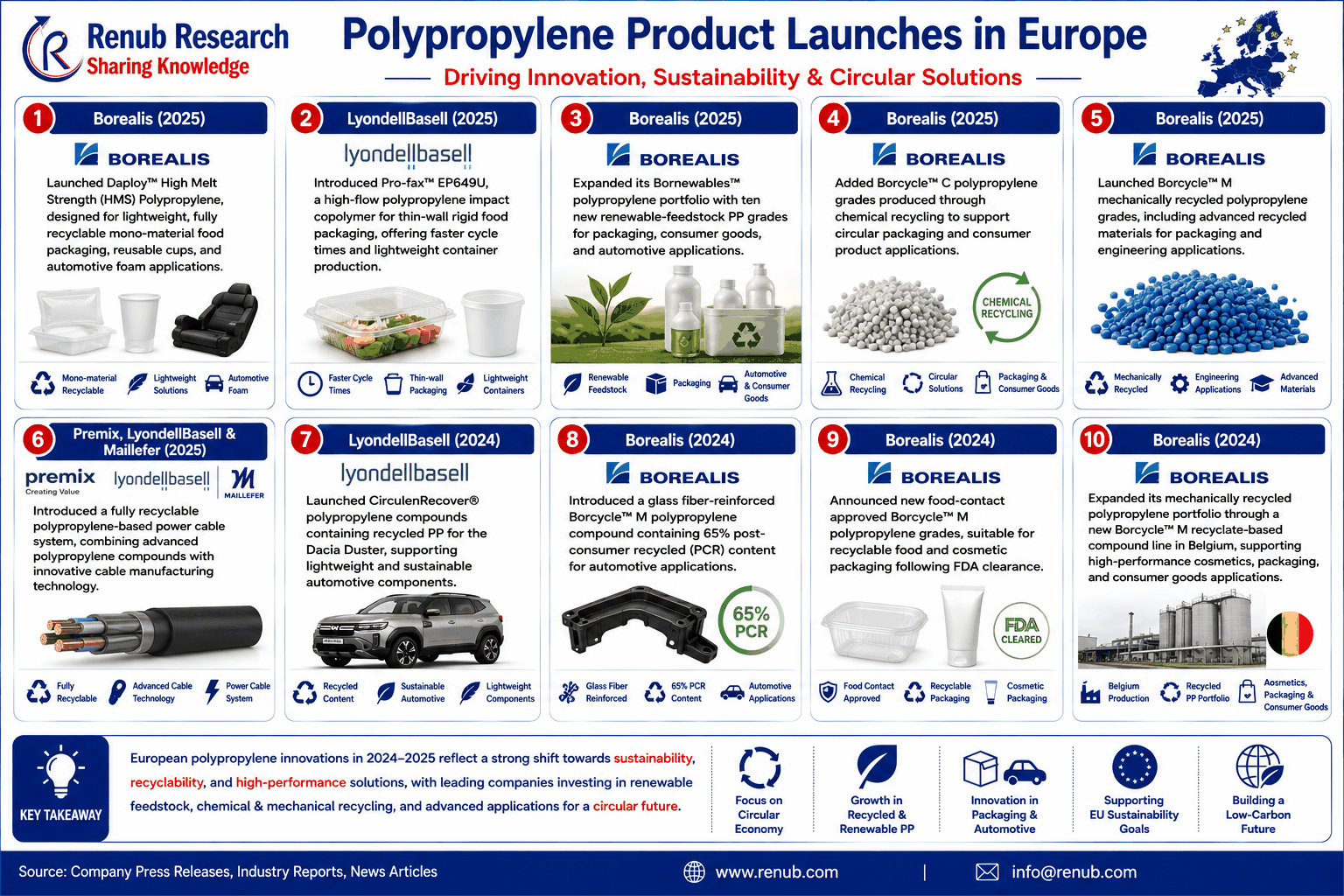
- Borealis (2025): Launched Daploy™ High Melt Strength (HMS) Polypropylene, designed for lightweight, fully recyclable mono-material food packaging, reusable cups, and automotive foam applications.
- LyondellBasell (2025): Introduced Pro-fax™ EP649U, a high-flow polypropylene impact copolymer for thin-wall rigid food packaging, offering faster cycle times and lightweight container production.
- Borealis (2025): Expanded its Bornewables™ polypropylene portfolio with ten new renewable-feedstock PP grades for packaging, consumer goods, and automotive applications.
- Borealis (2025): Added Borcycle™ C polypropylene grades produced through chemical recycling to support circular packaging and consumer product applications.
- Borealis (2025): Launched Borcycle™ M mechanically recycled polypropylene grades, including advanced recycled materials for packaging and engineering applications.
- Premix, LyondellBasell & Maillefer (2025): Introduced a fully recyclable polypropylene-based power cable system, combining advanced polypropylene compounds with innovative cable manufacturing technology.
- LyondellBasell (2024): Launched CirculenRecover® polypropylene compounds containing recycled PP for the Dacia Duster, supporting lightweight and sustainable automotive components.
- Borealis (2024): Introduced a glass fiber-reinforced Borcycle™ M polypropylene compound containing 65% post-consumer recycled (PCR) content for automotive applications.
- Borealis (2024): Announced new food-contact approved Borcycle™ M polypropylene grades, suitable for recyclable food and cosmetic packaging following FDA clearance.
- Borealis (2024): Expanded its mechanically recycled polypropylene portfolio through a new Borcycle™ M recyclate-based compound line in Belgium, supporting high-performance cosmetics, packaging, and consumer goods applications.
Market Restraints
Stricter Regulatory Mandates and Plastic Substitution Risks
The European polypropylene sector faces intense structural headwind from evolving supranational environmental policies and growing public opposition to conventional polymers, particularly within single-use consumer segments. Evolving EU packaging waste directives, microplastic mitigation frameworks, and escalating mandatory recycling targets are forcing brand owners and converters to aggressively audit their material workflows. Furthermore, negative consumer perception regarding marine pollution risk creates a constant threat of material substitution, driving downstream users to actively evaluate paperboard, glass, aluminum, or certified bio-degradable alternatives in specific retail categories.
Feedstock Volatility, Utility Cost Inflation, and Regional Margin Squeezes
European polypropylene converters and upstream producers operate under highly volatile production economics dictated by fluctuating feedstock costs and uncompetitive regional energy tariffs. Because PP production depends directly on a steady supply of monomer propylene sourced from naphtha crackers or refinery streams, local spot pricing is highly sensitive to crude oil fluctuations, natural gas spikes, and sudden cracker maintenance shutdowns. This economic vulnerability is further intensified by the financial impact of European carbon pricing mechanisms and geopolitical disruptions to traditional import channels, which compress processor margins and limit the global pricing leverage of domestic European manufacturers.
Type Insights
Homopolymer Polypropylene
Homopolymer polypropylene represents the largest product segment in the European polypropylene market due to its excellent stiffness, high tensile strength, and superior processing characteristics. It is extensively used in injection molding, film production, and sheet extrusion for manufacturing rigid packaging, food containers, caps and closures, household products, and automotive interior components. Its low density, cost-effectiveness, and dimensional stability make it an ideal material for applications requiring structural strength and lightweight performance. European manufacturers continue to develop advanced homopolymer grades with enhanced clarity, optimized melt flow, and faster processing capabilities to support lightweight product designs and improved manufacturing efficiency.
Process Insights
Blow Molding
The Europe blow molding polypropylene market is driven by increasing demand for lightweight, durable, and chemically resistant packaging solutions. Blow-molded polypropylene is widely used to manufacture bottles, containers, automotive reservoirs, air ducts, fuel tanks, and technical hollow components. Its excellent stiffness, chemical resistance, and environmental stress crack resistance make it suitable for packaging food products, detergents, chemicals, and personal care items. Manufacturers are increasingly introducing specialized polypropylene grades with improved melt strength, impact resistance, and processing stability to enable thinner wall designs and greater material efficiency. The growing emphasis on recyclable packaging and mono-material solutions is also encouraging the development of sustainable blow molding polypropylene products.
Extrusion Polypropylene
Extrusion-grade polypropylene plays a vital role in Europe’s packaging and industrial sectors, where it is processed into films, sheets, pipes, and profiles. Cast polypropylene (CPP) and biaxially oriented polypropylene (BOPP) films are widely utilized in food packaging, labels, laminates, and flexible packaging due to their excellent transparency, moisture barrier properties, and heat-sealing performance. Polypropylene sheets and profiles are also used in construction materials, stationery products, appliances, and industrial applications. European converters continue to seek extrusion grades offering consistent molecular weight distribution, superior processing performance, and high production speeds. The transition toward recyclable mono-material flexible packaging solutions is further strengthening demand for polypropylene films across the region.
Application Insights
Fiber Polypropylene
The Europe polypropylene fiber market is supported by growing demand from hygiene, healthcare, automotive, construction, and industrial textile applications. Polypropylene fibers are widely used in nonwoven fabrics, geotextiles, carpets, filtration materials, automotive interiors, and disposable hygiene products due to their lightweight nature, moisture resistance, chemical stability, and durability. Demand for meltblown and spunbond nonwoven polypropylene increased significantly following heightened focus on medical protective equipment and hygiene products. In the construction sector, polypropylene fibers are incorporated into concrete and asphalt mixtures to improve crack resistance and structural durability. European manufacturers continue to invest in advanced fiber technologies that deliver consistent quality, controlled fiber dimensions, and enhanced mechanical performance.
Raffia Polypropylene
The raffia polypropylene market in Europe serves a wide range of industrial and agricultural applications, including woven sacks, bulk bags, tarpaulins, shopping bags, and agricultural ground covers. Raffia-grade polypropylene provides excellent tensile strength, lightweight performance, durability, and resistance to environmental stress, making it suitable for demanding outdoor applications. Growing demand for reusable and recyclable packaging solutions has encouraged wider adoption of woven polypropylene products as sustainable alternatives to single-use plastic bags. Manufacturers are also focusing on improving processability and product durability to meet evolving regulatory and environmental requirements.
End User Insights
Packaging
Packaging remains the largest end-use sector for polypropylene in Europe, accounting for a significant share of overall consumption. Polypropylene is widely utilized in rigid containers, trays, closures, food packaging films, pouches, and flexible packaging due to its toughness, heat resistance, chemical stability, and excellent moisture barrier properties. The material is suitable for microwaveable packaging, hot-fill applications, and food-contact products. European packaging manufacturers are increasingly adopting lightweight designs, recyclable mono-material packaging, and recycled polypropylene to comply with circular economy objectives and stringent sustainability regulations. Growing demand for packaged food, e-commerce packaging, and convenience products continues to support market expansion.
Medical
The medical polypropylene market in Europe is expanding steadily due to rising healthcare expenditure and increasing demand for disposable medical products. Polypropylene is widely used in syringes, intravenous components, laboratory equipment, diagnostic devices, pharmaceutical packaging, and medical containers because of its excellent chemical resistance, sterilization capability, and mechanical strength. Medical-grade polypropylene can withstand steam sterilization, ethylene oxide treatment, and gamma radiation while maintaining product integrity. Increasing demand for single-use medical devices, home healthcare equipment, and diagnostic testing is expected to further drive polypropylene consumption across the healthcare sector.
Countries Insights
Germany
Germany represents one of Europe’s largest polypropylene markets, supported by its highly developed automotive, chemical, packaging, and manufacturing industries. Demand is driven by high-performance automotive components, engineering plastics, technical films, and premium packaging applications. German manufacturers emphasize product quality, precision engineering, and sustainability, encouraging the development of specialized polypropylene grades with enhanced performance characteristics. Investments in advanced recycling technologies, lightweight materials, and resource-efficient manufacturing continue to strengthen the country’s polypropylene industry. In May 2025, Borealis introduced a new production line at its Burghausen facility to manufacture Daploy® High Melt Strength (HMS) polypropylene, designed for recyclable mono-material food packaging, reusable cups, automotive components, and lightweight foam applications.
United Kingdom
The United Kingdom polypropylene market is supported by demand from packaging, consumer goods, construction, and automotive industries. Food packaging, household products, caps, closures, and flexible packaging remain the primary applications for polypropylene. The country’s increasing focus on plastic waste reduction and circular economy initiatives is accelerating innovation in recyclable packaging and recycled polypropylene materials. Despite evolving post-Brexit supply chain dynamics, polypropylene continues to play a vital role in manufacturing lightweight, corrosion-resistant products. In November 2025, Ducor Petrochemicals and Blue Circle Olefins announced a strategic partnership to produce and market segregated bio-based polypropylene and carbon-recycled polypropylene, targeting healthcare, automotive, electrical, packaging, engineering, and consumer product applications.
Netherlands
The Netherlands serves as both a major polypropylene consumer and a strategic petrochemical and logistics hub within Europe. Its integrated refinery and petrochemical infrastructure supports large-scale polypropylene production, import, export, and distribution across the region. Domestic demand is concentrated in packaging, consumer products, logistics containers, horticulture, and agricultural applications. The country’s strong commitment to circular economy principles continues to encourage innovation in plastic recycling and sustainable packaging materials. In June 2025, Premix, LyondellBasell, and Maillefer collaborated to introduce a fully recyclable polypropylene-based power cable system, combining advanced polypropylene materials with innovative cable manufacturing technologies.
Russia
Russia remains an important polypropylene producer within the broader European market due to its abundant hydrocarbon resources, integrated petrochemical capacity, and export-oriented production base. Polypropylene demand is primarily supported by packaging, construction materials, textiles, automotive components, and industrial applications. While geopolitical developments and trade restrictions have influenced export markets and technology access, domestic manufacturers continue to expand production of higher-value polypropylene grades. Infrastructure development, industrial modernization, and consumer goods manufacturing continue to support domestic demand. In July 2025, SIBUR launched PP MG182 K, a new polypropylene copolymer specifically developed for hygiene products and medical nonwoven fabrics, providing a locally produced alternative to imported specialty materials.
Market Segmentations
Type
- Homopolymer
- Copolymer
Process
- Injection Molding
- Blow Molding
- Extrusion
- Others
Application
- Film and Sheet
- Fiber
- Raffia
- Others
End User
- Packaging
- Automotive
- Building and Construction
- Medical
- Electrical and Electronics
- Others
Countries
- France
- Germany
- Italy
- Spain
- United Kingdom
- Belgium
- Netherlands
- Russia
- Poland
- Greece
- Norway
- Romania
- Portugal
- Rest of Europe
All companies have been covered with 5 Viewpoints
- Overviews
- Key Person
- Recent Developments
- SWOT Analysis
- Revenue Analysis
Company Analysis:
- BASF SE
- China Petrochemical Corporation
- Daelim Co. Ltd
- Exxon Mobil Corporation
- Formosa Plastics Corporation
- HPCL-Mittal Energy Limited (HMEL)
- INEOS
- LG Chem Ltd.
- LyondellBasell Industries N.V.
- Sumitomo Chemical Co. Ltd.
Report Details:
| Report Features | Details |
| Base Year |
2025 |
| Historical Period |
2022 - 2025 |
| Forecast Period |
2026 - 2034 |
| Market |
US$ Billion |
| Segment Covered |
Type, Process, Application, End User and Countries |
| Countries Covered |
|
| Companies Covered |
|
| Customization Scope |
20% Free Customization |
| Post-Sale Analyst Support |
1 Year (52 Weeks) |
| Delivery Format |
PDF and Excel through Email (We can also provide the editable version of the report in PPT/Word format on request) |
Customization Services available
- Analysis of Market Size and Its Segments
- More Company Profiles (Upto 10 without any additional cost):
- Additional Countries (Other than mentioned Countries):
- Region/Country Specific Reports:
- Market Entry Strategy:
- Region-Specific Market Dynamics:
- Regional Market Share Analysis:
- Trade Analysis:
- Production Insights:
- Others Customized Requests:
For more information contact our analysts.
Need More Assistance?
- Talk to our analysts to get more precious information on the current market trends.
- Include more countries and segments and customize the report based on the final requirement.
- Get a competitive advantage in your industry by knowing the report findings and making a positive impact on your revenues and operations.
- Our analysts are always ready to provide more help and pertinent information if you need any additional assistance.