Europe Motorcycle Loan Market Report by Vehicle Type, Provider Type, Percentage of Amount Sanctioned, Tenure, Countries and Company Analysis, 2025–2034
Buy NowEurope Motorcycle Loan Market Size and Forecast
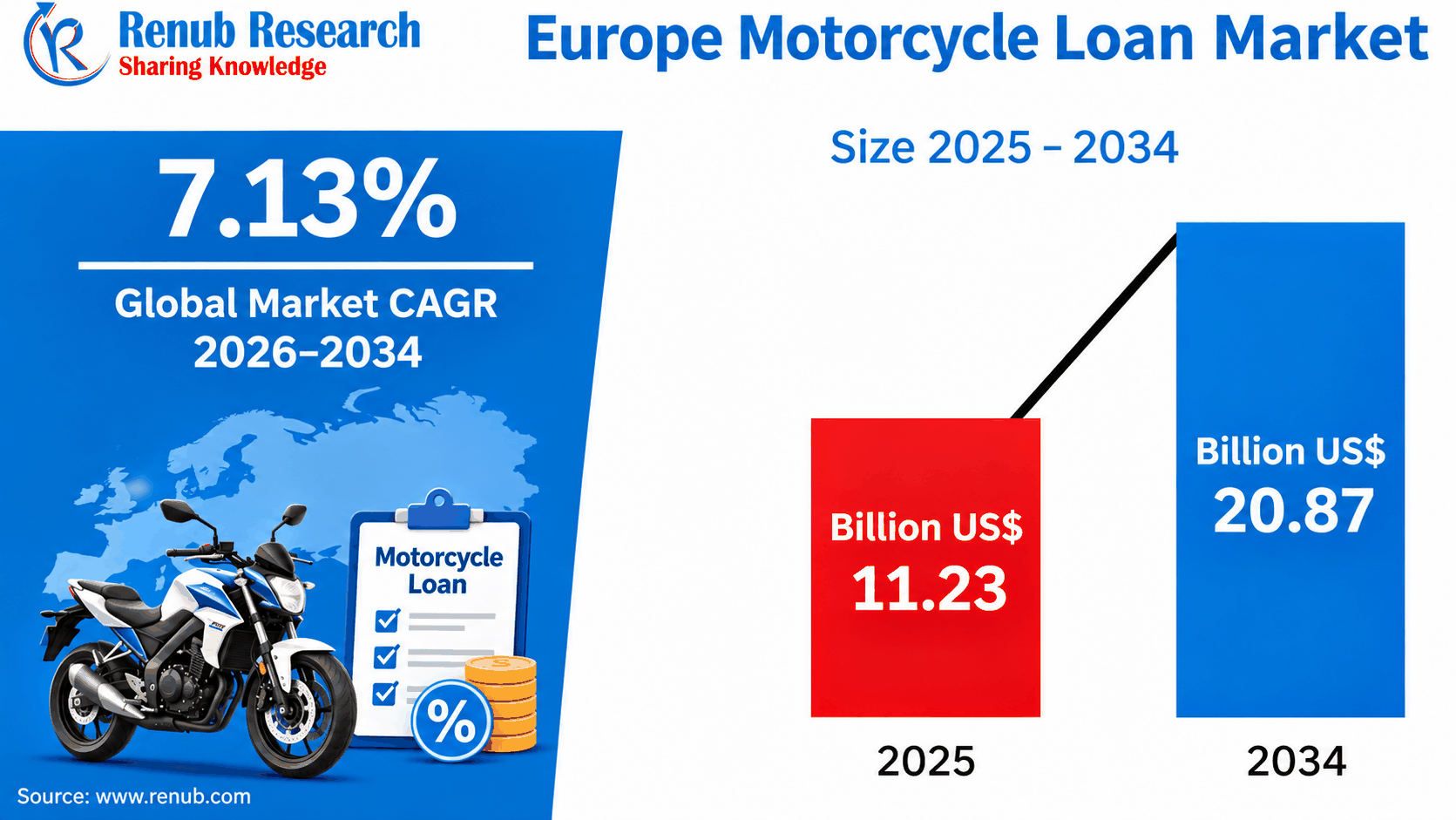
Europe Motorcycle Loan Market will grow from US$ 11.23 Billion in 2025 to US$ 20.87 Billion in 2034, at a Compound Annual Growth Rate (CAGR) of 7.13% from 2026–2034. Market expansion is supported by increasing demand for motorcycle financing, rising interest in personal mobility, and the availability of flexible loan options. Digital lending platforms, competitive financing packages, and partnerships between financial institutions and motorcycle manufacturers are further improving access to credit.
What Is a Motorcycle Loan and Its Uses & Popularity in Europe?
A motorcycle loan is a financing product that enables individuals to purchase motorcycles by borrowing money from banks, credit unions, financial institutions, or manufacturer-affiliated finance companies. Borrowers repay the principal amount along with interest through fixed monthly installments over an agreed repayment period. Motorcycle financing can cover new and used motorcycles, touring bikes, scooters, sport motorcycles, and, depending on the lender, electric two-wheelers. Common financing options include secured vehicle loans, unsecured personal loans, dealer-arranged financing, and hire-purchase agreements.
In Europe, motorcycle loans are used by commuters, recreational riders, delivery operators, and motorcycle enthusiasts seeking affordable access to personal transportation. Financing helps buyers spread the purchase cost rather than paying the entire amount upfront. Italy, France, Germany, Spain, and the United Kingdom are important motorcycle markets, supported by established riding cultures and diverse mobility needs. According to the European motorcycle industry association ACEM, the five largest European markets recorded approximately 1.003 million new motorcycle registrations in 2025, down 12.9% from 2024. Despite this decline, financing remains relevant for consumers seeking flexible payment options, while digital lending and manufacturer partnerships continue to shape the market.
Europe: Government Initiatives Supporting Two-Wheeler Loans and Financing in 2025
1. Italy: €30 Million Ecobonus Programme
Italy reintroduced its Ecobonus scheme in 2025, allocating €30 million to support eligible electric and hybrid motorcycles, scooters, and other light vehicles. Incentives for electric and hybrid vehicles could reach 40% of the purchase price, up to €4,000 when an eligible older vehicle was scrapped. Without scrappage, the incentive rate was lower. The programme opened for dealer reservations on 18 March 2025, with funding available until the end of the year or until exhausted. By lowering the purchase price, the programme helped reduce the amount consumers might need to borrow.
2. Ireland: Grants for Electric Motorcycles
In February 2025, Ireland announced an electric motorcycle grant scheme administered by the Sustainable Energy Authority of Ireland (SEAI), with support from the Department of Transport and Zero Emission Vehicles Ireland.
- €500 for eligible L1e-B light two-wheel powered vehicles.
- €1,000 for eligible L3e electric motorcycles capable of exceeding 45 km/h.
These grants reduce the initial purchase cost and may complement consumer financing arrangements.
3. Malta: Electric Motorcycle Purchase Incentives
Malta continued government support for electric mobility in 2025 through a programme covering electric vehicles, pedelecs, and motorcycles. The scheme offered incentives of up to €6,000 for electric motorcycles, alongside support for other sustainable transport options. By lowering the net purchase price, such grants can make financed electric two-wheelers more affordable for households and businesses.
4. Spain: Electric Mobility Incentives
Spain extended its MOVES III programme in April 2025, allocating €400 million for eligible electric-vehicle purchases and charging infrastructure during 2025. Although the headline passenger-car grant was up to €7,000, the programme was broader electric-mobility support, and eligibility for a specific motorcycle depended on the applicable rules. The initiative supported the wider shift toward electric transport rather than creating a dedicated nationwide motorcycle loan programme.
5. Madrid, Spain: CAMBIA 360 Micromobility Subsidies
Madrid’s 2025 CAMBIA 360 programme supported the purchase of new personal-mobility vehicles, including electric mopeds and motorcycles. The scheme had a total budget of €200,000 and accepted applications from 15 April to 2 October 2025. Eligible electric two-wheelers could receive purchase assistance under the programme’s category-specific conditions. Such municipal subsidies can lower the amount financed by a consumer, although they are grants rather than loans.
Growth Drivers of the Europe Motorcycle Loan Market
Increasing Demand for Flexible and Affordable Motorcycle Financing
The availability of flexible financing options is supporting the European motorcycle loan market by enabling consumers to spread vehicle purchase costs over manageable repayment periods. Motorcycles can serve as practical transport for commuting, leisure, and regional travel, but higher-priced touring and premium models may require substantial upfront expenditure. Loans, hire-purchase agreements, and dealer financing allow eligible buyers to access these vehicles without paying the full purchase price immediately. Financing providers are increasingly offering tailored repayment schedules, online applications, and options for new and used motorcycles. These services can appeal to younger professionals, experienced riders upgrading their vehicles, and customers seeking premium models. However, actual borrowing demand depends on interest rates, credit eligibility, household budgets, and motorcycle sales volumes. By reducing the immediate financial burden of vehicle ownership, accessible credit can support purchases and encourage continued development of the motorcycle financing sector across European markets.
Strong Motorcycle Demand in Major European Countries
The established motorcycle markets of Italy, France, Germany, Spain, and the United Kingdom create opportunities for motorcycle financing providers. These countries have large rider communities, developed dealership networks, and demand for commuter, touring, sport, and leisure motorcycles. ACEM reported that the five markets recorded 1,002,848 new motorcycle registrations in 2025, compared with 1,150,852 in 2024, representing a decline of approximately 12.9%. Italy recorded 331,634 registrations, Spain 242,580, France 179,225, Germany 159,764, and the UK 89,645. Although registrations declined overall, the substantial volume of new motorcycle purchases provides a continuing potential customer base for lenders. Financial institutions and dealerships can offer loans, installment plans, and hire-purchase products to buyers who prefer spreading payments. Financing demand can also arise from replacement purchases and upgrades to higher-capacity motorcycles. Market performance varies by country, and registration declines can limit new lending opportunities. Nevertheless, the scale of Europe’s motorcycle sector provides a foundation for financial providers to develop country-specific products and strengthen partnerships with manufacturers and retailers.
Digital Lending and Manufacturer–Finance Partnerships
Digital lending platforms and partnerships between motorcycle manufacturers, dealerships, and financial institutions are improving access to motorcycle financing across Europe. Online applications, digital identity verification, automated credit assessments, and electronic documentation can simplify the borrowing process and reduce the time required to obtain a financing decision. Manufacturer-affiliated finance companies and dealer-arranged credit also allow customers to explore financing while selecting a motorcycle, creating a more integrated purchasing experience. The European market includes major consumer-finance providers such as Santander Consumer Finance, BNP Paribas Personal Finance, and Crédit Agricole Consumer Finance, alongside manufacturer-related financing operations. These providers can offer structured installment plans and financing packages adapted to different motorcycle prices and borrower profiles. Digital tools also help lenders communicate repayment schedules and support account management after purchase. However, lending decisions remain subject to creditworthiness assessments and applicable consumer-credit regulations. As consumers increasingly expect convenient digital services, providers that combine transparent terms, efficient applications, and dealership partnerships may improve customer acquisition and strengthen their position in Europe’s motorcycle loan market.
Challenges of the Europe Motorcycle Loan Market
High Interest Rates and Household Affordability Pressures
Interest rates and household affordability remain important challenges for the Europe motorcycle loan market. Motorcycle loans increase the total cost of vehicle ownership because borrowers must repay interest and may also face fees, insurance expenses, maintenance costs, and taxes. When borrowing costs rise or household budgets tighten, prospective buyers may postpone purchases, choose less expensive motorcycles, increase their down payments, or avoid financing altogether. These pressures can be particularly significant for discretionary purchases such as premium sport bikes and large touring motorcycles. The market’s sensitivity to vehicle demand was evident in 2025, when new motorcycle registrations in Europe’s five largest markets fell by 12.9% to approximately 1.003 million units, according to ACEM figures. This decline does not establish that financing costs were the sole cause, but it illustrates the potential impact of market conditions on the pool of new buyers. Lenders must balance competitive interest rates with credit risk, funding costs, and responsible lending requirements. Transparent repayment terms and suitable loan durations can help consumers assess affordability, but sustained economic pressure may constrain new loan originations.
Credit Risk, Regulatory Compliance, and Changing Motorcycle Sales
Motorcycle lenders face credit risk because borrowers may experience income instability, unexpected expenses, or difficulties meeting monthly repayments. These risks can be more pronounced for applicants with limited credit histories or high existing debt. Financial institutions must assess borrowers’ repayment capacity, price loans appropriately, and comply with national and European consumer-credit requirements. They also need to provide clear information about interest rates, fees, early repayment conditions, and the consequences of missed payments. At the same time, motorcycle sales fluctuate in response to economic conditions, model availability, weather, consumer preferences, and regulatory changes. ACEM reported a 12.9% year-on-year decline in new motorcycle registrations across five major European markets in 2025, partly reflecting market adjustment following the transition to the Euro 5+ emissions standard. Such fluctuations can affect dealership financing volumes and lenders’ expectations for new business. Digital lending also requires investment in data security, fraud prevention, and reliable credit assessment. Providers must therefore balance convenient loan approvals with prudent underwriting, regulatory compliance, and effective management of changing demand.
Motorcycle Loan and Financing Launches in Europe
1. CFMOTO UK Motorcycle PCP Finance (April 2026): CFMOTO launched a Personal Contract Purchase (PCP) financing offer in partnership with Santander Consumer Finance across models including the 125NK, 450MT, 675NK, and 800MT-X. The offer featured a representative APR of 7.9%, with selected models available from £49 per month.
2. BMW Motorrad Ready2Ride (Greece, June 2026): BMW Financial Services Hellas introduced a flexible financing program featuring a 4.9% nominal annual interest rate, down payments starting at 20%, and repayment periods of 24 or 36 months. Selected BMW motorcycles were advertised from €99 per month.
3. Ducati UK Updated Finance Offers (January 2026): Ducati introduced a representative APR of 5.9% across much of its motorcycle range, including selected new models. The offer included PCP options and a 4.9% representative APR on the Multistrada V4 range.
4. Honda and Crédit Agricole Pan-European Financing Partnership (2026): Honda partnered with Crédit Agricole Personal Finance & Mobility and associated finance companies to provide motorcycle and vehicle financing across eight European countries: Austria, Belgium, Italy, Luxembourg, the Netherlands, Poland, Portugal, and Switzerland. The rollout began in January 2026 in selected countries.
5. Royal Enfield Ready to Ride Finance Package (UK, March 2026): Royal Enfield and CA Auto Finance launched a package for new riders, initially associated with the Guerrilla 450. The monthly payment can cover the motorcycle, accessories, riding apparel, and an A2 motorcycle licence, subject to participating-dealer terms.
6. Urban Moto and FinMatch Dealer Finance Programme (UK, April 2026): Urban Moto Distribution partnered with FinMatch to help dealers offer financing for Rieju and RFN motorcycles, including electric models. The programme included lender options for different credit profiles and digital tools for online and showroom sales.
7. Flying Flea Finance (UK and Europe, 2026): CA Auto Finance became the exclusive finance partner for Royal Enfield’s Flying Flea electric motorcycle brand. Hire-purchase financing options were introduced to support the launch of the C6 electric motorcycle across London, Paris, Barcelona, Rome, and Berlin.
8. Harley-Davidson and Crédit Agricole Financing Programme (Ukraine, April 2026): Crédit Agricole introduced financing for new Harley-Davidson motorcycles through official dealerships in Kyiv and Dnipro. Published terms included loan periods of up to 36 months and interest rates ranging from 0.01% to 8.99% annually, plus applicable fees.
9. Kawasaki K-Options Finance Campaign (UK, 2025–2026): Kawasaki offered 0% APR hire-purchase financing on selected motorcycles up to 650cc, alongside a 50/50 PCP option that allowed eligible buyers to pay half upfront and defer the remaining half for two years. The cited offer was available until September 30, 2026.
10. Ducati Accelerate PCP Finance Programme (UK, 2026): Ducati expanded its finance options with a 0% representative APR PCP offer on selected motorcycles, including the Monster V2, Scrambler, and Hypermotard 698. The programme offered eligible customers the option to keep the motorcycle, trade it in, or return it at the end of the agreement.
United Kingdom Rising Demand for Motorcycle Financing
The United Kingdom motorcycle loan market is influenced by demand for affordable personal mobility, commuter motorcycles, and recreational bikes. Financing options such as hire purchase (HP), personal contract purchase (PCP), and personal loans enable consumers to spread motorcycle costs over manageable monthly payments. According to the Motorcycle Industry Association, the UK registered 89,160 new motorcycles in 2025, a decline of 19.4% compared with 2024, highlighting the importance of affordability and competitive financing offers in supporting purchases. Online loan applications, dealer-arranged finance, and manufacturer-backed promotional offers are helping simplify motorcycle purchases. Flexible deposits, fixed monthly instalments, and promotional annual percentage rates can appeal to younger buyers, commuters, and enthusiasts upgrading to larger motorcycles. However, approval depends on creditworthiness, income, and lender affordability assessments. Higher borrowing costs, household budget pressures, and uncertainty over discretionary spending can discourage consumers from taking out loans. Nevertheless, demand for scooters, mid-range motorcycles, and electric two-wheelers offers opportunities for lenders to develop tailored financing products. Overall, the UK market’s prospects depend on motorcycle demand, accessible credit, and transparent repayment terms.
Germany Demand for Premium and Everyday Motorcycles
Germany represents a significant European market for motorcycles, supported by established manufacturers, a strong motorcycling culture, and demand for commuting and leisure riding. However, new registrations weakened considerably in 2025. Data reported by the European motorcycle industry association showed 159,764 motorcycle registrations in Germany, down 35.7% year on year. This decline highlights the importance of affordable financing and attractive dealer offers in stimulating purchases. Motorcycle buyers can access financing through banks, consumer-credit providers, dealership programmes, and manufacturer-affiliated financial services. Hire-purchase agreements and fixed-instalment loans help spread the cost of motorcycles, including premium touring bikes and adventure models. Digital applications and online eligibility checks can make financing more convenient, although lenders still assess income, credit history, and repayment capacity. High purchase prices, insurance expenses, maintenance costs, and borrowing charges can limit loan uptake, particularly among younger riders. Competition from public transport and car-sharing may also affect ownership decisions in major cities. Despite these challenges, flexible credit products and competitive financing offers can support future demand as motorcycle registrations stabilise.
Spain Two-Wheeler Demand in Urban Areas
Spain offers favourable opportunities for motorcycle lending because scooters and motorcycles are widely used for urban commuting and personal mobility. According to Spain’s motorcycle industry association, 265,220 motorcycles and other light vehicles were registered in 2025, an increase of 6.9% year on year. Scooters accounted for 132,264 registrations, or 49.8% of the total category. This substantial scooter segment creates opportunities for loans designed around everyday transportation needs. Installment loans, hire-purchase agreements, and dealership financing can help consumers purchase scooters, commuter motorcycles, and higher-powered models without paying the full cost upfront. Online applications and flexible repayment structures may appeal to younger buyers and urban residents. Financing can also support purchases of electric two-wheelers where suitable products and incentives are available. Household budgets, interest rates, insurance costs, and lenders’ credit checks can affect loan affordability. Demand may also vary between large cities and smaller towns, where commuting patterns and access to digital finance differ. Overall, Spain’s growing two-wheeler market provides a potential foundation for motorcycle loan expansion, particularly through affordable scooter financing and convenient digital lending.
France Motorcycle Ownership and Financing Demand
France is one of Europe’s major motorcycle markets, with demand spanning scooters, commuter motorcycles, touring bikes, and recreational models. However, registrations declined in 2025. Data from the European motorcycle industry association indicated 179,225 new motorcycle registrations in France, down 16.4% from 2024. This contraction makes competitive finance offers important for helping consumers manage purchase costs and encouraging replacement purchases. French consumers can use personal loans, hire-purchase arrangements, and manufacturer or dealership financing to spread motorcycle costs. Digital application processes and fixed monthly payments can simplify purchasing decisions, while promotional offers may make selected models more accessible. Financing can also play a role in purchases of electric two-wheelers, although affordability, charging convenience, and model availability influence adoption. Higher borrowing costs, insurance premiums, maintenance expenses, and household budget constraints may reduce consumers’ willingness to take on new credit. Urban public transport and shared-mobility services also compete with motorcycle ownership. Nevertheless, demand for convenient personal mobility and flexible payment options provides opportunities for lenders. Market growth will depend on motorcycle sales recovery, responsible lending, and financing products suited to different customer budgets.
Europe Motorcycle Loan Market Segments:
Vehicle Type
- Two-Wheeler
- Passenger Car
- Commercial Vehicle
Provider Type
- Banks
- NBFCs (Non-Banking Financial Services)
- OEM (Original Equipment Manufacturer)
- Others (Fintech Companies)
Percentage of Amount Sanctioned
- Less than 25%
- 25-50%
- 51-75%
- More than 75%
Tenure
- Less than 3 Years
- 3-5 Years
- More than 5 Years
Country:
- France
- Germany
- Italy
- Spain
- United Kingdom
- Belgium
- Netherlands
- Russia
- Poland
- Greece
- Norway
- Romania
- Portugal
- Rest of Europe
All companies have been covered from 5 viewpoints:
- Company Overview
- Key Persons
- Recent Development & Strategies
- SWOT Analysis
- Sales Analysis
Key Players Analysis
- Volkswagen Financial Services
- Santander Consumer Bank
- BNP Paribas Personal Finance
- Cofidis
- BMW Financial Services
- Yamaha Motor Finance
- TARGOBANK
- Honda Financial Services
- Credit Agricole Consumer Finance
Report Details:
| Report Features | Details |
| Base Year |
2024 |
| Historical Period |
2021 - 2024 |
| Forecast Period |
2025 - 2034 |
| Market |
US$ Billion |
| Segment Covered |
By Vehicle Type, By Provider Type, By Percentage of Amount Sanctioned, By Tenure and Countries |
| Countries Covered |
|
| Companies Covered |
|
| Customization Scope |
20% Free Customization |
| Post-Sale Analyst Support |
1 Year (52 Weeks) |
| Delivery Format |
PDF and Excel through Email (We can also provide the editable version of the report in PPT/Word format on request) |
Customization Services available
- Analysis of Market Size and Its Segments
- More Company Profiles (Upto 10 without any additional cost):
- Additional Countries (Other than mentioned Countries):
- Region/Country Specific Reports:
- Market Entry Strategy:
- Region-Specific Market Dynamics:
- Regional Market Share Analysis:
- Trade Analysis:
- Production Insights:
- Others Customized Requests:
For more information contact our analysts.
Need More Assistance?
- Talk to our analysts to get more precious information on the current market trends.
- Include more countries and segments and customize the report based on the final requirement.
- Get a competitive advantage in your industry by knowing the report findings and making a positive impact on your revenues and operations.
- Our analysts are always ready to provide more help and pertinent information if you need any additional assistance.