Europe Functional Water Market Report by Product, Flavor, Packaging, Distribution Channel, Countries and Company Analysis 2026-2034
Buy NowEurope Functional Water Market Size & Forecast
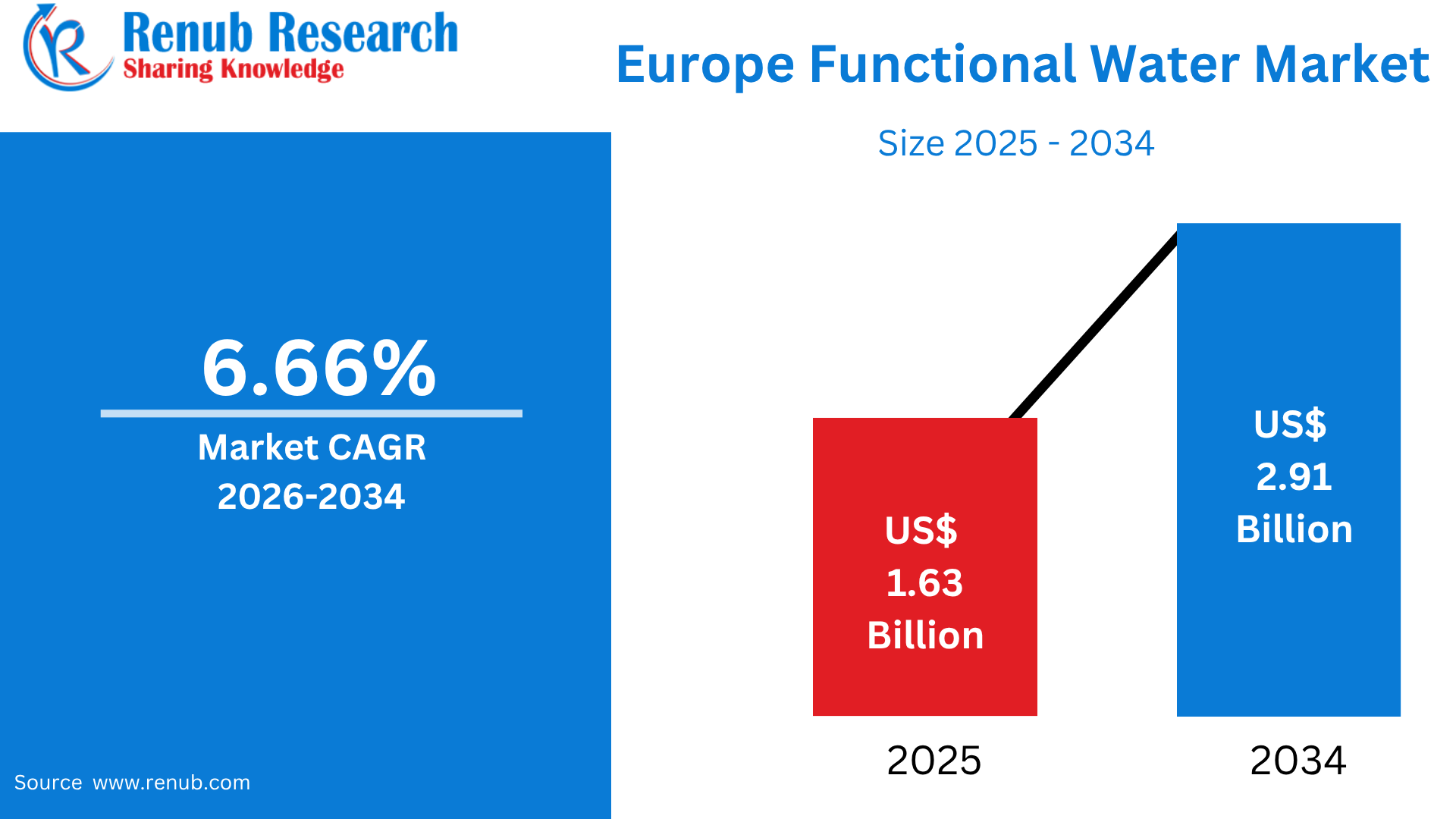
Europe Functional Water Market is expected to grow from US$ 1.63 billion in 2025 to approximately US$ 2.91 billion by 2034, expanding at a CAGR of 6.66% during 2026–2034. This growth is supported by increasing consumer awareness of health, wellness, and proper hydration, along with rising demand for fortified, flavored, and low-calorie beverages. The growing fitness and active-lifestyle trend is encouraging consumers to seek functional hydration products enriched with vitamins, minerals, electrolytes, and other beneficial ingredients.
What is Europe Functional Water Market and its Uses & Popularity?
Functional water is enhanced drinking water formulated with additional ingredients such as vitamins, minerals, electrolytes, antioxidants, amino acids, botanical extracts, or other nutrients to provide benefits beyond basic hydration. Products can be designed to support energy, immunity, exercise recovery, electrolyte replenishment, digestion, or general wellness.
In Europe, functional water is increasingly positioned as a convenient alternative to sugary soft drinks because many products are low-calorie or sugar-free. The category is used by fitness enthusiasts, working professionals, health-conscious consumers, and people seeking convenient hydration during everyday activities. Functional waters are gaining popularity alongside the broader European functional beverage market; more than half of Europeans reportedly consume functional beverages at least weekly, with the rate reaching 66% among Millennials. The growing preference for hydration, wellness, low-sugar beverages, and nutrient-enriched products is therefore creating opportunities for functional water across European supermarkets, convenience stores, gyms, cafés, and online channels.
Still vs. Sparkling Bottled Water Market Share in the European Union (2024)
- Still Water (Market Leader): Accounts for nearly two-thirds of the market at 65%.
- Sparkling Water: Holds the remaining 35% share of the European Union bottled water segment.
- Core Takeaway: While Europe has one of the highest per capita sparkling water consumption rates globally—led by markets such as Germany and Italy—still water remains the clear daily hydration choice across the EU.
Bottled Water Consumption in the EU: Litres per Capita (2024)
- Italy: 246 L
- Greece: 166 L
- Spain: 157 L
- Germany: 141 L
- Portugal: 139 L
- Romania: 129 L
- Belgium: 127 L
- France: 126 L
- Hungary: 125 L
- Bulgaria: 123 L
Growth Drivers of the European Functional Water Market
Rising Health and Wellness Awareness
Increasing consumer attention toward health, preventive wellness, and nutrition is a major driver of the Europe functional water market. Consumers are increasingly looking beyond conventional bottled water and seeking beverages that combine hydration with additional nutritional or functional benefits. Vitamin C, B vitamins, magnesium, calcium, zinc, antioxidants, and electrolytes are increasingly incorporated into functional water formulations. The wider health environment is also encouraging demand for healthier beverage choices. Eurostat reported that 16.3% of EU adults were obese in 2025, while another 35.4% were pre-obese, meaning more than half of adults were overweight or obese. These conditions are increasing attention toward healthier diets and lower-calorie consumption patterns. Functional water can appeal to consumers seeking hydration without the sugar and calories associated with conventional soft drinks. Consequently, manufacturers are expanding vitamin-, mineral-, antioxidant-, and electrolyte-enriched offerings to address different wellness requirements.
Demand for Low-Sugar and Low-Calorie Beverages
The shift away from high-sugar beverages is another important factor supporting functional water consumption in Europe. Consumers are increasingly looking for beverages that deliver flavor and functionality without adding substantial sugar or calories. Functional water fits this trend because manufacturers can combine water, natural flavors, vitamins, minerals, and electrolytes while maintaining low or zero sugar formulations. According to Kerry, no-, low-, and reduced-calorie beverages represented 41% of Europe’s soft-drink market in 2024, compared with 26% five years earlier. This substantial increase illustrates the broader movement toward lower-calorie beverage choices. Functional water brands are benefiting from this transition by introducing flavored products that provide hydration and added functionality without the positioning of traditional sugary drinks. Manufacturers are consequently experimenting with fruit, botanical, citrus, and other natural flavor profiles. This combination of low calorie content, appealing taste, and functional ingredients is expanding the category’s appeal beyond sports and fitness consumers.
Expansion of Fitness, Sports Nutrition, and Electrolyte Products
The growing popularity of fitness and sports nutrition is creating additional opportunities for functional water, particularly electrolyte- and mineral-enhanced products. Consumers increasingly use functional beverages before, during, or after exercise to support hydration and electrolyte replenishment. This trend is also broadening the role of electrolytes from specialist sports nutrition toward everyday wellness. Functional water is also increasingly targeting active commuters and consumers seeking convenient hydration outside traditional gym environments. Product innovation has expanded beyond simple electrolyte formulations to include combinations of minerals, vitamins, protein, and other functional ingredients. European functional beverage research similarly identifies hydration, energy, and wellness as important areas of consumer interest. The combination of fitness participation, sports nutrition awareness, and demand for convenient on-the-go products is therefore encouraging manufacturers to develop specialized functional waters for athletes, gym users, outdoor consumers, and everyday active lifestyles.
Challenges of the Europe Functional Water Market
Consumer Skepticism and Difficulty Demonstrating Functional Benefits
Despite increasing interest in functional beverages, consumer skepticism regarding the effectiveness of added ingredients remains a challenge for the Europe functional water market. Consumers may question whether vitamins, minerals, electrolytes, botanicals, or other ingredients provide meaningful benefits when delivered through beverages. Innova Market Insights reported in 2025 that European consumers were less likely than consumers in some other global regions to purchase functional beverages or believe that these products are effective. This creates a need for manufacturers to communicate product benefits clearly while avoiding unsupported health claims. Scientific evidence, transparent ingredient information, and credible labeling can help brands establish consumer trust. Companies must also differentiate functional water from conventional bottled water and other functional beverages. As the category expands, brands may need to invest more heavily in consumer education, evidence-backed formulations, and understandable nutritional communication to demonstrate why consumers should choose enhanced water over ordinary water or other low-calorie drinks.
Competition, Pricing Pressure, and Formulation Challenges
Functional water manufacturers face intense competition from bottled water, sports drinks, energy drinks, flavored water, functional juices, supplements, and other wellness beverages. Consumers have numerous alternatives for obtaining vitamins, minerals, electrolytes, and hydration, making product differentiation increasingly important. Cost pressures can further complicate market development because functional water generally requires additional ingredients, specialized formulations, packaging, and marketing compared with standard bottled water. Private-label competition can also pressure branded products to demonstrate clear value. In addition, manufacturers face technical challenges when using natural flavors, sweeteners, vitamins, minerals, and botanical ingredients while maintaining taste, stability, shelf life, and attractive nutritional profiles. Mordor Intelligence specifically identifies formulation difficulties involving natural flavor enhancers and sweeteners as a market restraint. These factors can increase development costs and make it more difficult for brands to maintain competitive pricing while delivering credible functionality.
Functional Water Product Launches in Europe
- February 2024 – Water Almighty (United Kingdom): Water Almighty introduced an aluminum-packaged functional water range in the UK, emphasizing sustainable hydration and reduced reliance on plastic packaging.
- September 2024 – BE WTR (France): BE WTR inaugurated an automated circular bottling facility in Paris, strengthening its sustainable premium-water solutions for the European luxury hospitality sector.
- February 2024 – Haus Cramer Group (Germany): Haus Cramer Group launched “El Puro”, a premium mineral water brand aimed at expanding its presence in the premium hydration and functional beverage segment.
- March 2024 – Danone (France): Danone expanded its European functional water portfolio with vitamin-enhanced hydration products positioned toward consumers seeking healthier beverage alternatives.
- April 2024 – Nestlé Waters (Switzerland): Nestlé Waters introduced flavored and mineral-enriched water products designed to appeal to European consumers interested in wellness-oriented hydration.
- June 2024 – Vitamin Well (Sweden): Vitamin Well broadened the availability of its sugar-free vitamin water range across multiple European markets, incorporating electrolytes and ingredients associated with immune support.
- July 2024 – VOSS Water (Norway): VOSS introduced functional hydration beverages containing vitamins and natural flavors, targeting the premium wellness beverage segment in Europe.
- August 2024 – Evian (France): Evian expanded its enhanced hydration portfolio with mineral-focused wellness formulations while incorporating sustainable packaging initiatives.
- January 2025 – Volvic (France): Volvic launched a naturally flavored functional water range containing vitamins and fruit extracts, targeting consumers with active and health-conscious lifestyles.
- March 2025 – Aqua Carpatica (Romania): Aqua Carpatica expanded its premium electrolyte-enhanced water offerings into Western European retail markets in response to increasing interest in functional and health-oriented hydration products.
Rising Demand for Nutrient-Enriched Hydration
Europe functional vitamin-infused water market is benefiting from growing consumer interest in healthier and nutrient-enriched beverages. Vitamin-infused waters combine hydration with added nutrients such as vitamins B, C, and D, minerals, and electrolytes, positioning them as convenient wellness products. The shift away from high-sugar beverages is particularly important. According to Kerry, no-, low-, and reduced-calorie beverages accounted for 41% of Europe’s soft-drink market in 2024, compared with 26% five years earlier. This transition is creating opportunities for vitamin waters that provide flavor and functionality without substantial sugar or calories. Functional beverages are also increasingly connected with preventive wellness, immunity, energy, and everyday nutrition. Research indicates that 51% of European consumers describe themselves as proactive about preventing health issues, highlighting a sizeable audience for health-oriented beverages. Manufacturers are responding through sugar-free, naturally flavored, clean-label, and fortified formulations. Sustainable bottles and improved packaging designs are also becoming important differentiators. As consumers seek convenient wellness products for work, travel, exercise, and daily routines, vitamin-infused water is gaining broader acceptance across European retail and foodservice channels.
Fitness Culture and Demand for Convenient Protein Supporting Growth
Europe functional protein-infused water market is developing as consumers increasingly combine hydration with protein supplementation. Protein water provides a lighter and more refreshing alternative to conventional milk-based protein shakes and can appeal to consumers seeking muscle recovery, maintenance, and convenient nutrition. The category is particularly relevant to athletes, gym users, runners, and consumers following protein-focused diets. European functional beverage research identifies energy, hydration, and wellness among key areas of consumer interest, supporting opportunities for products combining multiple benefits. Manufacturers are diversifying formulations through whey protein isolate, collagen peptides, and plant-based proteins, while flavor technologies are being developed to reduce the chalky texture sometimes associated with protein beverages. Low-sugar and low-calorie positioning further strengthens the category’s appeal. Europe’s broader shift toward reduced-calorie beverages is evident from the fact that no-, low-, and reduced-calorie products represented 41% of the European soft-drink market in 2024. As consumers increasingly seek convenient nutrition compatible with active lifestyles, protein-infused water is gaining opportunities in gyms, supermarkets, convenience stores, sports-nutrition outlets, and online retail.
Exotic Flavors and Wellness Positioning Attracting Younger Consumers
Europe functional tropical water market is gaining attention as consumers seek distinctive flavors combined with hydration and wellness benefits. Tropical formulations commonly use flavors inspired by coconut, pineapple, mango, passion fruit, guava, and other exotic fruits, while added vitamins, electrolytes, minerals, or botanical ingredients provide functional positioning. Flavor is particularly important because consumers increasingly want healthier beverages without sacrificing taste. Market research indicates that flavored products represented approximately 71.91% of Europe’s functional water revenue in 2025, demonstrating the strong role of flavor innovation within the category. Tropical flavors can help brands differentiate functional water from conventional bottled water while creating a more appealing alternative to carbonated soft drinks. Manufacturers are also developing low-sugar, sugar-free, organic, and naturally flavored products to align with clean-label preferences. Younger consumers, active consumers, and individuals interested in wellness are important target groups for these beverages. Attractive packaging and digital marketing further help brands communicate tropical flavor profiles and lifestyle positioning. Continued experimentation with fruit combinations, natural extracts, electrolytes, and vitamins is expected to support product innovation across Europe’s functional-water segment.
Convenience and Recyclable Packaging Supporting PET Adoption
Europe PET functional water market is supported by the widespread use of polyethylene terephthalate bottles for packaged hydration products. PET offers several practical advantages, including low weight, durability, transparency, portability, and efficient transportation, making it suitable for vitamin waters, electrolyte drinks, flavored waters, and sports beverages. On-the-go consumption is particularly relevant as consumers increasingly purchase beverages for commuting, exercise, travel, and work. However, sustainability has become a major consideration for PET packaging manufacturers. The EU generated approximately 79.7 million tonnes of packaging waste in 2023, equivalent to 177.8 kg per person, increasing pressure on packaging producers to improve material efficiency and recycling. Manufacturers are therefore investing in lightweight PET bottles, recycled PET (rPET), recyclable designs, and collection systems. European regulations are also encouraging greater circularity and reductions in packaging waste. Transparent PET additionally allows consumers to see the beverage and gives brands considerable flexibility in labeling and product presentation. While environmental concerns create challenges, improvements in recycled content and bottle-to-bottle recycling can strengthen PET’s role in functional water. Continued packaging innovation is expected to shape the segment’s development across Europe.
France Premium Wellness and Sustainable Hydration Driving Market Development
France functional water market is expanding as consumers increasingly seek premium hydration products that combine refreshment with wellness benefits. Functional waters containing vitamins, minerals, electrolytes, botanical extracts, and other functional ingredients are gaining attention as alternatives to conventional soft drinks. France’s established premium food and beverage culture creates opportunities for clean-label, naturally sourced, and high-quality hydration products. The broader European trend toward healthier beverages is also relevant, with no-, low-, and reduced-calorie beverages accounting for 41% of Europe’s soft-drink market in 2024, up from 26% five years earlier. French consumers are additionally showing interest in organic ingredients, plant-based formulations, and naturally flavored products. Sustainability is becoming another important market consideration, encouraging investment in refillable bottles, recyclable packaging, and localized water systems. In September 2024, BE WTR opened an automated circular bottling facility in Paris, targeting premium hospitality establishments with locally bottled water solutions. This development illustrates the convergence of premium positioning and circular packaging. Supermarkets, hotels, restaurants, cafés, gyms, and online retailers provide multiple channels for functional water brands. Continued product innovation and sustainability initiatives are expected to support market development in France.
Germany Wellness, Sports Nutrition, and Sustainability Supporting Demand
Germany is an important market for functional water in Europe, supported by strong consumer interest in wellness, fitness, and environmentally responsible beverages. Consumers are increasingly exploring enhanced waters containing electrolytes, vitamins, minerals, and botanical ingredients that can complement active lifestyles and everyday hydration. The country’s demand for healthier beverages is reinforced by the broader European transition toward reduced-sugar products. In 2024, 41% of Europe’s soft-drink market consisted of no-, low-, or reduced-calorie beverages, compared with 26% five years earlier. This trend provides opportunities for functional waters positioned as low-calorie alternatives to conventional soft drinks. Organic and naturally formulated products are also gaining attention among consumers who prioritize clean-label characteristics. Sustainability remains particularly important, encouraging manufacturers and retailers to emphasize recyclable packaging, recycled materials, and efficient production systems. In February 2024, Haus Cramer Group expanded its presence in the mineral-water category through its El Puro brand, reflecting continued diversification within Germany’s premium hydration market. Functional water manufacturers can also benefit from Germany’s extensive supermarket, discount-store, convenience, fitness, and e-commerce networks. Product differentiation through electrolyte formulations, vitamins, natural flavors, and sustainable packaging is expected to remain central to market development.
United Kingdom Health-Conscious Consumption and Low-Sugar Hydration Fueling Growth
United Kingdom functional water market is benefiting from rising health awareness, changing beverage preferences, and increasing interest in fitness and wellness. Consumers are increasingly seeking low-calorie, sugar-free, vitamin-enriched, electrolyte-enhanced, and naturally flavored beverages as alternatives to traditional carbonated soft drinks. The wider European market demonstrates this shift clearly: no-, low-, and reduced-calorie beverages accounted for 41% of the European soft-drink market in 2024, compared with 26% five years earlier. Functional water is particularly suited to active consumers, gym users, young professionals, and people seeking convenient hydration throughout the day. Supermarkets, convenience stores, gyms, cafés, online retailers, and direct-to-consumer channels are expanding access to these products. Sustainability is also shaping purchasing and product-development decisions, with brands exploring recyclable, recycled, aluminum, and other lower-impact packaging formats. In February 2024, Water Almighty introduced an aluminum-packaged functional water product in the UK, emphasizing reduced dependence on plastic packaging. Such developments demonstrate how functionality and sustainability are increasingly being combined within the category. Continued innovation in flavors, functional ingredients, packaging, and sugar-free formulations is expected to create further opportunities for functional water brands across the UK.
Europe Functional Water Market Segments
Product
- Vitamin-infused Water
- Mineral-infused Water
- Protein-infused Water
- Electrolyte-infused Water
- Herbal-infused Water
- CBD-infused Water
- Others
Flavor
- Fruit Flavor
- Berry
- Citrus
- Tropical
- Pineapple
- Others
Herbal & Botanical
Others
Packaging
- PET
- Cans
- Others
Distribution Channel
- Supermarkets/Hypermarkets
- Convenience/Grocery Stores
- Online Retail Stores
- Other Distribution Channels
Countries
- France
- Germany
- Italy
- Spain
- United Kingdom
- Belgium
- Netherlands
- Russia
- Poland
- Greece
- Norway
- Romania
- Portugal
- Rest of Europe
All the Key players have been covered from 5 Viewpoints:
- Overviews
- Key Person
- Recent Developments
- SWOT Analysis
- Revenue Analysis
Company Analysis
- Nestlé
- The Coca-Cola Company
- Protein2o
- Vieve Protein Water
- BiPro Protein Water
- Nutramino
- WOW HYDRATE
- Biotech USA
- The Hut.com Limited (Myprotein)
- XXLnutrition
Report Details:
| Report Features | Details |
| Base Year |
2025 |
| Historical Period |
2022 - 2025 |
| Forecast Period |
2026 - 2034 |
| Market |
US$ Billion |
| Segment Covered |
Product, Flavor, Packaging, Distribution Channel and Countries |
| Countries Covered |
|
| Companies Covered |
|
| Customization Scope |
20% Free Customization |
| Post-Sale Analyst Support |
1 Year (52 Weeks) |
| Delivery Format |
PDF and Excel through Email (We can also provide the editable version of the report in PPT/Word format on request) |
Key Questions Answered in Report:
- What is the market size of the Europe Functional Water Market in 2025, and what is its projected growth rate until 2034?
- What are the key drivers behind the growth of the Europe Functional Water Market?
- Which product types (e.g., vitamin-infused, mineral-infused, protein-infused) are most popular in the European functional water market?
- How is the increasing health and wellness awareness among European consumers influencing the market for functional water?
- What challenges are companies facing in the European functional water market, and how can they overcome them?
- How do different flavors (e.g., fruit, herbal, tropical) impact the demand for functional water in Europe?
- Which distribution channels (e.g., supermarkets, online retail) are most significant for the functional water market in Europe?
- What are the sustainability trends influencing packaging choices for functional water brands in Europe?
- How do regional markets like France, Germany, and the UK differ in their demand for functional water products?
- Which major companies are leading the European functional water market, and what strategies are they employing to expand their market share?
Customization Services available
- Analysis of Market Size and Its Segments
- More Company Profiles (Upto 10 without any additional cost):
- Additional Countries (Other than mentioned Countries):
- Region/Country Specific Reports:
- Market Entry Strategy:
- Region-Specific Market Dynamics:
- Regional Market Share Analysis:
- Trade Analysis:
- Production Insights:
- Others Customized Requests:
For more information contact our analysts.
Need More Assistance?
- Talk to our analysts to get more precious information on the current market trends.
- Include more countries and segments and customize the report based on the final requirement.
- Get a competitive advantage in your industry by knowing the report findings and making a positive impact on your revenues and operations.
- Our analysts are always ready to provide more help and pertinent information if you need any additional assistance.