Europe Food Cans Market Report by Product, Application, Countries and Company Analysis 2026-2034
Buy NowEurope Food Cans Market Size & Forecast
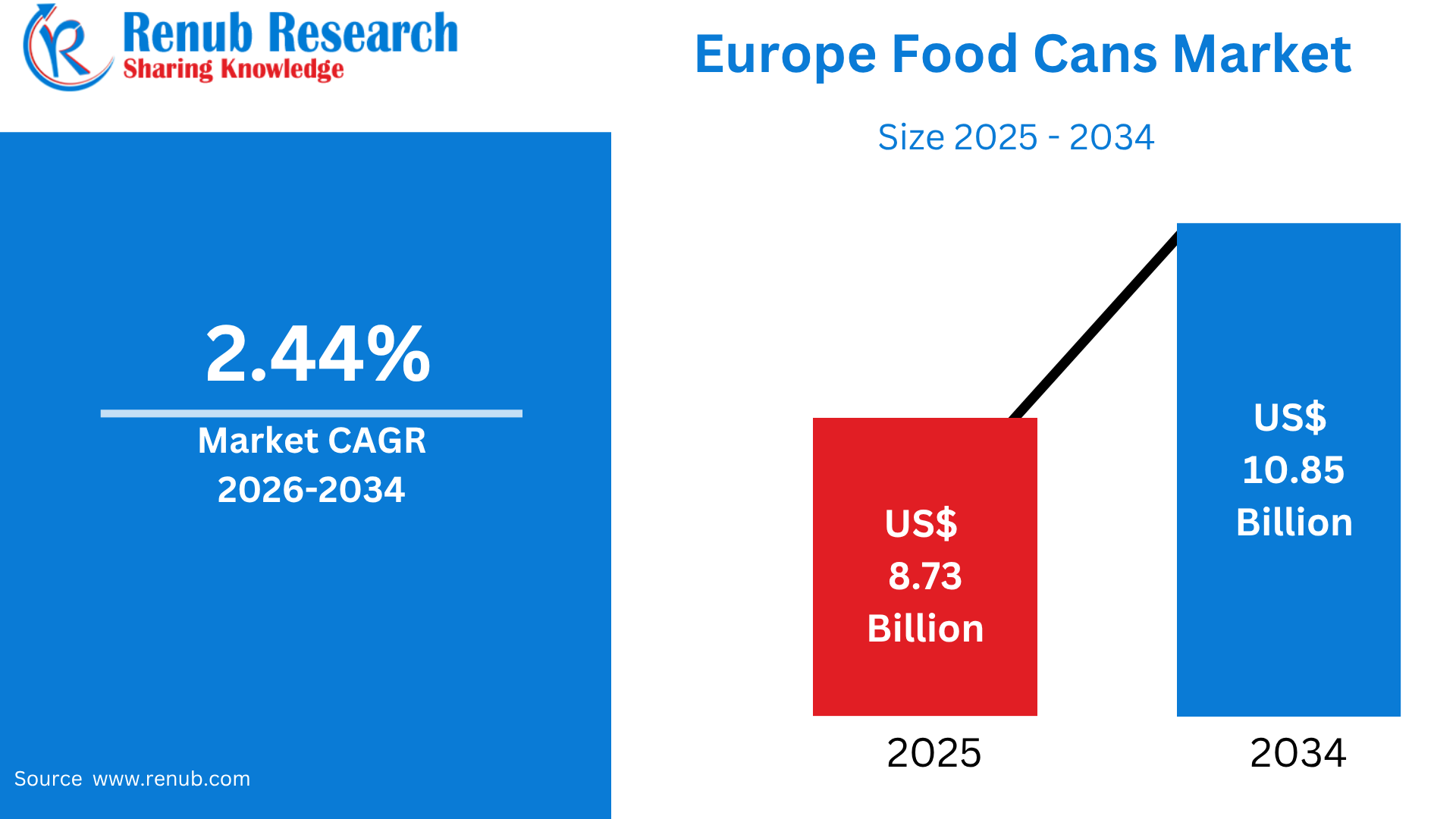
Europe Food Cans Market is projected to grow from US$ 8.73 billion in 2025 to approximately US$ 10.85 billion by 2034, registering a CAGR of 2.44% during 2026–2034. The market is expected to witness steady expansion, supported by increasing consumer demand for convenient and long-lasting food packaging solutions. Food cans provide effective protection against contamination while helping preserve the freshness, quality, and shelf life of various food products. Furthermore, growing demand for packaged and ready-to-store foods, changing consumer lifestyles, and the need for durable food preservation solutions are expected to contribute to the continued development of the European food cans market.
What is the Europe Food Cans Market and its Uses & Popularity?
Europe food cans market refers to the production, distribution, and consumption of metal containers—primarily steel and aluminium cans—used to package and preserve food products. Food cans are widely used for vegetables, fruits, meat, fish, soups, sauces, ready meals, beans, and other processed foods because they provide protection against light, oxygen, moisture, and contamination while extending shelf life. Their applications span household consumption, foodservice, retail, emergency food supplies, and long-distance distribution. The popularity of food cans in Europe is supported by their durability, convenient storage, portability, and ability to preserve food without continuous refrigeration. Consumer research has found that 75% of surveyed consumers considered cans their first-choice packaging for products requiring long shelf life, while 81% viewed food cans as robust and strong. Europe also has a substantial food-processing base, with about 309,000 food and beverage processing enterprises employing 4.8 million people in 2023. These factors maintain demand for food cans across European retail and food-processing markets.
European Imports of Canned Fruits and Vegetables by Origin (2018–2022)
- Accounts for the overwhelming majority of European imports, representing roughly three-quarters of the total market value.
- Rose steadily from approximately €8,100 million in 2018 to €8,900 million in 2020–2021, before surging sharply to reach nearly €11,000 million by 2022.
Leading Importers of Canned Fruits and Vegetables in Europe (2018–2022)
Germany (Market Leader):
- Rose steadily from ~1,700k tonnes in 2018 to ~1,770k tonnes in 2020.
- Held nearly stable in 2021 before surging to reach approximately 1,850k tonnes in 2022.
United Kingdom (Second Largest):
- Rose from ~990k tonnes in 2018 to ~1,110k tonnes in 2020.
- Experienced a sharp dip down to ~960k tonnes in 2021 before rebounding strongly to approximately 1,180k tonnes in 2022.
France (Third Largest):
- Remained largely flat to slightly declining between 2018 and 2021 (~1,110k down to ~1,040k tonnes).
- Rebounded slightly in 2022 to reach ~1,100k tonnes.
Netherlands (Logistics & Distribution Hub):
- Maintained stable import volumes between ~800k and ~840k tonnes from 2018 to 2021.
- Reached a 5-year high of roughly 910k tonnes in 2022.
Belgium:
- Remained consistently stable around the 500k tonne threshold across all five years (~490k to ~530k tonnes).
Spain:
- Recorded the lowest import volume among the top six, fluctuating between 410k and 430k tonnes annually.
Growth Drivers of the Europe Food Cans Market
Growing Demand for Long-Shelf-Life and Convenient Foods
The increasing demand for convenient, durable, and long-lasting food products is an important growth driver for the European food cans market. Canned foods allow consumers to store products for extended periods while requiring relatively little preparation, making them suitable for busy households, students, elderly consumers, and emergency food storage. Food cans are widely used for canned vegetables, fruits, seafood, meat, soups, beans, sauces, and prepared meals. Consumer research conducted by Metal Packaging Europe found that 75% of respondents identified long shelf life as a leading reason for purchasing food in cans, while 81% considered cans robust and capable of guaranteeing food safety. The broader European food industry also provides a substantial demand base. Eurostat reported approximately 309,000 food and beverage processing enterprises in the EU in 2023, employing 4.8 million people and generating €298.6 billion in value added. As food manufacturers continue supplying supermarkets, convenience stores, foodservice operators, and export markets, demand for reliable packaging formats such as cans is expected to remain significant.
Strong Food Processing and Retail Distribution Network
Europe’s extensive food-processing and distribution infrastructure supports continued consumption of food cans. Canned products can be transported over long distances and stored in warehouses and retail outlets without the same dependence on refrigerated distribution as many fresh products. This makes cans useful for manufacturers serving geographically dispersed European markets. Eurostat’s 2025 food-chain data show that the EU food and beverage processing industry comprised approximately 309,000 enterprises in 2023, representing 14.3% of all manufacturing enterprises. These businesses employed 4.8 million people and generated nearly €299 billion in value added. In addition, the European food distribution system includes large supermarket chains, wholesalers, specialised retailers, convenience outlets, and foodservice businesses. The food and beverage supply chain therefore provides multiple channels through which canned products can reach consumers. EU food-product manufacturing also showed continued momentum: Eurostat reported that the value of sold food-product production increased 3.8% in 2025 compared with 2024 and was 11.2% higher than in 2015 in constant prices. This expanding production environment supports ongoing packaging requirements.
Recyclability and Circular-Economy Advantages of Metal Packaging
Recyclability is becoming increasingly important in European packaging decisions, creating opportunities for metal food cans. Steel and aluminium can be recycled and returned to manufacturing systems, supporting Europe’s broader transition toward a circular economy. The European Commission’s Joint Research Centre estimated that 2.3 million tonnes of metal-based packaging were placed on the market across 19 EU Member States in 2024, representing countries covering more than 97% of the EU population. Strong recycling infrastructure further supports the sustainability positioning of metal packaging. For aluminium beverage cans, the recycling rate reached 76.3% in 2023 across the EU, UK, Switzerland, Norway, and Iceland, according to Metal Packaging Europe and European Aluminium. The recycled material represented an estimated 5.7 million tonnes of CO₂-equivalent emissions savings. Although beverage cans are different from food cans, these figures demonstrate the established recycling ecosystem for aluminium packaging in Europe. Growing attention to resource efficiency, packaging waste reduction, and circularity can therefore encourage manufacturers to improve can design, recycled content, lightweighting, and collection systems.
Challenges of the Europe Food Cans Market
Competition from Alternative Packaging Materials
Europe food cans market faces competition from glass, plastic, paper-based packaging, cartons, and flexible packaging. Food manufacturers increasingly evaluate packaging based on cost, weight, recyclability, convenience, appearance, and product-specific requirements. Some lightweight alternatives can reduce transportation weight or provide greater flexibility in packaging shapes and formats. The scale of this competition is visible in the European packaging landscape. The Joint Research Centre estimated that 42.8 million tonnes of packaging were placed on the market across 19 EU Member States in 2024, including 32.3 million tonnes of glass-based packaging, 5.9 million tonnes of plastic-based packaging, 2.1 million tonnes of paper-based packaging, and 2.3 million tonnes of metal-based packaging. Plastic packaging quantities increased by approximately 11% in absolute terms between 2011 and 2025, according to the JRC. Although metal cans offer durability and recyclability, manufacturers must compete with alternative formats that may provide different advantages in convenience, weight, design, or production economics.
Packaging Sustainability Requirements and Rising Waste-Management Pressures
Increasing regulatory and environmental pressure represents another challenge for the European food cans industry. Food packaging manufacturers must respond to requirements involving material efficiency, recycling, waste reduction, and circularity while maintaining product safety and economic viability. The overall scale of Europe’s packaging challenge is substantial. Eurostat reported that the EU generated 79.7 million tonnes of packaging waste in 2023, equivalent to 177.8 kg per inhabitant. Metal accounted for 4.9% of total packaging waste, while paper and cardboard represented 40.4%, glass 18.8%, and plastic 19.8%. At the same time, the EU generated approximately 58.2 million tonnes of food waste in 2023, equivalent to around 130 kg per person. These figures increase pressure on the food-packaging industry to demonstrate resource efficiency and minimize environmental impacts. Producers may therefore need to invest in lightweighting, recycled materials, efficient manufacturing processes, improved collection systems, and packaging designs compatible with evolving European circular-economy requirements.
Food Cans Launches in Europe
- Marigold & Sonoco Fully Recyclable Food Can – UK, 2024
Marigold Health Foods partnered with Sonoco to introduce a recyclable can for stock cubes, sauces, and plant-based meat and fish alternatives. The pack contains approximately 95% paper, with 60% post-consumer recycled fibre, and is designed for recycling through the UK paper-waste stream. - AkzoNobel Securshield 500 Series – Europe, 2024
AkzoNobel launched its Securshield 500 Series, a PVC-free and bisphenol-free internal coating for easy-open food cans. The coating is designed for food products including vegetables, fish, and fruit, while providing corrosion resistance. - Nestlé Coffee Sonoco Paper-Based Can – Europe, 2024
Nestlé adopted Sonoco’s 95% paper-based can for coffee products. The packaging uses a fibre-based bottom instead of a traditional metal base and is designed to improve recyclability while reducing packaging weight. - Eviosys Lightweight Horizon Metal Overcap – Europe, 2024
Eviosys introduced a lighter version of its Horizon metal overcap for resealable tins used for products such as infant formula, tea, coffee, and biscuits. The redesigned 99-diameter overcap weighs 5.8 grams, compared with 15 grams previously, representing a reported 33% reduction in CO₂ emissions. - Heinz Canned Spaghetti Carbonara – UK, 2024
Heinz announced the launch of canned spaghetti carbonara in the UK in September 2024. The product was priced at approximately £1.75 and represented a convenience-oriented expansion into a traditional Italian-style ready meal. - Vilsund Blue Canned Seafood Packaging Solution – Denmark, 2024
Danish seafood producer Vilsund Blue collaborated with DS Smith on a new packaging solution for canned products. The company replaced plastic pallets with corrugated cardboard, with the objective of increasing the number of cans transported per pallet while reducing plastic use. - Bonduelle Sustainable Canned Vegetables – Europe, 2024
Bonduelle expanded its focus on canned vegetable products featuring sustainability-oriented packaging and consumer-focused nutritional positioning. The development reflects European demand for convenient vegetables alongside recyclable and resource-efficient packaging solutions. - Princes Ready Meals in Cans – UK/Europe, 2024
Princes expanded its ready-meal portfolio in canned formats, targeting consumers seeking convenient meals with extended shelf life. The development reflects the continued role of cans in soups, pasta-based meals, beans, and other prepared-food categories. - AkzoNobel Accelshield 300 – European Packaging Market, 2024
AkzoNobel introduced Accelshield 300, a BPA-free internal coating designed to provide corrosion protection and support the transition toward packaging free from materials of concern. The technology is intended to help manufacturers address current and future European regulatory requirements. - MEADOW KAPSUL Pilot – Spain, 2024
Meadow launched its first MEADOW KAPSUL pilot in Spain toward the end of 2024. The development focuses on a redesigned can-end system intended to improve circularity and versatility while retaining the functionality of conventional easy-open can ends. The project subsequently moved toward broader commercialization discussions in 2025.
Lightweight and Recyclable Packaging Supporting Demand
Europe aluminum cans food market is supported by the material’s lightweight construction, corrosion resistance, durability, and recyclability. Aluminum cans are used for soups, vegetables, seafood, sauces, and ready meals because they protect contents from light, oxygen, and moisture while supporting convenient transportation and storage. Sustainability is becoming particularly important as European manufacturers seek packaging solutions that can contribute to circular-material systems. The European aluminium beverage-can recycling rate reached 76.3% in 2023 across the EU, UK, Switzerland, Norway, and Iceland, demonstrating the strength of the region’s aluminum recycling infrastructure. Food manufacturers are also focusing on lightweighting to reduce material consumption and transportation-related emissions. In January 2024, Ball Corporation highlighted initiatives around more sustainable aluminum packaging in Europe, including lightweighting and lower-carbon solutions. Growing consumer awareness of recyclable packaging, combined with regulatory pressure to improve resource efficiency, is encouraging food companies to evaluate aluminum formats for products requiring long shelf life and convenient handling.
Durable Protection and Material Efficiency Driving Adoption
Steel cans remain important across Europe’s food packaging industry because they provide strong mechanical protection and effective barriers against oxygen, light, and contamination. They are extensively used for meat, vegetables, pet food, soups, and other preserved products requiring extended shelf life. Steel packaging also benefits from established recycling infrastructure, supporting the European shift toward circular packaging systems. The Joint Research Centre estimated that approximately 2.3 million tonnes of metal-based packaging were placed on the market across 19 EU Member States in 2024, covering more than 97% of the EU population. Manufacturers are simultaneously pursuing lightweighting, thinner steel gauges, improved coatings, and reduced material consumption while maintaining can strength. BPA-related concerns have also encouraged packaging companies to develop alternative internal coatings and safer material solutions. In March 2024, Ardagh Group highlighted developments involving steel packaging and protective coating technologies. Such innovations are helping manufacturers balance food safety, durability, sustainability, and production efficiency, supporting continued demand for steel cans throughout Europe.
Convenience and Longer Shelf Life Increasing Consumption
Europe ready meals food cans market is benefiting from consumers’ increasing preference for convenient products that require limited preparation time. Canned soups, pasta meals, beans, stews, sauces, and ethnic dishes provide practical solutions for households managing busy lifestyles. Cans can also provide long shelf life without requiring continuous refrigeration, supporting storage in homes, supermarkets, and foodservice environments. The wider European food-processing sector provides a substantial demand base, with approximately 309,000 food and beverage processing enterprises in the EU in 2023, employing around 4.8 million people. Manufacturers are responding by introducing different portion sizes, recipes, nutritional profiles, and premium formulations to appeal to changing consumer preferences. Ready meals are also becoming increasingly diversified, with vegetarian, organic, high-protein, reduced-sodium, and internationally inspired products gaining attention. In February 2024, Princes Group announced expansion of its ready-meal offerings, reflecting continued product development within the category. As urbanization and time constraints influence food purchasing habits, canned ready meals remain an important convenience-oriented segment.
Year-Round Availability and Affordable Nutrition Supporting Demand
Europe vegetables food cans market continues to benefit from the affordability, convenience, and year-round availability of canned vegetables. Products such as peas, sweetcorn, tomatoes, beans, carrots, and mixed vegetables allow consumers to maintain household food supplies without relying entirely on seasonal fresh produce. Canning can preserve vegetables for extended periods, reducing dependence on refrigerated storage and helping retailers maintain consistent availability. Sustainability is also influencing purchasing and manufacturing decisions. In 2023, the EU generated approximately 79.7 million tonnes of packaging waste, equivalent to 177.8 kg per person, increasing pressure on producers to improve packaging efficiency and recyclability. Consumers are additionally showing greater interest in products with lower sodium, fewer additives, organic ingredients, and clearer nutritional information. Manufacturers are therefore investing in improved recipes, labeling, lightweight cans, and BPA-free or alternative coating technologies. In April 2024, Bonduelle introduced developments involving canned vegetable products and sustainable packaging. These innovations, together with demand for affordable and convenient nutrition, are expected to support the European canned-vegetable segment.
Pet Humanization and Premium Nutrition Expanding Canned Pet Food Demand
Europe pet food cans market is supported by increasing pet ownership and the growing tendency to treat pets as members of the family. Owners are increasingly interested in products that provide appropriate nutrition, hydration, palatability, and ingredient transparency. Canned pet food has a high moisture content and can therefore complement dry-food diets, while metal cans provide strong protection during transportation and storage. The European pet-food industry has developed a broad range of premium, natural, grain-free, functional, and specialized products to respond to changing consumer expectations. Sustainability is also becoming increasingly relevant, with manufacturers focusing on recyclable metal packaging and material efficiency. The European metal-packaging infrastructure provides an established recycling pathway, while the region’s wider circular-economy policies encourage greater resource efficiency. In May 2024, Nestlé Purina expanded premium canned pet-food offerings in Europe, emphasizing nutritional quality and ingredient positioning. As consumers continue spending on premium pet nutrition and specialized diets, canned formats remain an important part of the European pet-food packaging landscape, particularly for wet food and premium formulations.
France Premium, Sustainable, and Convenient Canned Foods Supporting Growth
France food cans market is supported by established consumption of canned vegetables, seafood, meat, soups, and ready-to-eat meals. French consumers have traditionally valued food quality and culinary variety, creating opportunities for premium and gourmet canned products alongside mainstream offerings. Convenience is also becoming increasingly important as households seek foods that are simple to store and prepare. Sustainability is another significant consideration, with manufacturers working toward recyclable packaging, lightweight materials, and alternative coatings. France forms part of the wider European food-processing industry, which comprised approximately 309,000 enterprises across the EU in 2023 and generated nearly €299 billion in value added. Organic and clean-label products are also receiving greater attention, encouraging manufacturers to introduce canned foods with simpler ingredient lists, lower sodium levels, and clearer labeling. Digital grocery platforms and rapid-delivery services are expanding the accessibility of packaged foods in major urban areas. Gopuff’s launch in France in March 2022 illustrated the development of rapid-delivery channels. These trends are creating opportunities for innovative canned-food products targeting convenience and premium consumption.
Germany Strong Food Processing and Recycling Infrastructure Supporting Demand
Germany’s food cans market is supported by a large food-processing industry and strong demand for preserved vegetables, meats, soups, and pet food. Cans provide German consumers with convenient storage, long shelf life, and reliable protection, while metal’s recyclability aligns with the country’s established waste-management infrastructure. Sustainability is particularly important as European packaging policies increasingly emphasize recycling, material efficiency, and circularity. Across 19 EU Member States, approximately 2.3 million tonnes of metal packaging were placed on the market in 2024, highlighting the substantial role of metal packaging within European supply chains. German consumers are also showing interest in healthier formulations, including products with fewer preservatives, reduced sodium, and clearer ingredient information. Manufacturers are responding through lightweighting, improved coatings, recyclable materials, and redesigned packaging. In August 2023, Crown Holdings acquired Helvetia Packaging AG in Saarlouis, Germany, strengthening its European metal-packaging operations. Such investments demonstrate continued industry consolidation and capacity development. The combination of established food manufacturing, strong recycling practices, and demand for convenient products supports continued development of the German food-cans market.
United Kingdom Convenience Foods and Sustainable Packaging Creating Opportunities
United Kingdom food cans market is driven by demand for convenient, affordable, and long-lasting food products. Canned beans, vegetables, soups, fish, meat, and ready meals are widely used because they can be stored for extended periods and require relatively little preparation. Convenience remains important for households facing time constraints, while consumers are increasingly examining ingredients, nutritional content, and packaging sustainability. The UK’s participation in the wider European metal-packaging ecosystem provides established recycling capabilities. Notably, the aluminium beverage-can recycling rate reached 76.3% in 2023 across the EU, UK, Switzerland, Norway, and Iceland, illustrating the region’s strong recovery infrastructure for aluminum packaging. Manufacturers are also responding to demand for cleaner formulations, recyclable materials, and alternative coatings. Supermarkets, convenience retailers, and online grocery platforms provide extensive distribution channels for canned products. In January 2024, NOMOQ introduced blank aluminum cans for the UK market, reflecting continuing innovation in aluminum packaging. As consumers balance affordability, convenience, nutrition, and environmental considerations, manufacturers are expected to continue developing differentiated canned-food formats.
Spain Canned Seafood and Traditional Foods Supporting Market Development
Spain’s food cans market benefits strongly from the country’s established food culture and long-standing consumption of canned seafood, vegetables, olives, and other preserved foods. Canned tuna, sardines, anchovies, mussels, tomatoes, and vegetables are important products because they combine convenience with extended shelf life while retaining distinctive flavors. Spain’s strong seafood and food-processing industries provide a substantial base for canned-food production and exports. Consumers are also increasingly interested in premium, organic, sustainably sourced, and nutritionally attractive products, encouraging manufacturers to improve recipes, ingredients, labeling, and packaging. Sustainability is becoming increasingly relevant as European packaging policy places greater emphasis on recycling and circularity. The broader EU generated 79.7 million tonnes of packaging waste in 2023, highlighting the continuing need for more efficient packaging systems. Spanish producers are responding through lightweight packaging, recyclable materials, improved portion sizes, and modern canning technologies. Growing exports are also creating opportunities for manufacturers to reach international markets with Spanish seafood and specialty foods. Consequently, the combination of culinary tradition, convenience, premiumization, and packaging innovation continues to shape Spain’s food cans market.
Europe Food Cans Market Segments
Product
- Aluminum
- Steel
Application
- Ready Meals
- Meat
- Vegetables
- Fish
- Fruits
- Powder Products
- Pet Food
- Others
Countries
- France
- Germany
- Italy
- Spain
- United Kingdom
- Belgium
- Netherlands
- Russia
- Poland
- Greece
- Norway
- Romania
- Portugal
- Rest of Europe
All companies have been covered with 5 Viewpoints
- Overviews
- Key Person
- Recent Developments
- SWOT Analysis
- Revenue Analysis
Company Analysis
- Ardagh Group
- Ball Corporation
- Can-Pack S.A.
- CPMC Holdings Limited
- Crown Holdings Inc.
- Nestlé S.A.
- Zwanenberg Food Group
- Silgan Holdings Inc.
- Lucky Star Ltd. (Glenryck)
- Sarten Romania SRL
Report Details:
| Report Features | Details |
| Base Year |
2025 |
| Historical Period |
2022 - 2025 |
| Forecast Period |
2026 - 2034 |
| Market |
US$ Billion |
| Segment Covered |
Product, Application and Countries |
| Countries Covered |
|
| Companies Covered |
|
| Customization Scope |
20% Free Customization |
| Post-Sale Analyst Support |
1 Year (52 Weeks) |
| Delivery Format |
PDF and Excel through Email (We can also provide the editable version of the report in PPT/Word format on request) |
Key Questions Answered in Report:
- What is the current market size of the Europe Food Cans Market in 2024, and what is its projected growth rate?
- Which factors are driving the demand for food cans in Europe, particularly in urban areas?
- How does the increasing trend for eco-friendly and BPA-free food cans impact the market?
- What role do government regulations and legislation play in shaping the food cans market in Europe?
- How significant is the rise in processed and ready-to-eat food consumption to the growth of food cans in Europe?
- Which countries in Europe are expected to contribute the most to the growth of the food cans market?
- What challenges do manufacturers face regarding the use of toxic coatings, such as BPA, in food cans?
- How is competition from alternative packaging solutions like pouches, glass jars, and paper packaging affecting the food cans market?
- What is the market share of aluminum cans versus steel cans in Europe, and how are they utilized in different food segments?
- How do consumer preferences for organic and preservative-free canned products influence the European food cans market?
Customization Services available
- Analysis of Market Size and Its Segments
- More Company Profiles (Upto 10 without any additional cost):
- Additional Countries (Other than mentioned Countries):
- Region/Country Specific Reports:
- Market Entry Strategy:
- Region-Specific Market Dynamics:
- Regional Market Share Analysis:
- Trade Analysis:
- Production Insights:
- Others Customized Requests:
For more information contact our analysts.
Need More Assistance?
- Talk to our analysts to get more precious information on the current market trends.
- Include more countries and segments and customize the report based on the final requirement.
- Get a competitive advantage in your industry by knowing the report findings and making a positive impact on your revenues and operations.
- Our analysts are always ready to provide more help and pertinent information if you need any additional assistance.