Europe Automotive Actuators Market Report by Actuator Types, Vehicle Type, Application, Countries and Companies Analysis 2026-2034
Buy NowEurope Automotive Actuators Market Size and Forecast
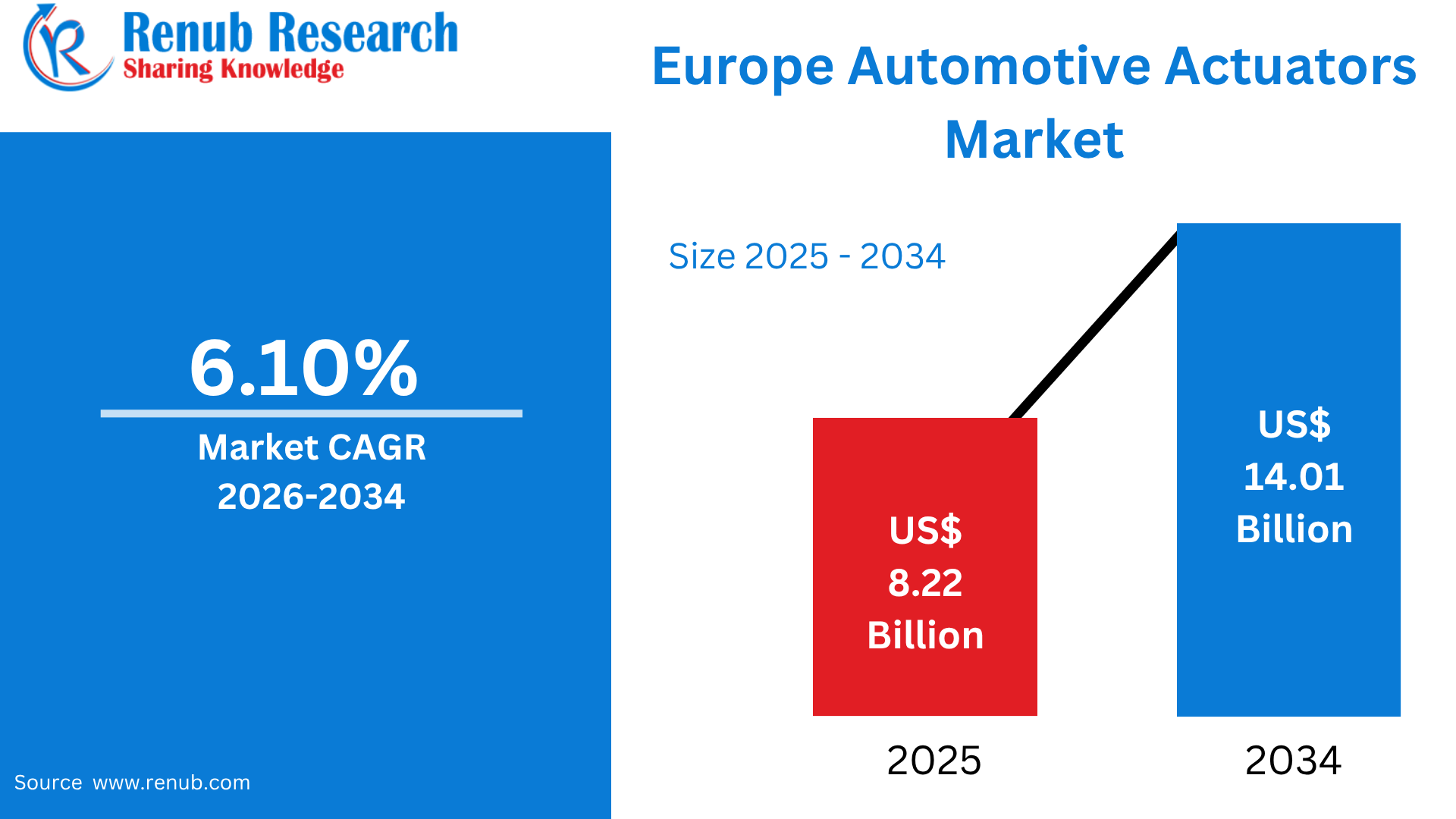
Europe Automotive Actuators Market is projected to reach US$ 14.01 Billion by 2034, increasing from US$ 8.22 Billion in 2025, at a CAGR of 6.1% during 2026–2034. The market is expected to witness sustained growth as vehicle manufacturers increasingly integrate advanced actuator technologies into electrified, connected, and automated vehicles. Rising adoption of electric and hybrid vehicles is increasing demand for precise and energy-efficient actuators across braking, steering, powertrain, HVAC, seating, and thermal-management systems. The expanding integration of advanced driver-assistance systems is further supporting demand for responsive electronic actuation technologies.
What is Europe Automotive Actuators and Its Uses & Popularity in Europe
Automotive actuators are electromechanical or electrohydraulic components that convert electrical, hydraulic, or pneumatic energy into controlled mechanical movement within a vehicle. They are essential for operating systems such as throttle control, braking, steering, HVAC, power seats, windows, doors, mirrors, engine management, transmission systems, active grille shutters, and thermal-management units. With the transition toward software-defined and electrified vehicles, actuators are increasingly integrated with electronic control units and sensor networks to deliver accurate, automated responses. Their importance is growing across Europe as vehicle manufacturers increase the use of electronically controlled functions. In 2025, battery-electric vehicles accounted for 17.4% of new EU car registrations, while hybrid-electric vehicles represented 34.5%, creating additional applications for electronically controlled actuation systems. Europe also had approximately 256 million cars on its roads in 2024, representing a substantial installed vehicle base requiring replacement and maintenance components. The growing integration of automated functions, electrification, connected systems, and advanced safety technologies is therefore strengthening demand for automotive actuators across European vehicle manufacturing and aftermarket applications.
New EU Car Registrations in Europe
- January: New car registrations decreased by 2.6% compared with 2024.
- February: Registrations declined by 3.4% year-on-year.
- March: Registrations decreased slightly by 0.2%.
- April: Registrations increased by 1.3%.
- May: Registrations increased by 1.6%.
- June: Registrations declined by 7.3%, the largest monthly decrease shown in the chart.
- July: Registrations increased by 7.4%.
- August: Registrations declined by 5.3%.
- September: Registrations increased by 10.0%, the strongest monthly growth shown.
- October: Registrations increased by 5.8%.
- November: Registrations increased by 2.1%.
- December: Registrations increased by 5.8%.
Growth Drivers of Europe Automotive Actuators Market
Accelerating Vehicle Electrification
The rapid transition toward electric and hybrid vehicles is one of the major factors supporting demand for automotive actuators in Europe. Electric vehicles use numerous electronically controlled systems for thermal management, braking, steering, battery cooling, charging, power distribution, and cabin functions, increasing the importance of precise and responsive actuation. According to the European Automobile Manufacturers’ Association (ACEA), battery-electric vehicles accounted for 17.4% of new EU car registrations in 2025, compared with 13.6% in 2024. Hybrid-electric vehicles represented an additional 34.5% of registrations, while plug-in hybrids reached 9.4%. The European Commission also reports that average CO₂ emissions from new passenger cars registered in Europe declined by 28% between 2019 and 2024, with zero-emission vehicles becoming an important contributor to this reduction. As automakers introduce more electric and hybrid platforms, manufacturers are increasing the use of compact, energy-efficient electric actuators. This transition is expanding actuator applications across battery systems, thermal-management modules, electronic braking, active aerodynamic systems, and automated vehicle functions.
Growing Adoption of ADAS and Automated Vehicle Functions
The expansion of advanced driver-assistance systems is creating additional opportunities for automotive actuator manufacturers because many safety and automation functions require precise mechanical responses. Actuators are used in electronically controlled braking, steering, adaptive lighting, active aerodynamic systems, parking functions, seat adjustment, and other automated vehicle systems. European regulatory requirements are also accelerating the integration of safety technologies. From July 2026, new passenger cars and vans registered across the EU are subject to additional requirements, including advanced emergency braking capable of detecting pedestrians and cyclists, improved forward vision, and advanced driver-distraction warning systems. These technologies increase the need for reliable electromechanical components capable of receiving signals from sensors and electronic control units and converting them into rapid physical actions. The European Commission has also identified automated mobility as an important component of the region’s future transport system. As vehicle manufacturers increasingly combine cameras, radar, sensors, software, and electronic control systems, actuator demand is expanding beyond traditional engine and cabin applications toward braking, steering, lighting, safety, and automated driving functions.
Stricter Emission and Efficiency Requirements
European environmental regulations are encouraging automakers to adopt technologies that improve vehicle efficiency, reduce emissions, and support electrification, thereby increasing demand for advanced actuator systems. The European Commission’s CO₂ standards establish increasingly stringent fleet-wide targets for new passenger cars and vans. For 2025–2029, the EU target is 93.6 g CO₂/km for cars, while the target falls to 49.5 g CO₂/km for 2030–2034 under the existing framework. The regulatory environment encourages manufacturers to optimize powertrain operation, thermal management, aerodynamics, and other vehicle systems. Actuators support these objectives by enabling precise control of components such as active grille shutters, exhaust and air-management systems, engine components, transmission mechanisms, cooling systems, and battery thermal-management units. In parallel, Europe’s transition toward cleaner mobility is increasing investment in electric and low-emission vehicle architectures. The European Commission’s 2025 Automotive Package continues to emphasize clean mobility while introducing additional flexibility for manufacturers. These developments encourage automotive suppliers to develop lighter, smaller, faster, and more energy-efficient actuator technologies capable of meeting evolving vehicle efficiency requirements.
Challenges of Europe Automotive Actuators Market
High Development Costs and Increasing System Complexity
The growing sophistication of automotive actuators is increasing development, testing, and integration costs for manufacturers. Modern actuator systems increasingly require embedded electronics, sensors, software interfaces, connectivity, and precise control algorithms rather than functioning as standalone mechanical components. This raises engineering requirements and increases the need for extensive validation under different temperature, vibration, durability, and electromagnetic conditions. The challenge is particularly significant as European vehicles incorporate increasingly complex electronic architectures. Automotive manufacturers and suppliers must ensure that actuators communicate reliably with vehicle control units while meeting stringent safety and performance requirements. The transition toward electric vehicles also requires new actuator designs for battery cooling, thermal management, electronic braking, steering, and other systems. Meanwhile, the European automotive sector is undergoing rapid technological change and faces substantial investment requirements associated with clean mobility. The European Commission’s Automotive Package recognizes the scale of this transition and includes measures intended to support automotive manufacturers in adapting to technological and regulatory changes. Smaller suppliers may therefore face greater financial and technical pressure when developing next-generation actuator platforms, conducting testing, and maintaining compatibility with increasingly software-intensive vehicle architectures.
Supply-Chain Pressures and Slow Fleet Replacement
Supply-chain volatility and the relatively slow replacement of Europe’s vehicle fleet can create challenges for automotive actuator manufacturers. Actuator production depends on electronic components, semiconductors, metals, magnets, sensors, motors, and specialized manufacturing processes, making suppliers vulnerable to component shortages, commodity-price fluctuations, and logistics disruptions. At the same time, the transition to new vehicle technologies occurs gradually because millions of older vehicles remain in operation. ACEA reported approximately 256 million cars on EU roads in 2024, while the average EU car age was about 12.3 years based on the latest available fleet-age dataset. This creates a dual market in which manufacturers must support conventional actuator technologies for existing vehicles while simultaneously developing advanced systems for electric, connected, and automated vehicles. Furthermore, although electrification is accelerating, the 2025 EU market still included substantial hybrid, petrol, and diesel vehicle volumes, meaning actuator suppliers must maintain diverse product portfolios. Managing multiple technologies, component supply chains, and vehicle platforms can increase production complexity and investment requirements across the European automotive actuator industry.
Hydraulic Actuator Launches in Europe
- KYB Mini Motion Package (MMP) – 2025
KYB introduced its fifth-generation Mini Motion Package (MMP) to the European market in 2025. The compact electro-hydraulic actuator integrates an electric motor, pump, valves, and hydraulic cylinder and can operate from 12 V, 24 V, or 220 V supplies. It can generate lifting forces of up to 1,200 kg and is designed for industrial, agricultural, medical, building, and mobile applications. - Liebherr Next-Generation Hydraulic Cylinders – 2024
Liebherr’s Components product segment announced next-generation hydraulic cylinders in December 2024. The cylinders incorporate lightweight carbon-fiber-reinforced plastic construction and integrated sensor technology, targeting improved machine efficiency and real-time condition monitoring. - Bosch Rexroth CGV Double-Rod Cylinder – 2024
Bosch Rexroth presented its CGV double-rod cylinder at Hannover Messe 2024 as part of its hydraulic solutions for hydrogen infrastructure. The actuator is designed for demanding compressor applications and emphasizes durability and energy efficiency. - Bosch Rexroth Servohydraulic Compressor Drives – 2024
Bosch Rexroth also introduced a scalable portfolio of servohydraulic drives for compressors at Hannover Messe 2024. The technology combines hydraulic actuation with advanced drive control for applications associated with hydrogen infrastructure and industrial compression. - Thomson H-Track Electro-Hydraulic Actuator Enhancement – 2025
Thomson introduced an enhanced version of its H-Track electro-hydraulic actuator in July 2025. The updated system uses marine-grade 316 stainless-steel components and a sealed motor housing that enables underwater operation, expanding its potential applications across marine, agricultural, industrial, and off-highway equipment. - Bucher Hydraulics HELAX Hydraulic-Electric Linear Axis – 2023/2024
Bucher Hydraulics developed its HELAX hydraulic-electric linear axis as an energy-efficient alternative to conventional load-sensing hydraulic systems. The technology combines hydraulic and electric drive principles and is designed particularly for the electrification of mobile machines. - Hydraulic Part-Turn Actuator Technology under EN 15714-4:2025 – 2025
Europe introduced the updated EN 15714-4:2025 standard for hydraulic part-turn actuators used with industrial valves. Published in May 2025, the standard covers single- and double-acting hydraulic actuators for on-off and modulating applications and updates requirements covering corrosion protection, controls, testing, and marking. - KYB MMP Fifth-Generation Hydraulic-Electric Actuator – 2025
The fifth-generation MMP represents a further product-generation introduction from KYB in Europe. Its compact architecture eliminates the requirement for a separate external hydraulic power unit, while the integrated system can provide controlled lifting and positioning. Applications include industrial automation, food-processing equipment, agricultural machinery, healthcare equipment, and greenhouse systems. - Liebherr Sensor-Integrated Hydraulic Cylinder Technology – 2024
Liebherr’s new cylinder generation combines hydraulic actuation with integrated sensing capabilities. The technology enables monitoring of operating conditions and supports predictive-maintenance approaches while using lightweight CFRP construction. Such sensor-integrated hydraulic cylinders represent the increasing convergence of traditional hydraulic components with digital machine-monitoring systems. - Thomson H-Track Corrosion-Resistant Configuration – 2025
Thomson’s 2025 H-Track enhancement added corrosion-resistant materials and sealed motor protection to broaden the actuator’s operating environment. The updated configuration is particularly relevant to agricultural, marine, industrial, and off-highway machinery where moisture and harsh operating conditions can affect conventional actuation systems.
High-Force Applications in Commercial and Heavy-Duty Vehicles
The Europe hydraulic actuator market remains important for automotive and commercial applications requiring high force, durability, and reliable motion control. Hydraulic actuators are used in braking, steering assistance, suspension, transmission systems, lifting mechanisms, and other heavy-duty functions where substantial mechanical force is required. Their relevance is particularly strong in commercial vehicles, trucks, buses, and specialized vehicles. The European commercial vehicle sector provides a significant installed and replacement base: the EU recorded 307,460 new truck registrations in 2025, while electrically chargeable trucks increased their market share to 4.2%. In the first half of 2026, EU truck registrations rose 9.8% to 171,933 units, with heavy-truck registrations increasing 11.1% and medium trucks rising 2.8%. Although electrification is encouraging greater adoption of electric actuation, hydraulic systems remain relevant where high load capacity, robustness, and established vehicle architecture are important. Manufacturers are increasingly combining hydraulic components with electronic controls, sensors, and electronically managed systems to improve precision and efficiency. Continued commercial-vehicle modernization and demand for advanced chassis technologies are therefore supporting opportunities for hydraulic actuator suppliers across Europe.
Electrification and Advanced Vehicle Functions Expand Actuator Applications
The Europe passenger cars automotive actuators market is expanding as vehicles incorporate increasing numbers of electronically controlled comfort, safety, powertrain, and chassis functions. Actuators operate systems including braking, steering, throttle control, HVAC, doors, windows, mirrors, seats, transmission mechanisms, and active aerodynamic components. Vehicle electrification is particularly important because electric and hybrid platforms require sophisticated electronic control across thermal management, braking, steering, battery systems, and cabin functions. ACEA reported that battery-electric vehicles represented 17.4% of new EU car registrations in 2025, while hybrid-electric vehicles accounted for 34.5%. During the first half of 2026, battery-electric vehicles increased further to 20.7% of EU registrations and hybrids reached 37.3%. This transition is increasing demand for compact, lightweight, energy-efficient, and digitally controlled actuator technologies. At the same time, advanced driver-assistance systems and increasingly automated vehicle functions require rapid and precise mechanical responses from electronically controlled actuators. European automakers are therefore incorporating actuators into a broader range of vehicle systems, while suppliers are developing integrated motor, sensor, and control solutions to meet requirements for efficiency, reliability, safety, and software-based vehicle architectures.
Rising Demand for Comfort, Personalization, and Electrified Interiors
The Europe seat adjustment actuator market is benefiting from increasing emphasis on passenger comfort, ergonomic design, personalization, and electronically controlled vehicle interiors. Seat actuators enable powered adjustment of seat position, height, recline, lumbar support, headrests, and memory functions, with more advanced systems supporting multiple user profiles and integrated comfort functions. Their adoption is expanding from premium vehicles into higher-volume passenger-car segments as electronic comfort features become increasingly common. The broader shift toward electrified vehicles is also supporting this segment because modern electric vehicles frequently incorporate digitally controlled interiors and advanced user interfaces. In 2025, battery-electric and hybrid-electric vehicles together accounted for more than half of new EU passenger-car registrations, at 51.9%, demonstrating the rapid transition toward electrified vehicle architectures. In the first half of 2026, the combined share increased further, with battery-electric vehicles at 20.7% and hybrids at 37.3%. Manufacturers are consequently developing quieter, lighter, compact, and energy-efficient seat motors and actuator assemblies. Integration with memory systems, electronic control units, connected interiors, and personalized seating functions is creating additional opportunities for actuator suppliers across European passenger-car platforms.
Germany Rapid Electric Vehicle Adoption and Advanced Automotive Manufacturing
Germany remains a major European market for automotive actuators because of its extensive vehicle manufacturing ecosystem, advanced component industry, and increasing adoption of electrified and automated vehicle technologies. Actuators are increasingly required for electric powertrains, thermal-management systems, electronically controlled braking and steering, HVAC, seating, active aerodynamics, and advanced safety functions. According to Germany’s Federal Motor Transport Authority (KBA), 545,142 battery-electric passenger cars were newly registered in Germany during 2025, representing an increase of approximately 43% compared with 2024. This rapid expansion of the electric vehicle fleet is increasing demand for electronically controlled actuator systems that can deliver precise and efficient mechanical movement. Germany also has a strong automotive research and manufacturing base, supporting continuous development of intelligent actuators, integrated sensors, and software-controlled systems. Increasing deployment of advanced driver-assistance technologies is creating further applications across braking, steering, lighting, and vehicle-body systems. As German automakers accelerate the transition toward software-defined and electrified vehicles, demand for lightweight, compact, energy-efficient, and highly responsive actuator technologies is expected to expand across both passenger and commercial vehicle platforms.
France EV Expansion and Electrification of Vehicle Systems
France’s automotive actuators market is supported by increasing electric vehicle adoption, decarbonization initiatives, and the modernization of vehicle technologies. Automotive actuators are used extensively in battery thermal management, electronic braking, steering, HVAC, powertrain control, seating, and other electronically controlled functions. According to the European Alternative Fuels Observatory, citing Avere-France, 363,130 battery-electric vehicles were registered in France during 2025, while the country’s electrified vehicle fleet exceeded 2.5 million vehicles. The expanding electric fleet is increasing the need for reliable electronic actuation across propulsion, thermal, safety, and comfort systems. France also maintains a substantial automotive manufacturing and supplier base, supporting local development and integration of advanced vehicle components. Government policies encouraging lower-emission mobility are further influencing automakers and consumers toward electrified vehicles. As electric and hybrid platforms use increasingly sophisticated electronic architectures, actuator suppliers are developing smaller, lighter, and more energy-efficient solutions. Growth in ADAS adoption is creating additional opportunities for electronically controlled braking and steering actuators. Consequently, France is becoming an important market for next-generation actuator technologies associated with vehicle electrification, efficiency, safety, and automated functions.
Italy Hybridization and Advanced Vehicle Control Technologies
Italy’s automotive actuators market is being supported by growing electrification, connected vehicle technologies, and increasing deployment of advanced driver-assistance systems. Actuators are essential for electronically controlled steering, braking, transmission systems, thermal management, HVAC, seating, doors, and other vehicle functions. According to the European Alternative Fuels Observatory, battery-electric and plug-in hybrid vehicles together represented approximately 12.7% of passenger-car registrations in Italy during 2025. Although Italy’s electrification rate remains different from several other major European markets, the growing share of rechargeable vehicles is creating additional applications for electronic actuator technologies. Italy’s established automotive manufacturing and component-supply ecosystem also provides opportunities for actuator manufacturers serving both domestic production and export-oriented vehicle programs. Increasing requirements for fuel efficiency and emissions reduction are encouraging manufacturers to adopt electronically managed vehicle systems, while ADAS integration is expanding demand for precise actuation in braking, steering, lighting, and safety applications. As hybrid and electric vehicle production expands, suppliers are focusing on compact, lightweight, and energy-efficient actuator designs. Continued investment in connected and automated vehicle technologies is expected to further broaden actuator applications throughout Italy’s passenger and commercial vehicle sectors.
Spain: Growing Vehicle Electrification and Automotive Manufacturing Investments
Spain represents an important automotive manufacturing market in Europe, with increasing electrification creating new opportunities for automotive actuator suppliers. Actuators are increasingly incorporated into electric powertrains, battery thermal-management systems, braking, steering, HVAC, seating, active aerodynamic systems, and advanced safety technologies. According to Spain’s automotive industry association ANFAC, around 243,000 rechargeable vehicles, including battery-electric and plug-in hybrid vehicles, were registered in Spain during 2025, representing close to 19% of total vehicle registrations. Approximately one in five new passenger vehicles therefore incorporated a rechargeable powertrain. This transition is increasing demand for electronically controlled actuator systems capable of supporting efficient operation across new vehicle architectures. Spain’s large vehicle-production industry and investments in electrification are also strengthening opportunities for component suppliers. Government-supported mobility initiatives and the expansion of charging infrastructure are contributing to the gradual development of the electric vehicle ecosystem. Meanwhile, the increasing use of ADAS and connected vehicle functions is expanding actuator requirements beyond traditional powertrain applications. Manufacturers are consequently focusing on intelligent, lightweight, and energy-efficient actuator technologies to meet the evolving requirements of Spain’s increasingly electrified automotive sector.
Market Segments
Actuator Type
- Hydraulic Actuator
- Pneumatic Actuator
- Electric Actuator
Vehicle Types
- Passenger Cars
- Light Commercial Vehicles
- Heavy Commercial Vehicles
Application
- Throttle Actuator
- Seat Adjustment Actuator
- Break Actuators
- Closer Actuators
- Others
Countries
- France
- Germany
- Italy
- Spain
- United Kingdom
- Belgium
- Netherlands
- Russia
- Poland
- Greece
- Norway
- Romania
- Portugal
- Rest of Europe
All companies have been covered with 5 Viewpoints
- Overviews
- Key Person
- Recent Developments
- SWOT Analysis
- Revenue Analysis
Key Players Analysis
- Robert Bosch GmbH
- Nidec Corporation
- Denso Corporation
- Johnson Electric Holdings Ltd
- Mitsubishi Electric Corp
- CTS Corp
- Hitachi Ltd
- Aptiv PLC
Report Details:
| Report Features | Details |
| Base Year |
2025 |
| Historical Period |
2022 - 2025 |
| Forecast Period |
2026 - 2034 |
| Market |
US$ Billion |
| Segment Covered |
Actuator Type, Vehicle Types, Application and Countries |
| Countries Covered |
|
| Companies Covered |
|
| Customization Scope |
20% Free Customization |
| Post-Sale Analyst Support |
1 Year (52 Weeks) |
| Delivery Format |
PDF and Excel through Email (We can also provide the editable version of the report in PPT/Word format on request) |
Customization Services available
- Analysis of Market Size and Its Segments
- More Company Profiles (Upto 10 without any additional cost):
- Additional Countries (Other than mentioned Countries):
- Region/Country Specific Reports:
- Market Entry Strategy:
- Region-Specific Market Dynamics:
- Regional Market Share Analysis:
- Trade Analysis:
- Production Insights:
- Others Customized Requests:
For more information contact our analysts.
Need More Assistance?
- Talk to our analysts to get more precious information on the current market trends.
- Include more countries and segments and customize the report based on the final requirement.
- Get a competitive advantage in your industry by knowing the report findings and making a positive impact on your revenues and operations.
- Our analysts are always ready to provide more help and pertinent information if you need any additional assistance.