Global Elevator and Escalator Market Size, Share, Growth Trends, Smart Elevators, Escalators, Moving Walkways, High-Rise Construction, Smart City Infrastructure and Forecast by Product, End Use, Countries and Company Analysis 2026-2034
Buy NowGlobal Elevator and Escalator Market Size & Forecast 2026-2034
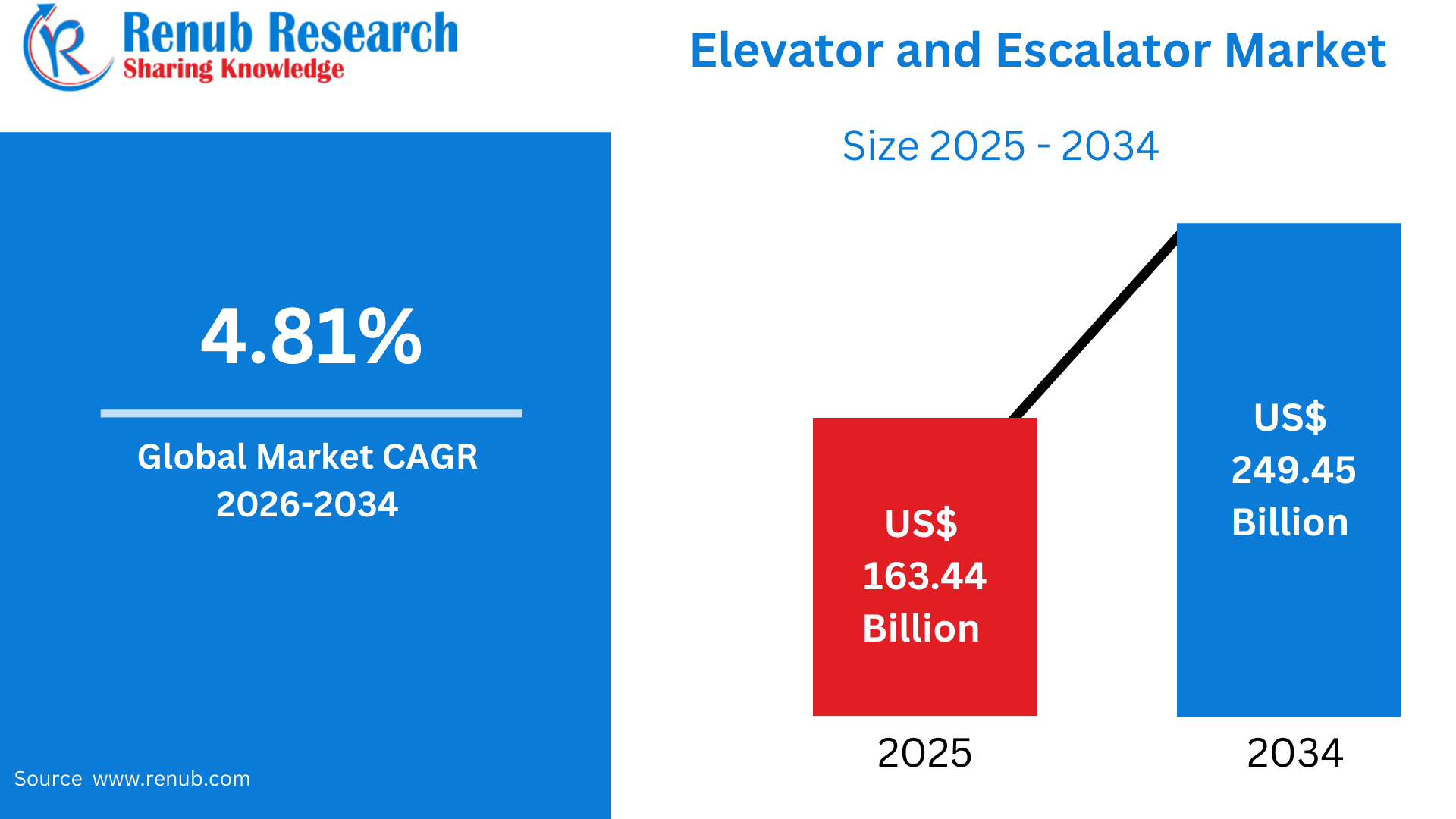
The Global Elevator and Escalator Market is set to exhibit steady growth and is expected to escalate from a value of US$ 163.44 Billion in 2025 to US$ 249.45 Billion by the end of 2034, registering a Compound Annual Growth Rate (CAGR) of 4.81% in 2026-2034. The key factors driving the growth of the market are the increased adoption of elevated structures due to the steady pace of urbanization and the development of smarter and more efficient elevators.
Global Elevator and Escalator Market Outlook
Elevators, also commonly spelled as elevators, and escalators belong to the vertical transport category, which is intended for the efficient transport of people as well as goods between floors, particularly within buildings as well as public areas. An elevator is a type of powered lift that moves along a vertical path between floors, especially within residential, commercial, as well as industrial buildings, while an escalator is a moving staircase especially found at malls, airports, metro stations, among other places with a high flow of people.
The global acceptance of elevators and escalators has improved remarkably because of the rising demand from rapidly growing cities and the increasing demand from the growing number of high-rise buildings being erected worldwide. In contemporary cities, the applications and uses of such systems have become indispensable, and technological advancements, such as the deployment of smart elevators with destination control, improved drives, and predictive technology, are responsible for this increasing acceptance. The key reason for the adoption of escalators, especially in the context of public facilities, is the necessity to transport a large quantity of passengers smoothly and effectively. The increasing longevity and resulting accessibility needs of the populace have significantly contributed to the adoption of vertical transport systems worldwide.
Growth Driver in the Elevator and Escalator Market
Rapid Urbanization and High-Rise Construction
The major driving factor for the elevators and escalators market is the increasing rate of urbanization. This is due to the increasing need for multi-story residential and commercial spaces that will cater to the growing population. The need for land will encourage the construction of multi-story buildings, making it unavoidable for the installation of elevators. Similarly, the increasing need for pedestrian transport in shopping malls, metro stations, and airports will boost the demand for the installation of escalators. The growing developing nations in the Asian, Middle Eastern, and Latin American regions are experiencing rapid urbanization and hence are experiencing major infrastructure development. February 2025: Lennar Corporation acquired Rausch Coleman Homes, a residential homebuilder in the US, marking its entry into the Arkansas (Little Rock/Bentonville and Fayetteville markets; Jonesboro), Oklahoma (Tulsa and Stillwater), Alabama (Birmingham and Tuscaloosa markets), and Kansas/Missouri (Kansas City metropolitan areas) markets.
Infrastructure Development and Smart City Initiatives
The major driving factor for the elevators and escalators market is the increasing rate of urbanization. This is due to the increasing need for multi-story residential and commercial spaces that will cater to the growing population. The need for land will encourage the construction of multi-story buildings, making it unavoidable for the installation of elevators. Similarly, the increasing need for pedestrian transport in shopping malls, metro stations, and airports will boost the demand for the installation of escalators. The growing developing nations in the Asian, Middle Eastern, and Latin American regions are experiencing rapid urbanization and hence are experiencing major infrastructure development. February 2025: Lennar Corporation acquired Rausch Coleman Homes, a residential homebuilder in the US, marking its entry into the Arkansas (Little Rock/Bentonville and Fayetteville markets; Jonesboro), Oklahoma (Tulsa and Stillwater), Alabama (Birmingham and Tuscaloosa markets), and Kansas/Missouri (Kansas City metropolitan areas) markets.
Technological Advancements and Energy Efficiency
Innovation in technology is another key driver that's rapidly altering the landscape of the elevator and escalator industry. Technology is helping companies develop intelligent elevators with destination dispatch technology, which decreases the time spend waiting and optimizes the flow of passengers. Energy-saving motors, regenerative drives, and the latest materials prevent the buildup of energy and lower running costs. IoT technology enables predictive maintenance, which greatly decreases the down time and extends the life of the equipment. Safety upgrades, touchless technology, and enhanced ride quality are key factors that see increased adoption. Building developers and owners have increasingly shown willingness to be eco-friendly and save on long-run energy costs, so energy-savers are in demand more than before. March 2024: Otis Worldwide Corporation bagged an order to upgrade 34 elevators in the Burj Khalifa, which is located in the U.A.E. Burj Khalifa is the world’s tallest tower. The company acquired the order for the upkeep and upgrade of the equipment for a ten-year period.
Challenge in the Elevator and Escalator Market
High Installation and Maintenance Costs
High installation or maintenance costs are a significant issue in the elevator and escalator industry. Modern technologies need high capital expenditure for equipment, installation, or integration. Maintenance, renovation, or safety regulations create additional expenses during the whole lifetime of a system. In a smaller building or a price-sensitive market, that additional expenditure may create a delay in adoption or upgrade. Further, expert labor or spare parts create additional costs for maintenance, particularly for high-capacity or customized equipment. In a developing area, high costs create additional delays in market penetration. Even though energy-efficient technologies create lower operating costs, high capital expenditure is a significant issue in a building developer or building owner's case.
Safety Regulations and Skilled Labor Shortages
Government regulations regarding safety and a shortage of qualified personnel are some of the challenges faced by the elevator and escalator industry. Meeting the safety regulations necessitates frequent system upgrades. Additionally, there is a high skill requirement for personnel involved in the installation, maintenance, and servicing of elevators and escalators. In many countries, there is a shortage of qualified personnel, thus affecting the cost of labor and the response time. Conversely, training personnel takes time, money, and efforts. It is a challenge to meet the various safety regulations yet have qualified personnel to facilitate growth in the elevator/escalator industry.
Global Elevator Market
The global elevator industry is growing steadily with the fast pace of urbanization and a rise in the number of high-rise buildings being constructed for residential and commercial purposes. Modern elevators play a crucial role in effective vertical transport in metropolitan areas, thereby facilitating a high population density and space optimization. However, the adoption of modern elevators with IoT technologies for remote monitoring and predictive maintenance, along with the growing senior population and stricter accessibility standards, is driving their demand for both new and retrofit installations. Modern elevators integrate the latest IoT-based remote monitoring and predictive maintenance, which leads to reduced down times and lower operational costs. Additionally, growing urbanization and a rise in the number of senior citizens are boosting the global use of modern elevators.
Global Escalator Market
The global market for escalators is primarily driven by the need to handle massive foot traffic in public as well as commercial areas. Also, as a function of continuous movement of people, escalators are applied extensively in malls, airports, Metro stations, railway stations, as well as public buildings. Infrastructure development initiatives, primarily in the transport sector, serve as major market drivers. Additionally, advancements, such as energy-efficient drives, intelligent speed controls, as well as enhanced safety solutions, are driving the adoption of these solutions. Moreover, they aid public accessibility while reacting as a complement to elevators in multi-level buildings. Consequently, as global spending on public transportinfrastructure, as well as commercial buildings, advances, the market for escalators continues to grow as a significant solution that allows smooth crowd movement.
Global Residential Elevator and Escalator Market
The residential elevator and escalator sector is emerging due to the importance being placed on comfort, safety, and accessibility. Residential elevators are being installed in apartment buildings, condominiums, and even in private residences. The increasing senior populations and mobility ailments are fueling a rise in demand for home elevators that encourage independent living. Smaller size, noiselessness, and increased efficiency are making modern residential elevators a preferred choice. Although less common in a private residential setup, escalators can be found in large residential structures. As housing density and a changing lifestyle dictate a certain standard of living in cities around the world, residential vertical transport systems are gaining importance.
Global Commercial Elevator and Escalator Market
The commercial elevator and escalator sector is one of the biggest markets worldwide. The support comes from office buildings, shopping centers, hotels, hospitals, and airports. The use of these elevators and escalators is very necessary for handling a large number of people efficiently and effectively. The primary component of smart elevators in commercial buildings is destination dispatch. These features significantly increase customer traffic and visibility in shopping centers. The factors considered for these systems include efficiency, effectiveness, and aesthetics. The rising construction and renovation of commercial structures around the world have thus kept the demand for high-end elevators and escalators high.
Global Industrial Elevator and Escalator Market
The industrial elevator and escalator market addresses the design of rugged systems for use in factories, warehouses, power stations, and mining stations. Industrial elevators serve the purpose of moving heavy goods, machinery, and people from one level to another in a safe manner. These systems are developed to provide stability, strength, and ability to work in harsh environments. As safety and compliance with industry norms have become essential for the growth of all industrial sectors, the demand for specialized vertical transport solutions is increasing. Escalators find limited use in the industrial sector in cases where the number of personnel movement is high.
United States Elevator and Escalator Market
The United States elevator and escalator industry is influenced by a constant upgrade and development process taking place within its infrastructure and a smart technologies trend for modern buildings. Existing structures within cities need an upgrade and replacement process for elevators for safety, efficiency, and accessibility. The primary contributors for these elevators come from business such as offices, hospitals, airports, and shopping centers. The primary factors for elevators revolve around efficiency and traffic. Research and development for smart elevators with destination control systems and energy-saving drives are being incorporated. Residential elevators in apartments and those for senior care facilities have a growing demand. April 2025: Schindler Elevator Corporation, one of the world leaders in elevators and escalators and moving walks, unveils a new product launch – Schindler 5000 – a machine room-less elevator.
United Kingdom Elevator and Escalator Market
Dense urban environments and a strong focus on the retrofitting of buildings characterize the United Kingdom elevator and escalator market. Most commercial and residential buildings require modernization to improve accessibility and energy efficiency. Mixed-use developments, offices, and residential towers in cities need elevators, while escalators find applications in transport hubs, shopping centers, and public buildings. Safety and accessibility legislation is strict, especially for older infrastructure, in support of demand for the same. Smart and compact elevator solutions are gaining appeal for space-constrained applications. Sustainability issues drive adoption of low-energy systems. In June 2024, OTIS Limited installed 26 VT units-15 Gen2 lifts, seven platform lifts, and four LinkTM escalators in One Exchange Square during the redevelopment and modernization of the 13-story office building on the Broadgate Campus in London. The elevators will offer IoT connectivity via Otis ONETM, together with the Compass 360 destination-dispatch system and the EMS PanoramaTM 2.0. elevator-management system.
China Elevator and Escalator Market
China has been considered the largest as well as fastest-growing market for elevators and escalators in the world, powered by rapid urbanization as well as high-rise building developments. Large-scale residential buildings, offices, public transport like subway systems, as well as other public infrastructure projects, lead to steady demands for vertical transport solutions. Moreover, elevators are crucial in high-rise buildings, with many people living in dense cities, while transport hubs as well as offices are equipped with escalators to handle huge passenger traffic. Strong manufacturing development, as well as faster adoption of intelligent as well as energy-efficient solutions, are major drivers of market development. Government support towards developing cities as well as upgradation of infrastructure adds to market development. February 2025, BOCA Group has formed a strategic collaboration with AuditMate. This strategic collaboration will witness the blend of BOCA’s vertical transport consultation expertise with that of AuditMate’s auditing as well as managing services.
Brazil Elevator and Escalator Market
Brazil's elevator and escalator market is growing fairly, supported by urban population growth and expanding residential and commercial construction. In large cities, elevators continue to be installed in mid- and high-rise residential buildings, offices, and mixed-use projects. Modernization of existing buildings also contributes to demand, particularly for improved safety and energy efficiency. Escalators are being installed in shopping malls, airports, and metro stations, supporting Brazil's expanding retail and transportation infrastructure. Though cost sensitivity remains elevated, demand for more reliable and durable systems is on the rise. With investment in urban infrastructure continuing and cities becoming more vertically developed, Brazil's market has long-term growth potential.
Saudi Arabia Elevator and Escalator Market
The Saudi Arabian elevator and escalator market is growing at a very fast pace owing to the construction and renovation of infrastructure on a massive scale. This includes the growing need for elevators and escalators in residential skyscrapers, business centers, hotels, airports, and religious tourism centers. The focus of major projects and smart cities is on the installation of state-of-the-art and highly efficient and capable vertical transport solutions. Escalators are very important for the efficient handling of huge flow volumes in malls, transport stations, and public spaces. The evolution of modernization for the renovation of existing infrastructure and the growing population are also major contributors. With continued spending in the areas of construction, tourism, and smart infrastructure development, the Saudi Arabian market for elevators and escalators has emerged as one of the most vibrant markets within the Middle East. August 2025 - Alat, a PIF company, and TK Elevator (TKE) have received all the statutory and regulatory approvals necessary for the final closing of their joint venture (JV) deal worth €160 million and Alat's 15% stake purchase in TKE. This signals the final consent for the plan first expressed in February 2025.
Market Segmentations
Product
- Elevators
- Escalators
- Moving Walkway
End Use
- Residential
- Commercial
- Industrial
Countries
North America
- United States
- Canada
Europe
- France
- Germany
- Italy
- Spain
- United Kingdom
- Belgium
- Netherlands
- Turkey
Asia Pacific
- China
- Japan
- India
- South Korea
- Thailand
- Malaysia
- Indonesia
- Australia
- New Zealand
Latin America
- Brazil
- Mexico
- Argentina
Middle East & Africa
- Saudi Arabia
- UAE
- South Africa
All companies have been covered with 5 Viewpoints
- Overviews
- Key Person
- Recent Developments
- SWOT Analysis
- Revenue Analysis
Key Players Analysis
- Schindler Group
- Otis Worldwide Corporation
- ThyssenKrupp AG
- Kone Oyj
- Hitachi Limited
- Fujitec Co. Limited
- Toshiba Corporation
- Mitsubishi Electric Corporation
Report Details:
| Report Features | Details |
| Base Year |
2025 |
| Historical Period |
2022 - 2025 |
| Forecast Period |
2026 - 2034 |
| Market |
US$ Billion |
| Segment Covered |
Product, End Use and Countries |
| Countries Covered |
|
| Companies Covered |
|
| Customization Scope |
20% Free Customization |
| Post-Sale Analyst Support |
1 Year (52 Weeks) |
| Delivery Format |
PDF and Excel through Email (We can also provide the editable version of the report in PPT/Word format on request) |
Customization Services available
- Analysis of Market Size and Its Segments
- More Company Profiles (Upto 10 without any additional cost):
- Additional Countries (Other than mentioned Countries):
- Region/Country Specific Reports:
- Market Entry Strategy:
- Region-Specific Market Dynamics:
- Regional Market Share Analysis:
- Trade Analysis:
- Production Insights:
- Others Customized Requests:
For more information contact our analysts.
Need More Assistance?
- Talk to our analysts to get more precious information on the current market trends.
- Include more countries and segments and customize the report based on the final requirement.
- Get a competitive advantage in your industry by knowing the report findings and making a positive impact on your revenues and operations.
- Our analysts are always ready to provide more help and pertinent information if you need any additional assistance.