Dairy Blends Market Size, Share, Growth, Trends, Industry Analysis & Forecast 2026–2034
Buy NowDairy Blends Market Trends
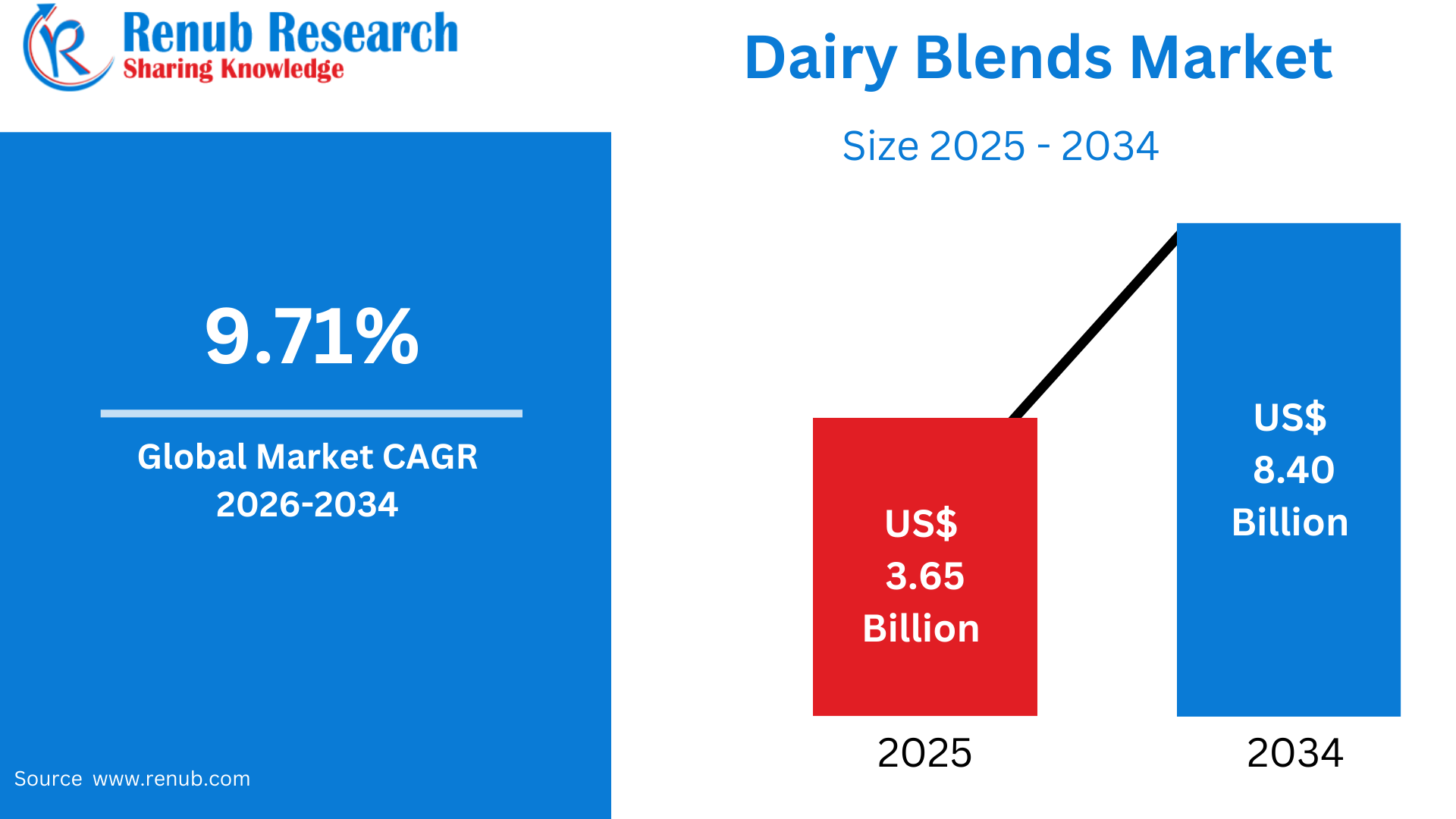
The global dairy blends market is expected to witness robust growth, expanding from US$ 3.65 billion in 2025 to US$ 8.40 billion by 2034, at a compound annual growth rate of 9.71% during the forecast period from 2026 to 2034. Market expansion is primarily driven by the increasing demand for cost-effective dairy alternatives, growing utilization of dairy blends in bakery and confectionery applications, and evolving consumer preferences for products that offer enhanced texture, flavor, and nutritional value. In addition, continuous advancements in dairy blend formulations, coupled with the expanding presence of foodservice establishments, are further supporting market growth.
Dairy Blends Industry
Dairy blends are formulated food ingredients created by combining conventional dairy components, including milk solids, butter, cream, or cheese, with non-dairy ingredients such as vegetable oils, plant-based proteins, emulsifiers, and functional food additives. These blends are designed to replicate the functional characteristics of traditional dairy products while providing advantages such as improved cost efficiency, extended shelf life, enhanced texture, and greater formulation flexibility. Owing to these benefits, dairy blends are widely utilized across bakery, confectionery, spreads, sauces, ready-to-eat meals, and foodservice applications, where consistent product performance, controlled fat content, and optimized functionality are essential.
The global demand for dairy blends continues to increase as consumer preferences and food manufacturing requirements evolve. Food manufacturers increasingly adopt dairy blends because they offer formulation versatility, more stable pricing compared to conventional dairy ingredients, and the ability to develop products tailored to specific nutritional and functional requirements. Rapid urbanization and rising consumption of processed and convenience foods in emerging economies are further contributing to market expansion. Additionally, restaurants, quick-service outlets, and foodservice operators are increasingly incorporating dairy blends into their product offerings due to their consistent quality, longer shelf life, and operational efficiency. Continuous product innovation and the development of value-added dairy blend formulations are further strengthening their adoption across a broad range of food and beverage applications worldwide.
Market Catalysts
Cost Efficiency and Price Stability
The ability to reduce production costs while maintaining product quality is one of the primary factors driving the growth of the dairy blends market. Traditional dairy ingredients such as butterfat, cream, and cheese are highly susceptible to price fluctuations resulting from variations in milk production, feed costs, and changing climatic conditions. Dairy blends provide manufacturers with a cost-effective alternative by partially replacing expensive dairy fats with functional vegetable oils and other complementary ingredients, enabling greater control over production costs and pricing. This flexibility allows food manufacturers to maintain product consistency while improving profit margins. Reflecting ongoing product innovation, FrieslandCampina Ingredients introduced the Biotis™ Fermentis range in April 2024, featuring next-generation dairy and plant-based protein blends formulated to support digestive health, muscle function, and satiety through a combination of dairy proteins, prebiotics, and fermented plant-based ingredients.
Expanding Applications in Processed and Convenience Foods
The growing consumption of processed and convenience foods worldwide is significantly increasing the demand for dairy blends across the food industry. These ingredients are widely used in bakery products, confectionery, spreads, sauces, frozen desserts, and ready-to-cook meals because of their excellent processing characteristics and functional performance. Dairy blends provide desirable melting behavior, improved texture, enhanced product stability, and extended shelf life, making them well suited for industrial food manufacturing. Their ability to maintain consistent performance under varying processing and storage conditions further enhances their suitability for large-scale production. In March 2024, Dairy Consumer Foods launched the SMUG Dairy product range, combining dairy ingredients with oats to produce blended milk, butter, and cheddar products that offer lower saturated fat content, enhanced nutritional value, and improved environmental sustainability.
Product Innovation and Nutritional Customization
Continuous innovation in dairy blend formulations is playing a pivotal role in expanding the market. Manufacturers are increasingly developing specialized dairy blends that address evolving consumer preferences for healthier and functional food products. Product innovations include reduced-fat formulations, trans-fat-free alternatives, and dairy blends fortified with proteins, vitamins, minerals, and other functional nutrients to support specific health and wellness claims. Advances in emulsification technologies and fat-structuring techniques have also significantly improved the taste, texture, and overall sensory characteristics of dairy blends, making them increasingly comparable to conventional dairy products. In June 2025, Dutch supermarket chain Albert Heijn introduced HYBRID MILK, a dairy blend combining conventional dairy milk with plant-based ingredients. Produced in collaboration with Farm Dairy Netherlands and PlanetDairy Denmark, the product offers the familiar taste and nutritional profile of dairy milk while reducing its environmental impact through a lower carbon footprint.
Challenges in the Dairy Blends Market
Consumer Perception and Labeling Challenges
Consumer perception remains one of the major obstacles to the wider adoption of dairy blends. Many consumers associate blended dairy products with highly processed foods or perceive them as lower-quality alternatives to traditional dairy products, particularly when formulations include vegetable oils or other non-dairy ingredients. The growing demand for clean-label products has increased consumer scrutiny of ingredient lists and product formulations, making transparency a critical factor for manufacturers. In addition, labeling regulations in several countries restrict the use of terms such as “pure dairy” or similar claims for blended products, creating marketing challenges and influencing consumer purchasing decisions.
Regulatory Complexity and Product Quality Consistency
The dairy blends market also faces challenges arising from diverse regulatory frameworks and quality management requirements across international markets. Different countries maintain distinct standards governing dairy content, the use of vegetable fats, food additives, product labeling, and packaging requirements, making regulatory compliance more complex and increasing operational costs for manufacturers. These variations can also create barriers to international trade and product standardization. Furthermore, maintaining consistent product quality remains challenging due to fluctuations in the quality and availability of raw materials, including dairy ingredients and vegetable oils. Even minor variations in ingredient composition can influence the functional properties, texture, flavor, and overall performance of dairy blends in finished food products, requiring manufacturers to implement stringent quality control and formulation management practices.
Dairy Blends Product launches in Worldwide
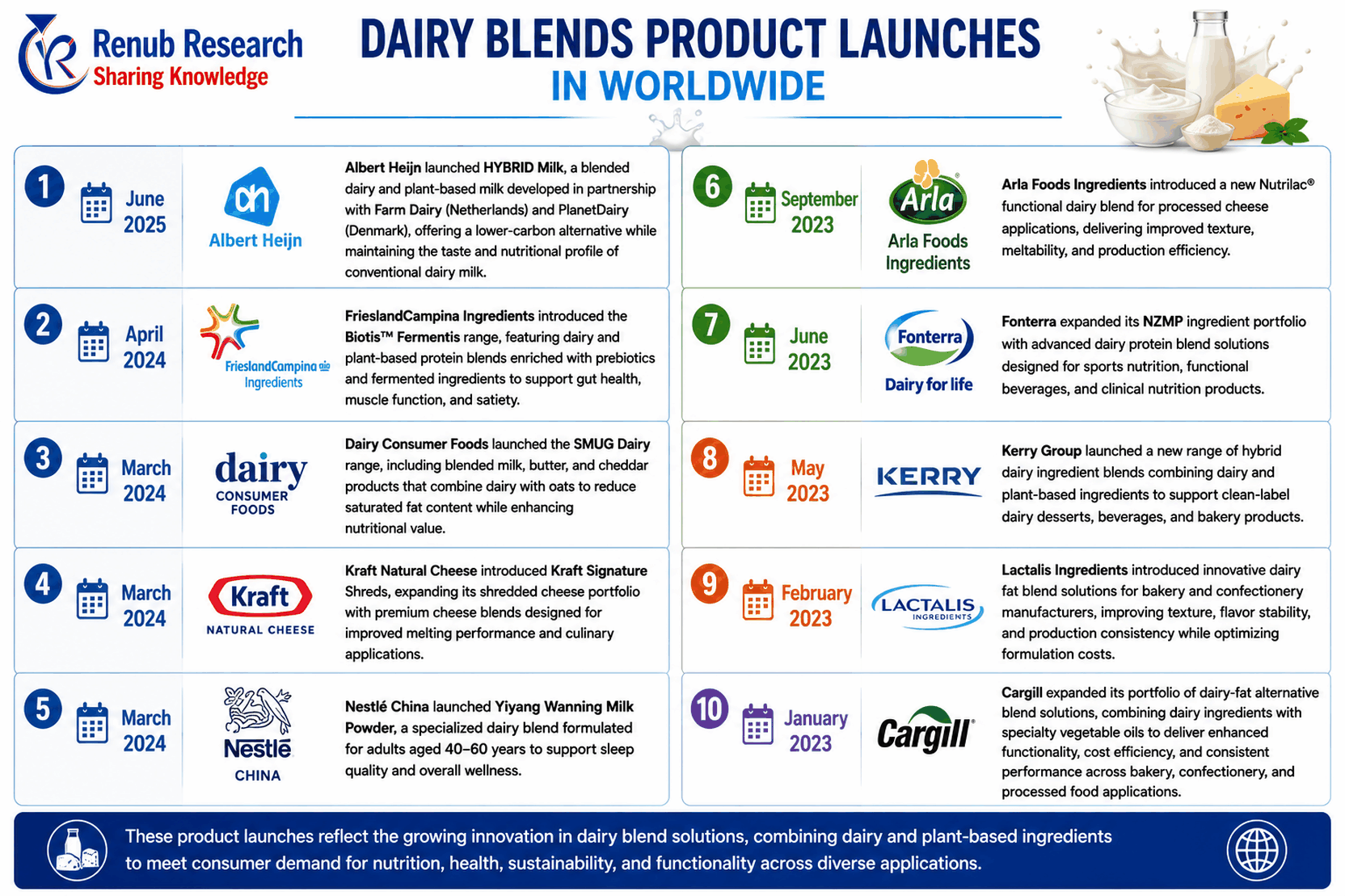
- June 2025 – Albert Heijn launched HYBRID Milk, a blended dairy and plant-based milk developed in partnership with Farm Dairy (Netherlands) and PlanetDairy (Denmark), offering a lower-carbon alternative while maintaining the taste and nutritional profile of conventional dairy milk.
- April 2024 – FrieslandCampina Ingredients introduced the Biotis™ Fermentis range, featuring dairy and plant-based protein blends enriched with prebiotics and fermented ingredients to support gut health, muscle function, and satiety.
- March 2024 – Dairy Consumer Foods launched the SMUG Dairy range, including blended milk, butter, and cheddar products that combine dairy with oats to reduce saturated fat content while enhancing nutritional value.
- March 2024 – Kraft Natural Cheese introduced Kraft Signature Shreds, expanding its shredded cheese portfolio with premium cheese blends designed for improved melting performance and culinary applications.
- March 2024 – Nestlé China launched Yiyang Wanning Milk Powder, a specialized dairy blend formulated for adults aged 40–60 years to support sleep quality and overall wellness.
- September 2023 – Arla Foods Ingredients introduced a new Nutrilac® functional dairy blend for processed cheese applications, delivering improved texture, meltability, and production efficiency.
- June 2023 – Fonterra expanded its NZMP ingredient portfolio with advanced dairy protein blend solutions designed for sports nutrition, functional beverages, and clinical nutrition products.
- May 2023 – Kerry Group launched a new range of hybrid dairy ingredient blends combining dairy and plant-based ingredients to support clean-label dairy desserts, beverages, and bakery products.
- February 2023 – Lactalis Ingredients introduced innovative dairy fat blend solutions for bakery and confectionery manufacturers, improving texture, flavor stability, and production consistency while optimizing formulation costs.
- January 2023 – Cargill expanded its portfolio of dairy-fat alternative blend solutions, combining dairy ingredients with specialty vegetable oils to deliver enhanced functionality, cost efficiency, and consistent performance across bakery, confectionery, and processed food applications.
Types Insights
Dairy Blends Mixtures
The dairy blends mixtures market comprises pre-formulated combinations of dairy and non-dairy ingredients designed to simplify food manufacturing processes and improve production efficiency. These blends typically contain standardized proportions of milk solids, butterfat, vegetable oils, emulsifiers, and stabilizers, ensuring consistent product quality across large-scale manufacturing operations. Their ready-to-use formulations help manufacturers reduce processing complexity, minimize production errors, and enhance operational productivity. In addition, dairy blend mixtures maintain stable performance under varying processing temperatures and manufacturing conditions, making them highly suitable for industrial applications across multiple food categories.
Dairy Blends as Functional Ingredients
The use of dairy blends as functional ingredients has gained significant importance due to their ability to improve the texture, stability, and overall quality of food products. These specialized formulations enhance creaminess, emulsification, melting characteristics, and shelf stability while supporting consistent product performance during processing. In bakery and confectionery applications, dairy blends improve dough handling, crumb softness, and fat distribution, contributing to superior product quality. In sauces, spreads, and dressings, they enhance mouthfeel, promote smooth texture, and minimize ingredient separation. Furthermore, dairy blends improve freeze-thaw stability, making them valuable ingredients for frozen and refrigerated food products.
Application Insights
Dairy Blends Ice Cream
The dairy blends ice cream market is expanding as manufacturers seek cost-effective alternatives to conventional dairy-based ice cream formulations. Dairy blends partially replace milk fat with vegetable-based fats while preserving the creamy texture, rich flavor, and desirable sensory characteristics expected in frozen desserts. These blends also improve control over ice crystal formation, enhance product consistency, and support efficient large-scale manufacturing. In regions with strong demand for frozen desserts, dairy blends enable manufacturers to offer competitively priced products without compromising product quality. Additionally, they support the development of reduced-fat and innovative frozen dessert formulations that address evolving consumer health preferences.
Dairy Blends Infant Formula
The dairy blends infant formula market is driven by the growing need for nutritionally balanced formulations that support healthy infant growth and development. These specialized blends combine carefully selected dairy ingredients with functional lipids, vitamins, minerals, and other micronutrients to deliver nutritional profiles that closely resemble infant dietary requirements. Many formulations are designed to replicate the structural characteristics of human milk lipids, improving nutrient absorption and digestive performance. Due to the highly sensitive nature of infant nutrition, manufacturing processes require advanced blending technologies, rigorous quality control, and strict compliance with regulatory standards, making this one of the most closely regulated application segments within the dairy blends industry.
Products Insights
Dairy Blends Powder
The dairy blends powder market continues to expand because powdered formulations offer extended shelf life, convenient transportation, and broad application versatility. Produced primarily through spray-drying and related processing technologies, powdered dairy blends are widely used in bakery products, beverage mixes, confectionery, instant meals, and dry food formulations. Compared with liquid alternatives, powdered blends provide superior storage stability, improved fat distribution, enhanced solubility, and reduced refrigeration requirements. Their lightweight nature and ease of handling make them particularly attractive for export markets and large-scale food manufacturing. Growing demand for convenience foods, powdered meal solutions, and dry ingredient systems is further supporting the adoption of powdered dairy blends across the global food industry.
Dairy Liquid Blends Market
The dairy liquid blends market serves food manufacturers that require ready-to-use ingredients capable of seamless integration into continuous production processes. Liquid dairy blends are extensively utilized in the production of sauces, soups, beverages, desserts, ice cream, and other processed food products where rapid incorporation and precise ingredient distribution are essential. These formulations provide consistent viscosity, stable emulsification, and uniform product quality while eliminating the need for rehydration before use. Although liquid dairy blends require refrigerated transportation and cold-chain logistics, their processing efficiency and functional advantages often outweigh these additional handling requirements. As a result, they are widely adopted by foodservice operators, ready-meal manufacturers, and large-scale dairy processing companies seeking improved manufacturing efficiency and product consistency.
Country insights
United States Dairy Blends
The United States dairy blends market is highly developed, supported by strong demand from the food processing, bakery, confectionery, and foodservice industries. Manufacturers are increasingly incorporating dairy blends into their product formulations to mitigate the impact of volatile dairy prices while maintaining consistent product quality and functional performance. The country’s advanced food processing infrastructure and continuous investment in research and development have accelerated the introduction of specialized dairy blends tailored for applications such as ice cream, sauces, bakery products, and ready-to-eat meals. In addition, rising consumer demand for convenience foods and clean-label, high-performance ingredients is encouraging manufacturers to develop innovative dairy blend formulations. Reflecting ongoing product innovation, Kraft Natural Cheese introduced its Kraft Signature Shreds product range in March 2024, expanding its portfolio with value-added cheese products designed to meet evolving consumer preferences.
United Kingdom Dairy Blends
The United Kingdom dairy blends market is supported by a well-established processed food industry and increasing emphasis on manufacturing efficiency and cost optimization. Food manufacturers are utilizing dairy blends to improve functional performance, enhance processing reliability, and manage production costs across bakery, dessert, spreads, and ready-to-eat food applications. Growing demand for shelf-stable, easy-to-use ingredients suitable for large-scale food production continues to strengthen market growth. Additionally, dairy blends enable manufacturers to reformulate products with improved nutritional profiles, including reduced-fat options and enhanced texture. Expansion of the foodservice industry and private-label food manufacturing has further accelerated the adoption of dairy blends as companies seek high-quality ingredients that deliver both performance and cost advantages. Broader innovation within the European dairy sector has also supported market development, highlighted by the June 2025 launch of Albert Heijn’s private-label hybrid dairy products, developed through a partnership between Farm Dairy in the Netherlands and PlanetDairy in Denmark.
China Dairy Blends
China’s dairy blends market is experiencing rapid expansion, driven by accelerating industrialization, urbanization, and increasing consumption of processed and packaged food products. Changing dietary preferences and rising disposable incomes have significantly increased demand for bakery products, confectionery, frozen desserts, and convenience meals, all of which represent important application areas for dairy blends. Food manufacturers are increasingly adopting dairy blends to improve product consistency, extend shelf life, and optimize production costs while supporting large-scale manufacturing operations. Ongoing investments in advanced food processing facilities and cold-chain infrastructure are further strengthening market growth. In addition, dairy blends provide domestic manufacturers with scalable solutions for producing high-quality dairy-based food products. Demonstrating continued innovation in the dairy sector, Nestlé introduced its Yiyang Wanning Milk Powder in March 2024, targeting consumers aged 40 to 60 years with a formulation designed to support improved sleep quality.
Brazilian Dairy Blends
Brazil’s dairy blends market is expanding steadily as the country’s food processing industry increasingly adopts cost-efficient ingredient solutions to enhance production efficiency. Dairy blends are widely utilized across bakery, confectionery, spreads, foodservice, and processed food applications, where manufacturers seek to balance product quality with cost optimization. By partially replacing traditional dairy fats while maintaining desirable taste and functional characteristics, dairy blends help manufacturers improve profitability without compromising product performance. Rising urbanization, changing consumer lifestyles, and increasing consumption of packaged and convenience foods continue to create favorable conditions for market expansion. Supporting this trend, Lactalis Brazil announced an investment of R$400 million in September 2025 to expand production capacity across multiple dairy product categories, including dairy blends, at several processing facilities throughout the country.
Saudi Arabia Dairy Blends
Saudi Arabia’s dairy blends market is witnessing consistent growth, supported by the expansion of the food and beverage industry and rising demand for processed and packaged food products. Dairy blends are increasingly used in bakery products, desserts, sauces, dairy beverages, and other food applications because of their excellent stability, extended shelf life, and reliable performance under high-temperature conditions. Food manufacturers are adopting these ingredients to maintain consistent product quality while effectively managing production costs. The rapid growth of the hospitality and foodservice sectors has further strengthened demand for dependable and versatile dairy ingredients. In addition, government initiatives aimed at enhancing food security and expanding domestic food manufacturing are encouraging greater adoption of scalable and cost-effective dairy blend solutions. Reflecting continued investment in the sector, Saudia Dairy & Foodstuff Co. inaugurated its Saudia Ice Cream Factory at KidZania in Arab Mall, Jeddah, in August 2025, strengthening the company’s regional presence while promoting educational engagement with the food manufacturing industry.
Market Segmentations
Type
- Dairy Mixtures
- Dairy/Nondairy ingredient
- Dairy as Functional
- Dairy as Carrier
- Others
Application
- Bakery
- Ice-cream
- Infant Formula
- Others
Products
- Powder
- Spreadable
- Liquid
Countries
North America
- United States
- Canada
Europe
- France
- Germany
- Italy
- Spain
- United Kingdom
- Belgium
- Netherlands
- Turkey
Asia Pacific
- China
- Japan
- India
- South Korea
- Thailand
- Malaysia
- Indonesia
- Australia
- New Zealand
Latin America
- Brazil
- Mexico
- Argentina
Middle East & Africa
- Saudi Arabia
- UAE
- South Africa
All companies have been covered with 5 Viewpoints
- Overviews
- Key Person
- Recent Developments
- SWOT Analysis
- Revenue Analysis
Key Players Analysis
- Cargill Foods
- Kerry Foods
- Archer Daniels Midland
- Tate & Lyle
- Aak AB
- Dana Foods Inc.
- Royal FrieslandCampina N.V.
- Galloway Company
Report Details:
| Report Features | Details |
| Base Year |
2025 |
| Historical Period |
2022 - 2025 |
| Forecast Period |
2026 - 2034 |
| Market |
US$ Billion |
| Segment Covered |
Type, Application, Product and Countries |
| Countries Covered |
|
| Companies Covered |
|
| Customization Scope |
20% Free Customization |
| Post-Sale Analyst Support |
1 Year (52 Weeks) |
| Delivery Format |
PDF and Excel through Email (We can also provide the editable version of the report in PPT/Word format on request) |
Customization Services available
- Analysis of Market Size and Its Segments
- More Company Profiles (Upto 10 without any additional cost):
- Additional Countries (Other than mentioned Countries):
- Region/Country Specific Reports:
- Market Entry Strategy:
- Region-Specific Market Dynamics:
- Regional Market Share Analysis:
- Trade Analysis:
- Production Insights:
- Others Customized Requests:
For more information contact our analysts.
Need More Assistance?
- Talk to our analysts to get more precious information on the current market trends.
- Include more countries and segments and customize the report based on the final requirement.
- Get a competitive advantage in your industry by knowing the report findings and making a positive impact on your revenues and operations.
- Our analysts are always ready to provide more help and pertinent information if you need any additional assistance.