Convenience Food Market Report by Type, Distribution Channel, Country and Company Analysis 2026-2034
Buy NowConvenience Food Market Size and Forecast
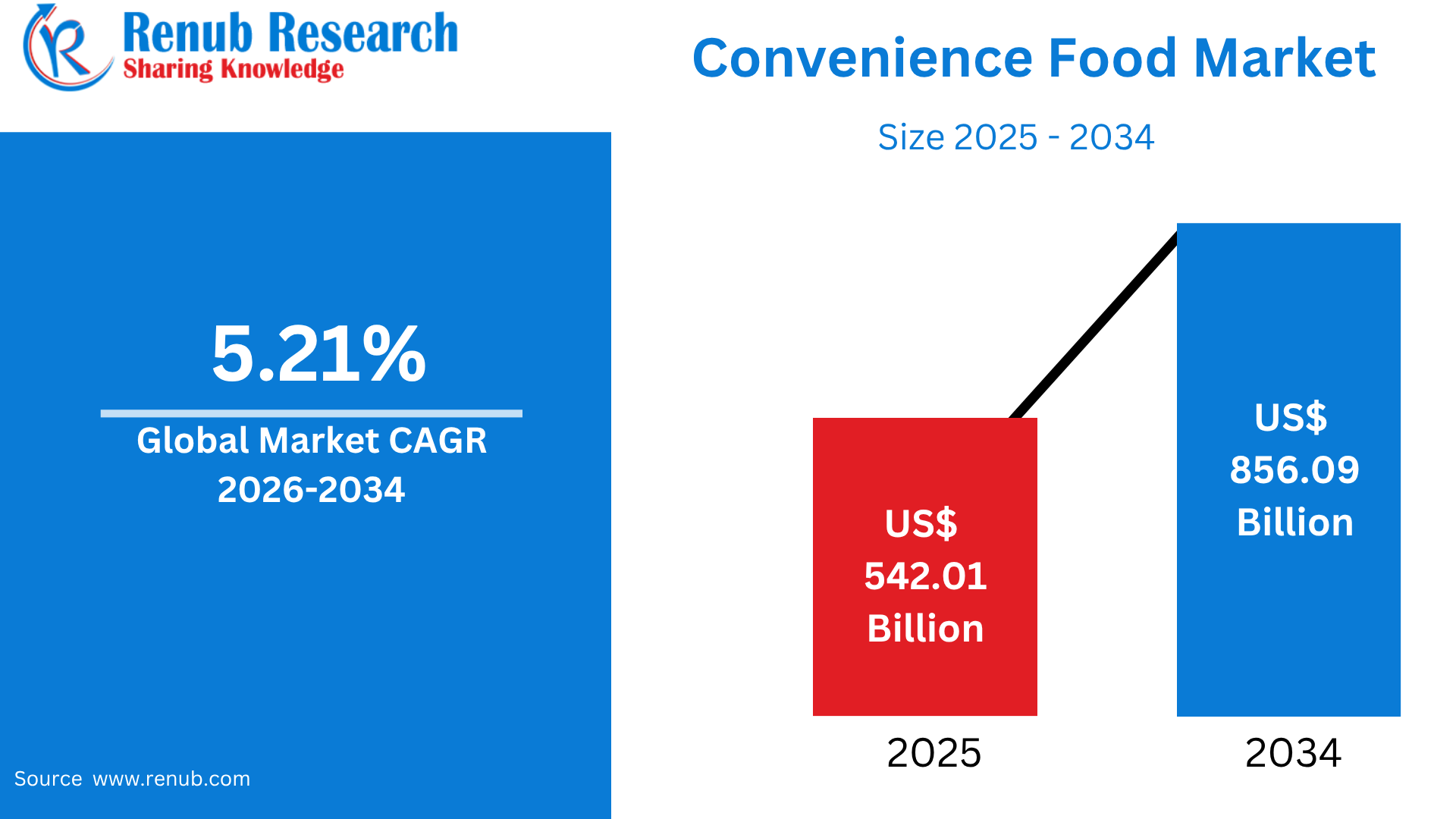
The Convenience Food Market is projected to expand from US$542.01 billion in 2025 to US$856.09 billion by 2034, registering a CAGR of 5.21% during 2026–2034. Market growth is being driven by busy lifestyles, urbanization, rising disposable incomes, and increasing consumer preference for quick and easy meal solutions. The growing participation of consumers in full-time employment and longer daily schedules is encouraging demand for products that require minimal preparation, including frozen meals, ready-to-eat foods, instant meals, microwaveable products, and packaged snacks.
What is Convenience Food? Uses and Popularity Worldwide
Convenience food refers to food products that are prepared, partially prepared, or packaged to reduce the time and effort required for cooking and consumption. These products include ready-to-eat meals, frozen foods, instant noodles, canned foods, packaged snacks, ready-to-cook products, microwaveable meals, processed meats, and pre-cut ingredients. Convenience foods are widely used by households, working professionals, students, travelers, and foodservice operators because they require minimal preparation and can be consumed quickly. Their popularity is increasing worldwide as urbanization, employment, changing lifestyles, smaller households, and busy schedules encourage consumers to seek faster meal solutions. Developed markets have strong demand for frozen and ready-to-eat products, while emerging economies are experiencing increasing adoption as modern retail and food-delivery infrastructure expands. Consumers are also becoming more selective, creating demand for healthier, high-protein, low-sodium, organic, plant-based, and clean-label convenience foods. Supermarkets, convenience stores, e-commerce platforms, and online grocery services have improved product availability and accessibility. Manufacturers are responding through innovative packaging, portion-controlled formats, extended shelf life, and microwave- or air-fryer-friendly products. As consumers increasingly prioritize time savings, convenience, affordability, and variety, convenience food is expected to remain an important component of the global food industry.
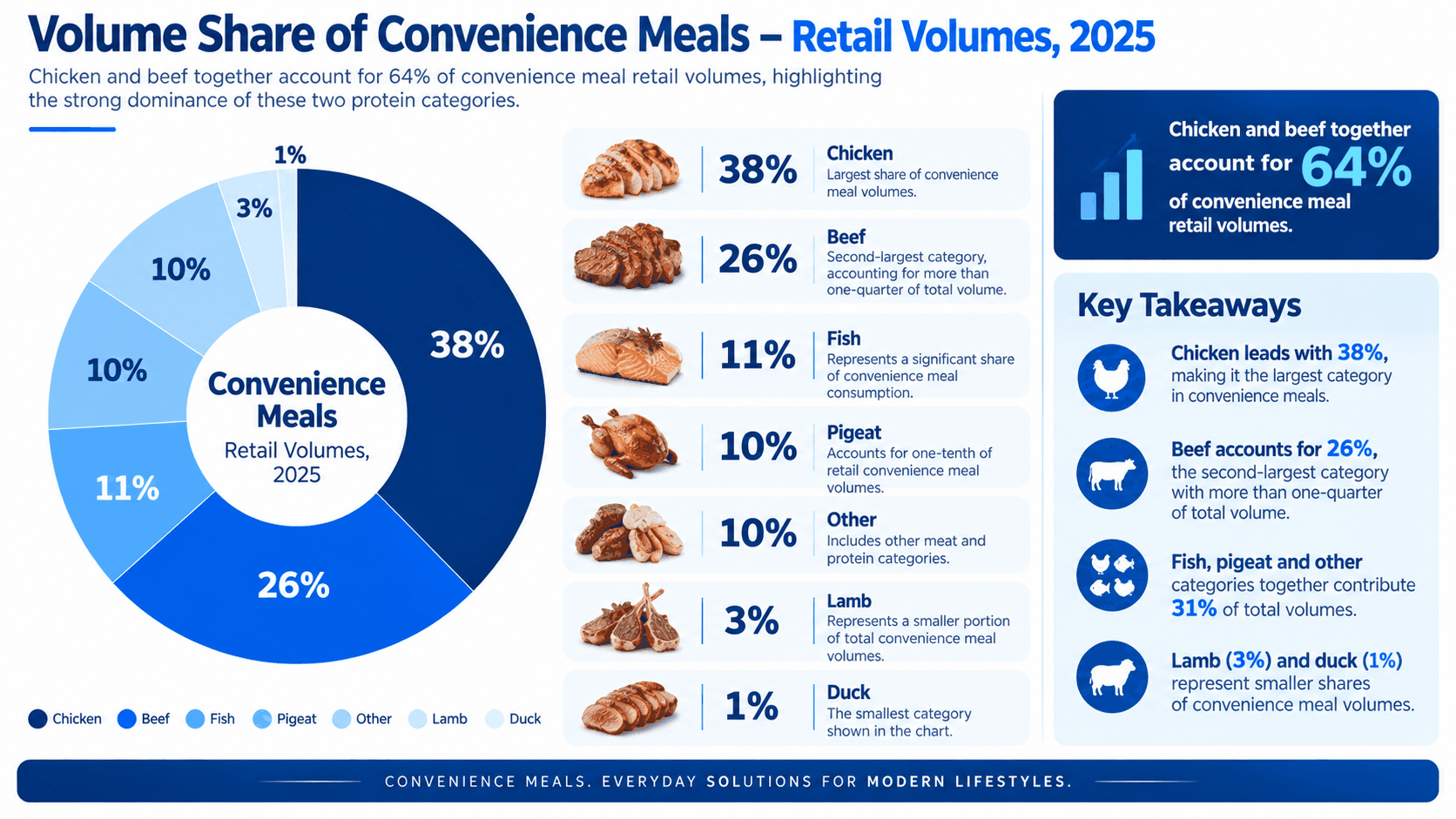
Volume Share of Convenience Meals – Retail Volumes, 2025
- Chicken: 38% — Largest share of convenience meal volumes.
- Beef: 26% — Second-largest category, accounting for more than one-quarter of total volume.
- Fish: 11% — Represents a significant share of convenience meal consumption.
- Pigeat: 10% — Accounts for one-tenth of retail convenience meal volumes.
- Other: 10% — Includes other meat and protein categories.
- Lamb: 3% — Represents a smaller portion of total convenience meal volumes.
- Duck: 1% — The smallest category shown in the chart.
- Overall: Chicken and beef together account for 64% of convenience meal retail volumes, highlighting the strong dominance of these two protein categories.
Demand for Convenience Foods
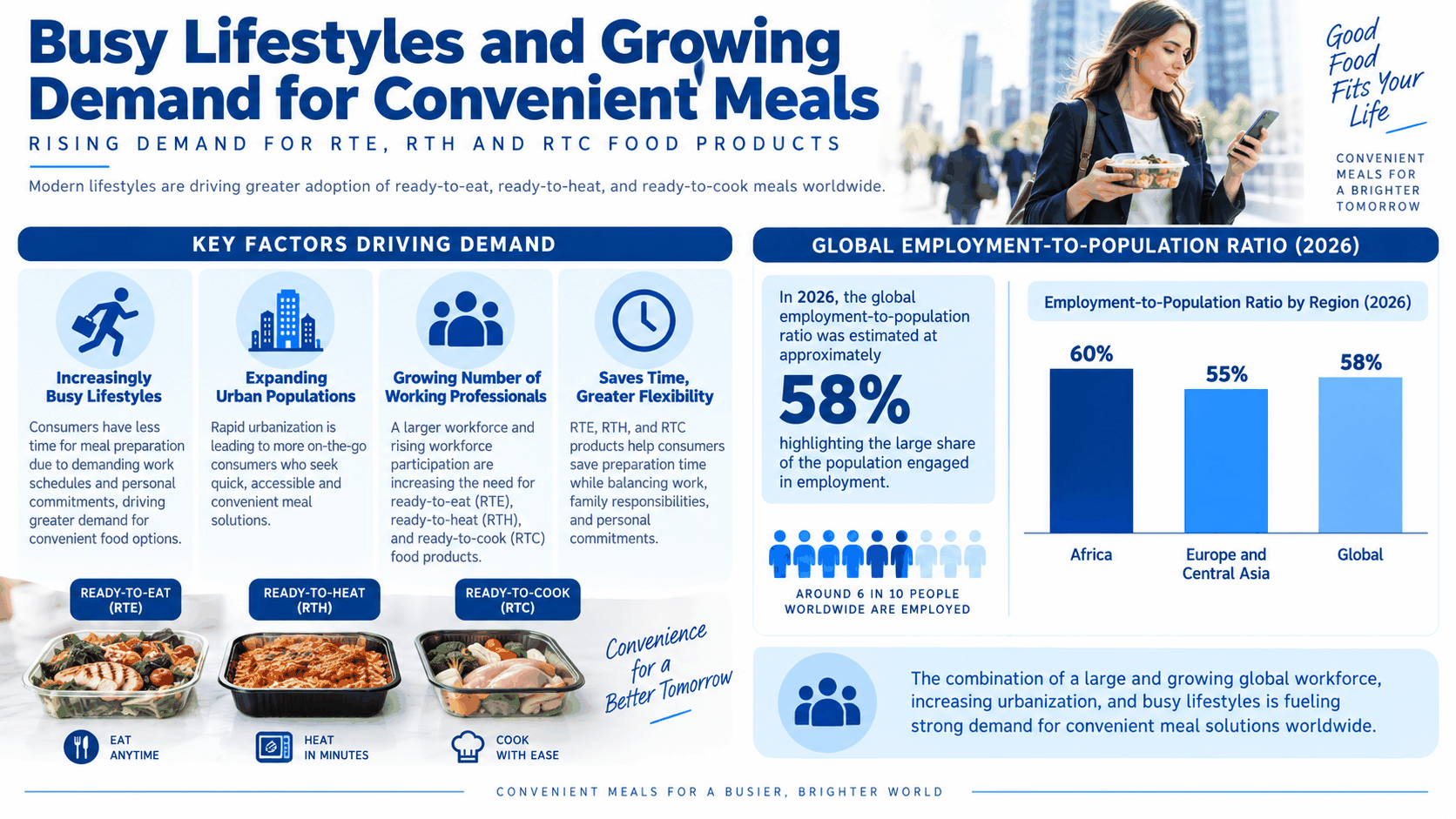
·Busy Lifestyles and Growing Demand for Convenient Meals
- Increasingly busy lifestyles, expanding urban populations, and a growing number of working professionals are driving demand for ready-to-eat (RTE), ready-to-heat (RTH), and ready-to-cook (RTC) food products.
- These products help consumers save preparation time while balancing work, family responsibilities, and personal commitments.
- The trend is supported by rising workforce participation and increasing demand for quick, accessible meal solutions.
- In 2026, the global employment-to-population ratio was estimated at approximately 58%, highlighting the large share of the population engaged in employment.
- Africa recorded the highest ratio at around 60%, followed by Europe and Central Asia at approximately 55%.
·Food Waste Reduction and Longer-Shelf-Life Products
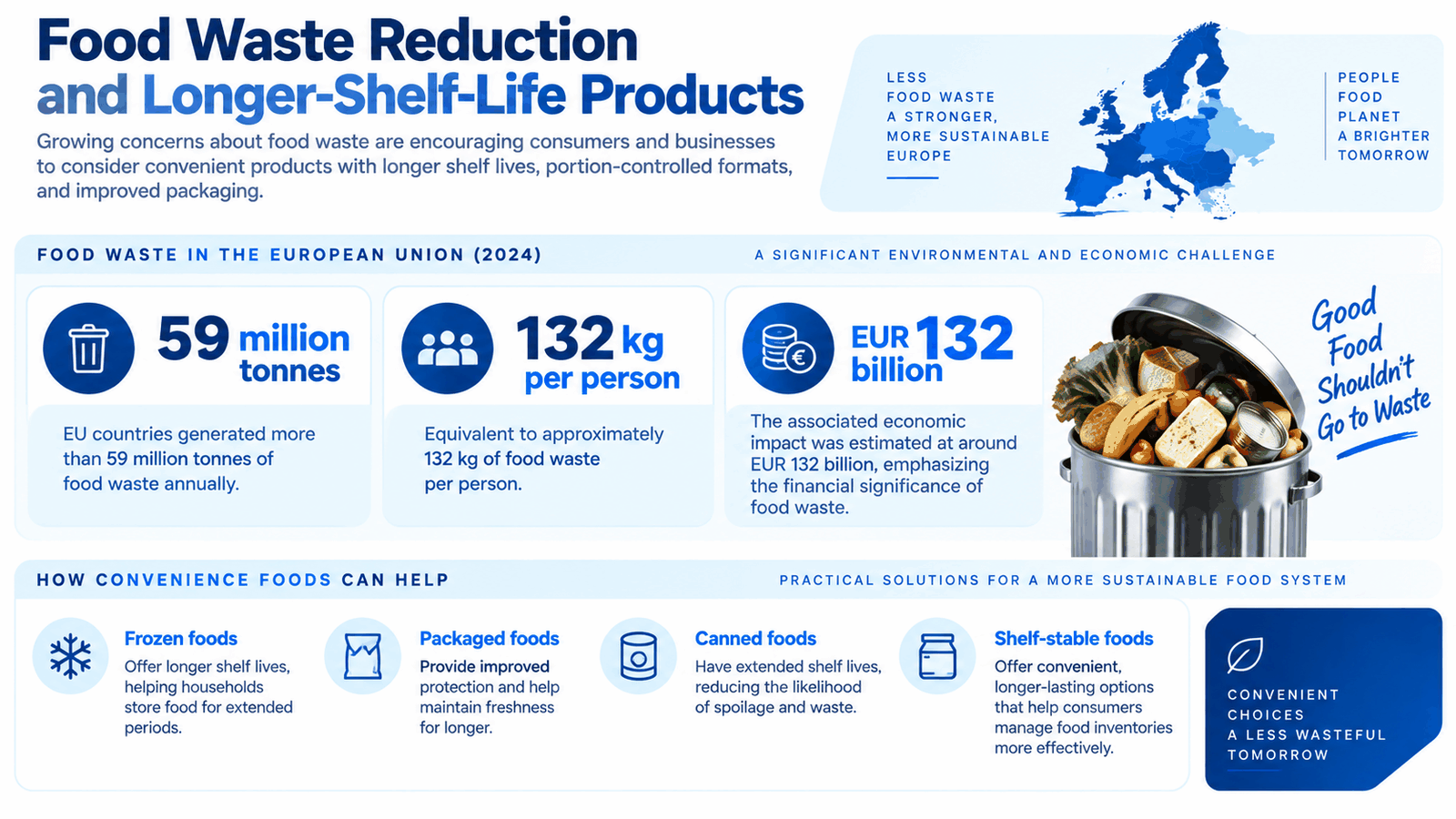
- Growing concerns about food waste are encouraging consumers and businesses to consider convenient products with longer shelf lives, portion-controlled formats, and improved packaging.
- According to a 2024 Eurostat report, EU countries generated more than 59 million tonnes of food waste annually, equivalent to approximately 132 kg per person.
- The associated economic impact was estimated at around EUR 132 billion, emphasizing the financial significance of food waste.
- Frozen, packaged, canned, and shelf-stable convenience foods can help households manage food inventories and potentially reduce spoilage-related waste.
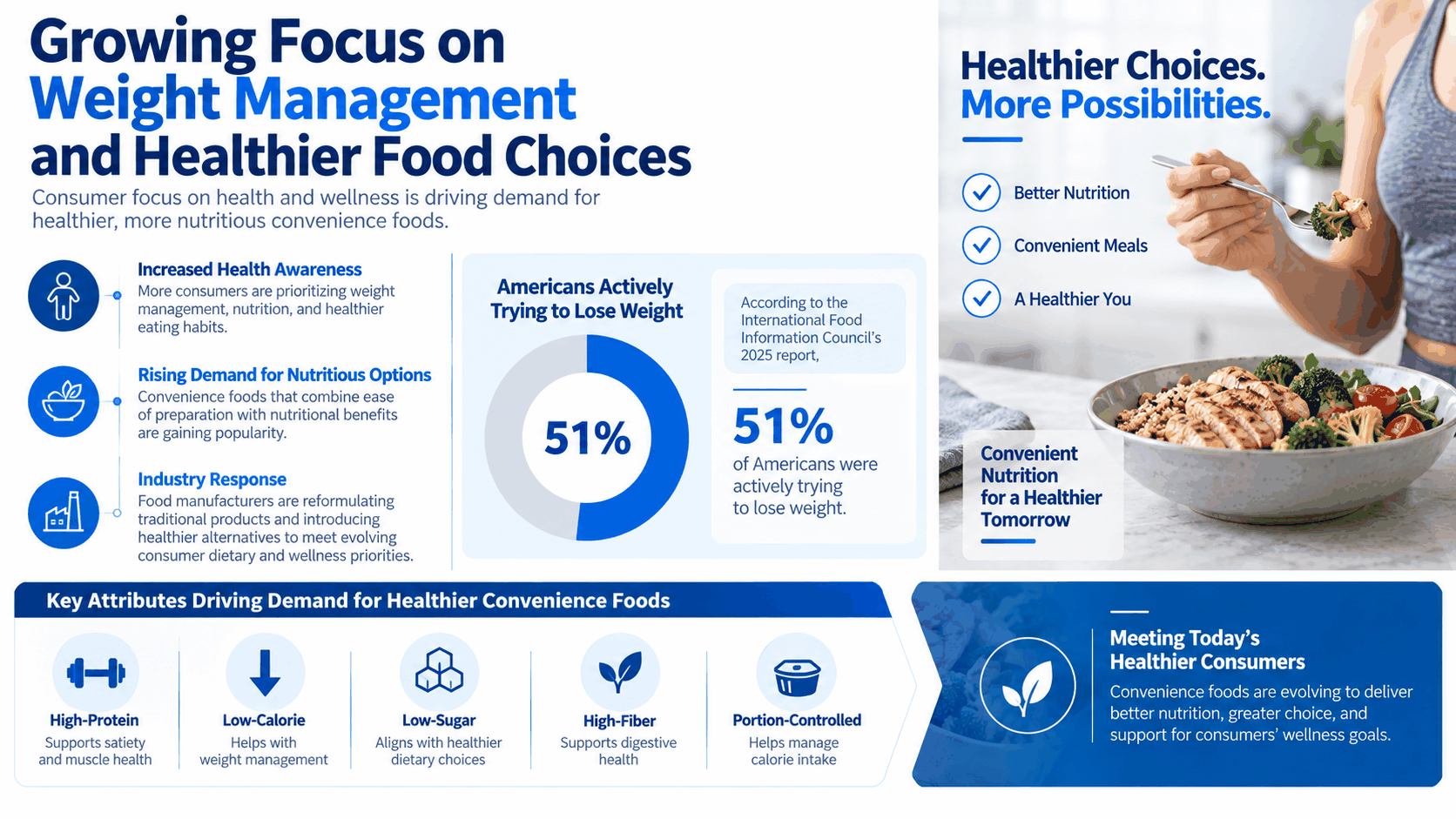
·Growing Focus on Weight Management and Healthier Food Choices
- Increasing consumer attention toward weight management, nutrition, and healthier eating habits is influencing the convenience food industry.
- The International Food Information Council’s 2025 report indicated that approximately 51% of Americans were actively trying to lose weight.
- This trend is encouraging demand for convenience products that combine ease of preparation with nutritional benefits, including high-protein, low-calorie, low-sugar, high-fiber, and portion-controlled meals.
- Food manufacturers are responding by reformulating traditional convenience foods and introducing healthier alternatives designed to meet consumers’ evolving dietary and wellness priorities.
Growth Drivers of the Global Convenience Food Market
Busy Lifestyles and Rising Demand for Time-Saving Meals
Changing lifestyles and increasingly busy schedules are among the strongest drivers of the global convenience food market. Urban consumers are spending more time at work, commuting, studying, and managing household responsibilities, increasing demand for foods that require little preparation. The United Nations estimates that around 57% of the world’s population lived in urban areas in 2023, and continued urbanization is expected to increase demand for convenient meal solutions. Ready-to-eat meals, frozen foods, instant noodles, canned products, microwaveable meals, and ready-to-cook ingredients help consumers significantly reduce preparation time. The expansion of single-person and smaller households is also encouraging demand for portion-controlled and individually packaged foods. Working professionals increasingly prefer meals that can be prepared within minutes without compromising taste or variety. Manufacturers are responding by introducing microwave-ready, air-fryer-compatible, frozen, chilled, and shelf-stable products. Convenience foods are also becoming more diverse, with options ranging from traditional meals to plant-based, high-protein, organic, and healthier formulations. As time constraints continue to influence food purchasing decisions, convenience is expected to remain a fundamental market growth driver.
Urbanization, Rising Incomes, and Expansion of Modern Retail
Urbanization and improving household purchasing power are creating favorable conditions for convenience food consumption worldwide. According to the World Bank, approximately 56% of the global population lived in urban areas in 2023, with the proportion continuing to rise as populations migrate toward cities. Urban consumers generally have greater access to supermarkets, hypermarkets, convenience stores, food-delivery platforms, and modern grocery channels, making packaged and ready-to-eat foods easier to purchase. Rising disposable incomes in developing economies are also enabling consumers to spend more on processed and value-added food products. Modern retail infrastructure is expanding rapidly across Asia-Pacific, Latin America, the Middle East, and Africa, providing manufacturers with additional distribution opportunities. E-commerce and online grocery services are further improving access to frozen meals, packaged snacks, instant foods, and ready-to-cook products. At the same time, manufacturers are introducing products across multiple price points to attract both price-sensitive and premium consumers. The combination of urban living, expanding retail infrastructure, greater purchasing power, and improved product availability is supporting wider adoption of convenience foods across both developed and emerging markets.
Product Innovation and Growing Demand for Healthier Convenience Foods
Continuous product innovation and changing nutritional preferences are creating new growth opportunities for the convenience food industry. Consumers increasingly want meals that save time while also providing nutritional value, encouraging manufacturers to develop products with higher protein, lower sodium, reduced sugar, added fiber, and cleaner ingredient profiles. The global food industry is responding with innovations in plant-based meals, functional foods, fortified products, organic convenience foods, and high-protein ready meals. Packaging technology is also improving through microwaveable, resealable, single-serving, recyclable, and extended-shelf-life formats. Major food manufacturers are investing in frozen and microwave-ready product lines to address demand for quick meal preparation. Air fryers and other countertop cooking appliances are also influencing product development, with manufacturers creating foods specifically designed for rapid preparation. In addition, consumers are increasingly seeking convenience without sacrificing taste, quality, or dietary preferences. The growth of vegetarian, vegan, gluten-free, and allergen-conscious diets is encouraging companies to diversify their portfolios. As innovation improves the nutritional profile, taste, convenience, and sustainability of packaged foods, healthier convenience products are expected to become an increasingly important source of market growth.
Challenges of the Global Convenience Food Market
Health Concerns Associated with Highly Processed Foods
Health concerns surrounding highly processed convenience foods represent a major challenge for market participants. Many traditional convenience products contain relatively high levels of sodium, saturated fat, added sugars, or preservatives, creating concerns among consumers and health organizations. The World Health Organization recommends that adults consume less than 2,000 mg of sodium per day, equivalent to less than 5 grams of salt. Products with excessive sodium can therefore face increasing scrutiny as consumers become more aware of diet-related health risks. Growing awareness of obesity, cardiovascular disease, diabetes, and other chronic conditions is encouraging consumers to evaluate ingredient lists and nutritional labels more carefully. This is particularly challenging for manufacturers whose portfolios rely heavily on highly processed products. Governments in several countries are also introducing or strengthening nutrition-labeling requirements, advertising restrictions, and initiatives aimed at reducing salt, sugar, and unhealthy fats. Consequently, companies are investing in reformulation, natural ingredients, lower-sodium recipes, and healthier alternatives. However, reformulating products while maintaining taste, shelf life, affordability, and consumer acceptance can be technically difficult and costly. Health concerns therefore create both a challenge and an incentive for innovation across the convenience food market.
Supply-Chain Volatility and Rising Production Costs
Raw-material price volatility, transportation costs, packaging expenses, and supply-chain disruptions pose significant challenges to the global convenience food industry. Manufacturers depend on agricultural commodities such as wheat, corn, potatoes, vegetable oils, meat, dairy ingredients, and spices, whose prices can fluctuate because of weather conditions, geopolitical tensions, energy costs, and changes in global supply and demand. Packaging materials and cold-chain transportation can add further costs, particularly for frozen and chilled convenience foods. The World Bank’s food price data demonstrate that global food commodity prices can experience substantial year-to-year fluctuations, creating uncertainty for food manufacturers and retailers. Frozen products face additional challenges because they require temperature-controlled storage and transportation throughout the supply chain. Higher logistics and energy costs can increase final retail prices, potentially reducing demand among price-sensitive consumers. Companies are therefore focusing on local sourcing, diversified supplier networks, efficient inventory management, automation, and improved packaging to reduce waste and operating expenses. Maintaining affordability while protecting margins and ensuring consistent product availability remains a key challenge, particularly in emerging markets where distribution infrastructure may still be developing.
Convenience Food Launches Worldwide
- Oscar Mayer NotHotDogs & NotSausages – 2024: Kraft Heinz and TheNotCompany launched plant-based versions of Oscar Mayer hot dogs and sausages, expanding the brand into convenient meat-alternative foods. The products were scheduled for rollout at major retailers across the U.S. in 2024.
- Delimex 360CRISP Crispy Quesadillas – 2024: Delimex introduced Crispy Quesadillas in Char-Grilled Chicken and Chipotle Chicken varieties. The products use 360CRISP technology to deliver a crispy texture directly from the microwave, targeting quick-meal consumers.
- Capri Sun Resealable Bottles – 2025: Capri Sun launched its first single-serve resealable bottle in more than 20 years. The 12-ounce bottles were introduced in Fruit Punch, Pacific Cooler, and Strawberry Kiwi flavors, providing a more portable format for on-the-go consumption.
- VELVEETA Vel2Go Packets – 2025: VELVEETA launched Vel2Go, its first single-serve cheese-condiment format. The portable packets allow consumers to add VELVEETA to meals and snacks while traveling, eating at events, or consuming food away from home.
- HEINZ Globally Inspired Sauces – 2025: HEINZ introduced three sauces inspired by international flavors: Mexican-Inspired Street Corn, Korean-Inspired Sweet & Tangy BBQ, and Thai-Inspired Sweet Chili. The products target consumers looking for quick ways to add global flavors to everyday meals.
- Kraft Mac & Cheese PowerMac – 2026: Kraft Heinz expanded its convenience-meal portfolio with PowerMac, a protein-focused variation of Kraft Mac & Cheese. The launch reflects increasing demand for convenient meals with enhanced nutritional positioning.
- Smucker’s Ready-to-Bake Crumb Pies – 2026: J.M. Smucker expanded into frozen desserts with ready-to-bake crumb pies in flavors including Cherry Crumb, Apple Crumb, Mixed Berry Crumb, and Peach Crumb. The products are designed to provide convenient at-home baking with minimal preparation.
- Eggo Syrup Relaunch – 2026: Eggo brought back its syrup range in updated squeeze bottles after more than two decades. The range includes five flavors designed to complement frozen waffles and provide a convenient breakfast option.
Demand for Quick and Minimal-Preparation Meals
Ready-to-Eat Convenience Food Market is expanding as consumers increasingly prioritize speed, convenience, and portion control. Ready-to-eat products include prepared meals, sandwiches, salads, packaged snacks, instant meals, and other foods that can be consumed with little or no cooking. More than half of the world’s population lives in urban areas, creating a large consumer base with busy work and commuting schedules. Working professionals, students, single-person households, and younger consumers are major users of these products. Manufacturers are also expanding healthier offerings, including high-protein, plant-based, low-sodium, organic, and clean-label ready meals. Improvements in modified-atmosphere packaging, refrigeration, and shelf-life technologies are increasing product quality and availability. Supermarkets, convenience stores, foodservice outlets, and online grocery platforms are broadening distribution. Consumers are increasingly willing to pay for products that save preparation time while providing familiar flavors and nutritional benefits. Product innovation, smaller household sizes, rising urbanization, and changing lifestyles are therefore expected to support steady growth in the ready-to-eat convenience food segment.
Longer Shelf Life and Improved Product Quality Drive Frozen Adoption
Frozen Convenience Food Market is benefiting from growing consumer demand for products that offer convenience, longer shelf life, and reduced food waste. Frozen foods include ready meals, frozen vegetables, meat products, seafood, pizzas, snacks, desserts, and ready-to-cook products. Freezing allows products to remain usable for extended periods while preserving much of their nutritional value and reducing the need for frequent grocery shopping. Rising numbers of working households and smaller families are supporting demand for portion-controlled frozen meals. Technological improvements in freezing, packaging, and cold-chain logistics have also enhanced product quality and consumer acceptance. Manufacturers are increasingly introducing healthier frozen products containing vegetables, whole grains, plant-based proteins, and reduced sodium. The popularity of air fryers and microwave ovens is further encouraging demand for frozen products designed for rapid preparation. Modern supermarkets and hypermarkets continue to allocate substantial freezer space to private-label and branded products. Although frozen foods require temperature-controlled transportation and storage, expanding cold-chain infrastructure is improving accessibility. Convenience, extended shelf life, product variety, and reduced preparation time will continue supporting this segment.
Convenience Food Broad Product Selection Strengthens Supermarkets & Hypermarkets Distribution
Supermarkets and hypermarkets remain important distribution channels for convenience foods because they provide consumers with extensive product selections at competitive prices. These stores typically offer dedicated sections for frozen meals, ready-to-eat foods, packaged snacks, canned products, instant meals, chilled foods, and ready-to-cook ingredients. Large-format retailers benefit from their ability to combine high product variety, promotional pricing, private-label offerings, and one-stop shopping convenience. Rising urban populations and increasing household participation in online and offline grocery shopping are supporting demand through these channels. Retailers are also expanding premium and healthier convenience-food ranges, including organic, vegan, gluten-free, high-protein, and low-sodium products. Private-label convenience foods are gaining traction because they generally provide lower prices compared with national brands, an important advantage during periods of inflation. Many supermarkets and hypermarkets are also developing omnichannel models that integrate physical stores with online ordering, home delivery, and click-and-collect services. Promotional campaigns, loyalty programs, meal bundles, and strategically positioned ready-meal sections further encourage purchases. The combination of broad accessibility, competitive pricing, and product diversity is expected to keep supermarkets and hypermarkets among the leading convenience food distribution channels.
Convenience Food Immediate Consumption and Extended Store Networks Support Convenience Stores Market Growth
Convenience Store Convenience Food Market is driven by consumers seeking fast access to meals, snacks, beverages, and ready-to-eat products close to homes, workplaces, transportation hubs, and major roads. Convenience stores are particularly attractive because they typically operate for extended hours and offer products suitable for immediate consumption. Ready-to-eat sandwiches, bakery products, instant meals, packaged snacks, hot foods, and chilled products are increasingly important components of convenience-store sales. The expansion of urban populations and busy lifestyles is increasing demand for quick meals and smaller portion sizes. Retailers are also improving product quality by adding healthier meals, fresh foods, high-protein snacks, and premium coffee and beverage options. In many markets, convenience stores are expanding prepared-food counters and in-store kitchens to provide fresher meal choices. Digital payment systems, loyalty applications, self-checkout, and delivery partnerships are further improving the shopping experience. Convenience stores also benefit from their extensive geographic presence and proximity to consumers. Although products may carry higher prices than supermarket alternatives, consumers often accept the premium in exchange for speed and accessibility. Continued urbanization and demand for immediate consumption are expected to support market expansion.
Convenience Food Online Retail and Home Delivery Transform Food Purchasing
Convenience Food Online Retail Market is growing rapidly as consumers increasingly use e-commerce platforms to purchase ready meals, frozen foods, packaged snacks, canned products, and ready-to-cook ingredients. The global e-commerce ecosystem now serves billions of consumers, creating significant opportunities for online food retailers and convenience-food manufacturers. Consumers benefit from home delivery, subscription services, digital promotions, personalized recommendations, and the ability to compare multiple brands and products without visiting physical stores. Online grocery platforms are particularly attractive to busy professionals and households seeking to reduce shopping time. The development of quick-commerce services, including delivery within 15–30 minutes in major urban areas, is further strengthening demand for convenience foods. Manufacturers are also using direct-to-consumer websites to introduce specialty, premium, organic, and niche products that may have limited availability in physical stores. Improved refrigerated and frozen delivery systems are helping retailers expand their assortment of temperature-sensitive products. Digital advertising and social commerce additionally allow brands to promote new products directly to targeted consumers. As smartphone penetration, digital payments, online grocery adoption, and last-mile delivery infrastructure continue to improve, online retail is expected to become an increasingly important channel for convenience foods.
Strong Consumer Demand and Product Innovation in USA
United States Convenience Food Market remains one of the most developed markets globally, supported by high consumer purchasing power, urban lifestyles, and extensive availability of ready-to-eat and ready-to-cook products. The U.S. population exceeds 340 million, creating a substantial consumer base for frozen meals, microwaveable foods, packaged snacks, instant products, and chilled prepared foods. Busy work schedules, long commuting times, and the growing number of smaller households encourage consumers to choose meals that require minimal preparation. Supermarkets, hypermarkets, convenience stores, warehouse clubs, and e-commerce platforms provide extensive access to convenience products. Manufacturers are increasingly introducing high-protein, plant-based, organic, clean-label, and lower-sodium formulations to address health-conscious consumers. Advanced freezing, packaging, and microwave technologies are also improving product quality and shelf life. However, inflation and increasing awareness of the health implications of highly processed foods are encouraging consumers to seek affordable and healthier alternatives. Companies are responding through product reformulation, private-label expansion, and value-oriented packaging. Strong cold-chain infrastructure, intense brand competition, and continuous product innovation are expected to maintain the U.S. as a key global convenience food market.
Germany Health, Quality, and Sustainability Shape Convenience Food Demand
Germany Convenience Food Market is supported by growing demand for convenient meal solutions, changing household structures, and increasingly busy lifestyles. Germany has more than 80 million inhabitants, while single-person households account for a substantial share of households, creating opportunities for portion-controlled and ready-to-eat products. Frozen meals, chilled foods, canned products, ready meals, and microwaveable offerings are widely distributed through supermarkets, discount retailers, hypermarkets, and convenience channels. German consumers place considerable emphasis on food quality, natural ingredients, sustainability, and transparent labeling, encouraging manufacturers to reduce artificial additives and develop healthier convenience products. Plant-based ready meals, organic foods, high-protein products, and sustainable packaging are gaining attention among younger and environmentally conscious consumers. Nevertheless, Germany maintains a strong cultural preference for fresh and home-prepared food, which can limit adoption among some consumer groups. Rising food prices also increase demand for private-label and value-oriented products. Strict food-safety standards and environmental expectations further influence product formulation and packaging. Despite these constraints, premium ready meals, frozen products, and healthier convenience foods are creating new opportunities for market expansion.
China Urbanization and Digital Retail Accelerate Convenience Food Expansion
China Convenience Food Market is experiencing rapid development as urbanization, rising incomes, and changing lifestyles increase demand for quick and easy meal solutions. China has a population exceeding 1.4 billion, providing an exceptionally large consumer base, while its urbanization rate has surpassed 65%. Young consumers, office workers, and urban households increasingly purchase instant foods, frozen meals, ready-to-cook products, packaged snacks, and prepared foods to reduce cooking time. The rapid development of e-commerce, online grocery platforms, and food-delivery services has further improved product accessibility. Manufacturers are adapting products to regional preferences by introducing traditional Chinese flavors, healthier recipes, premium ingredients, and convenient packaging formats. Increasing demand for high-protein, low-sodium, plant-based, and functional foods is also encouraging product diversification. However, manufacturers face challenges related to food safety, raw-material costs, logistics, and intense competition from restaurants and meal-delivery platforms. Consumers are also becoming more demanding regarding freshness, nutrition, and ingredient transparency. Despite these challenges, expanding urban populations, digital shopping adoption, and evolving food preferences are expected to keep China among the fastest-growing convenience food markets globally.
Young Consumers and Modern Retail Support Saudi Arabia Convenience Food Growth
Saudi Arabia Convenience Food Market is expanding as urbanization, changing lifestyles, increasing workforce participation, and growing demand for quick meal solutions influence consumer behavior. Saudi Arabia has a population of more than 35 million, with a relatively young demographic profile that creates strong potential for ready-to-eat meals, frozen foods, packaged snacks, instant products, and heat-and-eat meals. The expansion of supermarkets, hypermarkets, convenience stores, online grocery platforms, and food-delivery services is improving access to convenience products. Investments in food-processing capacity, cold-chain infrastructure, and domestic food production under Saudi Vision 2030 are also supporting supply-chain development and food security. Younger consumers are increasingly exposed to international food trends and are showing interest in Western-style frozen meals, premium snacks, ready-to-cook products, and convenient packaged foods. However, traditional preferences for freshly prepared meals remain an important competitive factor. Price sensitivity, imported raw materials, and concerns regarding highly processed foods can also affect purchasing decisions. Nevertheless, increasing urban lifestyles, modern retail expansion, and greater product availability are expected to support steady growth in Saudi Arabia’s convenience food market.
Recent Developments in Convenience Food Market
- In May 2024, Nestlé unveiled Vital Pursuit, a new line of twelve portion-controlled frozen meals designed specifically for individuals using GLP-1 weight-loss medications such as Ozempic, as well as consumers pursuing weight-management goals.
- In September 2023, Kraft Heinz introduced Lunchables grilled cheese sandwiches—its first frozen product and the debut innovation from its 360Crisp microwave platform, which enables foods to achieve a crispy, crunchy texture.
- In July 2023, Conagra Brands, Inc. rolled out more than 50 new products across its frozen, grocery, and snacking categories, expanding its diverse branded portfolio.
- In April 2023, Nestlé and private equity firm PAI Partners formed a joint venture for Nestlé’s European frozen pizza business, creating a focused player in a competitive and fast-growing category.
Convenience Food Market Segments
Type
- Ready-to-eat
- Frozen food
Distribution Channel
- Supermarkets & Hypermarkets
- Convenience Stores
- Online Retail
- Others
Country
North America
- United States
- Canada
Europe
- France
- Germany
- Italy
- Spain
- United Kingdom
- Belgium
- Netherlands
- Turkey
Asia Pacific
- China
- Japan
- India
- Australia
- South Korea
- Thailand
- Malaysia
- Indonesia
- New Zealand
Latin America
- Brazil
- Mexico
- Argentina
Middle East & Africa
- South Africa
- Saudi Arabia
- United Arab Emirates
All the Key players have been covered from 5 Viewpoints:
- Overviews
- Key Person
- Recent Developments
- SWOT Analysis
- Revenue Analysis
Company Analysis:
- General Mills Inc.
- Conagra Brands
- Nestlé S.A.
- Hormel Foods
- Unilever PLC
- The Kraft Heinz Company
- Nomad Foods Ltd
- B&G Foods, Inc.
Report Details:
| Report Features | Details |
| Base Year |
2025 |
| Historical Period |
2022 - 2025 |
| Forecast Period |
2026 - 2034 |
| Market |
US$ Billion |
| Segment Covered |
Type, Distribution Channel and Countries |
| Countries Covered |
|
| Companies Covered |
1. General Mills Inc. |
| Customization Scope |
20% Free Customization |
| Post-Sale Analyst Support |
1 Year (52 Weeks) |
| Delivery Format |
PDF and Excel through Email (We can also provide the editable version of the report in PPT/Word format on request) |
Customization Services available
- Analysis of Market Size and Its Segments
- More Company Profiles (Upto 10 without any additional cost):
- Additional Countries (Other than mentioned Countries):
- Region/Country Specific Reports:
- Market Entry Strategy:
- Region-Specific Market Dynamics:
- Regional Market Share Analysis:
- Trade Analysis:
- Production Insights:
- Others Customized Requests:
For more information contact our analysts.
Need More Assistance?
- Talk to our analysts to get more precious information on the current market trends.
- Include more countries and segments and customize the report based on the final requirement.
- Get a competitive advantage in your industry by knowing the report findings and making a positive impact on your revenues and operations.
- Our analysts are always ready to provide more help and pertinent information if you need any additional assistance.