Cloud Services Brokerage Market Size, Share, Growth, Trends, Industry Analysis & Forecast 2026–2034
Buy NowCloud Services Brokerage Market Size
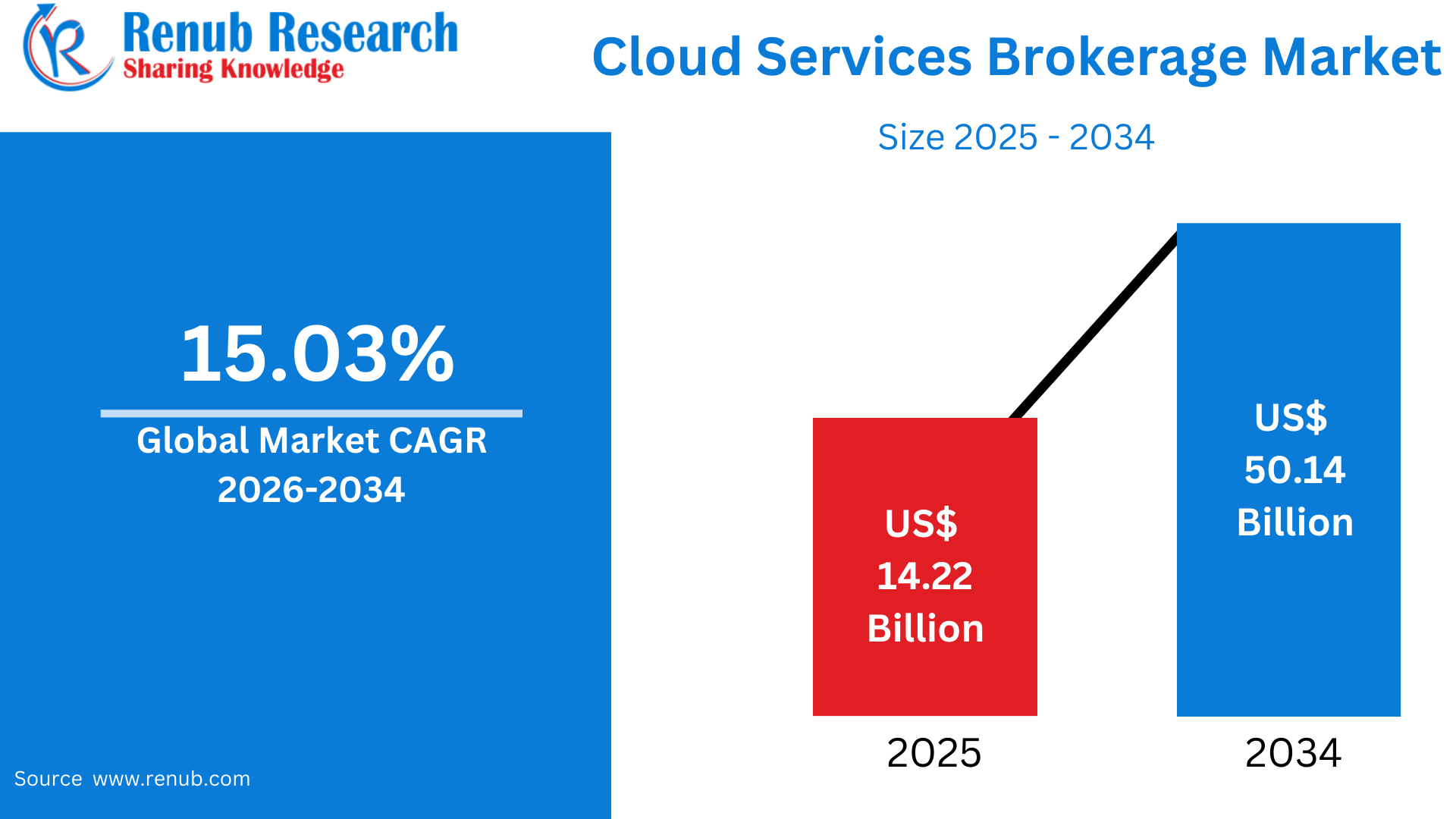
Cloud Services Brokerage Market is projected to grow from US$ 14.22 billion in 2025 to US$ 50.14 billion by 2034, expanding at a CAGR of 15.03% during the forecast period from 2026 to 2034. The market is experiencing robust growth as organizations increasingly adopt multi-cloud and hybrid cloud strategies to enhance operational flexibility, optimize costs, and simplify cloud service management. Cloud service brokers enable enterprises to integrate, manage, secure, and govern services across multiple cloud platforms through a single interface, improving efficiency and reducing complexity.
What is Cloud Services Brokerage and Its Uses & Popularity Worldwide?
Cloud Services Brokerage (CSB) is a business model and technology platform that helps organizations manage, integrate, optimize, and govern cloud services from multiple providers through a unified interface. Acting as an intermediary between cloud service providers and customers, cloud service brokers simplify the procurement, deployment, monitoring, security, and billing of cloud-based applications and infrastructure. CSB solutions offer services such as cloud aggregation, integration, customization, migration, performance monitoring, compliance management, identity and access management, and cost optimization. They enable businesses to efficiently manage hybrid and multi-cloud environments while ensuring interoperability between different cloud platforms.
Worldwide, Cloud Services Brokerage has gained significant popularity as enterprises accelerate digital transformation and increasingly adopt Software-as-a-Service (SaaS), Platform-as-a-Service (PaaS), and Infrastructure-as-a-Service (IaaS) solutions. The growing use of artificial intelligence (AI), big data analytics, Internet of Things (IoT), and edge computing has further increased demand for centralized cloud management. Organizations across healthcare, banking, retail, manufacturing, government, and telecommunications rely on CSB platforms to improve operational efficiency, strengthen cybersecurity, reduce vendor lock-in, optimize cloud spending, and ensure regulatory compliance, making cloud brokerage an essential component of modern enterprise IT strategies.
Top Cloud Providers in 2023
- Amazon Web Services (AWS)
- Headquarters: Washington, US
- Market Share: 32%
- Annual Revenue: ≈ US$80 billion
- Microsoft Azure
- Headquarters: Redmond, US
- Market Share: 22%
- Annual Revenue: ≈ US$34 billion
- Google Cloud Platform (GCP)
- Headquarters: California, US
- Market Share: 11%
- Annual Revenue: ≈ US$7.4 billion
- Alibaba Cloud
- Headquarters: Yu Hang District, China
- Market Share: 4%
- Annual Revenue: ≈ US$12 billion
- IBM Cloud
- Headquarters: New York, US
- Market Share: 3%
- Annual Revenue: ≈ US$22 billion
- Salesforce Cloud
- Headquarters: California, US
- Market Share: 3%
- Annual Revenue: ≈ US$33.07 billion
- Oracle Cloud
- Headquarters: Texas, US
- Market Share: 2%
- Annual Revenue: ≈ US$5.8 billion
- DigitalOcean
- Headquarters: New York, US
- Market Share: 1.55%
- Annual Revenue: ≈ US$650 million
- Rackspace
- Headquarters: Texas, US
- Market Share: 0.96%
- Annual Revenue: ≈ US$3.1 billion
- OVHcloud
- Headquarters: Roubaix, France
- Market Share: <1%
- Annual Revenue: ≈ US$220 million
Growth Drivers for the Cloud Services Brokerage Market
Growing Adoption of Multi-Cloud and Hybrid Cloud Environments
The increasing adoption of multi-cloud and hybrid cloud strategies is a major factor driving the growth of the Cloud Services Brokerage (CSB) Market. Organizations are increasingly deploying workloads across multiple public and private cloud platforms to improve flexibility, strengthen business continuity, and reduce dependence on a single cloud provider. However, managing multiple cloud environments creates challenges related to integration, governance, security, and cost control. Cloud service brokers address these issues by providing centralized platforms that simplify cloud orchestration, automate service management, and ensure seamless interoperability between different cloud providers. They also offer unified billing, policy management, performance monitoring, and compliance capabilities that improve operational efficiency and reduce administrative complexity. As enterprises continue their digital transformation journeys and expand hybrid cloud deployments, the need for intelligent brokerage solutions that optimize cloud resources and streamline management is expected to increase significantly, making multi-cloud adoption one of the strongest drivers of market growth.
Increasing Complexity of Enterprise IT Infrastructure
The growing complexity of enterprise IT ecosystems is significantly accelerating demand for Cloud Services Brokerage solutions. Modern organizations operate a combination of legacy infrastructure, on-premises applications, private clouds, and multiple public cloud platforms, creating highly fragmented technology environments. Managing these diverse systems efficiently while maintaining security, performance, and regulatory compliance has become increasingly challenging. Cloud service brokers simplify these environments by providing a unified management platform that integrates cloud services, automates workflows, and delivers real-time visibility into cloud operations. Advanced analytics, automation, and intelligent orchestration help organizations improve workload distribution, enhance operational efficiency, and reduce redundant IT processes. As enterprises continue adopting Software-as-a-Service (SaaS), Platform-as-a-Service (PaaS), and Infrastructure-as-a-Service (IaaS) solutions, the demand for centralized cloud management continues to rise. Cloud Services Brokerage platforms enable organizations to maximize the benefits of cloud computing while minimizing operational complexity, making them an essential component of modern enterprise IT management.
Rising Focus on Cloud Cost Optimization and Resource Efficiency
Growing emphasis on controlling cloud expenditure and maximizing resource utilization is another major driver of the Cloud Services Brokerage Market. As organizations expand their use of cloud-based applications and infrastructure, managing variable pricing models across multiple providers becomes increasingly complex. Without effective governance, businesses may experience unnecessary expenses resulting from idle resources, duplicate subscriptions, and inefficient workload allocation. Cloud service brokers provide advanced cost management tools, usage analytics, automated resource optimization, and financial governance capabilities that help organizations monitor cloud spending more effectively. These platforms identify underutilized resources, recommend cost-efficient service configurations, and automate workload scaling according to business demand. Additionally, brokers assist enterprises with contract management, subscription optimization, and vendor comparison to improve purchasing decisions and reduce operational costs. As organizations prioritize greater return on cloud investments while maintaining high performance and scalability, the demand for intelligent cloud brokerage solutions that enhance resource efficiency continues to strengthen worldwide.
Challenges in the Cloud Services Brokerage Market
Complex Integration Across Multi-Cloud and Legacy IT Systems
Integrating diverse cloud platforms with existing enterprise infrastructure remains one of the most significant challenges in the Cloud Services Brokerage Market. Many organizations operate hybrid environments consisting of legacy systems, private clouds, public cloud platforms, and multiple third-party applications, each using different architectures, interfaces, and security protocols. Ensuring seamless interoperability while maintaining consistent performance, data integrity, and security requires sophisticated integration capabilities and continuous system monitoring. Frequent software updates, evolving APIs, and changing cloud service offerings further increase implementation complexity. Additionally, businesses operating across multiple regions must address varying regulatory requirements and compliance standards during cloud integration. These technical challenges often increase deployment time, operational costs, and implementation risks, particularly for organizations with limited IT expertise. Cloud service brokers must continuously invest in advanced integration technologies, automation, and skilled technical resources to deliver reliable cloud management solutions while overcoming the growing complexity of enterprise cloud ecosystems.
Data Security, Privacy, and Regulatory Compliance Challenges
Protecting sensitive business data and ensuring regulatory compliance remain major challenges for the Cloud Services Brokerage Market. Since cloud service brokers manage enterprise workloads across multiple cloud environments, they must maintain robust security controls to prevent cyberattacks, unauthorized access, and data breaches. Organizations also face increasingly stringent data protection regulations across different countries and industries, requiring cloud brokers to support compliance with evolving legal frameworks and industry standards. Maintaining secure identity management, encryption, access control, continuous monitoring, and threat detection across multiple cloud providers is a complex and resource-intensive process. Additionally, concerns regarding third-party management of confidential business information may discourage some organizations from adopting brokerage services. The growing sophistication of cyber threats and ransomware attacks further increases the need for continuous security investments and specialized expertise. Successfully addressing data privacy, cybersecurity, and compliance requirements remains essential for cloud service brokers to build customer trust and sustain long-term market growth.
Cloud Services Brokerage Product Launches
- Cloudflare – Magic Cloud Networking (2024)
Cloudflare launched Magic Cloud Networking, enabling organizations to securely connect, manage, and orchestrate workloads across multiple public and private cloud environments through a unified networking platform. - LTIMindtree – Canvas CloudXperienz (2024)
LTIMindtree introduced Canvas CloudXperienz, an AI-powered SaaS hybrid cloud management platform that provides cloud orchestration, FinOps, automation, monitoring, and governance for enterprise cloud environments. - Rackspace Technology – Rackspace Managed Cloud (2023)
Rackspace launched Rackspace Managed Cloud (RMC), a comprehensive managed multi-cloud and hybrid cloud platform supporting AWS, Microsoft Azure, Google Cloud, private cloud, and on-premises infrastructure. - Cognizant – Skygrade™ Cloud Management Platform (2023)
Cognizant unveiled Skygrade, a multi-hybrid cloud and edge management platform designed to simplify cloud transformation, workload management, automation, and cloud-native modernization. - Blue Planet (Ciena) – Cloud Native Platform (2024)
Blue Planet launched its Cloud Native Platform, enabling service providers to automate orchestration, inventory management, and assurance across multi-cloud environments using Kubernetes-based architecture. - Jamcracker – White-Label Cloud Services Brokerage Platform (2024)
Jamcracker released a white-label Cloud Services Brokerage platform for telecommunications providers, enabling branded cloud marketplaces, automated provisioning, subscription management, and multi-cloud service delivery. - IBM – AI-Driven Multicloud Brokerage Enhancements (2024)
IBM expanded its multicloud management portfolio by introducing AI-powered cloud brokerage capabilities featuring predictive workload scaling, automated SLA optimization, and intelligent cloud resource management. - Flexera – Advanced FinOps Dashboard for Multi-Cloud Management (2023)
Flexera enhanced its cloud management platform with advanced FinOps dashboards, delivering enterprise-wide cloud cost governance, budget controls, anomaly detection, and multi-cloud spending optimization. - ActivePort – Network Ecosystem Orchestration (NEO) Platform (2024)
ActivePort launched its NEO Platform, providing enterprises with self-service orchestration for secure edge-to-cloud connectivity, network automation, and multi-cloud service management. - Coforge – EvolveOps.AI (2025)
Coforge introduced EvolveOps.AI, an Agentic AI-powered IT operations platform that automates hybrid cloud operations, infrastructure management, monitoring, and enterprise cloud optimization.
Centralized Cloud Governance Enhancing Enterprise Efficiency
Internal Cloud Services Brokerage Market is gaining momentum as large organizations establish in-house cloud brokerage capabilities to manage and optimize enterprise cloud services. Instead of relying entirely on third-party brokers, enterprises create internal brokerage platforms that centralize cloud provisioning, governance, security, compliance, and cost management across business units. Internal cloud service brokers provide employees with standardized access to approved cloud resources while enforcing corporate policies and regulatory requirements. These platforms simplify workload deployment, automate service requests, and improve visibility into cloud consumption across departments. Organizations also benefit from enhanced financial governance through centralized billing, resource allocation, and performance monitoring. Integration with existing enterprise systems enables seamless management of public, private, and on-premises infrastructure from a single interface. As enterprises continue expanding digital transformation initiatives and adopting hybrid cloud architectures, internal cloud brokerage solutions are becoming increasingly valuable for improving operational efficiency, reducing IT complexity, strengthening security, and maximizing the return on cloud investments.
Hybrid Cloud Services Brokerage Enabling Seamless Multi-Environment Cloud Management
Hybrid Cloud Services Brokerage Market is experiencing significant growth as organizations increasingly deploy applications across both public and private cloud environments. Hybrid cloud brokerage solutions help enterprises integrate diverse cloud platforms into a unified ecosystem while maintaining flexibility, security, and operational control. These platforms automate workload placement, optimize resource utilization, and enable seamless data movement between cloud environments based on business requirements. Organizations benefit from centralized governance, unified monitoring, automated compliance management, and intelligent policy enforcement across multiple cloud infrastructures. Hybrid cloud brokers also improve disaster recovery capabilities, business continuity, and workload scalability by enabling dynamic resource allocation between private and public cloud environments. Artificial intelligence, automation, and advanced analytics further enhance cloud orchestration and performance optimization. As businesses seek to balance cost efficiency, regulatory compliance, and operational agility, hybrid cloud brokerage solutions are becoming essential components of modern enterprise cloud strategies, supporting secure and efficient management of increasingly complex cloud ecosystems.
Large Enterprise Cloud Services Brokerage Managing Complex Cloud Operations at Scale
Large Enterprise Cloud Services Brokerage Market continues to expand as multinational organizations increasingly require sophisticated solutions to manage complex cloud infrastructures. Large enterprises typically operate multiple public cloud platforms, private clouds, SaaS applications, and legacy systems across geographically distributed operations. Cloud service brokerage platforms provide centralized visibility, governance, security, and automation that simplify the management of these highly complex environments. Advanced capabilities such as workload optimization, automated provisioning, identity and access management, compliance monitoring, cost analytics, and performance reporting enable enterprises to improve operational efficiency while reducing administrative burdens. Large organizations also leverage cloud brokers to negotiate vendor relationships, optimize cloud spending, and ensure consistent service quality across departments. The growing adoption of artificial intelligence, machine learning, and predictive analytics further enhances cloud resource optimization and decision-making. As digital transformation accelerates worldwide, large enterprises continue investing heavily in cloud brokerage platforms to strengthen scalability, security, business continuity, and long-term operational resilience.
Secure Cloud Management Supporting Digital Healthcare Industry
Healthcare Cloud Services Brokerage Market is growing rapidly as hospitals, healthcare providers, insurance companies, and life sciences organizations increasingly adopt cloud technologies to improve patient care and operational efficiency. Healthcare cloud brokerage solutions simplify the management of electronic health records, medical imaging systems, telemedicine platforms, healthcare analytics, and clinical applications across multiple cloud environments. These platforms provide centralized governance, secure data integration, identity management, and compliance monitoring to help healthcare organizations protect sensitive patient information while meeting stringent regulatory requirements. Cloud brokers also facilitate secure collaboration among healthcare professionals, improve disaster recovery capabilities, and optimize cloud resource utilization to reduce operational costs. The increasing adoption of artificial intelligence, Internet of Medical Things (IoMT), remote patient monitoring, and digital health platforms is generating greater demand for scalable cloud brokerage services. As healthcare organizations continue modernizing their IT infrastructure, cloud service brokerage solutions play a critical role in delivering secure, efficient, and compliant cloud management across the healthcare ecosystem.
Advanced Cloud Adoption Driving United States Market Leadership
United States Cloud Services Brokerage Market is the largest globally, supported by widespread cloud adoption, advanced digital infrastructure, and the strong presence of leading cloud service providers and technology companies. Enterprises across banking, healthcare, retail, manufacturing, government, and telecommunications are increasingly implementing multi-cloud and hybrid cloud strategies to improve operational flexibility and business resilience. Cloud service brokerage platforms help organizations integrate multiple cloud environments, optimize workloads, enhance cybersecurity, and control cloud spending through centralized management. The rapid adoption of artificial intelligence, machine learning, big data analytics, and Internet of Things (IoT) technologies is generating greater demand for scalable cloud brokerage solutions. Organizations are also investing heavily in cloud governance, automation, compliance management, and intelligent cloud orchestration to support digital transformation initiatives. Increasing demand for secure, vendor-neutral cloud management platforms and continuous investments in enterprise cloud modernization are expected to drive sustained growth in the United States Cloud Services Brokerage Market throughout the forecast period.
Hybrid Cloud Expansion Supporting United Kingdom Digital Transformation
United Kingdom Cloud Services Brokerage Market is experiencing steady growth as organizations accelerate digital transformation and modernize enterprise IT infrastructure. Businesses across financial services, healthcare, government, education, and retail are increasingly adopting hybrid and multi-cloud environments to improve operational efficiency, strengthen cybersecurity, and ensure business continuity. Cloud service brokers simplify cloud deployment, integration, workload management, and compliance by providing centralized platforms for managing multiple cloud providers. The increasing adoption of Software-as-a-Service (SaaS), Platform-as-a-Service (PaaS), and Infrastructure-as-a-Service (IaaS) solutions continues to expand the demand for brokerage services. Organizations are also leveraging automation, artificial intelligence, and advanced analytics to optimize cloud performance and reduce operational complexity. Growing emphasis on regulatory compliance, data privacy, and cloud cost optimization encourages enterprises to implement intelligent cloud governance solutions. Continued investments in digital infrastructure and enterprise cloud migration are expected to support long-term growth in the United Kingdom Cloud Services Brokerage Market.
India Digital Transformation and Cloud Adoption Fueling Rapid Growth
India Cloud Services Brokerage Market is expanding rapidly due to increasing cloud adoption, rapid digitalization, and the growing use of enterprise technology solutions across industries. Businesses are increasingly migrating applications and workloads to cloud platforms to improve scalability, operational efficiency, and business agility. The expansion of digital banking, e-commerce, healthcare, manufacturing, and information technology services has significantly increased demand for cloud brokerage solutions that simplify multi-cloud management and optimize cloud resources. Small and medium-sized enterprises are also embracing cloud technologies to reduce infrastructure costs and improve business flexibility. Cloud service brokers provide centralized governance, automation, workload optimization, security management, and compliance capabilities that support efficient cloud operations. The increasing deployment of artificial intelligence, data analytics, Internet of Things (IoT), and software-as-a-service applications further accelerates market growth. As enterprises continue investing in digital transformation and cloud modernization, India is expected to remain one of the fastest-growing Cloud Services Brokerage markets globally.
Saudi Arabia Vision-Led Digital Modernization Accelerating Cloud Adoption
Saudi Arabia Cloud Services Brokerage Market is witnessing strong growth as organizations increasingly adopt cloud computing to support economic diversification and digital transformation initiatives. Enterprises across government, banking, healthcare, energy, telecommunications, and retail sectors are implementing hybrid and multi-cloud strategies to improve operational efficiency, strengthen cybersecurity, and enhance business continuity. Cloud service brokerage platforms enable organizations to integrate multiple cloud environments, automate service delivery, optimize resource utilization, and maintain regulatory compliance through centralized cloud management. Growing investments in smart city projects, digital government services, artificial intelligence, and enterprise automation are creating additional opportunities for cloud brokerage providers. Organizations are also prioritizing cloud governance, identity management, workload optimization, and data protection to ensure secure cloud operations. The expansion of hyperscale cloud infrastructure, increasing enterprise cloud migration, and rising demand for intelligent cloud management solutions are expected to support sustained growth in the Saudi Arabia Cloud Services Brokerage Market over the forecast period.
Recent Developments in Cloud Services Brokerage Market
- In February 2025, Google Cloud and Salesforce inked a USD 2.5 billion infrastructure agreement, strengthening their strategic partnership.
- In order to boost partner cloud sales, Arrow Electronics introduced the Cloud Amplification Program throughout EMEA in February 2025.
- Wipro announced its agreement with MAHLE, a significant global automotive supplier, in July 2024. Wipro has been chosen by MAHLE to implement a hybrid cloud solution in order to modernize its IT infrastructure. In order to help MAHLE's IT structure enable business agility, digitize their IT ecosystem, and comply with regulations, Wipro would migrate MAHLE's core data centers into the hybrid solutions of Wipro FullStride Cloud.
- Cognizant announced its strategic alliance with Shopify and Google Cloud in April 2024 to support international retailers and brands in their digital transformation. In order to provide clients with shopping assistance, personalized offers, and real-time recommendations, the alliance intends to combine the experience of these companies—Shopify's commerce platform, Cognizant's client delivery, and Google Cloud's core cloud architecture.
Market Segmentation
Platform
- Internal Cloud Services Brokerage
- External Cloud Services Brokerage
Deployment Model
- Public
- Private
- Hybrid
Enterprise
- Small and Medium Enterprise (SME)
- Large Enterprise
End User- Industry is divided into 7 viewpoints:
- IT and Telecom
- BFSI
- Retail
- Healthcare
- Government
- Manufacturing
- Other End-user Industries
Countries
North America
- United States
- Canada
Europe
- France
- Germany
- Italy
- Spain
- United Kingdom
- Belgium
- Netherlands
- Turkey
Asia Pacific
- China
- Japan
- India
- Australia
- South Korea
- Thailand
- Malaysia
- Indonesia
- New Zealand
Latin America
- Brazil
- Mexico
- Argentina
Middle East & Africa
- South Africa
- Saudi Arabia
- United Arab Emirates
All companies have been covered with 5 Viewpoints
- Overview
- Key Persons
- Recent Development
- SWOT Analysis
- Financial Insights
Company Analysis
- Accenture PLC
- Capgemini SE
- NEC Corporation
- DXC Technology Company
- Rightscale Inc.
- Wipro Limited
- IBM Corporation
- NTT Data Inc.
- Cognizant Technology Solutions Corp.
Report Details:
| Report Features | Details |
| Base Year |
2025 |
| Historical Period |
2022 - 2025 |
| Forecast Period |
2026 - 2034 |
| Market |
US$ Billion |
| Segment Covered |
Platform, Deployment Model, Enterprise, End User and Countries |
| Countries Covered |
|
| Companies Covered |
|
| Customization Scope |
20% Free Customization |
| Post-Sale Analyst Support |
1 Year (52 Weeks) |
| Delivery Format |
PDF and Excel through Email (We can also provide the editable version of the report in PPT/Word format on request) |
Key Questions Answered in Report:
- How big is the Cloud Services Brokerage industry?
- What is the Cloud Services Brokerage growth rate?
- Who are the key players in Cloud Services Brokerage industry?
- What are the factors driving the Cloud Services Brokerage industry?
- Which Region held the largest market share in the Cloud Services Brokerage industry?
- What segments are covered in the Cloud Services Brokerage Market report?
Customization Services available
- Analysis of Market Size and Its Segments
- More Company Profiles (Upto 10 without any additional cost):
- Additional Countries (Other than mentioned Countries):
- Region/Country Specific Reports:
- Market Entry Strategy:
- Region-Specific Market Dynamics:
- Regional Market Share Analysis:
- Trade Analysis:
- Production Insights:
- Others Customized Requests:
For more information contact our analysts.
Need More Assistance?
- Talk to our analysts to get more precious information on the current market trends.
- Include more countries and segments and customize the report based on the final requirement.
- Get a competitive advantage in your industry by knowing the report findings and making a positive impact on your revenues and operations.
- Our analysts are always ready to provide more help and pertinent information if you need any additional assistance.