China Toys Market Size, Share, Growth, Trends, Industry Analysis & Forecast 2026–2034
Buy NowChina Toys Market Size, Share, and Strategic Forecast
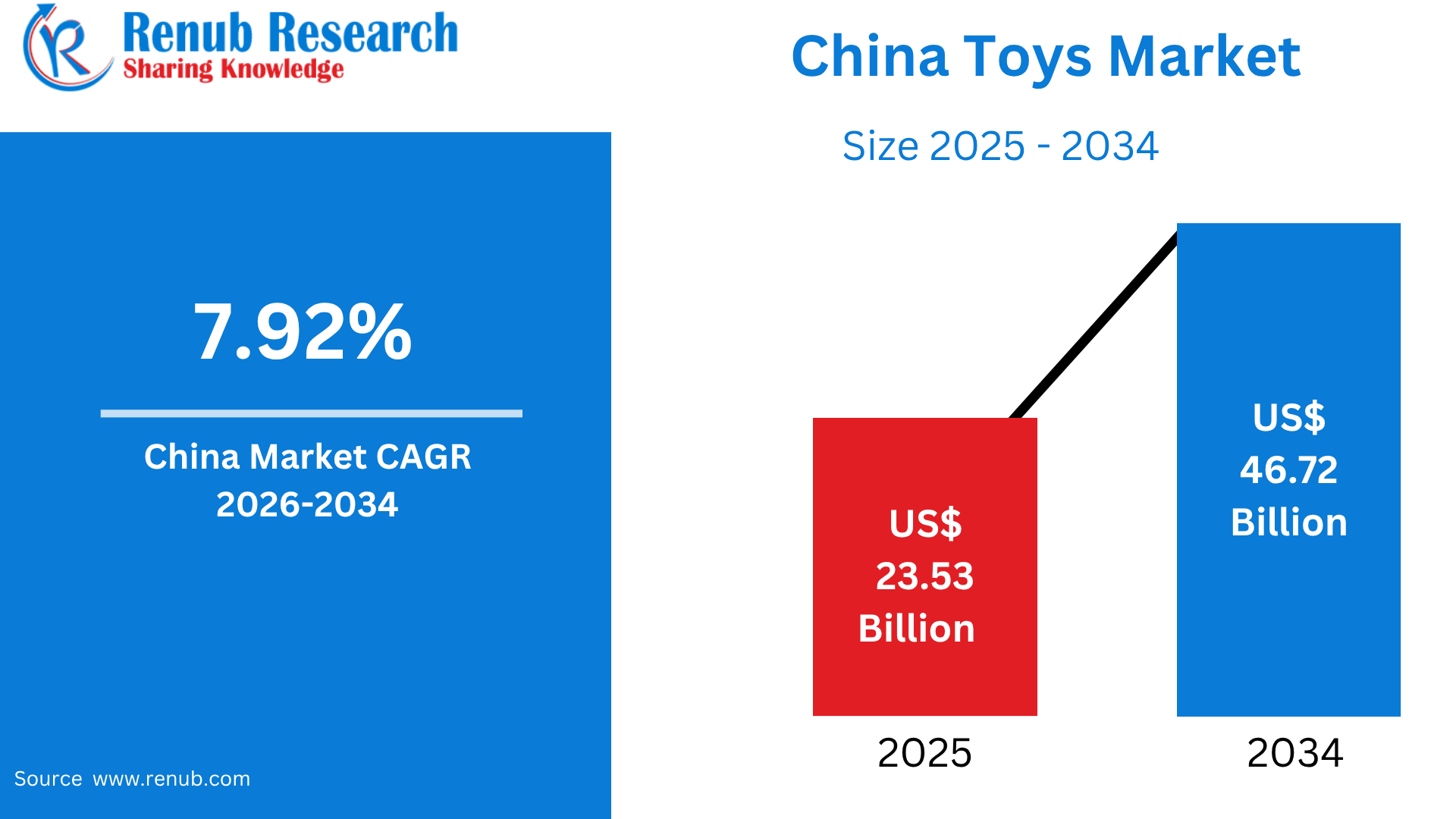
China Toys Market is projected to grow from US$ 23.53 billion in 2025 to US$ 46.72 billion by 2034, registering a compound annual growth rate (CAGR) of 7.92% during 2026–2034. Market growth is being driven by rising disposable incomes, rapid urbanization, and increasing consumer demand for educational, developmental, and interactive toys. The expanding middle-class population and greater emphasis on early childhood learning are encouraging higher spending on premium and innovative toy products.
China Toys Market Overviews
Toys, as a product category, include items used for play, learning, and entertainment, especially for children, although some toys can be appreciated by collectors and enthusiasts. The product category of toys comprises a variety of products, including action toys, dolls, puzzles, board games, building toys, educational toys, and smart toys. Toys contribute significantly to the development of children, including creativity, problem-solving, and cognitive abilities.
In China, toys have become extremely popular over the years owing to factors such as increasing disposable incomes and awareness among parents about the development of their children. The Chinese market is increasingly adopting toys that help their children learn and play at the same time. The influence of global brands and characters has also helped increase the popularity of toys. Moreover, the availability of products is also high in the Chinese market. The availability of products through e-commerce websites has helped parents explore different types of toys. Hence, the toys market is growing in China.
What are Toys and Their Uses & Popularity in China
Toys are products designed primarily for children’s play, learning, creativity, and cognitive development. They encompass a wide variety of categories, including educational toys, building blocks, dolls, action figures, puzzles, board games, plush toys, electronic toys, outdoor play equipment, and smart interactive toys. Beyond entertainment, toys play an essential role in supporting children’s physical, emotional, social, and intellectual development. Educational toys help improve problem-solving abilities, logical thinking, creativity, language skills, and hand-eye coordination, while interactive and STEM-based toys encourage science, technology, engineering, and mathematics learning from an early age. Technological advancements have also driven the popularity of AI-enabled, robotic, and app-connected toys that provide immersive and personalized play experiences.
In China, toys have gained significant popularity due to rising disposable incomes, rapid urbanization, and increasing parental investment in children’s education and development. China is not only the world’s largest toy manufacturing hub—accounting for more than 70% of global toy production—but also one of the fastest-growing consumer markets for toys. Demand is increasing for educational, licensed, collectible, and smart toys as parents prioritize early learning and skill development. The rapid expansion of e-commerce platforms, growing middle-class households, and higher spending during festivals and holidays continue to stimulate toy sales. In addition, domestic brands are introducing innovative products featuring artificial intelligence, augmented reality, and interactive learning functions, further strengthening the popularity of toys across China.
Top Export Destinations for China’s Toy Industry -May 2026
- The United States is the largest export destination, accounting for the highest share of China’s toy exports, with export value exceeding US$1.8 billion.
- The European Union (EU) ranks as the second-largest market, importing approximately US$1.1 billion worth of toys from China.
- Japan is the third-largest export destination, with imports valued at roughly US$400–450 million.
- The Netherlands is a major European distribution hub, receiving approximately US$250–300 million in toy exports from China.
- The United Kingdom imports around US$220–250 million worth of Chinese toys, reflecting strong consumer demand.
- Germany remains an important European market, with toy imports valued at approximately US$180–220 million.
- Singapore serves as a key Southeast Asian trading hub, importing roughly US$140–170 million in Chinese toy products.
- Hong Kong continues to play an important role in regional trade and re-export activities, with imports of approximately US$120–150 million.
- Brazil is one of China’s leading toy export markets in Latin America, importing approximately US$110–140 million worth of toys.
- Canada completes the top ten export destinations, with toy imports valued at around US$100–130 million, highlighting strong demand across North America.
China Toys Production vs. Rest of the World – Key Highlights
- China remains the world’s largest toy producer, consistently accounting for the majority of global toy manufacturing throughout the period.
- Global toy production increased from approximately 75 units in 2010 to around 115 units in 2025, reflecting steady worldwide industry growth.
- China’s toy production rose significantly from about 45 units in 2010 to approximately 85 units in 2025, demonstrating continuous expansion in manufacturing capacity.
- Production in the Rest of the World remained relatively stable, increasing only modestly from around 30 units in 2010 to roughly 30–31 units in 2025.
- China’s global production share increased from approximately 60% in 2010 to nearly 74% by 2025.
- Between 2010 and 2015, China’s share grew rapidly from about 60% to nearly 72%, driven by strong manufacturing investments.
- From 2015 to 2025, China’s production share remained consistently above 70%, reinforcing its dominant position in the global toy industry.
- The widening production gap indicates that China expanded manufacturing capacity faster than the rest of the world over the analyzed period.
- China’s extensive manufacturing ecosystem, efficient supply chains, skilled workforce, and export infrastructure continue to support its leadership in global toy production.
- The chart highlights China’s critical role in supplying toys to international markets while supporting growing domestic demand through large-scale manufacturing capabilities.
Growth Driver
Rising Disposable Income and Expanding Middle-Class Population
China’s growing middle-class population and rising household incomes are major drivers of the toys market. According to national economic estimates, China’s per capita disposable income exceeded RMB 41,000 in recent years, while urban households continue to increase spending on children’s education, entertainment, and developmental products. Families are increasingly purchasing premium toys, educational kits, STEM products, licensed merchandise, and interactive learning games that support early childhood development. The country’s urbanization rate has surpassed 66%, creating greater access to modern retail stores, shopping malls, and online marketplaces offering diverse toy selections. Parents are also placing greater emphasis on quality, safety, and educational value rather than simply purchasing low-cost products. Rising dual-income households have further strengthened purchasing power, enabling higher expenditure on children’s products. Seasonal shopping festivals, birthdays, and family celebrations continue to boost toy sales throughout the year. These favorable demographic and economic trends are expected to remain key contributors to sustained growth in China’s toys market.
Rapid Growth of Educational, Smart, and Technology-Enabled Toys
China is witnessing significant growth in demand for educational and technology-driven toys as parents increasingly prioritize early learning and cognitive development. STEM (Science, Technology, Engineering, and Mathematics) toys, coding kits, robotics, artificial intelligence-enabled learning devices, and interactive educational games have become highly popular among urban families. China has over 250 million children under the age of 15, creating one of the world’s largest consumer bases for educational toys. Smart toys featuring voice recognition, augmented reality (AR), Bluetooth connectivity, and app integration are increasingly adopted to combine entertainment with learning. Educational reforms emphasizing creativity, logical thinking, and digital literacy have further accelerated demand for innovative toy products. Domestic manufacturers continue investing in AI-powered educational toys and bilingual learning devices to meet evolving consumer preferences. Growing awareness of early childhood education, combined with technological innovation and expanding digital ecosystems, is expected to significantly strengthen the long-term growth of China’s smart and educational toys market.
Strong Manufacturing Ecosystem and Expanding E-commerce Channels
China remains the world’s largest toy manufacturing hub, producing over 70% of global toy exports, making its manufacturing capabilities a major growth driver for the domestic market. Highly developed supply chains, advanced production facilities, skilled labor, and efficient logistics enable manufacturers to introduce innovative products at competitive prices. Simultaneously, China’s booming e-commerce sector has transformed toy retailing. The country’s online retail sales exceed RMB 15 trillion annually, with major digital platforms providing nationwide access to domestic and international toy brands. Livestream commerce, social media marketing, and influencer promotions have become powerful sales channels, particularly for collectible toys, licensed characters, and educational products. Fast delivery services and integrated digital payment systems further enhance consumer convenience. Continuous investments in automation, product innovation, digital marketing, and cross-border e-commerce are enabling manufacturers to reach broader customer segments while strengthening China’s position as both a leading toy producer and one of the fastest-growing toy consumption markets globally.
Challenges
Declining Birth Rate and Aging Population
One of the most significant challenges facing China’s toys market is the country’s declining birth rate and changing demographic structure. China’s annual births have fallen considerably over recent years, while the national fertility rate has declined to approximately 1.0–1.2 births per woman, well below the population replacement level of 2.1. A shrinking child population directly affects long-term demand for traditional toys, particularly products targeting infants and preschool-aged children. Although government initiatives encouraging larger families aim to stabilize birth rates, demographic changes continue to create uncertainty for toy manufacturers. Companies are increasingly responding by expanding into educational toys, collectible products, family games, and adult hobby markets to diversify revenue sources. In addition, manufacturers are focusing on premium products with higher value rather than relying solely on increasing sales volumes. Successfully adapting to changing population trends will remain critical for sustaining long-term growth within China’s toy industry.
Intense Market Competition and Rising Manufacturing Costs
China’s toy market faces intense competition from both domestic manufacturers and international brands, creating significant pricing pressure across multiple product categories. Thousands of toy companies compete in educational toys, dolls, action figures, electronic toys, building sets, and licensed merchandise, making product differentiation increasingly challenging. At the same time, manufacturers are experiencing rising labor costs, raw material prices, transportation expenses, and stricter product safety and environmental compliance requirements. Plastic resins, electronic components, packaging materials, and logistics costs have all experienced considerable price volatility in recent years, affecting production margins. Consumers are also demanding higher-quality, safer, and environmentally sustainable toys, requiring continuous investment in research, product development, and certification. Smaller manufacturers often struggle to absorb these additional costs while maintaining competitive pricing. To remain competitive, companies are investing in automation, smart manufacturing technologies, premium product innovation, and sustainable materials, helping improve operational efficiency despite increasing cost pressures.
Toy Product Launches in China
- Mattel (2025) – Expanded its Barbie Dream Besties collection in China, introducing fashion dolls with interactive accessories and digital storytelling features targeted at children aged 5–10 years.
- LEGO Group (2025) – Launched new LEGO Chinese Traditional Festival Building Sets, celebrating Chinese cultural heritage with themed construction toys designed specifically for the Chinese market.
- Hasbro (2025) – Introduced the latest Transformers Studio Series Action Figures in China, featuring movie-inspired collectibles with enhanced articulation and premium accessories.
- Pop Mart (2025) – Released the LABUBU “The Monsters” Blind Box Series, featuring limited-edition collectible designer toys that quickly gained popularity among young consumers and collectors.
- Bandai Namco (2024) – Launched new Gundam Model Kits (Gunpla) in China, expanding its lineup with beginner-friendly and premium collector editions for hobby enthusiasts.
- Alpha Group (2024) – Introduced upgraded Super Wings Interactive Educational Toys, featuring voice interaction, sound effects, and STEM learning functions for preschool children.
- Bloks Group (2024) – Released new AULDEY Super Wings Building Block Sets, combining construction play with licensed animation characters to encourage creativity and problem-solving.
- Good Smile Company (2025) – Expanded its Nendoroid Anime Figure Collection in China, launching several licensed character figures from popular Japanese anime franchises through official Chinese distribution channels.
- 52TOYS (2025) – Introduced the BEASTBOX Transformable Collectible Series, featuring innovative transforming animal figures designed for collectors and older children in the Chinese market.
- TOP TOY (2025) – Launched a new range of Disney and Sanrio Licensed Collectible Toys, including blind boxes, plush toys, action figures, and limited-edition character merchandise through its retail stores across China.
Educational and Family Entertainment Driving Growth in China
China board toys market is experiencing steady growth as families increasingly seek educational and interactive play experiences for children. Board toys, including board games, puzzles, strategy games, educational kits, and memory games, are gaining popularity due to their ability to promote critical thinking, communication, teamwork, and problem-solving skills. China has more than 250 million children under the age of 15, providing a substantial consumer base for educational toys. Rising parental awareness regarding cognitive development and reduced screen time is encouraging higher spending on board games designed for both entertainment and learning. Schools and educational institutions are also incorporating educational board games into classroom activities to improve collaborative learning. Domestic manufacturers continue launching localized games featuring Chinese culture, language learning, and STEM education. Growing e-commerce sales, expanding specialty toy retailers, and increasing demand for family-oriented entertainment continue to support market expansion. Continuous innovation in educational game design is expected to sustain long-term growth in China’s board toys market.
China Action Figures Toys Licensed Characters and Collectibles Fueling Demand
China action figures toys market is expanding rapidly due to increasing popularity of licensed entertainment franchises, anime, gaming characters, and collectible merchandise. Demand is driven by both children and adult collectors, creating a broader consumer base than traditional toy categories. Popular action figures based on superheroes, animated films, video games, and domestic entertainment properties continue generating strong retail sales. China’s toy manufacturing industry, which produces over 70% of global toy exports, enables local manufacturers to introduce innovative and competitively priced collectible products. The growing influence of online gaming, streaming platforms, and social media has further increased consumer interest in licensed merchandise. Premium limited-edition figures, articulated collectibles, and designer toys have become particularly popular among urban consumers. Expansion of online retail platforms, livestream shopping, and toy conventions has strengthened product accessibility throughout the country. Continuous collaborations between toy manufacturers and entertainment companies are expected to further accelerate growth in China’s action figures toys market.
China Premium Toys Retail Experience Supporting Sales Growth
China’s toys specialty store market continues to expand as consumers increasingly prefer dedicated retail outlets offering premium products, expert guidance, and immersive shopping experiences. Specialty toy stores provide extensive selections of educational toys, STEM products, dolls, board games, action figures, collectibles, puzzles, and outdoor toys under one location. Rising urbanization, which has exceeded 66% of the population, has supported rapid expansion of modern shopping malls and specialty retail chains across major Chinese cities. Parents increasingly value in-store product demonstrations, personalized recommendations, and opportunities for children to interact with products before purchase. International toy brands and domestic manufacturers are strengthening their presence through branded retail stores and franchise networks. Many specialty retailers have adopted omnichannel strategies by integrating physical stores with e-commerce platforms, mobile applications, and livestream selling. Growing consumer preference for premium shopping experiences and high-quality educational toys is expected to continue supporting the long-term development of China’s toys specialty store market.
Girl Educational and Creative Play Products Driving Expansion in China
China girls toys market is growing steadily due to increasing demand for educational, creative, and character-based toys designed for girls across different age groups. Popular product categories include dolls, dollhouses, arts and crafts kits, plush toys, role-play sets, fashion toys, educational games, and interactive electronic toys. Rising household incomes and growing parental investment in child development are encouraging purchases of premium toy products that combine entertainment with creativity and learning. Educational toys emphasizing science, language development, music, and artistic skills are becoming increasingly popular among Chinese families. Licensed characters from animated movies, television programs, and digital media continue driving demand for branded products. E-commerce platforms and social media marketing have significantly improved product accessibility and consumer awareness nationwide. Manufacturers are also introducing smart toys with artificial intelligence, voice interaction, and app connectivity to enhance user engagement. Continuous innovation and expanding product variety are expected to sustain healthy growth in China’s girls toys market.
China Boys STEM, Construction, and Outdoor Toys Supporting Market Growth
The China boys toys market continues to expand as demand increases for construction toys, vehicles, robotics, action figures, outdoor play equipment, and STEM learning products. Educational building blocks, engineering kits, remote-controlled vehicles, coding toys, and robotic learning systems are increasingly purchased by parents seeking to develop children’s analytical thinking and technical skills. China remains one of the world’s largest toy consumer markets, supported by rising disposable incomes and increasing expenditure on children’s education and recreational products. Technology-enabled toys featuring artificial intelligence, augmented reality, and programmable functions have gained strong popularity among school-age children. Licensed products based on popular gaming franchises, animated series, and superhero characters continue contributing to higher sales across retail and online channels. Domestic manufacturers are introducing innovative products tailored to local educational requirements while maintaining competitive pricing. Expanding digital retail platforms, improved logistics infrastructure, and growing consumer interest in interactive educational toys are expected to support sustained growth of China’s boys' toys market.
Toys Export-Oriented Manufacturing and Rising Domestic Demand in Fujian
Fujian toys market plays an important role in China’s toy industry due to its strong manufacturing base, strategic coastal location, and well-developed export infrastructure. Fujian is home to numerous toy manufacturers producing educational toys, dolls, plush toys, electronic toys, building blocks, and licensed merchandise for both domestic and international markets. China manufactures more than 70% of the world’s toys, and Fujian contributes significantly through its efficient supply chains and proximity to major ports such as Xiamen. The province has experienced steady urbanization and rising household incomes, encouraging greater spending on premium and educational toys. Growing demand for STEM toys, smart learning products, and interactive games is supporting product innovation among local manufacturers. E-commerce platforms have expanded market access, enabling Fujian-based companies to reach consumers throughout China. Government support for advanced manufacturing, digital transformation, and export-oriented industries continues strengthening production capabilities, positioning Fujian as a key regional market within China’s expanding toy industry.
Advanced Toys Manufacturing Supporting Jiangsu Market Expansion
Jiangsu toy market is benefiting from the province’s advanced manufacturing ecosystem, high household incomes, and strong consumer demand for educational and premium toys. As one of China’s largest industrial provinces, Jiangsu possesses highly developed production facilities and efficient logistics networks that support the manufacturing of electronic toys, educational products, action figures, construction toys, and interactive learning devices. Jiangsu’s GDP exceeds RMB 13 trillion, reflecting strong purchasing power and a large middle-class consumer base. Parents increasingly invest in STEM toys, coding kits, robotics, and educational games to support children’s cognitive and technological development. The province also benefits from well-developed retail infrastructure, including shopping malls, specialty toy stores, and rapidly expanding e-commerce platforms. Manufacturers continue investing in automation, artificial intelligence, and product safety to remain competitive in both domestic and export markets. Continuous innovation, rising disposable incomes, and growing demand for premium educational toys are expected to sustain long-term growth in the Jiangsu toys market.
Shanghai Premium Consumer Spending Driving Toy Innovation
Shanghai represents one of China’s most developed and premium toy markets due to its high-income population, advanced retail infrastructure, and strong consumer preference for innovative products. With a population exceeding 24 million and one of the country’s highest per capita disposable incomes, Shanghai generates substantial demand for premium educational toys, collectibles, board games, electronic toys, and licensed merchandise. International toy brands maintain a strong retail presence through flagship stores, shopping malls, and specialty toy retailers across the city. Parents increasingly prioritize high-quality toys that promote creativity, STEM education, language learning, and early childhood development. E-commerce, omnichannel retailing, and livestream shopping further strengthen consumer access to domestic and imported toy products. Shanghai also serves as an important center for product launches, international toy exhibitions, and brand marketing activities. Continuous growth in household expenditure, technological innovation, and demand for smart interactive toys are expected to support sustained expansion of Shanghai’s toys market.
Beijing Educational Toys Focus and Strong Retail Network Supporting Growth
Beijing toys market continues to expand as families place greater emphasis on education, skill development, and high-quality recreational products for children. Beijing has a population of more than 21 million and one of China’s highest levels of educational attainment and household spending, creating favorable conditions for premium toy consumption. Educational toys, STEM learning kits, robotics, puzzles, board games, science experiments, and coding toys are particularly popular among parents seeking to enhance children’s academic and cognitive development. The city benefits from an extensive retail network that includes specialty toy stores, department stores, international retailers, and rapidly growing online marketplaces. Government support for digital education and technological innovation has also encouraged manufacturers to introduce AI-enabled and interactive learning toys. Licensed products based on popular films, animation, and gaming franchises continue generating strong demand among children and collectors. Rising disposable incomes, expanding premium retail channels, and increasing investment in educational products are expected to sustain long-term growth in Beijing’s toys market.
Market Segments
Toys Segmentation
-
Action Figures
- Board Games
- Card Games
- Construction Sets & Models
- Dolls & Stuffed Toys
- Plastic & Other Toys
- Puzzles
- Toys for Toddlers & Kids
Sales Channel
- E-commerce
- Specialty
- Discounters
- Department Stores
- Others
End-Users
- Unisex
- Boys
- Girls
City
- Beijing
- Shanghai
- Jiangsu
- Fujian
- Zhejiang
- Tianjin
- Guangdong
- Inner Mongolia
- Hubei
- Chongqing
- Rest of China
All the Key players have been covered from Viewpoints:
- Overviews
- Key Person
- Recent Developments
- SWOT Analysis
- Revenue Analysis
Company Analysis:
- Mattel Inc.
- Hasbro Inc.
- LEGO
- Spin Master Corp.
- Vtech
- Manhattan Associates
- Funko
- JAKKS Pacific
Report Details:
| Report Features | Details |
| Base Year |
2025 |
| Historical Period |
2022 - 2025 |
| Forecast Period |
2026 - 2034 |
| Market |
US$ Billion |
| Segment Covered |
Toys Segmentation, Sales Channel, End-User and City |
| City Covered |
|
| Companies Covered |
|
| Customization Scope |
20% Free Customization |
| Post-Sale Analyst Support |
1 Year (52 Weeks) |
| Delivery Format |
PDF and Excel through Email (We can also provide the editable version of the report in PPT/Word format on request) |
Customization Services available
- Analysis of Market Size and Its Segments
- More Company Profiles (Upto 10 without any additional cost):
- Additional Countries (Other than mentioned Countries):
- Region/Country Specific Reports:
- Market Entry Strategy:
- Region-Specific Market Dynamics:
- Regional Market Share Analysis:
- Trade Analysis:
- Production Insights:
- Others Customized Requests:
For more information contact our analysts.
Need More Assistance?
- Talk to our analysts to get more precious information on the current market trends.
- Include more countries and segments and customize the report based on the final requirement.
- Get a competitive advantage in your industry by knowing the report findings and making a positive impact on your revenues and operations.
- Our analysts are always ready to provide more help and pertinent information if you need any additional assistance.