Ceiling Fans Market Report by Type, Technology, Size, Application, Distribution Channel, Country and Company Analysis 2026-2034
Buy NowCeiling Fans Market Size and Forecast
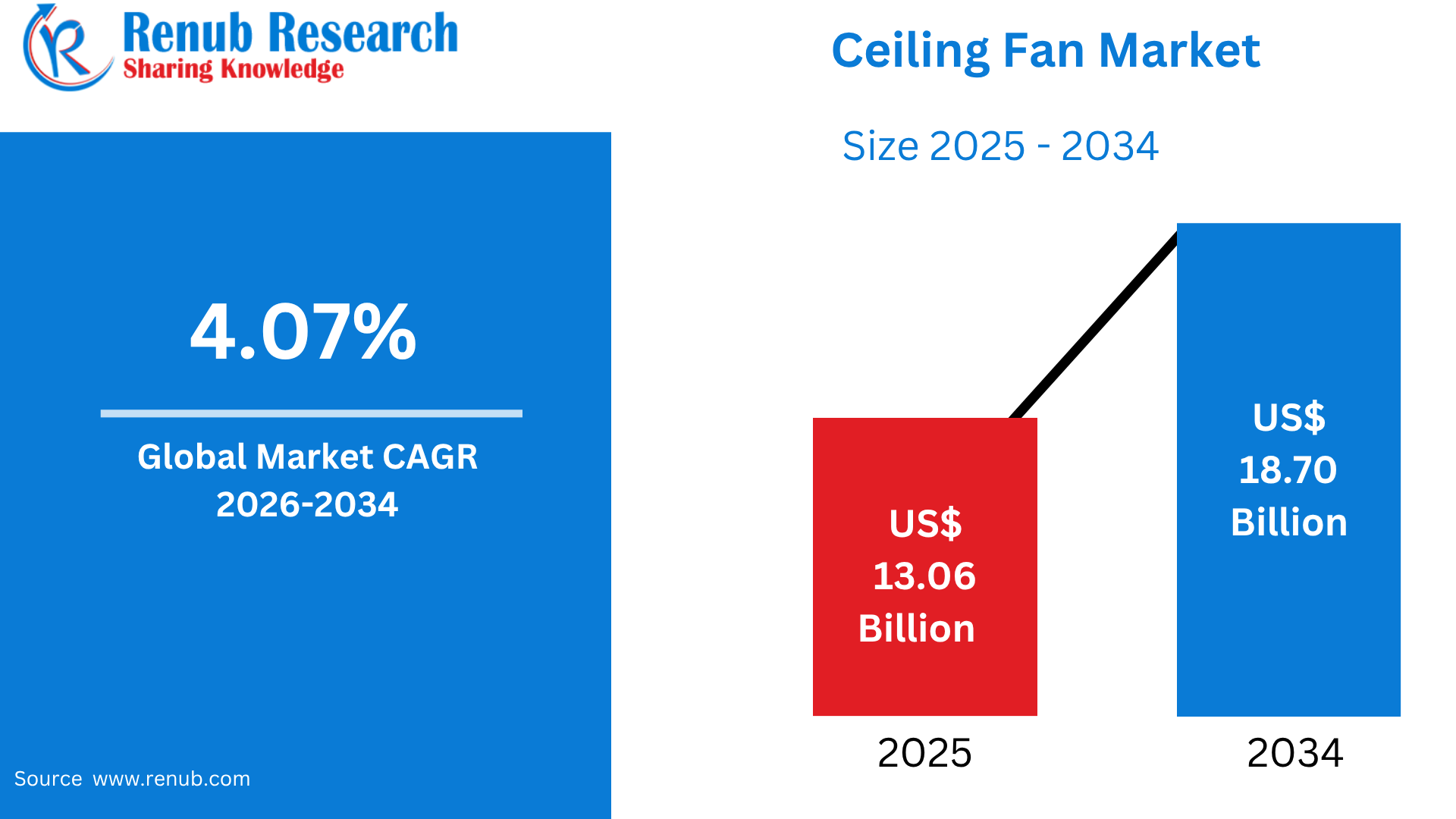
The global ceiling fans market is projected to expand from approximately US$ 13.06 billion in 2025 to US$ 18.70 billion by 2034, registering a CAGR of 4.07% during 2026–2034. Market growth is being supported by increasing consumer demand for energy-efficient and affordable cooling solutions, particularly in regions with warm and tropical climates. Rising residential and commercial construction activities are also creating new opportunities for ceiling fan manufacturers, as fans remain a cost-effective option for improving indoor air circulation.
What is a Ceiling Fan and Its Uses & Popularity Worldwide
A ceiling fan is an electrically powered appliance mounted on the ceiling that uses rotating blades to circulate air throughout an indoor or outdoor space. Unlike air conditioners, ceiling fans primarily improve air movement and create a cooling sensation without significantly lowering room temperature, making them an economical cooling solution. They are widely used in homes, offices, retail stores, restaurants, hotels, schools, hospitals, warehouses, and other commercial and industrial spaces.
Ceiling fans help improve ventilation, distribute conditioned air more evenly, and enhance indoor comfort. Their popularity worldwide is driven by their relatively low energy consumption, affordable installation, simple operation, and long service life. They are particularly important in tropical and warm-climate countries, where prolonged hot weather creates strong demand for continuous air circulation. Modern ceiling fans increasingly incorporate energy-efficient BLDC motors, remote controls, LED lighting, smart connectivity, timers, and automated speed controls, improving convenience and efficiency. Decorative designs, compact models, and customizable finishes have also increased their appeal as interior-design products. As consumers increasingly seek affordable and energy-saving cooling options amid rising electricity costs, ceiling fans continue to remain an important household and commercial appliance worldwide.
Growth Drivers of the Ceiling Fans Market
Rising Demand for Energy-Efficient Cooling Solutions
Increasing electricity costs and growing awareness of energy conservation are major factors supporting the global ceiling fans market. Ceiling fans consume considerably less electricity than conventional air-conditioning systems, making them an attractive cooling option for households and commercial establishments. According to the International Energy Agency, space cooling accounts for around 10% of global electricity consumption, highlighting the importance of energy-efficient cooling technologies. Ceiling fans can also complement air conditioners by improving air circulation and allowing users to maintain comfort at higher thermostat settings. This is particularly important in tropical and subtropical markets across Asia-Pacific, the Middle East, Africa, and Latin America, where cooling demand is increasing. The development of BLDC motor technology is further improving fan efficiency, with some modern BLDC ceiling fans consuming approximately 30–40 watts, compared with substantially higher consumption from conventional models. Rising household electricity expenditure, sustainability targets, and consumer preference for economical appliances are therefore encouraging the replacement of conventional fans with energy-efficient models. These trends are expected to support steady market growth through 2034.
Expansion of Residential and Commercial Construction
Growing construction activity worldwide is creating substantial opportunities for ceiling fan manufacturers because fans remain an essential component of residential and commercial ventilation systems. According to the United Nations, the global urban population is expected to reach approximately 68% by 2050, compared with around 56% in 2022. Increasing urbanization is encouraging the development of apartments, independent homes, offices, hotels, retail establishments, educational facilities, and healthcare buildings, creating additional demand for affordable air-circulation products. Emerging economies in India, Southeast Asia, Latin America, and the Middle East are particularly important because expanding populations and rising household incomes are supporting new housing construction. Ceiling fans are also widely installed during building renovation and replacement projects. In commercial environments, they can improve air movement while complementing HVAC systems. Government investment in housing, smart cities, infrastructure, and energy-efficient buildings is further supporting demand. As construction activity expands and consumers seek cost-effective ventilation solutions, the installation base for ceiling fans is expected to increase across both developed and developing markets.
Smart Technology and Modern Product Innovation
Technological innovation is transforming ceiling fans from basic mechanical appliances into connected and energy-efficient home and commercial devices. Manufacturers are increasingly incorporating BLDC motors, remote controls, timers, sensors, LED lighting, Wi-Fi connectivity, Bluetooth, and smart-home compatibility into new products. The global smart-home market is expanding rapidly, with connected devices becoming increasingly common in residential environments. Smart ceiling fans can be controlled through smartphones, voice assistants, or centralized home-automation platforms, allowing users to adjust speed, lighting, operating schedules, and energy consumption remotely. BLDC motors also provide quieter operation and improved energy efficiency compared with conventional induction motors. Modern consumers are additionally demanding ceiling fans that complement interior décor, encouraging manufacturers to introduce minimalist, designer, low-profile, and integrated-lighting models. Premium models are therefore gaining popularity in urban households, hotels, offices, and luxury residential developments. The growing adoption of IoT-enabled appliances and increasing consumer interest in convenience and automation are expected to accelerate the development of smart ceiling fans and create new revenue opportunities for manufacturers.
Challenges of the Ceiling Fans Market
Competition from Air Conditioners and Alternative Cooling Technologies
The growing adoption of air-conditioning systems represents a significant challenge for the ceiling fans market, particularly in developed economies and higher-income urban households. Air conditioners provide active temperature reduction and humidity control, whereas ceiling fans primarily improve perceived comfort through air circulation. Rising household incomes in emerging economies are allowing more consumers to purchase air-conditioning systems, potentially reducing dependence on ceiling fans as the primary cooling appliance. The International Energy Agency estimates that the global stock of air conditioners could increase to approximately 5.6 billion units by 2050, compared with around 2 billion today. This long-term expansion highlights the competitive pressure from active cooling technologies. In addition, portable air conditioners, evaporative coolers, heat pumps, and advanced HVAC systems provide consumers with multiple alternatives. However, ceiling fans remain significantly more economical in terms of electricity consumption and upfront cost. Manufacturers are responding by developing hybrid products, smart controls, and highly efficient motors that allow ceiling fans to complement air conditioners. Nevertheless, competition from increasingly affordable cooling technologies remains an important market constraint.
Raw Material Costs and Supply-Chain Volatility
Fluctuations in the prices of raw materials and components can affect ceiling fan manufacturers’ production costs and profitability. Ceiling fans require materials including copper, aluminum, steel, plastics, electronic components, permanent magnets, and motor components, making manufacturers vulnerable to commodity-price movements and supply-chain disruptions. Copper is particularly important for motor windings, while aluminum and steel are widely used in motors, housings, and blades. Global commodity markets have experienced substantial price volatility in recent years due to energy costs, geopolitical developments, transportation disruptions, and changes in industrial demand. Electronic components used in smart fans can also face supply shortages, particularly when manufacturers depend on internationally sourced semiconductors and controllers. These cost pressures can increase retail prices and make it difficult for manufacturers to maintain margins in highly competitive markets. Smaller manufacturers may be particularly affected because they have less purchasing power and limited access to diversified supply networks. Companies are therefore increasingly focusing on localized sourcing, efficient inventory management, product redesign, and diversified supplier networks to reduce exposure to supply-chain risks.
Ceiling Fan Launches Worldwide
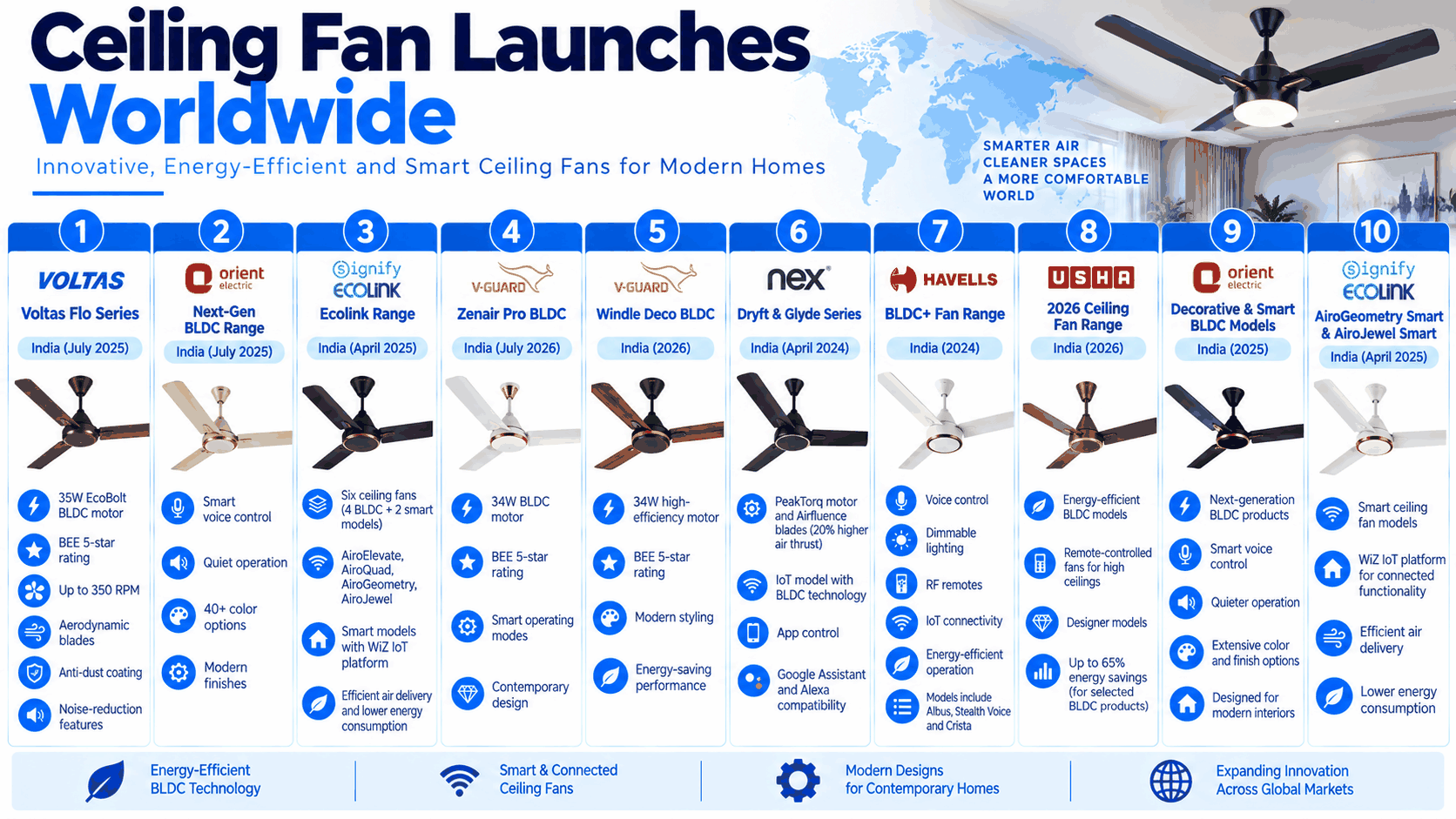
- Voltas Flo Series – India (July 2025): Voltas launched the Flo Series of energy-efficient BLDC ceiling fans. The BEE 5-star-rated range uses a 35W EcoBolt BLDC motor, reaches up to 350 RPM, and includes aerodynamic blades, anti-dust coating, and noise-reduction features.
- Orient Electric Next-Gen BLDC Range – India (July 2025): Orient Electric introduced its Next-Gen BLDC Ceiling Fan Range featuring smart voice control, quiet operation, modern finishes, and 40+ color options.
- Signify Ecolink Range – India (April 2025): Signify launched six Ecolink ceiling fans, including four BLDC models—AiroElevate, AiroQuad, AiroGeometry, and AiroJewel—and two smart models powered by its WiZ IoT platform.
- V-Guard Zenair Pro BLDC – India (July 2026): V-Guard launched the Zenair Pro BLDC Ceiling Fan, featuring a 34W BLDC motor, BEE 5-star energy rating, smart operating modes, and a contemporary design.
- V-Guard Windle Deco BLDC – India (2026): V-Guard introduced the Windle Deco BLDC Ceiling Fan, combining a 34W high-efficiency motor, BEE 5-star rating, modern styling, and energy-saving performance.
- Nex Dryft & Glyde Series – India (April 2024): Nex launched premium Dryft and Glyde ceiling fans with its PeakTorq motor and Airfluence blades, claiming 20% higher air thrust. The lineup also included an IoT model with BLDC technology, app control, Google Assistant, and Alexa compatibility.
- Havells BLDC+ Fan Range – India (2024): Havells introduced its BLDC+ range, including models such as Albus, Stealth Voice, and Crista, incorporating features such as voice control, dimmable lighting, RF remotes, IoT connectivity, and energy-efficient operation.
- Usha 2026 Ceiling Fan Range – India (2026): Usha introduced its 2026 ceiling-fan lineup, featuring energy-efficient BLDC models, remote-controlled fans for high ceilings, and designer models. The company highlights energy savings of up to 65% for selected BLDC products.
- Orient Electric Decorative & Smart BLDC Models – India (2025): Orient expanded its fan portfolio with next-generation BLDC products combining energy efficiency, smart voice control, quieter operation, and extensive color and finish options aimed at modern interiors.
- Signify AiroGeometry Smart & AiroJewel Smart – India (April 2025): Signify introduced these dedicated smart ceiling-fan models under its Ecolink portfolio, using the WiZ IoT platform for connected functionality while emphasizing efficient air delivery and lower energy consumption.
Growing Demand for Efficient Cooling Appliances
Energy-Saving Ceiling Fans Market is expanding as consumers and businesses increasingly seek cooling appliances that reduce electricity consumption and operating costs. Modern energy-efficient fans commonly use Brushless Direct Current (BLDC) motors, which can consume significantly less electricity than conventional induction-motor fans. Many BLDC ceiling fans operate at approximately 30–40 watts, compared with around 70–80 watts for some conventional models, depending on operating speed and product specifications. Lower power consumption makes these fans attractive for homes, offices, hotels, schools, and commercial establishments where fans operate for extended periods. They also generate relatively less motor heat and typically provide quieter operation, improving indoor comfort. Rising electricity prices and growing awareness of household energy consumption are encouraging consumers to replace older fans with more efficient models. Manufacturers are further introducing remote controls, timers, multiple speed settings, and smart connectivity to improve functionality. Increasing emphasis on energy conservation, lower household electricity bills, and sustainable appliance consumption is expected to support continued demand for energy-saving ceiling fans worldwide.
Combining Air Circulation With Interior Aesthetics
Decorative Ceiling Fans Market includes products designed to provide effective air circulation while complementing the visual appearance of residential and commercial interiors. Unlike conventional fans that primarily focus on functionality, decorative models emphasize design, premium finishes, integrated lighting, blade styling, and contemporary aesthetics. These products are increasingly used in living rooms, bedrooms, dining areas, luxury residences, hotels, restaurants, resorts, and premium commercial spaces. Manufacturers offer decorative fans in finishes such as wood, metallic, matte, and brushed textures, allowing consumers to match them with different interior-design themes. Integrated LED lighting is also becoming increasingly common, combining two household functions within a single fixture. Rising spending on home improvement and interior decoration is supporting demand for aesthetically appealing appliances. In addition, the expansion of luxury hospitality and premium residential developments is creating opportunities for designer ceiling fans. Consumers increasingly consider household appliances part of their overall interior décor rather than purely functional products. Consequently, the combination of cooling performance, lighting, premium materials, and distinctive designs is strengthening the position of decorative ceiling fans in the global market.
IoT Connectivity and Intelligent Temperature Control
Smart Ceiling Fans Market is gaining momentum alongside the global expansion of smart-home technologies and connected appliances. Smart ceiling fans allow users to control fan speed, lighting, operating schedules, and other functions through remote controls, smartphones, Wi-Fi, Bluetooth, or voice assistants. Some advanced models can integrate with smart-home ecosystems and automatically adjust operating settings based on room temperature or user preferences. This functionality provides greater convenience while potentially improving energy management by preventing unnecessary operation. The expansion of connected-home technologies is creating a larger customer base for smart fans, particularly among urban and technology-oriented consumers. Manufacturers are also developing models with BLDC motors, sensors, timers, app-based controls, and voice-command compatibility, combining energy efficiency with automation. Smart fans are increasingly attractive for modern apartments, premium homes, hotels, offices, and other technologically advanced spaces. As connected devices become more common and consumers increasingly expect household appliances to integrate with digital ecosystems, demand for intelligent ceiling fans is expected to increase. Continued innovation in IoT connectivity, automation, and energy monitoring will further strengthen the market’s long-term growth potential.
Versatile Solution for Moderate-Sized Rooms
Medium Ceiling Fans Market generally includes fans with blade spans of approximately 42–52 inches, making them suitable for moderate-sized indoor spaces. These fans provide a balance between air circulation, physical size, energy consumption, and installation flexibility. They are commonly used in bedrooms, living rooms, dining areas, home offices, and standard-sized commercial rooms where large industrial or oversized fans are unnecessary. Their versatility makes them one of the most widely applicable ceiling fan categories in residential environments. Manufacturers offer medium-sized models in numerous designs, motor configurations, finishes, and technology options, including remote controls, LED lighting, BLDC motors, and smart connectivity. Increasing residential construction and renovation activity is creating continued demand for appropriately sized ventilation appliances. According to the United Nations, the global urban population is projected to reach approximately 68% by 2050, supporting long-term growth in housing and urban infrastructure. Medium-sized fans can also be installed relatively easily in apartments and compact commercial spaces where ceiling area may be limited. Their combination of practical performance, design flexibility, and suitability for everyday rooms is expected to maintain their importance within the global ceiling fan market.
Strong Household Adoption and Affordable Cooling
Residential Ceiling Fans Market represents one of the largest applications within the global ceiling fan industry. Ceiling fans are widely installed in living rooms, bedrooms, kitchens, dining rooms, hallways, and other household spaces to improve air circulation and enhance thermal comfort. Their relatively low purchase and operating costs make them particularly attractive in warm and tropical regions where consumers may require cooling for long periods. Ceiling fans can also complement air-conditioning systems by improving air distribution and potentially allowing households to operate air conditioners at higher thermostat settings. Residential demand is supported by new housing construction, urbanization, home renovation, and replacement of older appliances with energy-efficient models. Modern residential fans are available in different blade sizes, finishes, colors, and designs, while advanced models offer remote controls, integrated LED lighting, BLDC motors, timers, and smart-home connectivity. The global urban population is expected to continue increasing substantially through 2050, creating additional housing and appliance requirements. Rising electricity costs are also encouraging households to consider energy-efficient fans as economical cooling solutions. With increasing residential construction and consumer focus on comfort, affordability, and energy savings, residential applications are expected to remain a major contributor to the global ceiling fans market.
Energy Efficiency and Smart-Home Adoption in the USA
United States ceiling fans market is a mature market supported by demand for energy-efficient cooling, residential renovation, and new construction. Ceiling fans are widely used in homes, offices, restaurants, hotels, and other commercial spaces to improve air circulation and reduce reliance on air-conditioning systems. This is particularly relevant in warmer states, where cooling demand remains high for extended periods. Increasing electricity costs and consumer awareness of energy conservation are encouraging households to consider efficient ceiling fans equipped with BLDC motors, remote controls, timers, LED lighting, and smart connectivity. Smart models can also integrate with mobile applications and voice assistants, providing greater convenience and control. Design innovation is another important trend, with consumers increasingly selecting fans that complement modern interior décor. According to the U.S. Census Bureau, approximately 1.36 million privately owned housing units were started in 2024, creating continued opportunities for new fan installations. The renovation of existing homes is generating additional replacement demand. In May 2025, Lasko expanded its Misto product family with a 42-inch Outdoor Misting Tower Fan, demonstrating continued innovation in residential and outdoor cooling products.
Increasing Interest in Ventilation and Low-Energy Cooling in United Kingdom
United Kingdom ceiling fans market is developing steadily as households and businesses seek affordable and energy-efficient ways to improve indoor ventilation and comfort. Although the UK generally experiences a temperate climate, increasingly frequent periods of elevated summer temperatures and heatwaves are creating greater awareness of alternative cooling solutions. Ceiling fans are used in homes, offices, restaurants, hotels, schools, and other commercial facilities, where they can improve air movement without the electricity requirements associated with continuous air-conditioning. Decorative and low-noise ceiling fans are also gaining attention as consumers increasingly seek appliances that combine functionality with contemporary interior design. The UK’s extensive housing stock provides a significant replacement and retrofit opportunity, while commercial buildings are increasingly focused on ventilation and energy efficiency. In November 2025, Vortice introduced the VORTICE F4L (“Fan For Life”), positioning the product as a long-term ventilation solution for addressing damp and mold-related issues, particularly in social housing. Growing awareness of energy-efficient appliances, indoor air quality, and climate-related cooling requirements is expected to gradually strengthen demand for ceiling fans in the UK.
India Hot Climate, Large Household Base, and BLDC Innovation
India ceiling fans market is one of the world’s most significant markets, supported by the country’s warm climate, large population, expanding housing stock, and widespread household use of fans. Ceiling fans are commonly installed in homes, offices, schools, shops, restaurants, and public facilities, making them an essential household appliance across much of the country. Rapid urbanization, increasing residential construction, rising household purchasing power, and replacement of older appliances are creating sustained demand. Energy efficiency has become increasingly important as consumers face higher electricity expenses. Consequently, manufacturers are introducing BLDC motor technology, which provides efficient air circulation while using substantially less electricity than many conventional fan motors. Smart connectivity, remote controls, voice operation, integrated lighting, and decorative designs are also transforming the category. In July 2025, Orient Electric introduced its Next Gen BLDC Ceiling Fan Range, featuring claimed whisper-quiet operation, smart voice control, and more than 40 color options, including Creme Latte, Dark Olive, and Ice Blue. Such innovations are expanding consumer choices and positioning ceiling fans as both functional and decorative appliances. Continued urbanization, housing development, and demand for energy-efficient cooling are expected to support India’s market growth.
Complementary Cooling and Expanding Infrastructure in Saudi Arabia
Saudi Arabia ceiling fans market is being supported by the country’s extremely warm climate, expanding construction sector, and growing interest in energy-efficient indoor comfort solutions. Air conditioning remains the dominant cooling technology; however, ceiling fans can complement HVAC systems by improving air circulation and distributing conditioned air more effectively. This can potentially enhance comfort while reducing the need for continuous high-intensity air-conditioning operation. Ceiling fans are used across residential properties, restaurants, commercial facilities, warehouses, outdoor areas, and hospitality establishments. Modern decorative models are also becoming relevant as developers and consumers increasingly incorporate stylish appliances into contemporary interiors. Saudi Arabia’s large-scale residential, hospitality, tourism, commercial, and mixed-use development projects under Vision 2030 are creating additional opportunities for cooling and ventilation products. Manufacturers are also introducing energy-efficient motors, remote controls, smart connectivity, and outdoor-rated models to address different applications. The combination of extreme temperatures, infrastructure expansion, energy-efficiency objectives, and increasing adoption of modern interior designs is expected to support demand for ceiling fans. However, the market remains strongly influenced by competition from air-conditioning systems, which continue to represent the primary cooling solution in the country.
Market Segments
Type
- Standard
- Decorative
- High Speed
- Energy Saving
- Others
Technology
- Conventional
- Smart
Size
- Medium
- Small
- Large
Application
- Commercial
- Residential
Distribution Channel
- Online
- Offline
Countries
North America
- United States
- Canada
Europe
- France
- Germany
- Italy
- Spain
- United Kingdom
- Belgium
- Netherlands
- Turkey
Asia Pacific
- China
- Japan
- India
- Australia
- South Korea
- Thailand
- Malaysia
- Indonesia
- New Zealand
Latin America
- Brazil
- Mexico
- Argentina
Middle East & Africa
- South Africa
- Saudi Arabia
- United Arab Emirates
All the Key players have been covered from 5 Viewpoints:
- Overviews
- Key Person
- Recent Developments
- SWOT Analysis
- Revenue Analysis
Key Company Covered
- Crompton
- Orient electric
- Havells
- Emerson Electric
- Lowe’s Companies
- Panasonic
- The Home Depot
Report Details:
| Report Features | Details |
| Base Year |
2025 |
| Historical Period |
2022 - 2025 |
| Forecast Period |
2026 - 2034 |
| Market |
US$ Billion |
| Segment Covered |
Product Type, Lead Type, End User and Countries |
| Countries Covered |
|
| Companies Covered |
|
| Customization Scope |
20% Free Customization |
| Post-Sale Analyst Support |
1 Year (52 Weeks) |
| Delivery Format |
PDF and Excel through Email (We can also provide the editable version of the report in PPT/Word format on request) |
Customization Services available
- Analysis of Market Size and Its Segments
- More Company Profiles (Upto 10 without any additional cost):
- Additional Countries (Other than mentioned Countries):
- Region/Country Specific Reports:
- Market Entry Strategy:
- Region-Specific Market Dynamics:
- Regional Market Share Analysis:
- Trade Analysis:
- Production Insights:
- Others Customized Requests:
For more information contact our analysts.
Need More Assistance?
- Talk to our analysts to get more precious information on the current market trends.
- Include more countries and segments and customize the report based on the final requirement.
- Get a competitive advantage in your industry by knowing the report findings and making a positive impact on your revenues and operations.
- Our analysts are always ready to provide more help and pertinent information if you need any additional assistance.