Carpet Market: Growth, Sustainable Materials, Smart Flooring, Product Types, End Uses, Countries and Company Analysis 2026–2034
Buy NowCarpet Market Size and Forecast
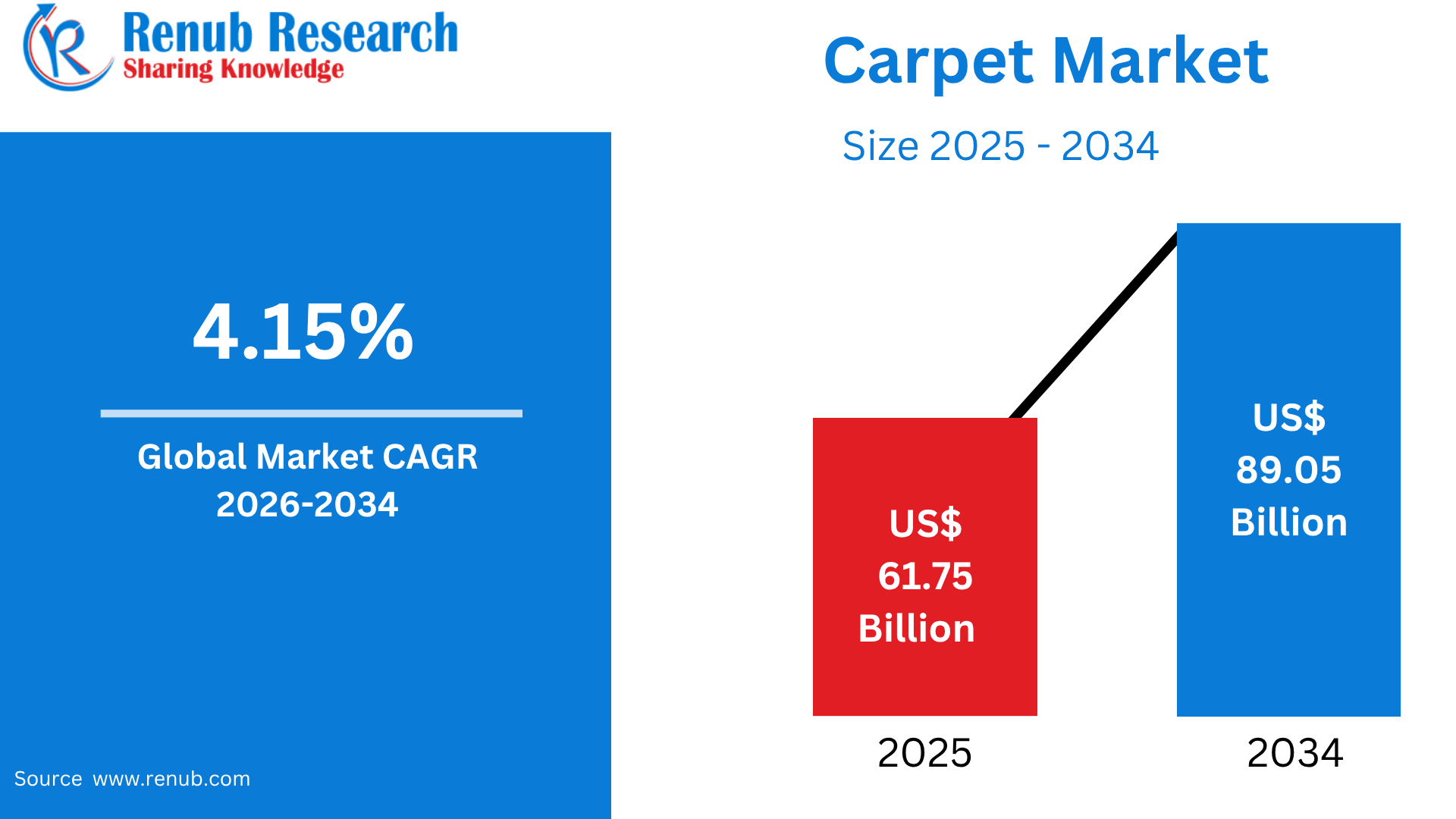
Global Carpet market is projected to expand from approximately US$ 61.75 billion in 2025 to US$ 89.05 billion by 2034, registering a CAGR of 4.15% during 2026–2034. Market growth is being supported by increasing demand for interior decoration and aesthetically appealing flooring solutions across residential, commercial, and hospitality spaces. Rising construction and renovation activities are also creating opportunities for carpet manufacturers, particularly in developing economies where residential and commercial infrastructure is expanding. Growing consumer preference for comfortable, visually attractive, and functional flooring products is further contributing to market development.
What is Carpet and Its Uses & Popularity Worldwide
A carpet is a textile floor covering made by attaching or weaving fibers such as wool, nylon, polyester, polypropylene, or recycled materials into a backing material. Carpets are available in numerous colors, patterns, textures, and designs, making them an important element of interior decoration. They are widely used in residential homes, offices, hotels, restaurants, retail stores, airports, educational institutions, and healthcare facilities.
Besides improving the visual appearance of interiors, carpets provide thermal insulation, reduce noise, enhance walking comfort, and offer additional protection to floors. Their popularity worldwide is supported by increasing construction and renovation activities, particularly in residential and commercial buildings. Growing consumer interest in comfortable and aesthetically appealing interiors is also strengthening demand for decorative flooring solutions.
Manufacturers are increasingly introducing eco-friendly carpets made from recycled fibers, natural materials, and low-emission components to address sustainability concerns. Technological advancements have also resulted in stain-resistant, durable, easy-to-clean, and customizable carpets. The growing hospitality, corporate office, and luxury residential sectors are further supporting market demand. As interior design trends increasingly emphasize comfort, functionality, and sustainability, carpets remain a popular flooring choice globally.
Why Global Demand for “Made in India” Carpets Is Increasing
The global demand for “Made in India” carpets is rising due to a combination of traditional craftsmanship, product quality, sustainability, and extensive design capabilities. Indian carpets have established a strong reputation in international markets, particularly across the United States, Europe, the Middle East, and other premium flooring markets.
Superior Craftsmanship and Product Quality
India is recognized as a leading producer and exporter of handmade carpets, with its products valued for intricate designs, detailed knotting techniques, high-quality wool, silk, cotton, and blended fibers. Traditional craftsmanship passed down through generations gives Indian carpets a distinctive appearance and premium positioning. Their durability and artistic value make them attractive to international consumers seeking decorative flooring that can provide long-term use.
Sustainable and Ethical Manufacturing
Growing global awareness of environmental sustainability is strengthening demand for Indian carpets. Manufacturers increasingly use natural fibers such as wool, jute, cotton, and silk, while many producers are adopting environmentally responsible production and ethical sourcing practices. These characteristics appeal to international buyers seeking products with lower environmental impact and stronger supply-chain transparency.
Wide Variety and Customization
Indian manufacturers offer an extensive range of products, from traditional Mughal and Indo-Persian patterns to contemporary, minimalist, and modern designs. Manufacturers can also provide customized sizes, colors, patterns, materials, and finishes. This flexibility enables Indian carpet producers to meet the requirements of luxury hotels, interior designers, residential consumers, and international retailers, further strengthening the global appeal of Indian-made carpets.
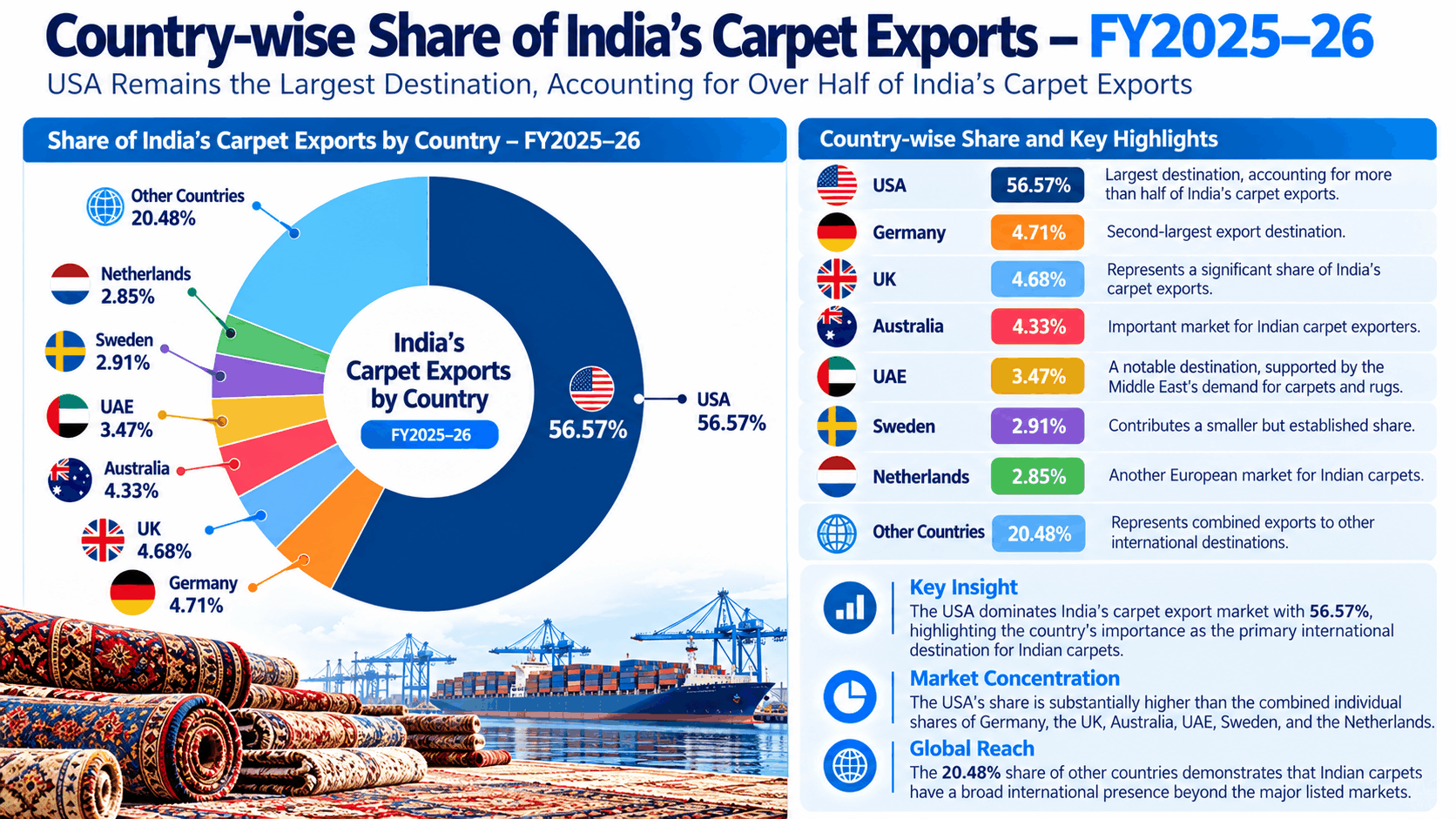
Country-wise Share of India’s Carpet Exports – FY2025–26
- USA: 56.57% — Largest destination, accounting for more than half of India’s carpet exports.
- Germany: 4.71% — Second-largest export destination.
- UK: 4.68% — Represents a significant share of India’s carpet exports.
- Australia: 4.33% — Important market for Indian carpet exporters.
- UAE: 3.47% — A notable destination, supported by the Middle East’s demand for carpets and rugs.
- Sweden: 2.91% — Contributes a smaller but established share.
- Netherlands: 2.85% — Another European market for Indian carpets.
- Other Countries: 20.48% — Represents combined exports to other international destinations.
- Key Insight: The USA dominates India’s carpet export market with 56.57%, highlighting the country’s importance as the primary international destination for Indian carpets.
- Market Concentration: The USA’s share is substantially higher than the combined individual shares of Germany, the UK, Australia, UAE, Sweden, and the Netherlands.
- Global Reach: The 20.48% share of other countries demonstrates that Indian carpets have a broad international presence beyond the major listed markets.
Growth Drivers of the Global Carpet Market
Expansion of Residential and Commercial Construction
The continued expansion of global construction activity is a major growth driver for the carpet market, as new residential and commercial properties require flooring solutions for bedrooms, offices, hotels, retail spaces, and public facilities. Global building floor area reached approximately 273 billion square meters in 2024, increasing by 1.7% during the year, according to GlobalABC and UNEP. Residential buildings represented more than three-quarters of global building floor area, creating a substantial addressable market for carpets and other floor coverings. Increasing urbanization, household formation, hotel development, office construction, and commercial infrastructure investment are consequently supporting demand. Carpet manufacturers are benefiting from demand for products that combine comfort, acoustic insulation, aesthetics, and durability. The construction and renovation opportunity is particularly strong in emerging markets, where building floor area continues to expand rapidly. At the same time, mature markets are generating demand through replacement and refurbishment projects. As construction and renovation activities remain important across residential, hospitality, corporate, and institutional sectors, the requirement for attractive and functional flooring solutions is expected to support steady carpet market expansion.
Rising Demand for Interior Décor, Comfort, and Renovation
Growing consumer interest in attractive interiors and comfortable living spaces is encouraging greater adoption of carpets in residential and commercial environments. Carpets provide aesthetic appeal while offering softness, thermal comfort, and sound-absorption properties, making them particularly suitable for bedrooms, living rooms, offices, hotels, and hospitality spaces. Recent market research identifies home renovation, interior aesthetics, and consumer demand for comfortable flooring as important factors supporting carpet industry growth. Renovation and remodeling projects provide an important recurring demand source because consumers frequently replace flooring to modernize interiors without undertaking complete structural changes. Commercial property owners are similarly upgrading offices, hotels, retail outlets, and institutional buildings to improve appearance and occupant experience. Increasing availability of customized colors, textures, patterns, carpet tiles, and digitally designed products is also helping manufacturers address diverse design preferences. Additionally, carpets can contribute to acoustic management in offices and hospitality environments, supporting their use beyond purely decorative purposes. As disposable incomes, urban lifestyles, and spending on home improvement increase in many markets, demand for aesthetically appealing and comfortable flooring products is expected to remain a significant market driver.
Growing Adoption of Sustainable and Innovative Carpet Products
Sustainability and product innovation are becoming increasingly important growth catalysts for the global carpet market. Manufacturers are developing carpets using recycled fibers, natural materials, recyclable backing systems, low-VOC adhesives, and modular designs to address environmental concerns and changing consumer preferences. Recent industry analysis highlights sustainable and eco-friendly carpets as a major opportunity, with circular-economy concepts increasingly influencing product development, including recyclable carpet tiles and product take-back programs. This trend is supported by the broader environmental pressure facing the construction sector: buildings accounted for approximately 32% of global energy demand and 34% of global CO₂ emissions in 2023, strengthening attention toward more sustainable building materials and practices.Carpet manufacturers are also investing in stain-resistant, durable, lightweight, and easy-maintenance products that extend product life and reduce replacement requirements. Advances in digital printing and manufacturing technologies are enabling greater customization in colors, textures, patterns, and dimensions. As architects, commercial developers, and consumers increasingly consider environmental performance alongside appearance and functionality, sustainable and technologically advanced carpets are expected to create new revenue opportunities.
Challenges of the Global Carpet Market
Volatility in Raw Material Prices and Manufacturing Costs
Fluctuations in raw material prices represent a significant challenge for carpet manufacturers because production depends heavily on synthetic fibers, wool, polypropylene, nylon, polyester, backing materials, dyes, and chemicals. Changes in petroleum prices can directly influence the cost of synthetic fibers, while agricultural conditions, livestock supply, and labor expenses can affect natural materials such as wool. Industry analysis identifies raw-material price volatility and price instability among the key challenges facing the carpet market. Manufacturers may find it difficult to immediately transfer higher production costs to consumers, particularly in price-sensitive markets, which can compress profit margins. Transportation, energy, packaging, and labor expenses can further increase overall manufacturing costs. Smaller manufacturers may be particularly vulnerable because they often have less purchasing power and fewer opportunities to secure long-term supply contracts. At the same time, consumers increasingly expect competitive prices while demanding better quality, durability, and sustainable materials. Manufacturers therefore need to improve production efficiency, diversify sourcing strategies, optimize inventory, and develop cost-effective recycled-material alternatives. Managing cost fluctuations while maintaining product quality and competitive pricing will remain an important challenge for carpet producers worldwide.
Environmental Concerns and Competition from Alternative Flooring
Environmental concerns associated with carpet production, disposal, and raw materials can create challenges for market expansion. Certain synthetic carpets rely on petroleum-derived fibers and may involve adhesives, chemicals, and backing materials that complicate recycling at the end of their useful life. Increasing awareness of product lifecycle impacts is encouraging consumers, architects, and developers to evaluate flooring materials based on sustainability as well as price and appearance. The carpet industry is responding through recycled fibers, recyclable backing, take-back programs, and circular-design initiatives, but the transition requires additional investment and technological development. Carpets also compete with hardwood, laminate, vinyl, luxury vinyl tile, ceramic tile, and other flooring products, which can offer advantages such as easier cleaning, moisture resistance, durability, or lower maintenance requirements depending on the application. This competition is particularly relevant in kitchens, bathrooms, healthcare facilities, and high-traffic commercial environments. Furthermore, differences in consumer preferences across regions can make product positioning challenging. To remain competitive, carpet manufacturers increasingly need to demonstrate durability, recyclability, low emissions, design flexibility, and overall lifecycle value while controlling costs.
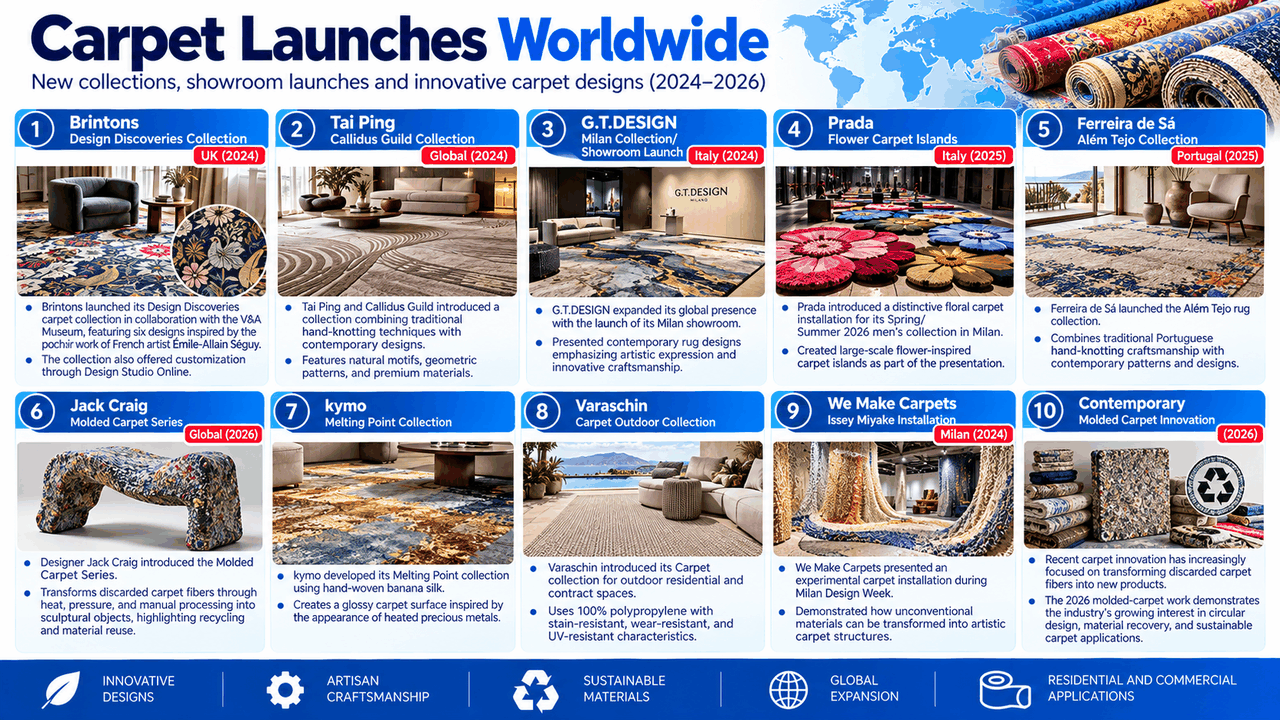
Carpet Launches Worldwide
- Brintons – Design Discoveries Collection, UK (2024): Brintons launched its Design Discoveries carpet collection in collaboration with the V&A Museum, featuring six designs inspired by the pochoir work of French artist Émile-Allain Séguy. The collection also offered customization through Design Studio Online.
- Tai Ping – Callidus Guild Collection, Global (2024): Tai Ping and Callidus Guild introduced a collection combining traditional hand-knotting techniques with contemporary designs, featuring natural motifs, geometric patterns, and premium materials.
- G.T.DESIGN – Milan Collection/Showroom Launch, Italy (2024): G.T.DESIGN expanded its global presence with the launch of its Milan showroom, presenting contemporary rug designs emphasizing artistic expression and innovative craftsmanship.
- Prada – Flower Carpet Islands, Italy (2025): Prada introduced a distinctive floral carpet installation for its Spring/Summer 2026 men’s collection in Milan, creating large-scale flower-inspired carpet islands as part of the presentation.
- Ferreira de Sá – Além Tejo Collection, Portugal (2025): Ferreira de Sá launched the Além Tejo rug collection, combining traditional Portuguese hand-knotting craftsmanship with contemporary patterns and designs.
- Jack Craig – Molded Carpet Series, Global (2026): Designer Jack Craig introduced the Molded Carpet Series, transforming discarded carpet fibers through heat, pressure, and manual processing into sculptural objects, highlighting recycling and material reuse.
- kymo – Melting Point Collection: kymo developed its Melting Point collection using hand-woven banana silk, creating a glossy carpet surface inspired by the appearance of heated precious metals.
- Varaschin – Carpet Outdoor Collection: Varaschin introduced its Carpet collection for outdoor residential and contract spaces, using 100% polypropylene with stain-resistant, wear-resistant, and UV-resistant characteristics.
- We Make Carpets – Issey Miyake Installation, Milan (2024): We Make Carpets presented an experimental carpet installation during Milan Design Week, demonstrating how unconventional materials can be transformed into artistic carpet structures.
- Contemporary Molded Carpet Innovation (2026): Recent carpet innovation has increasingly focused on transforming discarded carpet fibers into new products. The 2026 molded-carpet work demonstrates the industry’s growing interest in circular design, material recovery, and sustainable carpet applications.
Premium Craftsmanship and Long-Lasting Appeal for Woven Carpet
Woven Carpets Market represents a traditional and premium segment of the global carpet industry. Woven carpets are manufactured using specialized looms in which the pile and backing are produced simultaneously, creating a highly integrated and durable structure. This manufacturing technique allows producers to develop intricate patterns, detailed textures, and premium finishes that are particularly attractive for luxury residential and commercial interiors. Woven carpets are commonly manufactured from wool, nylon, polyester, or blended fibers, offering different combinations of durability, softness, and aesthetic appeal. Their strong construction provides better resistance to wear and supports long-term use, making them suitable for high-end homes, hotels, corporate offices, and prestigious institutional spaces. Increasing consumer interest in premium interior décor and products with extended service lives is supporting demand for woven carpets. In addition, advances in manufacturing technology are enabling greater customization in patterns, colors, textures, and dimensions. Although woven carpets generally command higher prices than tufted alternatives, their craftsmanship, durability, and luxury positioning continue to attract consumers seeking high-quality flooring solutions.
Cost-Effective Production and Design Flexibility in Tufted Carpets
Tufted Carpets Market is one of the largest segments of the global carpet industry, supported by efficient manufacturing, affordability, and extensive design choices. Tufted carpets are produced by inserting yarn into a pre-existing backing using specialized tufting machines, creating either cut-pile or loop-pile surfaces. Compared with traditional woven production, tufting generally enables faster manufacturing and greater production volumes, helping manufacturers offer competitively priced products. Tufted carpets are available in a broad range of colors, patterns, textures, and pile heights, making them suitable for diverse interior applications. They are widely used in homes, offices, hotels, retail stores, shopping centers, and hospitality facilities. Increasing demand for affordable yet attractive flooring is strengthening this segment, while synthetic fibers such as nylon and polyester provide improved durability, stain resistance, and color retention. Technological advancements in tufting machinery and fiber processing are further improving product quality and manufacturing efficiency. Growing residential construction, commercial renovation, and consumer preference for customizable flooring are expected to support continued expansion of the tufted carpet market worldwide.
Nylon Carpets Durability and High-Performance Flooring
Nylon Carpets Market continues to benefit from the material’s strong durability, resilience, and performance characteristics. Nylon is one of the most widely used synthetic fibers in carpet manufacturing because it can withstand repeated foot traffic while maintaining its appearance and structural integrity. Its high resilience allows carpet fibers to recover after compression, making nylon products particularly suitable for offices, hotels, retail stores, airports, and other high-traffic commercial environments. Nylon also offers strong resistance to abrasion, good color retention, and relatively easy maintenance, increasing its attractiveness to both residential and commercial consumers. Technological developments in fiber engineering have enabled manufacturers to improve softness, stain resistance, durability, and overall performance. Sustainability is also becoming increasingly important, with manufacturers developing nylon carpets containing recycled materials and recyclable components. Although nylon products can be more expensive than some alternative synthetic fibers, their longer service life can provide better lifecycle value. Rising demand for durable, low-maintenance, and visually attractive flooring solutions, particularly in high-use environments, is expected to sustain demand for nylon carpets globally.
Affordable Alternative to Wool Flooring
Acrylic Carpets Market is gaining attention because acrylic fibers can provide several characteristics associated with wool while generally offering a more affordable alternative. Acrylic carpets are lightweight, soft, and comfortable, making them suitable for residential applications such as living rooms, bedrooms, decorative areas, and low- to moderate-traffic spaces. The material also provides good color retention and resistance to sunlight, helping carpets maintain their visual appearance over extended periods. Acrylic fibers can additionally offer resistance to moisture, mildew, and certain stains, supporting their use in environments where appearance and ease of maintenance are important. The comparatively lower production cost of acrylic compared with natural wool can make acrylic carpets attractive to price-conscious consumers seeking a premium-looking floor covering. However, acrylic generally offers lower durability and resilience than high-performance fibers such as nylon, limiting its suitability for heavily trafficked commercial environments. Manufacturers are improving fiber formulations and production techniques to enhance strength, stain resistance, and longevity. As consumers continue seeking affordable decorative flooring with a soft and luxurious appearance, acrylic carpets are expected to maintain a stable position in selected residential and interior-design applications.
Durable Flooring for High-Traffic Environments in Commercial Carpets
Commercial Carpets Market represents an important segment of the flooring industry, driven by demand from offices, hotels, airports, conference centers, schools, shopping malls, healthcare facilities, and other commercial properties. Commercial carpets are specifically engineered to withstand frequent foot traffic while maintaining appearance, comfort, and functionality. Products commonly incorporate durable fibers, reinforced backing, stain resistance, and modular construction to support long-term use and simplify maintenance. Carpet tiles are particularly attractive for commercial environments because damaged or heavily worn sections can be replaced individually rather than replacing an entire floor. Carpets also provide acoustic benefits by helping absorb and reduce indoor noise, which is valuable in open-plan offices, hotels, educational institutions, and conference facilities. In addition to functional benefits, commercial carpets allow businesses to incorporate corporate colors, patterns, and architectural themes into interior spaces. Continued investment in office renovations, hospitality properties, retail facilities, and modern commercial infrastructure is creating additional demand. As businesses increasingly prioritize workplace aesthetics, occupant comfort, acoustic performance, durability, and sustainable interior design, the commercial carpet segment is expected to maintain steady growth worldwide.
Strong Residential Renovation and Commercial Demand in USA
United States carpets market remains one of the most established globally, supported by residential construction, remodeling, replacement activity, and commercial development. Carpets remain widely used in bedrooms, living areas, offices, hotels, conference centers, educational institutions, and healthcare facilities because they provide comfort, thermal insulation, aesthetic appeal, and acoustic benefits. According to the U.S. Census Bureau, privately owned housing starts reached approximately 1.36 million units in 2024, creating a substantial opportunity for flooring products. Renovation and home-improvement spending also contributes significantly to replacement demand, while commercial properties increasingly use durable and modular carpet products. Technological advances are improving stain resistance, durability, recyclability, and maintenance characteristics, making modern carpets more attractive to consumers. Demand is also shifting toward sustainable materials, recycled fibers, and products with longer lifecycles. In March 2025, Rugs America Corp. introduced an enhanced Rug Display System at the New York Home Fashions Market, featuring a self-service rug gallery and backup inventory storage. Continued housing activity, remodeling, product innovation, and demand for attractive interiors are expected to support steady growth in the U.S. carpets market.
United Kingdom Comfort, Renovation, and Sustainable Flooring Trends
United Kingdom carpets market continues to develop as households and commercial property owners prioritize comfortable, attractive, and functional interiors. Carpets remain particularly popular in bedrooms, living rooms, hotels, offices, schools, and other spaces where warmth and acoustic performance are important. Renovation and remodeling activity represents a significant source of replacement demand, as consumers increasingly upgrade flooring while improving overall interior design. The market is also experiencing increasing interest in recycled and environmentally responsible carpets, reflecting stronger sustainability awareness among consumers and businesses. Manufacturers are introducing stain-resistant and easy-maintenance products to improve durability and reduce the effort associated with carpet care. According to the UK Office for National Statistics, the country’s housing stock exceeds 25 million dwellings, representing a substantial installed base for carpet replacement and refurbishment opportunities. Design customization is another emerging trend. In December 2024, Brintons introduced its Design Discoveries collection in collaboration with the V&A Museum, featuring six designs inspired by French artist Émile-Allain Séguy and available through its Design Studio Online platform. Rising renovation activity, sustainability preferences, and demand for customized interiors are expected to sustain market growth.
Traditional Craftsmanship Meets Modern Interior Design in India
India carpets market holds an important position globally because of the country’s long-standing tradition of handmade carpet production and its strong export industry. Indian manufacturers are renowned for products made using traditional craftsmanship, particularly wool, silk, and blended fibers, while modern producers are increasingly introducing contemporary patterns and machine-made products. Domestic demand is also expanding as rising urbanization, household incomes, hospitality development, and interest in interior decoration encourage greater use of carpets in homes, hotels, offices, and commercial properties. India’s hospitality industry is particularly important because hotels and resorts use carpets to enhance aesthetics, comfort, and premium positioning. The country’s large middle-class consumer base is also creating opportunities for affordable decorative flooring. According to the World Bank, India’s urban population is projected to reach approximately 600 million by 2036, supporting long-term demand for housing, commercial infrastructure, and interior products. In July 2025, Jaipur-based home décor startup Asterlane entered the carpet manufacturing business, expanding its product portfolio to address demand for contemporary and traditional floor décor. The combination of traditional expertise, expanding domestic consumption, exports, and modern design trends is expected to strengthen India’s carpet market.
Tourism, Construction, and Cultural Design Supporting Saudi Arabia Demand
Saudi Arabia carpets market is benefiting from expanding residential construction, commercial infrastructure, hospitality development, and tourism investment. Carpets and rugs have traditionally played an important role in Saudi Arabian interiors, offering comfort, decorative appeal, and cultural significance. Residential consumers use carpets to create warm and visually attractive interiors, while hotels, resorts, restaurants, offices, and commercial properties increasingly require premium flooring solutions to support high-quality interior design. The country’s tourism and hospitality expansion under Saudi Vision 2030 is creating additional opportunities as new hotels, resorts, entertainment destinations, and mixed-use developments are constructed. Saudi Arabia’s National Tourism Strategy targets more than 100 million domestic and international visits annually, supporting continued investment in tourism infrastructure. Traditional rugs and carpets also remain important elements of regional interior aesthetics, while contemporary designs are gaining popularity in modern developments. In October 2023, Saudi Arabia replaced its traditional red ceremonial carpet with a lavender-colored carpet, symbolically highlighting cultural heritage and modernization. Increasing construction activity, tourism investment, luxury hospitality development, and continued appreciation of traditional décor are expected to support demand for carpets and rugs across Saudi Arabia.
Carpet Market Segments
Product Type
- Woven
- Knotted
- Needle Felt
- Tufted
Material
- Nylon
- Polypropylene
- Polyester
- Acrylic
- Wool & its blends
- Others
End Use
- Residential
- Commercial
- Industrial
Countries
North America
- United States
- Canada
Europe
- France
- Germany
- Italy
- Spain
- United Kingdom
- Belgium
- Netherlands
- Turkey
Asia Pacific
- China
- Japan
- India
- Australia
- South Korea
- Thailand
- Malaysia
- Indonesia
- New Zealand
Latin America
- Brazil
- Mexico
- Argentina
Middle East & Africa
- South Africa
- Saudi Arabia
- United Arab Emirates
All the Key players have been covered from 5 Viewpoints:
- Overviews
- Key Person
- Recent Developments
- SWOT Analysis
- Revenue Analysis
Key Company Covered
- Armstrong Flooring Inc.
- Balta Industries nv.
- Mohawk Industries Inc.
- Tarkett
- Victoria PLC
- Mannington Mills Inc.
- Dorsett Industries
Report Details:
| Report Features | Details |
| Base Year |
2025 |
| Historical Period |
2022 - 2025 |
| Forecast Period |
2026 - 2034 |
| Market |
US$ Billion |
| Segment Covered |
Product Type, Material, End User and Countries |
| Countries Covered |
|
| Companies Covered |
|
| Customization Scope |
20% Free Customization |
| Post-Sale Analyst Support |
1 Year (52 Weeks) |
| Delivery Format |
PDF and Excel through Email (We can also provide the editable version of the report in PPT/Word format on request) |
Customization Services available
- Analysis of Market Size and Its Segments
- More Company Profiles (Upto 10 without any additional cost):
- Additional Countries (Other than mentioned Countries):
- Region/Country Specific Reports:
- Market Entry Strategy:
- Region-Specific Market Dynamics:
- Regional Market Share Analysis:
- Trade Analysis:
- Production Insights:
- Others Customized Requests:
For more information contact our analysts.
Need More Assistance?
- Talk to our analysts to get more precious information on the current market trends.
- Include more countries and segments and customize the report based on the final requirement.
- Get a competitive advantage in your industry by knowing the report findings and making a positive impact on your revenues and operations.
- Our analysts are always ready to provide more help and pertinent information if you need any additional assistance.