Canada Saskatchewan Grain Market Report by Grain Production, Non-Grain Production, End-Use, Regions, Export Demand and Company Analysis 2026-2034
Buy NowCanada Saskatchewan Grain Market Size & Forecast 2026-2034
Canada Saskatchewan Grain Market is expected to grow from US$ 5,222.76 Million in 2025 to US$ 6,989.15 Million by 2034, growing at a CAGR of 3.29% during the forecast period 2026–2034. Market development may be attributed to the solid agricultural foundation in Saskatchewan, increasing export demand for wheat and pulses, supportive farming technology, and the increased global food security requirement, hence further strengthening the position of Saskatchewan as a major grain contributor in Canada.
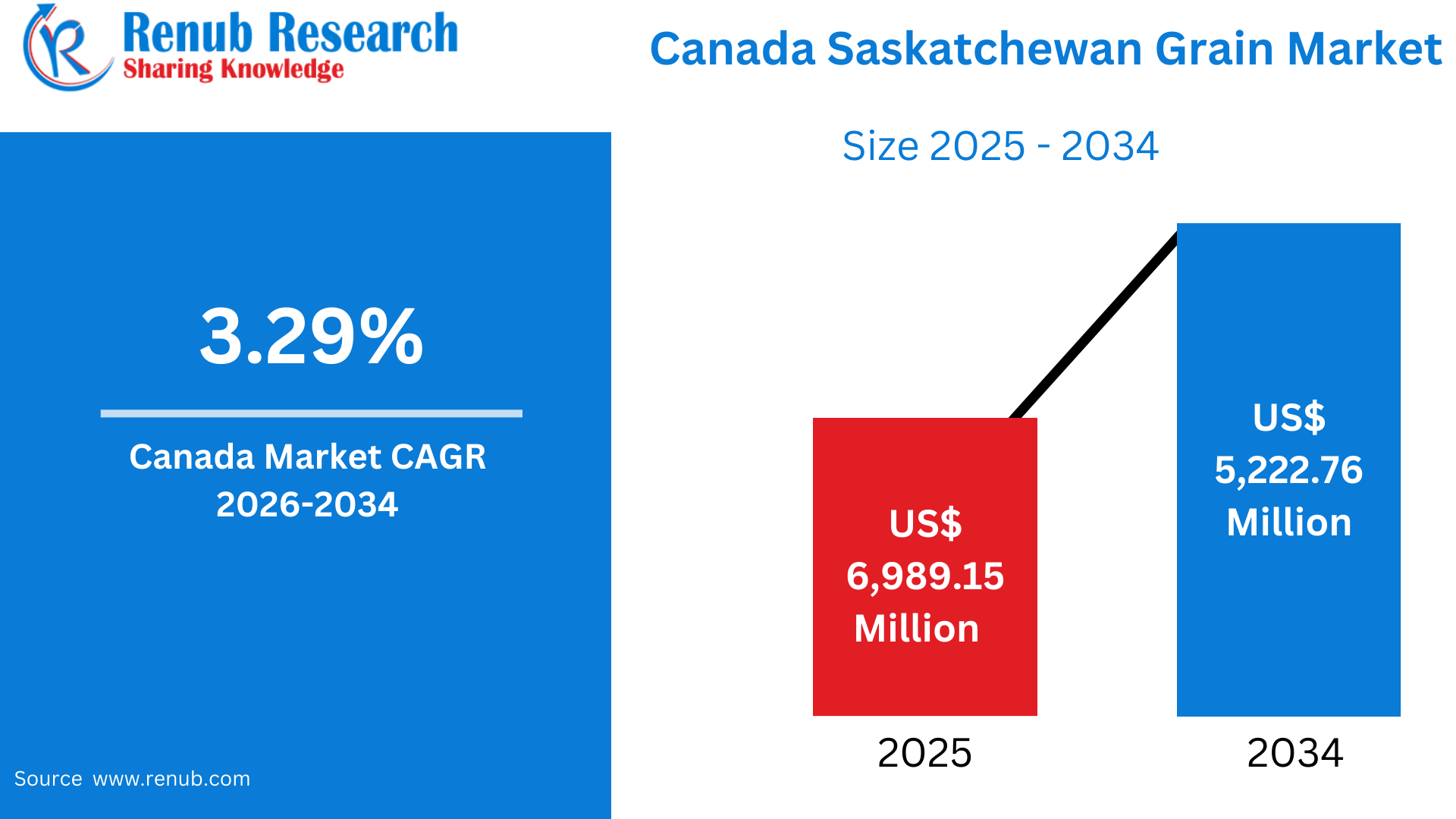
Canada Saskatchewan Grain Market Outlook
Grains pertain to very small, hard, dry plant Seeds that are obtained for consumption, for feeding animals, or for industrial purposes. Some types of grains include wheat, barley, oats, corn, rye, and pulses such as lentils, among others, typically classified directly with grains when sold in the agricultural market. In fact, grains are the backbone of the food industry all around the world. Numerous food items such as bread, pasta, breakfast grains, animal feed, biofuels, among others, are obtained from grains. Grains have a remarkably long lifespan, possess high nutritional value, and are versatile.
Grains are an exceptionally popular and profitable sector in the province of Saskatchewan. Saskatchewan is commonly called Canada’s “bread basket” owing to its rich agricultural land and favorable climate for farming. One of the top grain-exporting and -producing countries in the global market, Saskatchewan supplies products like wheat, durum, barley, canola, and pulses. Grains account for a large share in the agricultural GDP in Canada, with grain farming being an integral part of the rural economy, facilitating large-scale exports. The increasing global demand for grains, better agricultural techniques, and an established supply chain make grain farming an established and popular sector in the agricultural segment in Saskatchewan.
Growth Drivers of the Canada Saskatchewan Grain Market
Strong Global Demand for Food and Feed Grains
A major driver of growth for the province of Saskatchewan is the expanding demand for food grains and animal feed amidst the rise in the global population, urbanization, and changes in eating habits. The increasing demand for imported wheat, durum, barley, and pulses from countries within the Asian, Middle Eastern, and African regions is a significant driver for the growth of the province's agricultural sector. The demand for high-quality protein-rich grains, as well as the existence of long-term free trade agreements, makes the province a preferred destination for suppliers of grains. Moreover, the demand for alternative protein sources, particularly the increase in the demand for plant proteins, has led to a rise in the export of lentils and peas. A record production of 41.9 million tonnes of grains and oilseeds was reported by the agriculture ministry for the year 2025, a 13.7% increase from the previous year.
Advanced Agricultural Technology and Farm Productivity
Technological developments in the agricultural sector also act as a significant driver for the growth of the grains industry in the province of Saskatchewan. Precision agricultural technologies include the use of GPS-guided machinery, the imaging of satellites, soil sensors, and the use of agricultural data analysis to help the farmer increase the efficiency of planting, application, as well as harvesting. Additionally, the development of nueva or new breeds of seeds with stronger resistance to disease as well as enhanced drought tolerance also boosts agricultural production. Technological innovation is also adopted by agricultural producers promptly, thanks to premier research organizations as well as agricultural programs initiated by the government. Increased yields per acre enable the producers to compete in the world market, thereby solidifying the province as a major producer of grains. Nov 2025, A new Atlantic Institute for Digital Agriculture AIDA is being launched by Dalhousie University on its Agricultural Campus at Truro.
Well-Developed Export and Transportation Infrastructure
Saskatchewan’s grain market is supported by a robust transportation and export infrastructure that connects producers to global markets. An extensive rail network links grain elevator to major ports on the West Coast and Great Lakes, enabling efficient bulk exports. Investments in high-capacity grain terminals, storage facilities, and logistics technology have improved supply chain reliability. Efficient infrastructure reduces transportation bottlenecks, minimizes post-harvest losses, and supports timely delivery to international buyers. As global trade volumes increase, Saskatchewan’s ability to move large quantities of grain efficiently enhances its competitiveness. Continued infrastructure modernization and public–private investment further strengthens this growth driver. Nov 2025, The Minister of Transport and Leader of the Government in the House of Commons and the Minister of International Trade, announced two trade infrastructure funds. Powered by $6 billion over seven years thanks to Budget 2025, these investments will build the infrastructure Canada needs to unlock the doors to new global markets while doubling non-American exports. The funds could help increase exports by $300 billion more over the next decade.
Challenges of the Canada Saskatchewan Grain Market
Climate Variability and Weather-Related Risks
Climate variability affects the grain sector in Saskatchewan significantly. The impact may come in the form of droughts, floods, premature frosts, and heatwaves. All such aspects tend to significantly decrease the quantity and quality of crops. Variabilities in the climate also tend to create uncertain environments with respect to planting and harvesting crops. Although some support may come from technology and insurance related to crops, uncontrollable environmental changes tend to create volatility in farmers’ revenues or may lead to increased costs in case of prolonged environmental changes against favorable crops in Saskatchewan’s grain industry.
Transportation Constraints and Market Volatility
In addition to the strength of the infrastructure for the grain market in Saskatchewan, the industry periodically operates under conditions of transport shortage. During the peak harvest period, for instance, rail line capacity and the availability of trained personnel may result in freight delays or impact the ability to fulfillexport obligations. Further, one of the weaknesses of the wholesale market for grains is that prices respond very strongly to world market changes driven by geopolitical considerations and foreign currency movements.
Canada Saskatchewan Wheat Market
The wheat market is the core of the agricultural economy in the province of Saskatchewan. The region is one of the top providers of spring wheat and durum wheat in the world, with reputation globally for possessing high protein and top quality. Wheat grown in the region has gone to extensive markets in Asia, Europe, Africa, and the Middle East to be used in the preparation of pasta, noodles, and other staple foods. Due to its popularity in the international market and assurance of its supply to the international community by the people of Canada, its growth in the long term has remained stable. Farmers in the region are also supported by proper inspection to determine the type of grain and proper studies for the development of seeds along with sufficient guidance according to the world market.
Canada Saskatchewan Canary Seed Market
Canary seed serves as a specialty grain crop where the province of Saskatchewan has an overarching leadership role in producing most of the world’s canary seeds. This type of grain seed was historically used for purposes of bird feed but has found renewed popularity with the approval of consumption by humans in international markets. Saskatchewan farmers are uniquely positioned for this utilization aspect because of their knowledge in production. Additionally, the region provides appropriate weather conditions for such a crop. This grain type provides rotation variety for farmers growing other cereal grains. Additionally, the demand for this product comes from the health food markets of Europe, Latin America, and Europe. Although smaller compared to wheat and barley markets, this particular grain crop enables individuals to pay higher amounts without fear of competition because of this small marketplace.
Canada Saskatchewan Wheat - Human Food Market
The wheat grown in Saskatchewan and used as human food has optimal milling and baking quality. The segment of interest is high-protein spring wheat and durum delivered as bread-making, pasta-making, noodle-making, and specialty flour ingredients. The segment highlights that international purchase of Saskatchewan wheat emphasizes its predictability, traceability, and strict quality standards mandated by the grain grading system followed by Canada as a whole. The increasing demand for food security with a rising global population has always remained a major factor increasing demand for high-quality food-grade wheat. Another factor causing this segment to remain stable and of increasing value is that of interest in high-quality specialty and premium food ingredients and items, particularly baking and fortified food ingredients and items. The human food industry targets farmers willing to pay a price premium with strict quality requirements concerning protein, moisture, and purity requirements of grain supplied by producers.
Canada Saskatchewan Barley Animal Feed, Waste, and Dockage Market
Barley grown for the production of livestock feed, as well as any associated by-products or barley dockage, is an important part of the grain industry in Saskatchewan. This livestock feed barley is mostly marketed for domestic use by cattle, pig, and poultry-raising industries, serving the livestock industry in Canada. Barley which may not qualify for the malting or food-grade categories is effectively marketed as livestock feed, with no grain going to waste. By-products, including dockage, are also added to livestock feed. Such by-products make an important contribution to the effective delivery of cost-efficient nutrients to livestock. It is not as profitable, as with other high-grade grains, although the market demands, revenues, and prices remain stable.
Canada Saskatchewan Oats Industrial Use Market
Oats that are produced in the Saskatchewan Province have industrial applications, unlike the food sector. Oats that are processed in the industrial sector have applications in the following sectors: industrial animal feeds, bio-products, health products, and cosmetic products. Various components of oatmeal, such as the presence of beta-glucans, have potential functional properties such as the reduction of cholesterol levels in the body, acting as a soothing agent for the skin, among others. Oatmeal production in the clean, growing conditions of the Province of Saskatchewan is being driven by the growing industrial sector. Even if the market for the industrial sector is smaller in the case of oatmeal, still, the industrial sector helps in the added-value production of oatmeal.
Ontario Saskatchewan Grain Market
The market for Saskatchewan grains in Ontario is fueled by a strong processing sector and the need for feed and other uses. The province of Ontario has the most people in Canada and a well-developed food processing industry, including both flour mills and cereal manufacturers, bakeries, and animal feed processing. The grains from Saskatchewan, such as wheat, barley, and oats, and their sister pulse crops, are hauled from the west to fill local supply, mostly for feeds requiring higher or different qualities. The transportation support and rail infrastructure are facilitative and help to reliably supply grains from Saskatchewan to Ontario. The requirement in Ontario is fairly stable, being based mostly on domestic rather than export demands. The intake from Saskatchewan helps to steady and guarantee the supplies and supplies enough to ensure a stable supply to processors in Ontario.
Quebec Saskatchewan Grain Market
In the province of Quebec, the Saskatchewan wheat is mainly regarded for quality and predictability rather than quantity. The agri-food industry in Quebec encompasses the milling of flour, baking products, the processing of food products, and the production of livestock feed on the basis of guaranteed grain quality. Saskatchewan wheat, oat products, and barleys are commonly imported as supplemental sources of grain during the phases of fluctuating growth influenced by the Quebec climate. High-protein wheat from Saskatchewan is of major use for bread-making purposes. Saskatchewan grain imports enter the province through the railway system or eastern distribution channels. The demand within the province of Quebec is influenced by their consumption of food products, process level of food or feed products, as well as governmental considerations of cost factors.
Alberta Saskatchewan Grain Market
The Saskatchewan market in the Province of Alberta is quite integrated because of the Prairie geographic configuration and the agricultural systems in the area. Grain is moved easily between Saskatchewan and Alberta to service the demand for processed foods as well as the livestock sector in the Province of Alberta. Saskatchewan barley and oats are used for feed while the better quality wheat is required for the processing of foods. Market forces in the Prairie area depend on the production level of the areas and not the distant markets of grain exports. This allows the Prairie market to be flexible in the sense that the grain is channeled to the area of higher demand.
Market Segmentation
Grain Production Volume & Market
- Wheat
- Barley
- Oats
Non-Grain (Oilseeds and Pulses) Production Volume & Market
- Canary Seed
- Canola
- Chick Peas
- Flaxseed
- Lentils
- Mustard
- Peas
End User Volume
Wheat
- Human food
- Seed requirements
- Industrial use
- Animal feed, waste and dockage
- Others
Barley
- Human food
- Seed requirements
- Animal feed, waste and dockage
- Others
Oats
- Human food
- Seed requirements
- Industrial use
- Animal feed, waste and dockage
Region
- Ontario
- Quebec
- British Columbia
- Alberta
- Rest of Canada
All the key players have been covered from 5 Viewpoints:
- Overview
- Key Persons
- SWOT Analysis
- Recent Development & Strategies
- Financial Insights
Key Players Analysis:
- Cargill, Inc.
- Archer Daniels Midland Company
- Bunge
- AGT Food and Ingredients Inc
- Louis Dreyfus Company
Report Details:
| Report Features | Details |
| Base Year |
2025 |
| Historical Period |
2022 - 2025 |
| Forecast Period |
2026 - 2034 |
| Market |
US$ Million |
| Segment Covered |
Grain Production, Non-Grain Production, End-Use, Export Demand and Regions |
| Region Covered |
|
| Companies Covered |
|
| Customization Scope |
20% Free Customization |
| Post-Sale Analyst Support |
1 Year (52 Weeks) |
| Delivery Format |
PDF and Excel through Email (We can also provide the editable version of the report in PPT/Word format on request) |
Customization Services available
- Analysis of Market Size and Its Segments
- More Company Profiles (Upto 10 without any additional cost):
- Additional Countries (Other than mentioned Countries):
- Region/Country Specific Reports:
- Market Entry Strategy:
- Region-Specific Market Dynamics:
- Regional Market Share Analysis:
- Trade Analysis:
- Production Insights:
- Others Customized Requests:
For more information contact our analysts.
Need More Assistance?
- Talk to our analysts to get more precious information on the current market trends.
- Include more countries and segments and customize the report based on the final requirement.
- Get a competitive advantage in your industry by knowing the report findings and making a positive impact on your revenues and operations.
- Our analysts are always ready to provide more help and pertinent information if you need any additional assistance.