Building Automation Systems Market Report by Product Component, Automation Technology, Application, End User, Country and Company Analysis 2026-2034
Buy NowBuilding Automation Systems Market Size and Forecast
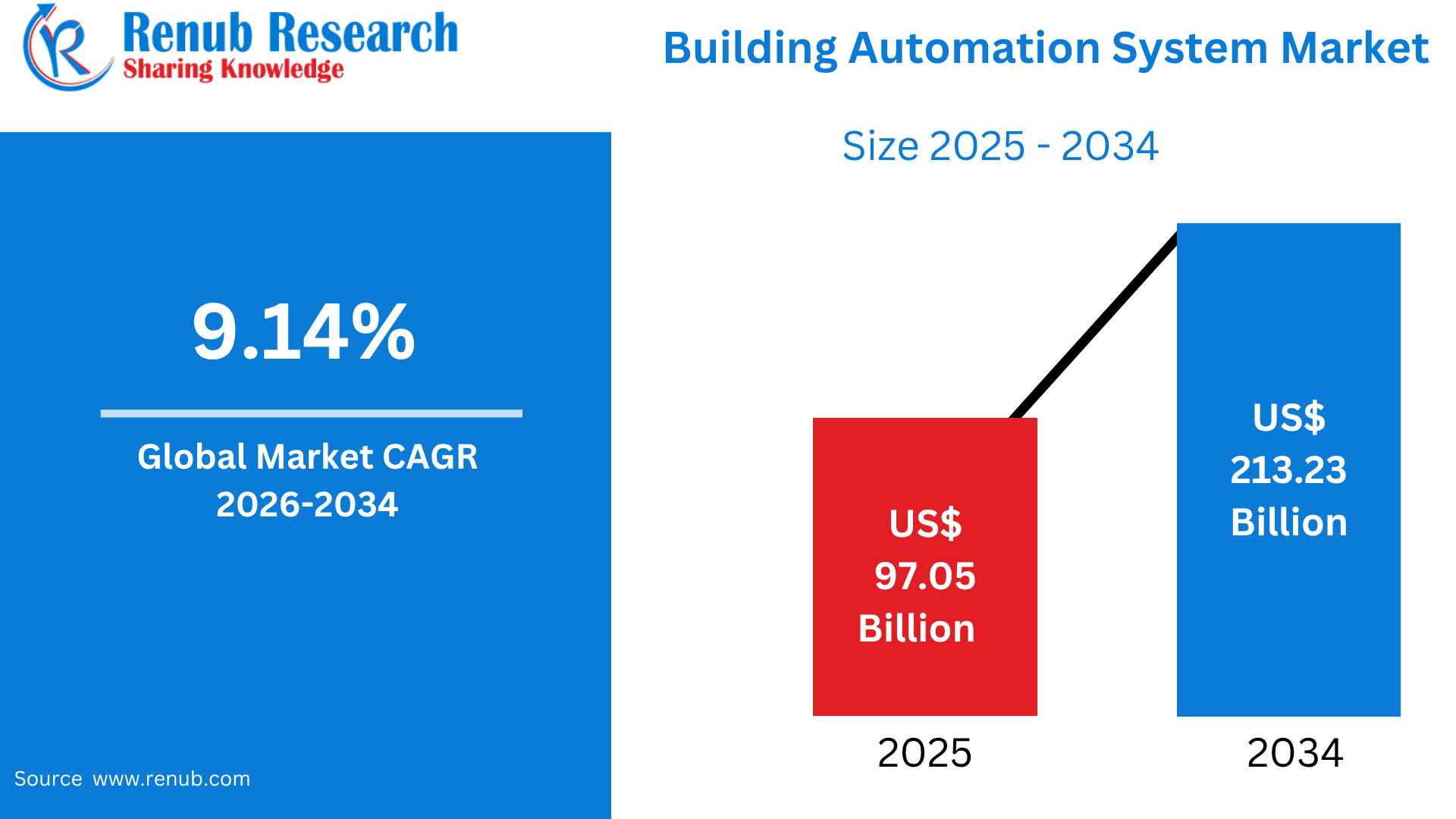
The global building automation systems (BAS) market is projected to expand significantly, increasing from approximately US$ 97.05 billion in 2025 to US$ 213.23 billion by 2034, registering a CAGR of 9.14% during 2026–2034. Market growth is being supported by the rising adoption of energy-efficient building solutions, smart infrastructure, and advanced automation technologies. Increasing efforts to reduce energy consumption, operating costs, and carbon emissions are encouraging commercial, residential, and industrial facilities to deploy integrated automation systems.
What Are Building Automation Systems and Their Uses & Popularity Worldwide
Building Automation Systems (BAS) are centralized technology platforms that automatically monitor, control, and manage key building functions to improve operational efficiency, occupant comfort, safety, and energy performance. BAS typically integrates heating, ventilation, and air conditioning (HVAC), lighting, security systems, fire alarms, access control, elevators, and energy management through connected sensors, controllers, and software. These systems enable facility managers to monitor building conditions in real time, identify equipment problems, automate temperature and lighting adjustments, and optimize energy consumption.
BAS are increasingly used across commercial offices, hospitals, hotels, shopping centers, airports, educational institutions, industrial facilities, and smart residential buildings. Their popularity is growing worldwide as governments, businesses, and property owners focus on energy conservation, sustainability, carbon reduction, and operational cost optimization. Integration with the Internet of Things (IoT), artificial intelligence (AI), cloud computing, and advanced analytics is making modern BAS more intelligent and responsive. The growing development of smart cities and green buildings is further accelerating adoption. As organizations seek connected, secure, and energy-efficient facilities, building automation systems are becoming an increasingly important component of modern building infrastructure globally.
Energy Demand in Buildings by Sector, 2015–2024
- 2015: Total building energy demand was approximately 115 EJ, comprising around 79 EJ from residential buildings and 36 EJ from services.
- 2016: Total demand increased to approximately 117 EJ, with residential demand at 80 EJ and services at 37 EJ.
- 2017: Building energy demand reached around 120 EJ, including approximately 82 EJ residential and 38 EJ services.
- 2018: Total demand rose to approximately 123 EJ, with 84 EJ from residential and 39 EJ from services.
- 2019: Energy demand remained near 123 EJ, consisting of about 84 EJ residential and 39 EJ services.
- 2020: Total demand declined slightly to approximately 121 EJ, with residential demand at 84 EJ and services at 37 EJ.
- 2021: Demand recovered to around 124 EJ, including approximately 86 EJ residential and 38 EJ services.
- 2022: Total building energy demand reached approximately 125 EJ, with 86 EJ residential and 39 EJ services.
- 2023: Demand was around 124 EJ, comprising approximately 85 EJ residential and 39 EJ services.
- 2024: Total energy demand reached approximately 126 EJ, the highest level shown, with around 86 EJ from residential buildings and 40 EJ from services.
- Overall trend: Building energy demand increased from approximately 115 EJ in 2015 to 126 EJ in 2024, indicating steady long-term growth.
- Residential sector: Remained the largest energy-consuming building sector throughout the period.
- Services sector: Recorded gradual growth, increasing from approximately 36 EJ to 40 EJ between 2015 and 2024.
Growth Drivers of the Building Automation Systems Market
Rising Focus on Energy Efficiency and Sustainable Buildings
The increasing global focus on energy efficiency is a major growth driver for the building automation systems (BAS) market. Buildings account for approximately 30% of global energy consumption and around 26% of global energy-related emissions, creating strong pressure on property owners and governments to improve building performance. BAS can automatically regulate heating, ventilation, air conditioning, lighting, and other systems according to occupancy, temperature, and real-time energy demand. These capabilities can help buildings reduce unnecessary energy consumption while maintaining occupant comfort. Growing adoption of green-building certifications, energy-performance standards, and carbon-reduction targets is further encouraging automation investments. Commercial offices, hospitals, hotels, shopping centers, and industrial facilities are increasingly implementing centralized building management platforms to monitor and optimize energy use. Rising electricity prices are also motivating businesses to identify energy-saving opportunities and reduce operating expenses. As governments worldwide strengthen energy-efficiency regulations and organizations establish net-zero targets, demand for intelligent energy-management solutions is expected to increase significantly, supporting sustained BAS market expansion during the forecast period.
Rapid Integration of IoT, AI, and Cloud Technologies
The integration of Internet of Things (IoT), artificial intelligence (AI), cloud computing, and advanced analytics is transforming traditional building management into intelligent automation, creating significant opportunities for BAS providers. Modern buildings can connect thousands of sensors and devices to continuously collect information about temperature, occupancy, lighting, air quality, energy consumption, and equipment performance. AI-based systems can analyze this information to identify patterns, predict equipment failures, and automatically adjust building operations. Cloud-based BAS platforms also allow facility managers to monitor multiple properties remotely through centralized dashboards. Predictive maintenance can reduce unexpected equipment downtime and extend asset life, while occupancy-based controls can optimize HVAC and lighting usage. As businesses increasingly demand real-time visibility, automation, cybersecurity, and data-driven decision-making, the convergence of IoT and AI with BAS is expected to accelerate adoption across commercial, industrial, healthcare, hospitality, and residential buildings.
Expansion of Smart Cities and Intelligent Infrastructure
The rapid development of smart cities and connected infrastructure is another important factor supporting the building automation systems market. Urban populations are projected to reach approximately 68% of the global population by 2050, increasing pressure on cities to develop efficient, sustainable, and digitally connected infrastructure. Buildings represent a critical component of smart-city ecosystems because they interact with electricity networks, transportation systems, telecommunications, security infrastructure, and other urban services. BAS enables buildings to respond dynamically to occupancy levels, energy demand, environmental conditions, and operational requirements. New commercial developments are increasingly designed with integrated HVAC, lighting, access control, surveillance, fire safety, and energy-management systems rather than isolated controls. Governments and developers are also investing in smart campuses, intelligent hospitals, connected airports, and energy-efficient residential communities. The growing construction of high-rise buildings and technologically advanced commercial facilities in Asia-Pacific and the Middle East is creating additional opportunities. As urban infrastructure becomes increasingly digitalized, demand for interoperable and centrally managed building automation solutions is expected to strengthen worldwide.
Challenges of the Building Automation Systems Market
High Initial Investment and Complex System Integration
High upfront investment represents a significant challenge for the adoption of building automation systems, particularly among small and medium-sized businesses and owners of older buildings. A complete BAS installation may require sensors, controllers, communication networks, software platforms, HVAC integration, lighting controls, security equipment, installation services, and ongoing maintenance. Retrofitting older buildings can be particularly expensive because existing electrical and mechanical systems may not be designed to communicate with modern digital controls. Integration of equipment from different manufacturers can also create interoperability problems and require specialized engineering expertise. Although automation can generate long-term savings through reduced energy consumption and improved maintenance, the initial capital expenditure can delay purchasing decisions. Building owners may also face additional costs for staff training, software upgrades, cybersecurity measures, and system maintenance. In developing markets, limited access to financing and comparatively low awareness of long-term energy savings can further restrict adoption. Consequently, BAS providers are increasingly focusing on scalable, modular, cloud-based, and retrofit-friendly solutions that can reduce implementation costs and improve return on investment.
Cybersecurity and Data Privacy Risks
Increasing connectivity is creating significant cybersecurity and data-privacy challenges for the building automation systems market. Modern BAS platforms connect HVAC equipment, lighting, access control, surveillance cameras, elevators, sensors, and cloud applications, expanding the number of potential entry points for cyberattacks. Smart buildings also generate large volumes of data related to occupancy, movement, energy usage, and equipment performance, raising privacy concerns. Organizations therefore need strong authentication, network segmentation, encryption, software updates, continuous monitoring, and cybersecurity policies. However, implementing these protections increases system costs and requires specialized personnel. As BAS adoption expands and more buildings become connected to cloud platforms and enterprise networks, cybersecurity will remain a critical concern that manufacturers and facility operators must address to maintain customer confidence and accelerate market adoption.
Building Automation Systems Launches Worldwide
- Johnson Controls Metasys 15.0 – 2025: Johnson Controls launched Metasys 15.0 in November 2025, its flagship open BAS platform. It supports up to 1,000 IP devices per server, alongside multi-server redundancy and advanced energy-management tools for emissions tracking, benchmarking, and budgeting.
- Automated Logic WebCTRL 10 – 2025: Automated Logic introduced WebCTRL 10 in November 2025, marking the 25th anniversary of the platform. The new version incorporates connected technologies and AI-powered insights to improve building energy and operational efficiency.
- Siemens Wireless Plug and Play Automation Bundle – 2025: Siemens showcased its Wireless Plug and Play Automation solution at ISH 2025, targeting small and medium-sized buildings with easier deployment and digital connectivity.
- Siemens Connect Box IoT Solution – 2025: Siemens presented the Connect Box IoT solution at ISH 2025 as part of its building-automation portfolio, supporting connectivity, monitoring, and digital transformation for buildings.
- Johnson Controls Metasys 14.0 – 2024: Johnson Controls launched Metasys 14.0 in September 2024. The update supports up to 800 IP devices and introduced enhanced energy dashboards, single sign-on, and 802.1x security capabilities.
- Johnson Controls Facility Explorer FX90 – 2024: Johnson Controls launched the FX90 Supervisory Controller in May 2024. The controller includes more than 20 productivity tools, scalable architecture, and a drop-in replacement design for the previous FX80 controller.
- Honeywell INNCOM Direct – 2024: Honeywell launched INNCOM Direct in August 2024 as an energy-management solution for mid-market hotels. It enables automated control of energy-intensive HVAC systems and helps properties manage energy consumption during periods of room vacancy.
- Siemens Desigo PXC4 & PXC5 Controllers: Siemens introduced the Desigo PXC4 and PXC5 building automation controllers as part of its Desigo portfolio. The controllers support HVAC automation, system integration, wireless access, remote cloud connectivity, and encrypted communications.
- Siemens Desigo Building Management System – 2025: Siemens showcased its Desigo building management system at ISH 2025 as a comprehensive solution for high-performing buildings across multiple industries, with emphasis on energy efficiency and cybersecurity.
- Honeywell Building Automation Xpress – 2025: Honeywell introduced Building Automation Xpress in India in October 2025, an interactive mobile initiative designed to bring building-management, fire, security, and automation technologies directly to customers across multiple Indian cities.
Smart Hardware Driving Building Intelligence
Building Automation Systems (BAS) Hardware Market comprises physical components used to monitor, control, and automate building operations, including sensors, controllers, actuators, communication devices, control panels, and gateways. These components support HVAC, lighting, security, energy management, and access-control applications. The demand for BAS hardware is increasing as buildings become more connected and energy efficient. Buildings currently account for around 30% of global energy demand, highlighting the importance of technologies that can optimize energy consumption. Sensors continuously measure temperature, humidity, occupancy, air quality, and energy use, while controllers analyze this information and transmit commands to connected equipment. Increasing deployment of IoT-enabled sensors, wireless communication, edge computing, and intelligent controllers is making BAS hardware more compact, scalable, and responsive. Smart-city development, green-building initiatives, and stricter energy-efficiency requirements are further supporting adoption. As commercial and residential facilities increasingly seek automated, reliable, and connected infrastructure, demand for advanced BAS hardware is expected to expand worldwide.
Automated Indoor Air Purification in Electrostatic Precipitators
Building Automation Systems Electrostatic Precipitators Market focuses on integrating electrostatic air-cleaning equipment with automated building-management platforms. Electrostatic precipitators use electrically charged components to capture airborne particles such as dust, smoke, and other particulate pollutants. When integrated with BAS, these systems can automatically adjust air-cleaning operations according to indoor air-quality measurements, occupancy levels, and ventilation requirements. The opportunity for automated air purification is strengthened by growing concern about indoor and outdoor pollution. According to the World Health Organization, 99% of the global population lived in locations where air-quality guideline levels were not met in 2019, demonstrating the scale of air-quality challenges. Electrostatic precipitators are particularly relevant to commercial buildings, hospitals, industrial facilities, airports, and other high-occupancy environments. Integration with BAS enables centralized monitoring, automated equipment control, and optimized energy use. As building owners increasingly prioritize healthier indoor environments and energy-efficient facility management, demand for intelligent air-purification technologies is expected to increase.
Intelligent High-Efficiency Air Filtration HEPA
Building Automation Systems HEPA Market involves integrating High-Efficiency Particulate Air (HEPA) filtration units with automated building-management systems to improve indoor air quality. HEPA filters are designed to capture extremely small airborne particles, including dust, pollen, mold, bacteria, and other particulate matter. According to the U.S. Environmental Protection Agency, a HEPA filter can theoretically remove at least 99.97% of particles measuring 0.3 microns under specified conditions. BAS integration allows sensors to continuously monitor air-quality conditions and automatically adjust filtration, ventilation, and airflow according to building requirements. This technology is particularly valuable in hospitals, laboratories, pharmaceutical facilities, cleanrooms, offices, schools, and other environments where air quality is critical. Growing awareness of airborne contaminants and healthier indoor environments is strengthening demand for advanced filtration. The World Health Organization estimates that combined ambient and household air pollution is associated with approximately 7 million premature deaths annually, reinforcing the importance of air-quality management. Continued development of smart buildings and automated HVAC systems is expected to create additional opportunities for BAS-integrated HEPA solutions.
Growing Adoption Across Commercial Facilities
TCommercial Building Automation Systems Market represents a major application area because offices, shopping centers, hotels, hospitals, airports, and other commercial facilities require continuous monitoring and centralized control of multiple building functions. BAS enables facility managers to integrate HVAC, lighting, security, access control, fire systems, and energy management into a unified platform. This integration helps organizations improve operational efficiency, reduce unnecessary energy consumption, enhance occupant comfort, and identify equipment problems before failures occur. The commercial opportunity is particularly significant because commercial and public buildings account for approximately 30% of total building energy demand, according to the International Energy Agency. Businesses are therefore increasingly investing in automated systems that can optimize energy use and reduce operating expenses. Smart-building development, corporate sustainability targets, rising energy costs, and demand for predictive maintenance are further encouraging adoption. Cloud monitoring, IoT sensors, AI-based analytics, and remote facility management are also expanding the capabilities of commercial BAS. As businesses modernize existing properties and develop intelligent new buildings, the commercial segment is expected to remain a key contributor to BAS market growth.
Expansion of Cloud-Based and Remote Building Management
Building Automation Systems Online Market focuses on internet-connected platforms that allow building operators to remotely monitor, analyze, and control automated building functions. Cloud-based BAS solutions enable facility managers to access information on HVAC, lighting, energy consumption, occupancy, security, and equipment performance through centralized dashboards from virtually any location. The growing adoption of IoT is supporting this transition by connecting sensors, meters, controllers, and building equipment to digital platforms. Connected systems can generate real-time operational data and provide alerts when abnormal conditions or equipment failures are detected. Cloud analytics can also support predictive maintenance, energy optimization, and performance benchmarking across multiple facilities. The importance of connected infrastructure is increasing as buildings become more energy intensive and digitally integrated; buildings currently account for around 30% of global energy demand. Online BAS platforms can help organizations respond to this challenge by providing continuous visibility into energy and operational performance. Increasing demand for remote facility management, smart buildings, centralized control, and scalable subscription-based software is expected to support the expansion of online BAS solutions worldwide.
Advanced Infrastructure and Energy-Efficiency Adoption in USA
United States Building Automation Systems (BAS) market is well established and continues to expand as commercial and institutional facilities increasingly adopt intelligent technologies to improve energy efficiency, security, and operational performance. Office buildings, healthcare facilities, educational institutions, industrial sites, and retail properties are deploying BAS to centrally manage HVAC, lighting, access control, and energy consumption. Increasing pressure to meet energy-efficiency requirements and corporate sustainability objectives is encouraging building owners to modernize older infrastructure. The integration of IoT sensors, cloud-based monitoring, artificial intelligence, and advanced analytics is further improving system capabilities by enabling real-time monitoring and predictive maintenance. The market is also benefiting from strategic industry consolidation. In May 2025, Automated Logic, a Carrier company, acquired Logical Building Automation, strengthening its capabilities and expanding its presence in building automation solutions. Growing investment in smart buildings, energy optimization, and connected facility management is expected to maintain the United States as a major BAS market.
Sustainability Regulations Supporting United Kingdom Market Development
United Kingdom Building Automation Systems market is growing as building owners, developers, and organizations focus increasingly on energy efficiency, carbon reduction, and sustainable facility management. BAS solutions allow commercial properties, hospitals, educational institutions, government facilities, and other buildings to automatically manage HVAC, lighting, energy consumption, and security systems. The country’s focus on improving building energy performance and reducing carbon emissions is encouraging investment in intelligent building technologies. Modernization of older buildings is another important opportunity, as retrofit BAS solutions can improve operational efficiency without requiring complete infrastructure replacement. Integration with IoT devices, cloud platforms, smart meters, and analytics is enabling more effective real-time monitoring and remote management. In July 2025, King’s Cross announced a partnership with KODE Labs to deploy KODE OS centralized smart-building technology across the managed King’s Cross estate, highlighting the growing adoption of integrated digital building platforms in major UK developments. Increasing investment in green buildings, smart infrastructure, and digital facility management is expected to support steady BAS market growth.
Rapid Urbanization and Smart Infrastructure Development in India
India is emerging as a high-growth market for Building Automation Systems due to rapid urbanization, expanding commercial infrastructure, smart-city development, and increasing awareness of energy efficiency. Major metropolitan areas such as Delhi, Mumbai, Bengaluru, Hyderabad, and Chennai are experiencing continued development of office complexes, shopping centers, hospitals, airports, hotels, and residential projects, creating significant demand for intelligent building-management solutions. BAS helps facility managers optimize HVAC, lighting, security, and energy consumption while improving occupant comfort and operational efficiency. Rising electricity costs and increasing corporate sustainability commitments are encouraging organizations to adopt automated energy-management technologies. IoT connectivity, cloud monitoring, wireless sensors, and affordable digital technologies are making BAS solutions more accessible to a broader range of facilities. Industry investment is also strengthening the local technology ecosystem. In March 2026, ABB announced an additional investment of approximately US$75 million in India, following more than US$35 million invested in 2025, to expand manufacturing and R&D capabilities. Approximately 85% of ABB products and solutions sold in India are locally manufactured, supporting the country’s growing intelligent-infrastructure ecosystem.
Smart Infrastructure and Climate-Driven Saudi Arabia Demand
Saudi Arabia’s Building Automation Systems market is gaining momentum due to large-scale infrastructure development, smart-city investments, and the country’s focus on economic diversification under Vision 2030. The development of commercial complexes, luxury residential projects, hotels, healthcare facilities, airports, and mixed-use developments is creating strong demand for automated building-management technologies. The country’s hot climate is particularly supportive of BAS adoption because HVAC systems account for a significant portion of building energy consumption. Automated controls can optimize cooling according to occupancy, temperature, and operating schedules, helping reduce energy use while maintaining indoor comfort. BAS also improves security, centralized monitoring, equipment management, and predictive maintenance. Increasing adoption of IoT sensors, cloud-based platforms, and connected building technologies is further enhancing system capabilities. Industrial and infrastructure investment is also strengthening the local automation ecosystem. In November 2025, Rockwell Automation announced a strategic agreement with alfanar to design a dedicated manufacturing area within Alfanar’s facility in Riyadh Industrial City, supporting industrial innovation and Saudi Arabia’s Vision 2030 objectives. Continued megaproject development and smart-building investment are expected to accelerate BAS adoption across the Kingdom.
Market Segments
Component
- Hardware
- Software
- Services
Technology
- Activated Carbon
- Electrostatic Precipitators
- High Efficiency Particulate Air (HEPA)
- Ion and Ozone Generators
- Others
Application
- Commercial
- Industrial
- Residential
End User
- Offline
- Online
Countries
North America
- United States
- Canada
Europe
- France
- Germany
- Italy
- Spain
- United Kingdom
- Belgium
- Netherlands
- Turkey
Asia Pacific
- China
- Japan
- India
- Australia
- South Korea
- Thailand
- Malaysia
- Indonesia
- New Zealand
Latin America
- Brazil
- Mexico
- Argentina
Middle East & Africa
- South Africa
- Saudi Arabia
- United Arab Emirates
All the Key players have been covered from 5 Viewpoints:
- Overviews
- Key Person
- Recent Developments
- SWOT Analysis
- Revenue Analysis
Company Analysis:
- Cisco Systems Inc.
- Hitachi Ltd
- Mitsubishi Electric Corporation
- Honeywell International Inc.
- Emerson Electric Co.
- United Technologies Corporation
- Trane Technologies
- Huawei Technologies Corporation
- Hubbell Inc.
Report Details:
| Report Features | Details |
| Base Year |
2025 |
| Historical Period |
2022 - 2025 |
| Forecast Period |
2026 - 2034 |
| Market |
US$ Billion |
| Segment Covered |
Component, Technology , Application, End User and Countries |
| Countries Covered |
|
| Companies Covered |
|
| Customization Scope |
20% Free Customization |
| Post-Sale Analyst Support |
1 Year (52 Weeks) |
| Delivery Format |
PDF and Excel through Email (We can also provide the editable version of the report in PPT/Word format on request) |
Customization Services available
- Analysis of Market Size and Its Segments
- More Company Profiles (Upto 10 without any additional cost):
- Additional Countries (Other than mentioned Countries):
- Region/Country Specific Reports:
- Market Entry Strategy:
- Region-Specific Market Dynamics:
- Regional Market Share Analysis:
- Trade Analysis:
- Production Insights:
- Others Customized Requests:
For more information contact our analysts.
Need More Assistance?
- Talk to our analysts to get more precious information on the current market trends.
- Include more countries and segments and customize the report based on the final requirement.
- Get a competitive advantage in your industry by knowing the report findings and making a positive impact on your revenues and operations.
- Our analysts are always ready to provide more help and pertinent information if you need any additional assistance.