Baby Monitor Market Report by Product Type, Mode of Communication, Distribution Channel, Countries and Companies Analysis 2026-2034
Buy NowBaby Monitor Market Size & Forecast
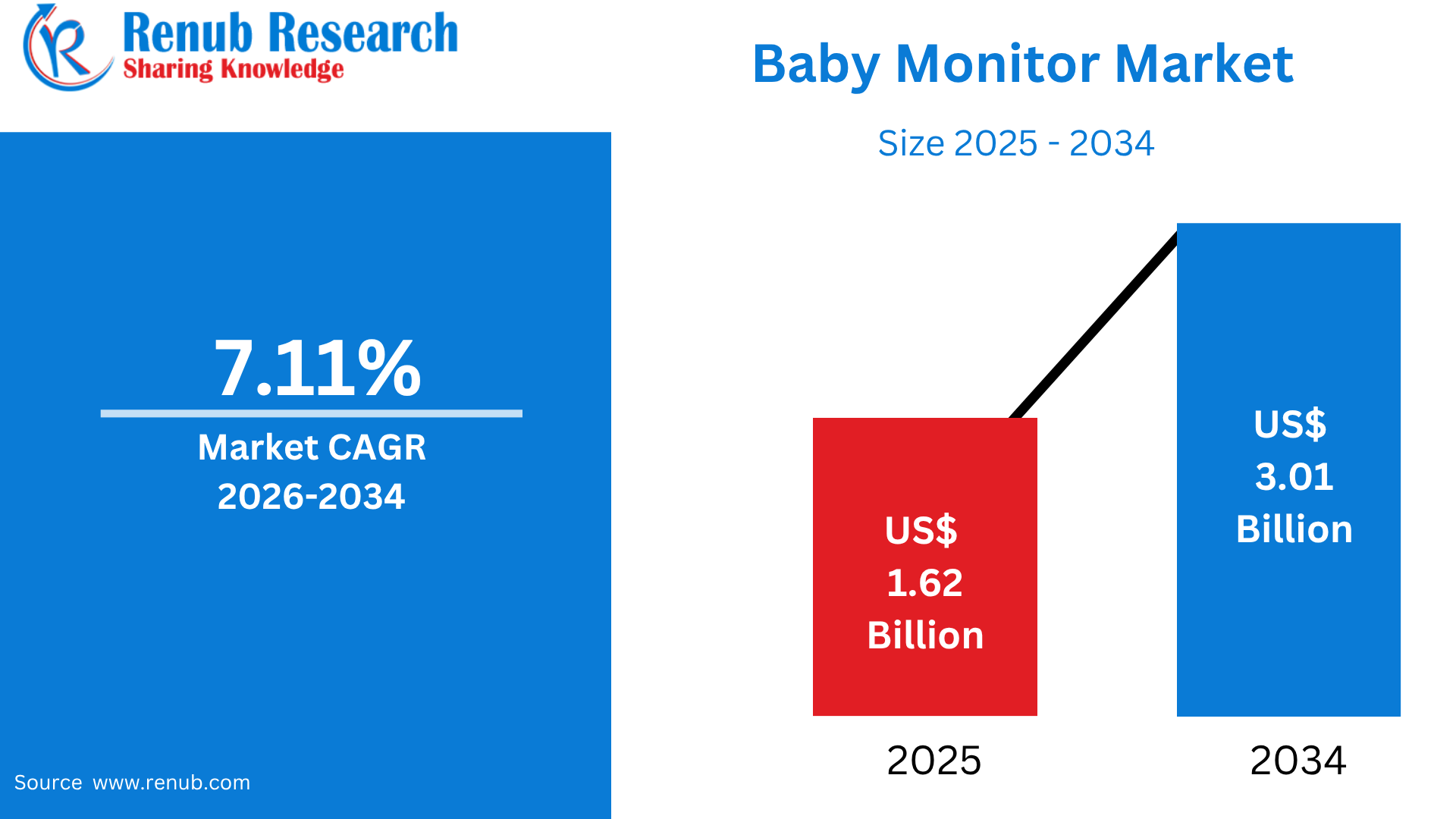
Baby Monitor Market is projected to grow from US$ 1.62 Billion in 2025 to US$ 3.01 Billion by 2034, registering a Compound Annual Growth Rate (CAGR) of 7.11% during the forecast period from 2026 to 2034. Market expansion is being supported by increasing parental awareness regarding infant safety, rapid technological advancements in monitoring devices, and growing adoption of smart home technologies. Rising urbanization and busy lifestyles are also encouraging parents to adopt remote monitoring solutions that provide greater convenience and reassurance while caring for infants.
What is a Baby Monitor and its Uses & Popularity Worldwide?
A baby monitor is an electronic device designed to help parents and caregivers remotely observe and listen to infants, particularly when the child is sleeping or in another room. Traditional models primarily provide audio transmission, while modern devices increasingly combine high-definition video, night vision, two-way communication, temperature and humidity sensing, motion detection, sleep tracking, and smartphone connectivity. Internet-enabled monitors can transmit live audio and video through mobile applications, allowing caregivers to check their baby remotely. The global popularity of baby monitors is supported by increasing parental awareness of infant safety, busy lifestyles, nuclear-family structures, and the growing adoption of connected-home technologies. UNICEF estimates that the world has more than 200 million children under five, highlighting the substantial global population requiring infant and early-childhood care. Growing smartphone and internet adoption is also making app-connected monitoring more accessible, while AI-enabled alerts and sleep analytics are transforming baby monitors from simple surveillance products into broader digital childcare solutions.
Top 10 Countries by Number of Newborn Babies, 2025
- India: ~23.07 million newborns
- China: ~8.71 million newborns
- Nigeria: ~7.64 million newborns
- Pakistan: ~6.91 million newborns
- Democratic Republic of the Congo: ~4.56 million newborns
- Indonesia: ~4.44 million newborns
- Ethiopia: ~4.18 million newborns
- United States: ~3.66 million newborns
- Bangladesh: ~3.50 million newborns
- Brazil: ~2.4–2.5 million newborns
UN World Population Prospects data
Growth Drivers of the Baby Monitor Market
Rising Parental Awareness and Focus on Infant Safety
Growing parental awareness of infant safety is a major factor supporting demand for baby monitors worldwide. Parents increasingly seek continuous visibility of sleeping infants without remaining physically beside the crib, encouraging adoption of audio, video, motion-sensing, and connected monitoring systems. This demand is reinforced by ongoing concerns about infant and child health. In 2024, approximately 4.9 million children under five died globally, while neonatal deaths accounted for 2.3 million, or 47%, of all under-five deaths. Although baby monitors cannot prevent medical complications, the statistics reinforce the importance parents place on observing infants and responding promptly to unusual situations. Modern monitors can provide real-time video, movement notifications, sound alerts, room-temperature information, and two-way communication, improving parents’ awareness of the infant’s environment. The growing availability of smart monitoring systems is therefore shifting consumer preferences from basic audio devices toward multifunctional products capable of providing greater reassurance, convenience, and remote visibility. This heightened safety consciousness is expected to remain a fundamental driver of market expansion.
Rapid Adoption of Smart and Connected Baby-Monitoring Technologies
Technological advancement is transforming baby monitors from basic audio receivers into connected childcare platforms. Wi-Fi connectivity, smartphone applications, artificial intelligence, cloud services, high-definition cameras, sleep analytics, motion detection, and environmental sensors are expanding the functionality of these devices. Connected products allow parents to monitor infants remotely through smartphones and receive alerts when sound, movement, temperature, or other predefined conditions change. AI-powered systems are also increasingly capable of identifying patterns in sleep and activity, increasing the perceived value of premium devices. The wider growth of smart-home ecosystems further supports adoption because consumers are becoming accustomed to connected cameras, speakers, sensors, and mobile-controlled devices. Consequently, manufacturers are integrating baby monitors with broader home-automation environments, encouraging replacement of conventional audio-only products and creating opportunities for higher-value connected monitoring solutions.
Growth of Working Parents, Urban Households, and Digital Parenting
Changing household structures and increasingly busy lifestyles are encouraging parents to adopt technologies that provide greater flexibility in childcare. Urban families, dual-income households, and parents who divide childcare responsibilities across multiple locations can benefit from remote monitoring that allows them to check an infant without being physically present in the same room. Market research identifies working parents as a key growth driver for smart baby-monitor adoption, while urbanization and nuclear-family structures are also supporting the wider baby-monitoring-devices market. Digital parenting habits further strengthen this opportunity. Pew Research found that 68% of parents with minor children reported that their smartphone at least sometimes distracted them from spending quality time with their children, demonstrating how deeply mobile technology is integrated into modern parenting routines. Smartphone-connected baby monitors fit naturally into this digital environment by allowing caregivers to receive notifications and view their child remotely. As e-commerce also expands access to connected childcare products, these devices are becoming increasingly convenient for digitally engaged households worldwide.
Challenges of the Baby Monitor Market
Privacy, Cybersecurity, and Data-Security Concerns
Privacy and cybersecurity concerns represent a significant challenge for connected baby monitors because many products continuously capture highly sensitive audio and video inside homes. Wi-Fi-enabled devices may transmit recordings or live feeds through cloud platforms and smartphone applications, creating potential exposure to unauthorized access if manufacturers or consumers do not implement adequate security measures. The increasing integration of AI and cloud-based analytics can further increase the amount of personal and household information collected by monitoring systems. Parents are particularly sensitive to digital risks involving children. Although these statistics concern children’s broader digital environment rather than baby monitors specifically, they demonstrate the high level of parental sensitivity toward child-related digital security. Manufacturers therefore need strong encryption, secure authentication, regular software updates, transparent data policies, and privacy-by-design approaches. Failure to address these concerns can reduce consumer trust and slow adoption of connected monitoring products.
High Cost and Complexity of Advanced Monitoring Devices
The increasing sophistication of baby monitors can create affordability and usability barriers, particularly in price-sensitive markets. Basic audio monitors are relatively inexpensive, whereas premium connected products can incorporate high-resolution cameras, night vision, cloud storage, AI analytics, sleep tracking, environmental sensors, and subscription-based services. These additional capabilities increase product and ownership costs, potentially limiting adoption among lower-income households. Complexity is another concern because parents may need to configure Wi-Fi networks, mobile applications, cloud accounts, firmware updates, and multiple alert settings. Poor connectivity can also reduce the reliability of internet-based monitoring, particularly in areas with limited broadband infrastructure. As manufacturers add more features, they must maintain simple interfaces and dependable performance while controlling prices. Companies that can deliver essential safety and monitoring capabilities at accessible price points are therefore better positioned to expand adoption across emerging and price-sensitive markets.
Baby Monitor Launches Worldwide
- Momcozy BM08 Contact-Free Smart Baby Monitor – 2026
Momcozy launched the BM08 Contact-Free Smart Baby Monitor in May 2026, using millimeter-wave (mmWave) radar technology to monitor breathing and heart dynamics without wearables, sensor pads, or physical contact. The monitor launched at US$249.99. - Owlet Dream Sight & Dream Duo – 2025
Owlet launched its Dream Sight HD Video Monitor and next-generation Dream Duo in September 2025. Dream Sight provides 2K HD video monitoring, while Dream Duo combines video and sleep monitoring with health tracking capabilities. Dream Sight launched at US$99.99 and became available across the U.S., Canada, UK, and Europe. - CuboAi Smart Baby Monitor 3 – 2025
CuboAi introduced its third-generation Smart Baby Monitor in January 2025, expanding its connected baby-monitoring portfolio with faster and smarter monitoring capabilities. The launch reflects growing demand for AI-enabled infant monitoring and connected parenting technologies. - eufy Baby Monitor E20 & E21 – 2024
eufy launched the E20 and E21 Baby Monitors in November 2024. The E21 features 4K HD resolution and 8× zoom, while both models include a 5-inch display, up to 1,000-foot open-area connection range, and local microSD storage. Prices started at US$169.99 for E20 and US$249.99 for E21. - Philips Avent Premium Connected Baby Monitor – 2024
Philips Avent launched its Premium Connected Baby Monitor in October 2024. The device incorporates SenseIQ technology for wearable-free sleep and breathing tracking, along with AI-based cry detection and translation. Parents can use a dedicated parent unit or the Baby Monitor+ smartphone application. - Gigaset Baby Monitor Portfolio – 2024/2025
Gigaset entered the baby-monitor market in 2024 with a new portfolio of four baby-monitor models, ranging from audio-only monitoring to video monitoring with a large screen and smartphone application. The products were initially targeted at Germany and Austria, with sales planned from spring 2025. - Momcozy BM03 5.5-Inch Full HD Baby Monitor – 2024
Momcozy launched the BM03 5.5-inch Full HD Baby Monitor in July 2024. The non-Wi-Fi monitor offered a claimed 1,640-foot transmission range and up to 120 hours of battery life, targeting parents seeking long-range monitoring without dependence on internet connectivity. - Ellie Baby Plus – 2024
Ellie launched Ellie Baby Plus in June 2024 as a non-Wi-Fi baby monitor incorporating advanced AI functions. The system allows parents to access AI monitoring features through a dedicated screen without requiring Wi-Fi, while also supporting smartphone connectivity. Local SD-card storage was emphasized as a privacy-oriented feature. - Maxi-Cosi See Pro 360° Baby Monitor – 2024
Maxi-Cosi launched the See Pro 360° Baby Monitor in January 2024 with CryAssist AI technology, designed to analyze and interpret different types of baby cries. The system aims to help parents identify whether a baby may be hungry, sleepy, fussy, gassy, or agitated, adding AI-based interpretation to conventional video monitoring. - Timeflys Baby Monitor & Doorbell 2-in-1 – 2024
Timeflys launched a Baby Monitor and Doorbell 2-in-1 in September 2024, combining infant monitoring with home-security functionality. The system offers a 1,000-foot transmission range, zero-latency display, and portable HD screen, allowing parents to monitor their child while also integrating doorbell functionality into the household.
United States Baby Monitor Market
United States baby monitor market is one of the most advanced markets globally, supported by high parental awareness, strong purchasing power, and widespread adoption of connected-home technologies. Video-based monitoring is gaining particular importance because parents increasingly want real-time visual supervision of sleeping patterns, movements, and nursery conditions. Smart baby monitors are also benefiting from integration with smartphones, smart speakers, artificial intelligence, motion detection, and remote alerts. United States accounted for more than 80% of North America’s smart baby monitor market in 2025, reflecting its strong technology ecosystem and consumer preference for connected childcare products. Working parents, urban households, and digitally connected families are further encouraging demand for remote monitoring solutions. Consequently, manufacturers are increasingly competing through advanced video quality, AI-powered insights, sleep analytics, and seamless smart-home integration.
United Kingdom Baby Monitor Market
United Kingdom baby monitor market is supported by high internet connectivity, strong adoption of smart-home technologies, and growing parental interest in connected childcare solutions. The country’s digital infrastructure provides favorable conditions for Wi-Fi-enabled baby monitors that allow parents to access live video, receive notifications, and communicate with infants through smartphones. In 2025/26, 95% of UK adults reported using the internet during the previous three months, while 91% reported using broadband or home internet, demonstrating the country’s highly connected consumer environment. Ofcom data also shows that 2% of households owned smart baby monitors that could be viewed or used for communication through mobile phones or smart speakers, with ownership reaching 6% among adults aged 25–34, an important age group for new parents. In addition, the UK had approximately 29.0 million households in 2025, providing a large household base for baby-care products. Rising adoption of connected devices, online retail, and smart-home ecosystems is expected to support continued demand for advanced baby monitoring solutions.
China Baby Monitor Market
China baby monitor market is expanding as urban households increasingly adopt connected consumer electronics, smart-home devices, and digitally enabled childcare products. China benefits from a strong domestic electronics manufacturing ecosystem, extensive e-commerce infrastructure, and widespread smartphone usage, allowing manufacturers to offer feature-rich monitoring devices at different price points. Demand is increasingly shifting toward Wi-Fi-connected cameras, high-definition video, night vision, two-way communication, cloud storage, and AI-enabled alerts. E-commerce is particularly important because consumers can compare products, access reviews, and purchase devices through China’s extensive digital retail ecosystem. Urban parents are also increasingly interested in technologies that provide remote visibility of infants while managing work and household responsibilities. The country’s large population and substantial urban consumer base provide significant long-term opportunities for baby-monitor manufacturers. Competition among domestic technology companies and specialized childcare brands is encouraging improvements in image quality, intelligent motion recognition, privacy controls, and affordability. As smart-home ecosystems become increasingly integrated into Chinese households, baby monitors are likely to develop from standalone surveillance devices into connected components of broader digital parenting environments.
United Arab Emirates Baby Monitor Market
United Arab Emirates baby monitor market is supported by high purchasing power, advanced digital infrastructure, strong smartphone penetration, and consumer interest in premium smart-home products. Parents in the UAE increasingly favor connected baby monitors featuring high-definition video, night vision, two-way audio, motion detection, temperature monitoring, and smartphone-based remote access. The country’s highly connected lifestyle provides favorable conditions for Wi-Fi-enabled childcare devices, while established international brands benefit from sophisticated retail and e-commerce channels. The market is also influenced by the UAE’s expatriate-heavy population, where families may seek convenient technologies that allow parents to monitor infants while working or managing busy urban lifestyles. Premium products with advanced connectivity and intelligent monitoring capabilities can command greater consumer interest because purchasing decisions are often influenced by convenience, reliability, and technology features. Dubai and Abu Dhabi represent important demand centers because of their concentration of affluent households, modern residential developments, and technology-oriented consumers. As smart-home adoption expands and parents increasingly seek convenient childcare solutions, demand for connected baby monitors is expected to increase, particularly for premium video and AI-enabled devices.
Recent Developments in Baby Monitor Market
- September 2025: Owlet launched the Dream Sight baby monitor at USD 99.99, becoming the first brand to achieve the SGS Cybersecurity Mark, which validates end-to-end encryption and secure firmware update protocols. The gadget is positioned as a clinical-grade consumer solution by integrating with Owlet's FDA-approved Dream Sock wearable to offer associated video and biometric monitoring.
- October 2024: The Philips Avent Connected Baby Monitor with a mobile app was introduced by Philips, a world leader in health technology and innovation. To improve children's safety and wellbeing, this monitor incorporates cutting-edge technologies. It gives parents a complete picture of their child's surroundings, even in low light, thanks to motion detection, two-way communication, high-definition video streaming, and clear audio transmission.
Baby Monitor Market Segments
Product Type
- Audio Baby Monitor
- Video Baby Monitor
- Motion Sensor Baby Monitor
Mode of Communication
- Wired
- Wireless/Wi-Fi
Distribution Channel
- Online Retail Stores
- Hypermarkets/Supermarket
- Specialty Stores
- Other Distribution Channels
Countries
North America
- United States
- Canada
Europe
- France
- Germany
- Italy
- Spain
- United Kingdom
- Belgium
- Netherlands
- Turkey
Asia Pacific
- China
- Japan
- India
- Australia
- South Korea
- Thailand
- Malaysia
- Indonesia
- New Zealand
Latin America
- Brazil
- Mexico
- Argentina
Middle East & Africa
- South Africa
- Saudi Arabia
- United Arab Emirates
All companies have been covered with 5 Viewpoints
- Overviews
- Key Person
- Recent Developments
- SWOT Analysis
- Revenue Analysis
Key Players Analysis
- Lenovo Group Limited
- Samsung Group
- Hanwha Corporation
- Panasonic Holdings Corporation
- Koninklijke Philips N.V.
- Infant Optics
- Dorel Industries Inc.
- VTech Communications Inc.
- Anker Technology (UK) Limited
Report Details:
| Report Features | Details |
| Base Year |
2025 |
| Historical Period |
2022 - 2025 |
| Forecast Period |
2026 - 2034 |
| Market |
US$ Billion |
| Segment Covered |
Product Type, Mode of Communication, Distribution Channel and Countries |
| Countries Covered |
|
| Companies Covered |
|
| Customization Scope |
20% Free Customization |
| Post-Sale Analyst Support |
1 Year (52 Weeks) |
| Delivery Format |
PDF and Excel through Email (We can also provide the editable version of the report in PPT/Word format on request) |
Customization Services available
- Analysis of Market Size and Its Segments
- More Company Profiles (Upto 10 without any additional cost):
- Additional Countries (Other than mentioned Countries):
- Region/Country Specific Reports:
- Market Entry Strategy:
- Region-Specific Market Dynamics:
- Regional Market Share Analysis:
- Trade Analysis:
- Production Insights:
- Others Customized Requests:
For more information contact our analysts.
Need More Assistance?
- Talk to our analysts to get more precious information on the current market trends.
- Include more countries and segments and customize the report based on the final requirement.
- Get a competitive advantage in your industry by knowing the report findings and making a positive impact on your revenues and operations.
- Our analysts are always ready to provide more help and pertinent information if you need any additional assistance.