Azodicarbonamide Market Size, Share, Growth, Trends, Industry Analysis & Forecast 2026–2034
Buy NowAzodicarbonamide Market Size & Forecast
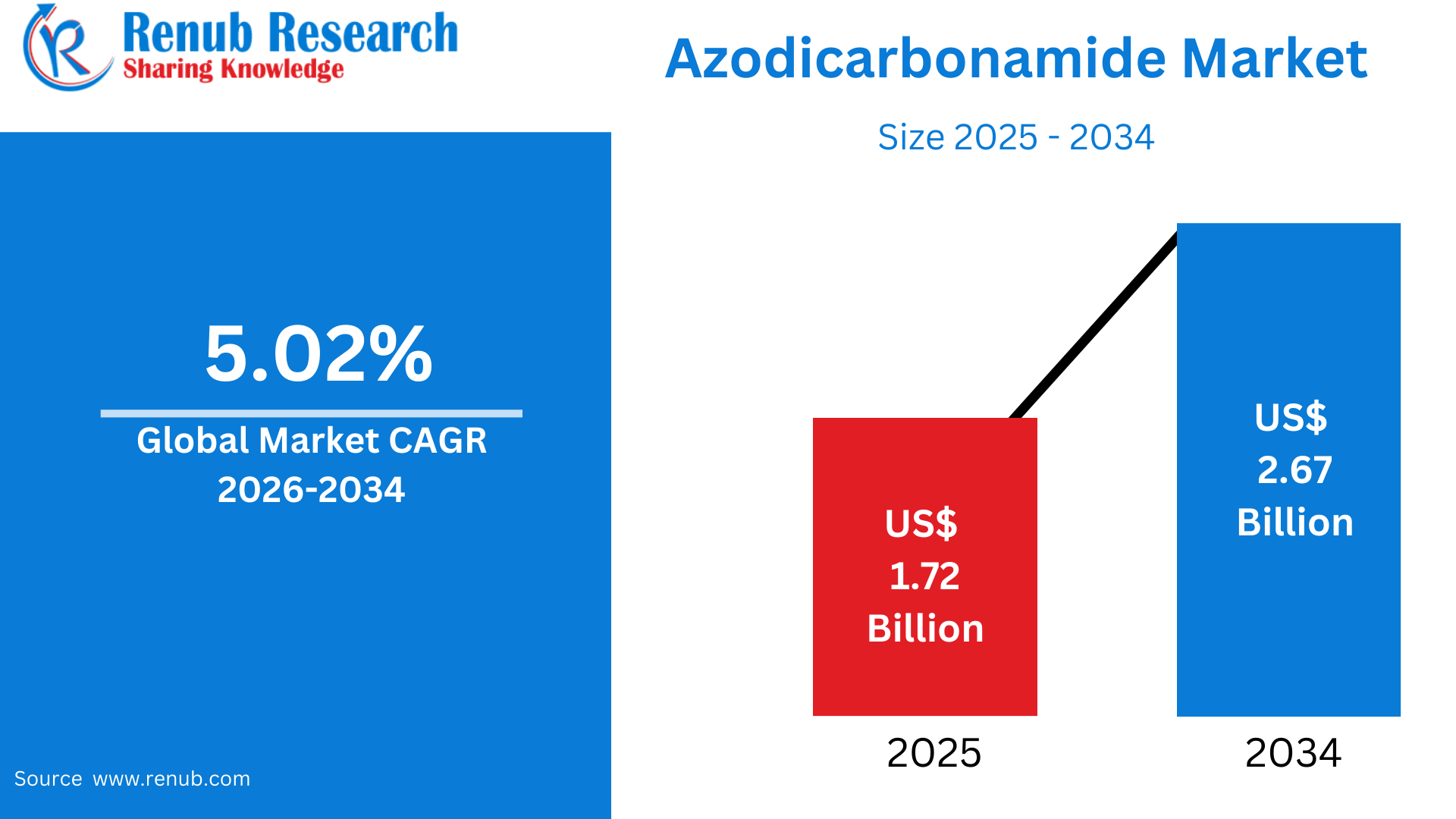
Azodicarbonamide Market is projected to grow from US$ 1.72 billion in 2025 to US$ 2.67 billion by 2034, registering a CAGR of 5.02% during the forecast period from 2026 to 2034. Market growth is primarily driven by strong demand from the plastics, rubber, and food processing industries, where azodicarbonamide is widely used as a chemical blowing agent and dough conditioner. Increasing applications in construction materials, footwear, automotive components, and packaging products are further supporting market expansion. The growing demand for lightweight polymer-based products and foam materials continues to create new growth opportunities.
What is Azodicarbonamide? Its Uses & Popularity Worldwide
Azodicarbonamide (ADA) is a synthetic chemical compound primarily used as a chemical blowing agent in the plastics and rubber industries and, in some countries, as a flour treatment and dough conditioning agent in food processing. In industrial applications, azodicarbonamide decomposes when heated, releasing gases such as nitrogen and carbon monoxide that create a uniform cellular structure in materials. This property makes it highly effective for manufacturing lightweight foam products with improved insulation, flexibility, cushioning, and durability. It is widely used in the production of PVC foam, polyethylene foam, EVA foam, synthetic leather, footwear soles, automotive components, construction materials, insulation products, packaging, sports equipment, and various consumer goods. In food applications, where permitted by regulations, azodicarbonamide helps improve dough elasticity, texture, consistency, and baking performance.
Globally, azodicarbonamide remains an important industrial chemical because of its efficiency, cost-effectiveness, and compatibility with multiple polymer manufacturing processes. Demand is particularly strong in rapidly industrializing regions where construction, automotive, packaging, and footwear industries continue to expand. The increasing use of lightweight polymer foams in building insulation, transportation, and consumer products further supports market growth. However, its application in food products has become increasingly restricted or prohibited in several countries due to health and regulatory concerns, encouraging manufacturers to adopt alternative dough conditioners. Despite these regulatory differences, azodicarbonamide continues to maintain strong worldwide demand, particularly in industrial manufacturing, where it remains one of the most widely used chemical blowing agents for producing high-quality foam materials.
Growth Drivers for the Azodicarbonamide Market
Rising Demand from the Plastics and Foam Manufacturing Industry
The increasing use of lightweight polymer foams across multiple industries is one of the key factors driving the growth of the azodicarbonamide (ADA) market. Azodicarbonamide is widely used as a chemical blowing agent in the production of foamed plastics such as polyvinyl chloride (PVC), polyethylene (PE), ethylene-vinyl acetate (EVA), and polyurethane. These foam materials are extensively utilized in construction insulation, packaging, automotive components, flooring, furniture, sports equipment, and consumer goods due to their lightweight structure, durability, thermal insulation, and cushioning properties. The rapid expansion of the construction industry, increasing demand for energy-efficient buildings, and growing adoption of lightweight materials in transportation are significantly boosting consumption of foamed plastics worldwide. In addition, technological advancements in polymer processing and foam manufacturing have improved production efficiency and product quality, further increasing the demand for high-performance blowing agents. As industrialization and infrastructure development continue across emerging economies, particularly in Asia-Pacific, the demand for azodicarbonamide is expected to remain strong.
Expanding Rubber and Footwear Manufacturing
The continued growth of the global rubber and footwear industries is another major driver supporting the azodicarbonamide market. ADA is extensively used in rubber processing to improve flexibility, elasticity, durability, and product consistency while also serving as a blowing agent for producing lightweight rubber foams. It plays an important role in manufacturing footwear soles, automotive seals, rubber mats, insulation materials, sporting goods, and industrial rubber products. Rising global footwear production, supported by increasing disposable incomes, urbanization, and changing fashion trends, continues to stimulate demand for lightweight and comfortable shoe materials manufactured using azodicarbonamide. Similarly, the expansion of automotive manufacturing and industrial equipment production is increasing the need for high-performance rubber components that offer superior mechanical properties and long service life. Manufacturers continue to prefer ADA because of its cost-effectiveness, reliable processing characteristics, and ability to produce uniform foam structures. Growing industrial activity in Asia-Pacific and Latin America is expected to further strengthen demand from the rubber and footwear sectors.
Growing Demand from the Food Processing Industry
The food processing industry also contributes to the growth of the azodicarbonamide market, particularly in countries where its use as a dough conditioner remains approved. In commercial baking, azodicarbonamide is used to strengthen gluten, improve dough elasticity, enhance bread volume, and deliver consistent product quality during large-scale production. The growing consumption of packaged bread, bakery products, and convenience foods, driven by urbanization, changing lifestyles, and expanding food processing industries, continues to support demand in this application. Industrial bakeries benefit from ADA’s ability to improve production efficiency, product uniformity, and shelf stability while reducing processing variability. Although regulatory restrictions have limited its use in several countries, controlled applications continue in certain markets where food safety authorities permit its use within established limits. As demand for mass-produced bakery products remains strong in many developing economies, azodicarbonamide continues to play a role in supporting efficient commercial baking operations where regulations allow its application.
Challenges in the Azodicarbonamide Market
Increasing Regulatory Restrictions and Health Concerns
One of the most significant challenges facing the azodicarbonamide market is the growing regulatory scrutiny surrounding its use, particularly in food applications. During baking, azodicarbonamide can decompose into compounds such as semicarbazide (SEM), which has raised health-related concerns among regulatory authorities and consumers. Consequently, several countries, including members of the European Union and other developed markets, have banned or significantly restricted its use as a food additive. Even in regions where its application remains permitted, manufacturers must comply with strict concentration limits, labeling requirements, and product safety regulations, increasing compliance costs and operational complexity. Growing consumer preference for natural ingredients, clean-label foods, and enzyme-based dough conditioners is further encouraging food manufacturers to seek alternative processing aids. As health awareness continues to rise worldwide, regulatory pressures are expected to limit growth opportunities for food-grade azodicarbonamide while encouraging investment in safer substitute technologies.
Raw Material Price Fluctuations and Environmental Compliance
The azodicarbonamide market also faces ongoing challenges related to raw material price volatility and increasingly stringent environmental regulations. Production of ADA depends on industrial chemicals such as urea, hydrazine derivatives, and other petrochemical intermediates, whose prices fluctuate according to changes in crude oil, natural gas, and global chemical supply chains. These fluctuations directly affect manufacturing costs and profit margins for producers. In addition, the production and processing of azodicarbonamide require careful management of industrial emissions, waste disposal, and environmental safety standards. Governments worldwide are implementing stricter environmental regulations to reduce industrial pollution and promote sustainable chemical manufacturing practices. Compliance with these regulations often requires significant investment in emission control technologies, waste treatment systems, and cleaner production processes. Furthermore, industries such as plastics, rubber, and chemicals are increasingly adopting environmentally friendly manufacturing methods, placing additional pressure on producers to develop more sustainable blowing agents while maintaining product performance and cost competitiveness.
Food Grade Azodicarbonamide Improving Dough Quality in Commercial Baking
Food Grade Azodicarbonamide Market serves the commercial baking industry by supplying azodicarbonamide as a dough conditioning and flour treatment agent. It is primarily used to strengthen gluten networks, improve dough elasticity, enhance bread volume, and produce a more uniform crumb structure in baked products. Large-scale bakeries and food processors value its ability to deliver consistent product quality, reduce processing time, and improve manufacturing efficiency. Food-grade azodicarbonamide is commonly utilized in the production of bread, buns, pizza bases, rolls, and bakery mixes where regulations permit its use. However, the market is strongly influenced by regional regulatory policies, as several countries have restricted or prohibited its application due to health concerns, while others continue to allow its controlled use within prescribed safety limits. Manufacturers are increasingly focusing on regulatory compliance, quality assurance, and product traceability while also exploring alternative dough improvers. Despite regulatory challenges, demand remains stable in approved markets where industrial baking continues to expand and consistent product quality remains a priority.
Plastic and Rubber Azodicarbonamide Expanding Demand for Lightweight Foam Materials
Plastic and Rubber Azodicarbonamide Market represents the largest application segment for azodicarbonamide, driven by its effectiveness as a chemical blowing agent in producing lightweight polymer and rubber foams. When heated during processing, azodicarbonamide releases gases that create a uniform cellular structure, improving flexibility, cushioning, insulation, and weight reduction in finished products. It is widely used in manufacturing PVC foam, polyethylene foam, EVA foam, rubber sheets, footwear soles, automotive components, insulation materials, packaging products, sports equipment, and construction materials. Increasing demand for lightweight, durable, and energy-efficient materials across the automotive, construction, and consumer goods industries continues to drive market growth. Rapid industrialization and infrastructure development, particularly in emerging economies, further support rising consumption. Manufacturers continue investing in advanced blowing agent technologies that improve processing efficiency, product consistency, and environmental performance while meeting evolving industrial quality standards. The expanding plastics and rubber industries are expected to remain the primary growth engine for this market.
Food and Beverage Azodicarbonamide Supporting Industrial Bakery Production
The Food and Beverage Azodicarbonamide Market is driven primarily by the commercial bakery sector, where azodicarbonamide is used to improve dough handling characteristics and maintain consistent product quality. It functions as an oxidizing agent that strengthens gluten formation, resulting in improved dough elasticity, higher loaf volume, better texture, and enhanced processing performance during large-scale bread production. Industrial bakeries utilize azodicarbonamide to standardize manufacturing processes, reduce production variability, and improve operational efficiency. Although its use is permitted in some countries under regulated conditions, increasing consumer preference for clean-label ingredients and stricter food safety regulations have encouraged many manufacturers to adopt alternative dough conditioners. Nevertheless, commercial bakeries operating in markets where its use remains approved continue to value its cost-effectiveness and reliable performance. The market is expected to evolve as food manufacturers balance regulatory compliance, consumer expectations, product quality, and manufacturing efficiency while expanding production of packaged bakery products to meet growing global demand.
Azodicarbonamide Industrial Applications Driving Global Growth
The Azodicarbonamide Market continues to expand due to its broad industrial applications across plastics, rubber, construction, automotive, footwear, packaging, textiles, and food processing industries. As one of the most widely used chemical blowing agents, azodicarbonamide enables manufacturers to produce lightweight foam materials with excellent insulation, flexibility, durability, and mechanical strength. Growing demand for energy-efficient construction materials, lightweight automotive components, comfortable footwear, and high-performance packaging solutions continues to support market expansion worldwide. Rapid industrialization, infrastructure development, and increasing polymer production in emerging economies further strengthen demand. While industrial applications remain the dominant market segment, regulatory restrictions affecting food-grade azodicarbonamide have encouraged manufacturers to diversify toward higher-value industrial uses. Ongoing research and development efforts focus on improving blowing efficiency, reducing environmental impact, and enhancing compatibility with modern polymer processing technologies. Continuous innovation and expanding industrial applications are expected to support the long-term growth of the global azodicarbonamide market.
Leather and Textile Azodicarbonamide Enhancing Lightweight Synthetic Materials
Leather and Textile Azodicarbonamide Market is growing steadily as manufacturers increasingly utilize azodicarbonamide in the production of synthetic leather, coated fabrics, foam-backed textiles, and specialty industrial materials. As a chemical blowing agent, azodicarbonamide creates fine, uniform cellular structures within polymer coatings, producing lightweight, flexible, and durable materials with improved cushioning and insulation properties. Synthetic leather manufactured using azodicarbonamide is widely used in footwear, automotive interiors, furniture upholstery, luggage, sports equipment, fashion accessories, and consumer products. The expanding demand for artificial leather as a cost-effective and animal-free alternative to natural leather continues to create new growth opportunities. In the textile industry, azodicarbonamide contributes to the production of foam laminates, insulation fabrics, and performance textiles that require enhanced comfort and durability. Manufacturers are increasingly adopting advanced processing technologies to improve product quality, reduce material consumption, and comply with evolving environmental regulations, supporting continued growth across the global leather and textile industries.
United States Azodicarbonamide Strong Industrial Applications Supporting Stable Demand
The United States Azodicarbonamide Market is a mature industrial market driven primarily by demand from the plastics, rubber, construction, automotive, and packaging industries. Azodicarbonamide is extensively used as a chemical blowing agent in the production of lightweight polymer foams, insulation materials, footwear components, and automotive parts, where its ability to improve product strength, flexibility, and thermal insulation is highly valued. The country’s advanced manufacturing sector and continuous investment in high-performance materials continue to support industrial consumption. In the food industry, however, the use of azodicarbonamide has declined due to increasing consumer awareness, preference for clean-label ingredients, and the availability of alternative dough conditioners, despite its regulated approval for certain applications. Environmental regulations and occupational safety standards also encourage manufacturers to adopt cleaner production technologies and improve emission control systems. Ongoing innovation in polymer processing, expanding demand for lightweight materials, and technological advancements in foam manufacturing continue to support the long-term growth of the United States azodicarbonamide market.
United Kingdom Azodicarbonamide Industrial Demand Sustaining Market Growth
The United Kingdom Azodicarbonamide Market is primarily supported by industrial applications, particularly within the plastics, rubber, construction, and specialty manufacturing sectors. Azodicarbonamide is widely utilized as a chemical blowing agent in producing lightweight foam products for insulation panels, flooring materials, automotive components, footwear, and industrial packaging. The country’s emphasis on energy-efficient buildings and sustainable construction continues to drive demand for high-performance polymer foam materials. Unlike some international markets, the use of azodicarbonamide in food processing is highly restricted, shifting market dependence almost entirely toward industrial applications. Manufacturers continue investing in advanced polymer processing technologies to improve production efficiency, product quality, and environmental performance while complying with stringent health and environmental regulations. Growing adoption of lightweight materials in transportation and construction, along with increasing investment in advanced manufacturing technologies, is expected to support stable demand for azodicarbonamide across the United Kingdom’s industrial sector over the coming years.
India Azodicarbonamide Expanding Industrial Manufacturing Driving Strong Growth
India Azodicarbonamide Market is witnessing significant growth, supported by rapid industrialization, expanding plastics and rubber manufacturing, and increasing investments in infrastructure development. The chemical is extensively used as a blowing agent in the production of PVC foam, polyethylene foam, footwear soles, synthetic leather, insulation materials, automotive components, and packaging products. India’s rapidly growing construction industry, automotive manufacturing sector, and footwear production continue to generate strong demand for lightweight and durable polymer foam materials. In addition to industrial applications, azodicarbonamide has historically been used in commercial baking where permitted under domestic regulations, although manufacturers are increasingly evaluating alternative dough conditioning agents in response to evolving consumer preferences and regulatory developments. Rising domestic manufacturing under government industrial initiatives, growing exports of footwear and polymer products, and increasing investments in specialty chemicals continue to strengthen market expansion. As India’s manufacturing sector continues to develop, demand for azodicarbonamide in industrial applications is expected to remain robust throughout the forecast period.
Saudi Arabia Azodicarbonamide Construction and Industrial Development Creating New Opportunities
Saudi Arabia Azodicarbonamide Market is growing steadily, driven by expanding industrialization, large-scale infrastructure projects, and increasing demand for advanced polymer materials. Under the Kingdom’s Vision 2030 economic diversification strategy, investments in construction, manufacturing, automotive components, and industrial production have significantly increased the need for lightweight foam materials and specialty chemicals. Azodicarbonamide is widely used in the production of insulation materials, PVC foam, synthetic leather, rubber products, packaging materials, and construction components that support residential, commercial, and industrial development projects. The country’s hot climate also increases demand for thermal insulation products manufactured using polymer foams, further supporting consumption. Growing investments in local manufacturing capabilities, industrial zones, and petrochemical industries are strengthening domestic demand for chemical blowing agents. Although environmental regulations are becoming more stringent, continued expansion of industrial infrastructure, increasing adoption of advanced manufacturing technologies, and diversification of non-oil industries are expected to support sustained growth of the Saudi Arabia azodicarbonamide market over the coming years.
Recent Developments in Azodicarbonamide Market
- In In February 2025, China formally delisted azodicarbonamide from approved food additives under GB 2760-2024, hastening the country's transition to industrial-only uses.
- In July 2024, the Codex Committee on Food Additives agreed to withdraw the international endorsement of azodicarbonamide (INS 927a), sending the proposal for approval by the Codex Alimentarius Commission and indicating global regulatory convergence.
Market Segmentation
Type
- Food Grade
- Industrial Grade
Application
- Plastic and Rubber industry
- Food and Beverage industry
- Leather and Textile industry
- Others
Countries
North America
- United States
- Canada
Europe
- France
- Germany
- Italy
- Spain
- United Kingdom
- Belgium
- Netherlands
- Turkey
Asia Pacific
- China
- Japan
- India
- Australia
- South Korea
- Thailand
- Malaysia
- Indonesia
- New Zealand
Latin America
- Brazil
- Mexico
- Argentina
Middle East & Africa
- South Africa
- Saudi Arabia
- United Arab Emirates
All the key players have been covered from 5 Viewpoints:
- Overview
- Key Persons
- Recent Development
- SWOT Analysis
- Financial Insights
Key Players Analysis:
- Lanxess AG
- Otsuka Chemical Co. Ltd
- Jiangxi Selon Industrial Co. Ltd
- Abtonsmart Chemicals (Group) Co. Ltd
- Haihang Industry Co. Ltd
- SPL Group
- Nikunj Chemical Limited
- Sri Dwarikadheesh Polymers Pvt. Ltd.
Report Details:
| Report Features | Details |
| Base Year |
2025 |
| Historical Period |
2022 - 2025 |
| Forecast Period |
2026 - 2034 |
| Market |
US$ Billion |
| Segment Covered |
Type, Application and Countries |
| Countries Covered |
|
| Companies Covered |
|
| Customization Scope |
20% Free Customization |
| Post-Sale Analyst Support |
1 Year (52 Weeks) |
| Delivery Format |
PDF and Excel through Email (We can also provide the editable version of the report in PPT/Word format on request) |
Customization Services available
- Analysis of Market Size and Its Segments
- More Company Profiles (Upto 10 without any additional cost):
- Additional Countries (Other than mentioned Countries):
- Region/Country Specific Reports:
- Market Entry Strategy:
- Region-Specific Market Dynamics:
- Regional Market Share Analysis:
- Trade Analysis:
- Production Insights:
- Others Customized Requests:
For more information contact our analysts.
Need More Assistance?
- Talk to our analysts to get more precious information on the current market trends.
- Include more countries and segments and customize the report based on the final requirement.
- Get a competitive advantage in your industry by knowing the report findings and making a positive impact on your revenues and operations.
- Our analysts are always ready to provide more help and pertinent information if you need any additional assistance.