Global Automotive Seat Market Report by Seat Type, Vehicle Type, Vehicle Energy Source Type, Technology, Countries and Company Analysis 2026-2034
Buy NowGlobal Automotive Seat Market Size, Lightweight Materials, and Revenue Outlook
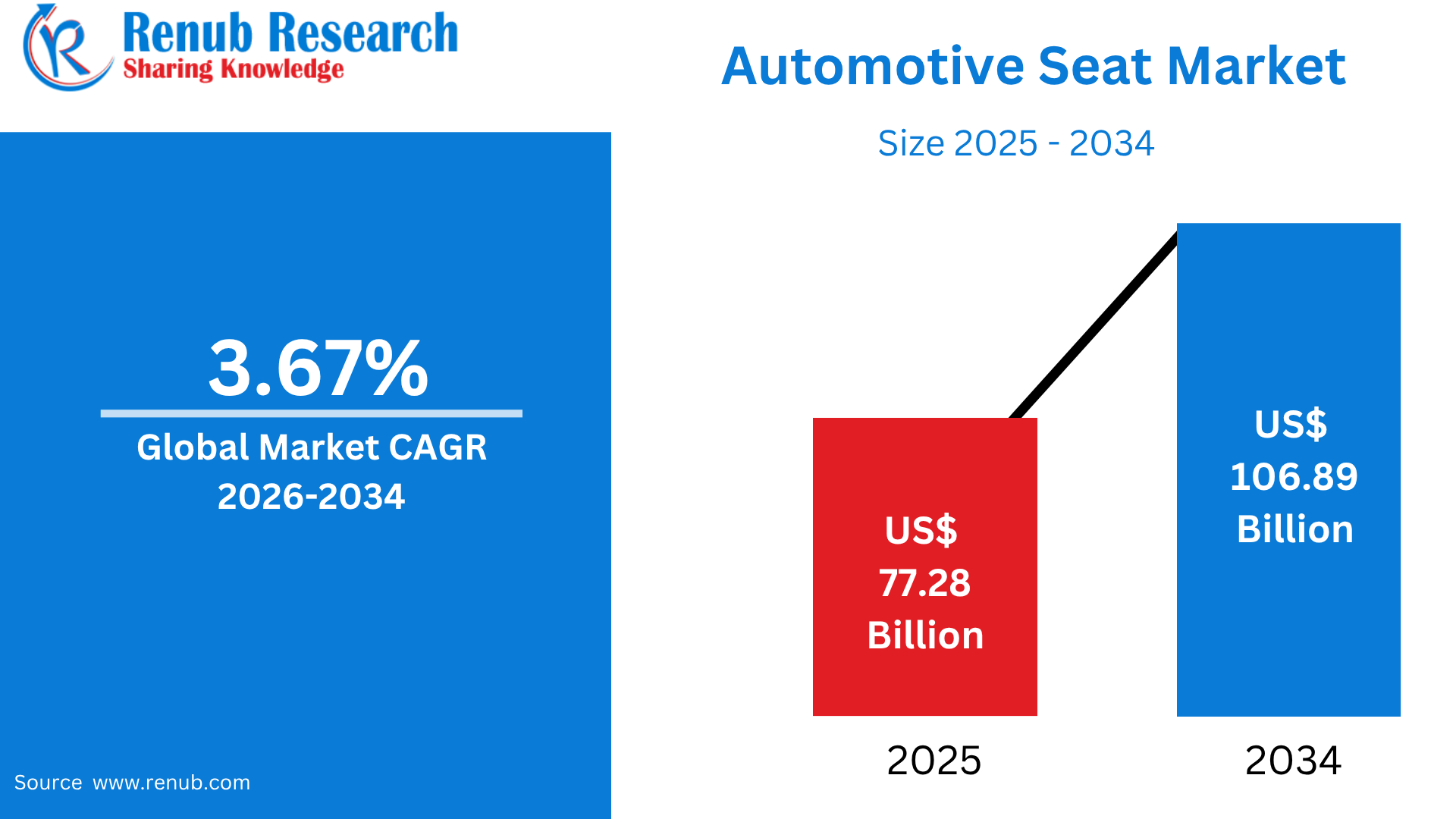
Automotive Seat Market is projected to be valued at US$ 77.28 billion in 2025 and is anticipated to reach US$ 106.89 billion by 2034, expanding at a CAGR of 3.67% during 2026–2034. Market growth is driven by rising global automobile production, growing consumer preference for enhanced comfort, ergonomics, and advanced safety features, and ongoing advancements in smart seating systems. Furthermore, the accelerating adoption of electric vehicles (EVs), connected vehicles, and autonomous driving technologies is expected to create significant opportunities for innovative automotive seating solutions throughout the forecast period.
Evolution of the Automotive Seat: Key Functions, Smart Tech Integration, and Worldwide Trends
Automotive seats are specialized seating systems installed in vehicles to provide comfort, safety, support, and proper posture for drivers and passengers during travel. Modern automotive seats are engineered with advanced materials such as high-strength steel, aluminum, polyurethane foam, leather, synthetic fabrics, and composites to improve durability, reduce weight, and enhance occupant protection. They are equipped with features including adjustable positioning, lumbar support, headrests, heating, ventilation, massage functions, memory settings, and integrated airbags to enhance driving comfort and safety. Automotive seats are used in passenger cars, sport utility vehicles (SUVs), commercial vehicles, buses, trucks, and electric vehicles. They also play a critical role in minimizing injury during collisions by working alongside seat belts and airbag systems.
Worldwide, automotive seats have gained significant popularity due to rising vehicle production, increasing consumer expectations for premium interiors, and growing demand for enhanced comfort and safety. Automakers are investing in ergonomic designs, lightweight seat structures, and smart seating technologies featuring occupancy sensors, biometric monitoring, and electronic adjustments. The rapid growth of electric and autonomous vehicles is further driving innovation in modular and flexible seating configurations. Additionally, increasing adoption of luxury vehicles, connected mobility solutions, and sustainable materials continues to strengthen demand for advanced automotive seating systems across developed and emerging automotive markets.
Global Car Sales by Year (2015–2024)
- 2015: 76.47 million cars sold globally.
- 2016: 81.25 million cars sold, reflecting strong growth in worldwide vehicle demand.
- 2017: 80.00 million cars sold, remaining at historically high levels.
- 2018: 82.00 million cars sold, marking the highest sales during the pre-pandemic period.
- 2019: 77.04 million cars sold as several major automotive markets slowed.
- 2020: 67.50 million cars sold due to the COVID-19 pandemic and global supply chain disruptions.
- 2021: 70.97 million cars sold, showing gradual recovery supported by improving production.
- 2022: 68.00 million cars sold, impacted by semiconductor shortages and supply constraints.
- 2023: 76.11 million cars sold, driven by strong recovery and rising electric vehicle adoption.
- 2024: 79.55 million cars sold, reflecting continued growth in both electric and conventional vehicle markets.
Source: International Organization of Motor Vehicle Manufacturers (OICA)
Growth Driver
Rising Global Vehicle Production and Automotive Sales
The steady increase in global vehicle production remains one of the primary growth drivers for the automotive seat market. Worldwide automobile production exceeds 90 million vehicles annually, with passenger cars accounting for approximately 70–75% of total output. Every newly manufactured vehicle requires multiple seating systems, directly linking seat demand to automotive production volumes. Growing demand for sport utility vehicles (SUVs), crossovers, and premium passenger cars has increased the adoption of advanced seating featuring power adjustment, heating, ventilation, massage functions, and memory settings. Emerging economies continue witnessing higher vehicle ownership due to rising disposable incomes and urbanization, further expanding market opportunities. Commercial vehicle production is also increasing to support logistics, e-commerce, and public transportation, boosting demand for durable seating solutions. Automakers are continuously introducing new vehicle models with enhanced interior comfort and ergonomic seating to differentiate their products. Continuous investments in automotive manufacturing facilities and expanding production capacity are expected to sustain long-term growth in the global automotive seat market.
Growing Demand for Premium Comfort, Safety, and Smart Seating Features
Consumer expectations for greater comfort and enhanced safety have significantly accelerated innovation in automotive seating systems. Industry estimates indicate that over 60% of newly launched mid-range and premium passenger vehicles now include electronically adjustable seats, while heated and ventilated seats are becoming increasingly common across multiple vehicle segments. Automotive seats are evolving into intelligent systems incorporating occupancy sensors, integrated airbags, lumbar support, massage functions, posture monitoring, and memory settings. Safety regulations requiring improved occupant protection have encouraged manufacturers to integrate side airbags, active head restraints, and seatbelt reminder systems directly into seat structures. Automakers are also focusing on ergonomic seat designs that reduce driver fatigue during long-distance travel. Artificial intelligence, biometric sensors, and health-monitoring capabilities are emerging as next-generation features, particularly in luxury vehicles. Rising consumer willingness to pay for premium interiors and advanced comfort technologies continues driving strong demand for technologically advanced automotive seating systems worldwide.
Expansion of Electric and Autonomous Vehicles Encouraging Seating Innovation
The rapid expansion of electric vehicles (EVs) and autonomous driving technologies is creating substantial growth opportunities for the automotive seat market. Global electric vehicle sales have surpassed 17 million units annually, accounting for approximately 20% of new passenger vehicle sales in several major automotive markets. EV manufacturers increasingly prioritize lightweight seating structures using aluminum frames, composite materials, and sustainable fabrics to improve driving range and energy efficiency. Autonomous vehicle development is also transforming seat design by introducing rotating seats, reclining configurations, modular layouts, and flexible cabin arrangements that enhance passenger comfort. Smart seating technologies with integrated sensors, climate control, biometric monitoring, and personalized adjustment systems are becoming key differentiators in next-generation vehicle interiors. Sustainability initiatives further encourage the use of recycled plastics, bio-based foams, vegan leather, and environmentally friendly textiles. Continued advancements in connected mobility, shared transportation, and autonomous driving are expected to drive sustained innovation and long-term growth within the global automotive seat market.
Challenge
Volatility in Raw Material Prices and Supply Chain Disruptions
Fluctuating prices of raw materials remain one of the major challenges for the automotive seat market. Automotive seats rely heavily on steel, aluminum, polyurethane foam, leather, synthetic fabrics, electronic components, and specialty plastics, all of which are subject to changing global commodity prices. Raw materials typically account for 40–50% of automotive seat manufacturing costs, making profitability highly sensitive to price volatility. Supply chain disruptions, transportation delays, semiconductor shortages, and geopolitical uncertainties have further complicated procurement strategies for seat manufacturers. Rising logistics costs and limited availability of premium upholstery materials have increased production expenses across the automotive industry. Manufacturers are increasingly diversifying suppliers, adopting regional sourcing strategies, and investing in automation to reduce operational risks. However, balancing production costs while maintaining product quality, safety compliance, and competitive pricing remains a significant challenge for automotive seating companies operating in highly competitive global markets.
Stringent Safety Regulations and Increasing Design Complexity
The automotive seat market faces growing challenges from increasingly stringent vehicle safety regulations and rising product complexity. Automotive seating systems must comply with numerous international crash safety standards covering seat strength, head restraint performance, child restraint compatibility, side-impact protection, and integrated airbag deployment. Modern seats now incorporate more than 100 individual components in many premium vehicle models, significantly increasing engineering complexity and manufacturing precision requirements. Electronic adjustment motors, occupancy sensors, heating systems, ventilation units, memory modules, and advanced wiring harnesses further complicate production and quality assurance processes. Continuous testing for crashworthiness, durability, vibration resistance, and long-term reliability extends product development timelines and increases certification costs. Automakers also require customized seating solutions for different vehicle platforms while maintaining strict weight reduction targets and sustainability objectives. Meeting evolving regulatory requirements, ensuring occupant safety, and managing increasingly sophisticated seat designs continue to present major challenges for manufacturers in the global automotive seat market.
Automotive Seat Launches Worldwide
- June 2026 – Adient launched its Smart Comfort Seat Platform, featuring AI-based occupant posture adjustment, integrated wellness sensors, and enhanced lumbar support for premium passenger vehicles.
- April 2026 – Lear Corporation introduced the Intu™ Intelligent Seating System, integrating biometric monitoring, memory settings, climate control, and over-the-air software update capabilities.
- February 2026 – Forvia (Faurecia) unveiled its Lightweight Sustainable Automotive Seat, utilizing recycled materials, bio-based foam, and modular architecture to reduce vehicle weight and carbon emissions.
- November 2025 – Toyota Boshoku launched its Next-Generation Ergonomic EV Seat, designed with slimmer seat frames, improved cabin space utilization, and integrated seat ventilation for electric vehicles.
- September 2025 – Magna International introduced its ComfortMotion Powered Seat System, incorporating multi-way electronic adjustment, massage functionality, and adaptive side bolsters for luxury vehicles.
- July 2025 – Brose Fahrzeugteile launched its Smart Seat Adjustment Module, featuring faster electric actuators, memory positioning, and energy-efficient motor technology for passenger vehicles.
- May 2025 – Grammer AG unveiled its Premium Commercial Vehicle Seat, offering active suspension, automatic weight adjustment, improved vibration isolation, and enhanced driver ergonomics for trucks and buses.
- March 2025 – TS Tech Co., Ltd. introduced its Eco-Friendly Automotive Seat Series, manufactured with recycled fabrics, lightweight structural components, and sustainable cushioning materials for global automakers.
- October 2024 – RECARO Automotive launched its Podium Carbon Performance Seat, featuring an ultra-lightweight carbon-fiber shell, enhanced lateral support, and FIA-compliant safety design for sports and performance vehicles.
- June 2024 – Isringhausen (ISRINGHAUSEN) introduced its Next Generation Commercial Driver Seat, equipped with advanced air suspension, climate control, ergonomic lumbar adjustment, and intelligent seating controls for heavy-duty commercial vehicles.
Sporty Designs and Enhanced Ergonomics Driving Seat Bucket Demand
Automotive Seat Bucket market is expanding steadily due to rising demand for improved driver comfort, occupant support, and premium vehicle interiors. Bucket seats are designed with contoured side bolsters that provide enhanced lateral support during cornering and long-distance driving. They are widely installed in passenger cars, sports cars, SUVs, pickup trucks, and performance vehicles. Approximately 65–70% of newly manufactured passenger vehicles now feature bucket seats in the front row because of their ergonomic advantages over conventional bench seats. Premium models increasingly incorporate heating, ventilation, massage functions, memory settings, and integrated airbags within bucket seat designs. Manufacturers are also adopting lightweight materials such as high-strength steel, aluminum, magnesium, and composite frames to reduce vehicle weight and improve fuel efficiency. Growing consumer preference for sporty interiors, luxury features, and improved seating comfort continues supporting market growth. Continuous innovation in seat cushioning, smart sensors, and sustainable upholstery materials is expected to strengthen long-term demand for automotive bucket seats worldwide.
Rising Vehicle Production Supporting Passenger Car Seat Expansion
Passenger Car Seat market represents the largest segment of the global automotive seating industry, accounting for approximately 75–80% of total automotive seat demand. Increasing global passenger car production, expanding middle-class populations, and rising consumer demand for comfort continue driving market growth. Modern passenger vehicle seats integrate numerous advanced features including power adjustment, lumbar support, heating, ventilation, massage functions, memory controls, and occupancy detection systems. Safety technologies such as integrated side airbags, active head restraints, and seatbelt reminders have become standard in many mid-range and premium vehicles. Manufacturers increasingly utilize lightweight seat structures and environmentally friendly materials to meet fuel efficiency and sustainability targets. Electric vehicles are further accelerating innovation by requiring thinner, lighter, and more flexible seating systems that maximize cabin space. Growing demand for premium interiors, connected vehicle technologies, and personalized driving experiences continues encouraging automakers to invest in next-generation passenger car seating solutions across global automotive markets.
Commercial Vehicle Demand Sustaining Growth in Diesel Automotive Seat
Automotive Seat Diesel market remains an important segment due to the continued use of diesel-powered commercial vehicles, heavy-duty trucks, buses, agricultural machinery, and construction equipment. Diesel vehicles account for approximately 30–35% of global commercial vehicle production, creating steady demand for durable, ergonomic seating systems capable of supporting extended operating hours. Manufacturers emphasize driver comfort through adjustable suspension seats, air-cushioned seating, lumbar support, armrests, and vibration reduction technologies that minimize fatigue during long-distance transportation. Fleet operators increasingly prioritize durable seat materials with enhanced wear resistance to reduce maintenance costs and extend service life. Commercial vehicle regulations promoting driver safety and workplace ergonomics have further encouraged adoption of advanced seating systems featuring integrated seatbelt technologies and adjustable positioning. Although diesel passenger vehicle production has declined in several regions, demand for specialized seating in logistics, mining, agriculture, and public transportation continues supporting stable growth in the automotive seat diesel market worldwide.
Automotive Seat Electric Vehicle Growth Accelerating Seating Innovation
Automotive Seat Electric market is experiencing rapid expansion alongside the global adoption of battery electric vehicles (BEVs), plug-in hybrid electric vehicles (PHEVs), and hybrid automobiles. Electric vehicles now represent approximately 20% of new passenger vehicle sales in several major automotive markets, creating increasing demand for lightweight and technologically advanced seating solutions. EV manufacturers prioritize optimized cabin space, reduced vehicle weight, and energy-efficient seat components to maximize driving range. Electric vehicle seats increasingly feature integrated climate control, smart occupancy detection, memory functions, biometric monitoring, and customizable seating positions. Sustainable materials including recycled fabrics, vegan leather, bio-based foams, and lightweight composites are becoming common in EV interiors to support environmental goals. Modular seating layouts are also gaining popularity as next-generation electric platforms enable greater design flexibility. Continuous innovation in connected vehicle technologies, autonomous driving capabilities, and intelligent cabin systems is expected to drive sustained growth in the automotive seat electric market throughout the forecast period.
Premium Vehicle Features Driving Consumer Adoption in Automotive Powered Seat
Automotive Powered Seat market continues expanding as consumers increasingly demand greater comfort, convenience, and personalized driving experiences. Powered seats utilize electric motors to adjust seat position, height, recline angle, lumbar support, thigh extension, and memory settings through electronic controls. Industry estimates indicate that more than 50% of premium passenger vehicles and an increasing share of mid-range vehicles are equipped with powered front seats. Luxury models often include multi-way power adjustment, massage functionality, ventilation, heating, memory profiles, and integrated health-monitoring features. Automakers are incorporating artificial intelligence and occupant recognition technologies that automatically adjust seating preferences based on individual driver profiles. Growing consumer demand for premium interiors, aging driver populations seeking improved ergonomics, and increased availability of powered seating in mainstream vehicles continue supporting market expansion. Continuous advancements in lightweight electric motors, smart electronic controls, and connected cabin technologies are expected to strengthen long-term growth in the global automotive powered seat market.
United States Advanced Vehicle Manufacturing Driving Premium Seat Demand
United States automotive seat market remains one of the largest globally, supported by robust vehicle production, high consumer purchasing power, and strong demand for premium vehicle interiors. The country manufactures more than 10 million vehicles annually, with passenger cars, SUVs, and pickup trucks representing the largest demand for advanced seating systems. Approximately 65–70% of newly sold mid-range and premium vehicles feature powered front seats with heating, ventilation, lumbar support, and memory functions. Growing electric vehicle production has accelerated demand for lightweight seat frames, sustainable upholstery materials, and intelligent seating technologies. Domestic automakers and international manufacturers continue investing in ergonomic seat designs integrated with airbags, occupancy sensors, and electronic adjustment systems to meet stringent safety standards. Increasing consumer preference for luxury features, connected vehicle technologies, and enhanced cabin comfort continues supporting innovation. Ongoing investments in electric mobility, autonomous vehicle development, and advanced manufacturing technologies position the United States as a leading market for automotive seating systems.
United Kingdom Premium Vehicles and Electrification Supporting Growth
United Kingdom automotive seat market is expanding steadily due to increasing demand for premium vehicles, growing electric vehicle adoption, and continuous technological innovation. The country produces more than 900,000 vehicles annually, with luxury brands and premium passenger vehicles representing an important share of automotive seating demand. Approximately 35–40% of newly registered vehicles now incorporate advanced seating features such as powered adjustment, heating, lumbar support, and integrated safety technologies. The rapid transition toward battery electric vehicles is encouraging manufacturers to adopt lightweight seat structures, recycled fabrics, vegan leather, and bio-based materials that improve sustainability and vehicle efficiency. Automotive suppliers continue investing in modular seating platforms that support flexible interior configurations for future mobility solutions. Stringent vehicle safety regulations and increasing consumer expectations for comfort have accelerated adoption of smart seating technologies featuring occupancy sensors and electronic controls. Continued investments in premium automotive manufacturing and sustainable vehicle production support long-term growth of the United Kingdom automotive seat market.
India Expanding Passenger Vehicle Production Accelerating Demand
India’s automotive seat market is experiencing strong growth due to rising vehicle production, increasing household incomes, and expanding domestic automotive manufacturing. The country produces more than 5 million passenger vehicles annually, making it one of the world’s largest automobile manufacturing hubs. Passenger cars account for approximately 70–75% of total automotive seat demand, while growing SUV sales continue increasing demand for premium seating systems. Manufacturers are introducing adjustable seats, improved lumbar support, dual-tone upholstery, and enhanced cushioning to meet evolving consumer expectations. The expansion of electric vehicle production has also encouraged investment in lightweight seat designs using recyclable materials and optimized structural components. Government initiatives supporting domestic manufacturing and automotive exports continue strengthening the local supplier ecosystem. Rising demand for comfort, improved vehicle safety, and affordable premium features in mid-range vehicles is driving continuous innovation. Growing urbanization and increasing automobile ownership continue supporting long-term expansion of India’s automotive seat market.
Saudi Arabia Rising Vehicle Sales and Luxury Segment Driving Expansion
Saudi Arabia’s automotive seat market is expanding steadily as increasing vehicle ownership, rising disposable incomes, and economic diversification initiatives stimulate automotive demand. Passenger vehicles account for approximately 80% of automotive seat consumption, supported by strong demand for SUVs, luxury sedans, and premium imported vehicles. Consumers increasingly prefer advanced seating systems featuring power adjustment, leather upholstery, heating, ventilation, and memory functions suited to the region’s climatic conditions. Growing sales of electric and hybrid vehicles are creating opportunities for lightweight and sustainable seating technologies with integrated electronic features. Automotive distributors and manufacturers continue introducing premium vehicle models equipped with ergonomic seating, side airbags, and advanced occupant safety systems. Government investments in industrial development and automotive manufacturing under Vision 2030 are expected to strengthen regional supply chains and component production. Rising consumer awareness of vehicle comfort, increasing adoption of luxury automobiles, and continued investment in modern mobility solutions position Saudi Arabia as an emerging growth market for advanced automotive seating systems.
Automotive Seat Market Segments
Seat Type – Market breakup in 3 viewpoints:
- Bucket
- Bench
- Others
Vehicle Type – Market breakup in 2 viewpoints:
- Passenger Car
- Commercial Vehicle
Vehicle Energy Source Type – Market breakup in 4 viewpoints:
- Gasoline
- Diesel
- Electric
- LPG
Technology – Market breakup in 4 viewpoints:
- Powered Seats
- Standard Seats
- Ventilated Seats
- Other Seats
Country
North America
- United States
- Canada
Europe
- France
- Germany
- Italy
- Spain
- United Kingdom
- Belgium
- the Netherlands
- TurkeyAsia Pacific
- China
- Japan
- India
- Australia
- South Korea
- Thailand
- Malaysia
- Indonesia
- New Zealand
Latin America
- Brazil
- Mexico
- Argentina
Middle East & Africa
- South Africa
- Saudi Arabia
- United Arab Emirates
All companies have been covered with 5 Viewpoints
- Overviews
- Key Person
- Recent Developments
- SWOT Analysis
- Revenue Analysis
Company Analysis:
- Aisin Seiki Co. Ltd.
- Gentherm Incorporated
- IFB Automotive
- Magna International Inc
- Tata Autocomp Systems Limited
- Grammar Seating Systems
- Adient Inc
- Lear Corporation
- Toyota Boshoku Corporation
Report Details:
| Report Features | Details |
| Base Year |
2024 |
| Historical Period |
2020 - 2024 |
| Forecast Period |
2025 - 2033 |
| Market |
US$ Billion |
| Segment Covered |
Seat Type, Vehicle Type, Vehicle Energy Source Type, Technology and By Countries |
| Countries Covered |
|
| Companies Covered |
|
| Customization Scope |
20% Free Customization |
| Post-Sale Analyst Support |
1 Year (52 Weeks) |
| Delivery Format |
PDF and Excel through Email (We can also provide the editable version of the report in PPT/Word format on request) |
Customization Services available
- Analysis of Market Size and Its Segments
- More Company Profiles (Upto 10 without any additional cost):
- Additional Countries (Other than mentioned Countries):
- Region/Country Specific Reports:
- Market Entry Strategy:
- Region-Specific Market Dynamics:
- Regional Market Share Analysis:
- Trade Analysis:
- Production Insights:
- Others Customized Requests:
For more information contact our analysts.
Need More Assistance?
- Talk to our analysts to get more precious information on the current market trends.
- Include more countries and segments and customize the report based on the final requirement.
- Get a competitive advantage in your industry by knowing the report findings and making a positive impact on your revenues and operations.
- Our analysts are always ready to provide more help and pertinent information if you need any additional assistance.