Australia Watch Market Report by Type, Gender, Price Range, Distribution Channel, States and Company Analysis 2026-2034
Buy NowAustralia Watch Market Size & Forecast
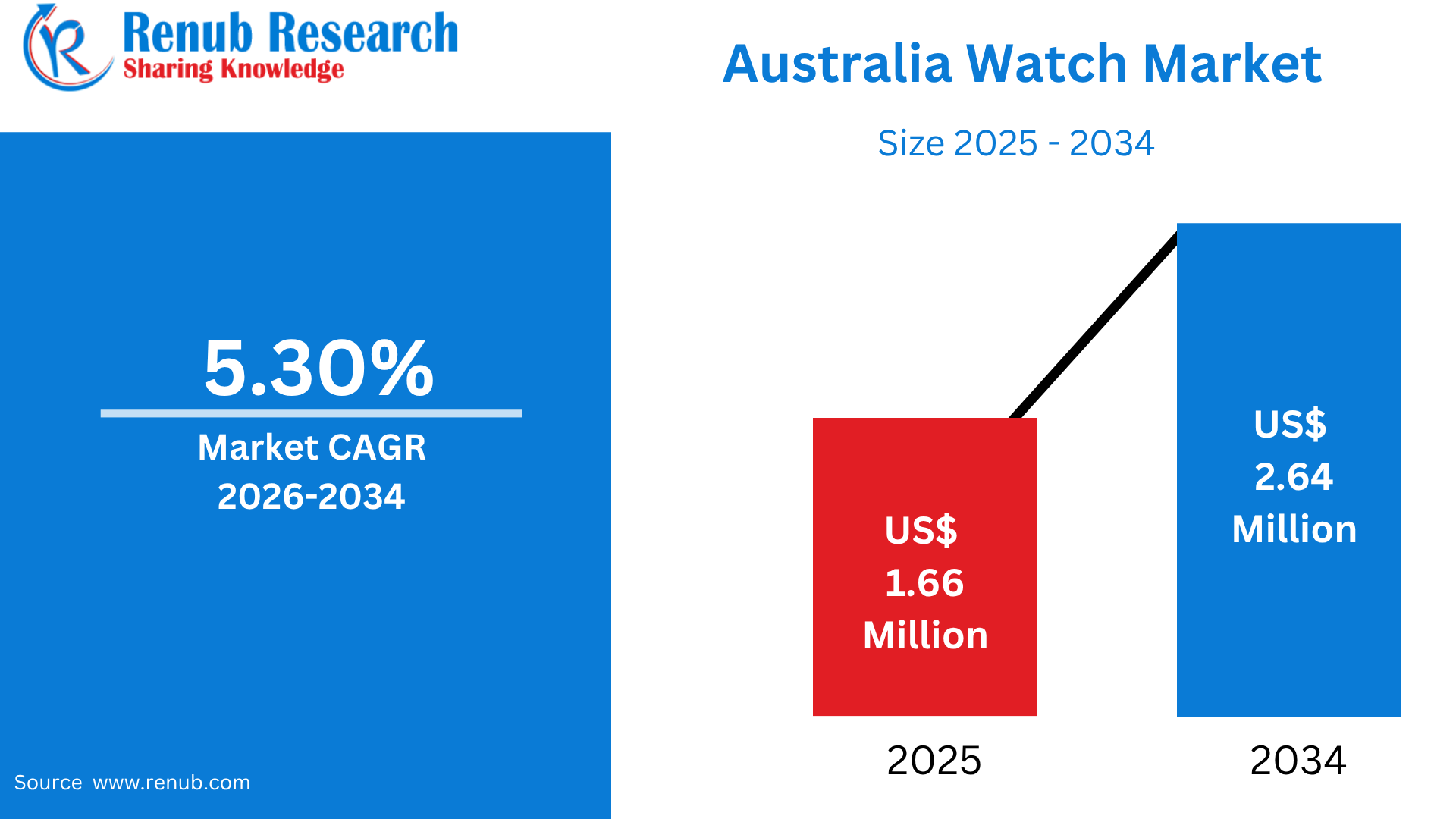
Australia Watch Market is projected to grow from US$ 1.66 Million in 2025 to US$ 2.64 Million by 2034, registering a Compound Annual Growth Rate (CAGR) of 5.3% during the forecast period from 2026 to 2034. Market growth is primarily driven by increasing consumer demand for smartwatches, rising fashion consciousness, and strong consumer purchasing power. The growing adoption of wearable technology, particularly devices offering health, fitness, and connectivity features, is further supporting market expansion.
What is a Watch and its Uses & Popularity in Australia
A watch is a timekeeping device worn on the wrist and is available in traditional, luxury, fashion, sports, and smartwatch formats. Watches are used not only to display time but increasingly to support fitness tracking, health monitoring, communication, navigation, notifications, payments, and other connected functions. In Australia, the market has evolved from conventional analog and quartz watches toward technologically advanced smartwatches that combine timekeeping with digital health and lifestyle features. Smartwatches can monitor activity, heart rate, sleep, exercise, and other wellness indicators, making them increasingly relevant to Australia’s health-conscious consumers.
Australian Communications and Media Authority reported that 37% of Australian adults had a wearable device connected to the internet in 2024, up from 33% in 2023. Among internet users aged 16–64, 28.2% owned a smartwatch in the GWI Q3 2023 survey, above the worldwide average of 24.1%. Watches also remain important fashion and lifestyle accessories, with premium and designer products attracting consumers interested in personal style and status. Strong digital connectivity, health awareness, purchasing power, and expanding online retail are therefore supporting the popularity of watches across Australian consumer segments.
Growth Driver
Connected Health and Fitness Features Expand Consumer Demand
The increasing adoption of smartwatches and wearable technology is one of the strongest growth drivers for Australia’s watch market. Modern smartwatches combine traditional timekeeping with activity tracking, heart-rate monitoring, sleep analysis, exercise measurement, notifications, GPS, communication, and other connected functions. The Australian Communications and Media Authority reported that 37% of Australian adults had a wearable device connected to the internet in 2024, compared with 33% in 2023, demonstrating continued expansion in wearable adoption. The increase was particularly notable among older consumers, with ownership reaching 28% among people aged 65–74 and 23% among those aged 75 and over. Smartwatches are also increasingly integrated into Australia’s broader digital-health ecosystem. The Australian Institute of Health and Welfare identifies wearable devices such as fitness trackers and monitors as important components of digital health, enabling consumers to track activity, symptoms, heart rate, weight, and other health measures. Consequently, demand for multifunctional watches is expected to remain strong as consumers increasingly value health, fitness, connectivity, and convenience.
Wellness Monitoring Encourages Smartwatch Adoption
Growing health and fitness awareness among Australian consumers is supporting demand for watches equipped with wellness and activity-monitoring capabilities. Smartwatches enable consumers to monitor daily steps, exercise, heart rate, sleep, calories, and other indicators, helping them incorporate health tracking into everyday routines. Australia’s health profile provides a favorable environment for these products. According to the Australian Bureau of Statistics, 65.8% of Australian adults were overweight or obese in 2022, while only 23.9% of people aged 15 years and over met physical activity guidelines. These conditions are increasing consumer interest in physical activity, exercise monitoring, and preventive health practices. Australia’s digital-health infrastructure further supports wearable adoption because health information collected through connected devices can help consumers make informed decisions about diet, activity, sleep, and general wellbeing. Wearables are also becoming relevant across different age groups rather than being limited to young technology enthusiasts. The ACMA recorded increasing wearable ownership among Australians aged 55–64 and 65–74 in 2024. This broadening consumer base creates opportunities for smartwatch manufacturers to introduce products focused on fitness, wellness, sports, and healthy aging.
Online Shopping Improves Accessibility to Domestic and International Watch Brands
The expansion of e-commerce is increasing the accessibility of watches and smartwatches across Australia and is enabling consumers to compare products, prices, specifications, and brands more conveniently. Online channels are particularly important for watches because consumers can access a broad selection ranging from affordable fashion watches and fitness trackers to premium smartwatches and luxury timepieces. Australia Post reported that Australians spent A$82.6 billion online in 2025, representing a 14% year-on-year increase, while 24% of all retail spending occurred online. The report also found that 82% of Australian households, equivalent to 9.8 million households, shopped online in 2025. The Australian Bureau of Statistics similarly reported that seasonally adjusted online retail sales reached A$4.70 billion in June 2025, increasing 13.0% year over year. This well-developed digital retail environment provides watch manufacturers and retailers with opportunities to reach consumers beyond physical stores. Online marketplaces, brand websites, social-commerce channels, digital advertising, and influencer marketing can further stimulate product discovery. As consumers increasingly combine online research with convenient home delivery and competitive pricing, e-commerce is expected to remain an important contributor to Australia’s watch market growth.
Challenge
Rapid Technology Changes Increase Pressure on Manufacturers
The Australian watch market faces strong competitive pressure, particularly within the smartwatch segment, where manufacturers must continuously introduce new features and differentiate their products. Smartwatch consumers increasingly expect improvements in battery performance, health sensors, software, connectivity, design, and compatibility with smartphones and digital ecosystems. This creates relatively short product innovation cycles and can encourage consumers to postpone purchases until newer models become available. Competition is also intense between traditional watch brands, technology companies, sports-watch manufacturers, and emerging wearable-device brands. Earlier Australian consumer research from Deloitte showed that wearable-device ownership had risen to 23% of adults aged 18–75, compared with 17% in 2020 and 12% in 2019, while also noting that some technology purchases were upgrades or replacements rather than entirely new users. Although the wearable category continues to expand, manufacturers must therefore balance innovation with affordability and product differentiation. Traditional watches also face competition from smartwatches among consumers who prioritize functionality. Maintaining brand loyalty, improving product durability, and providing meaningful technological upgrades will remain important for sustaining demand in Australia’s increasingly competitive watch market.
Consumer Budget Constraints Can Affect Discretionary Watch Purchases
Price sensitivity and broader cost-of-living pressures can limit demand for watches, particularly in premium, luxury, and technologically advanced segments. Watches are often discretionary purchases, meaning consumers may postpone upgrading or purchasing a new product when household budgets become constrained. Smartwatches can also carry relatively high prices when equipped with advanced health sensors, cellular connectivity, premium materials, and sophisticated software. Australia’s online retail environment provides consumers with greater price transparency and access to international competitors, increasing competition among domestic retailers and brands. Australia Post reported that Australian consumers became more budget-conscious in 2025, with average online basket sizes declining to A$96, even though total online spending increased 14% to A$82.6 billion. Competition from low-cost online marketplaces is another challenge; Roy Morgan reported that Temu had approximately 5 million Australian shoppers in 2025, while Shein had 2.9 million, highlighting the growing reach of price-focused digital platforms. Consequently, watch manufacturers need to offer compelling value, financing options, durability, innovative features, and differentiated designs to maintain consumer demand amid changing purchasing priorities.
Watch Launches in Australia
- Apple Watch Series 11 – Apple – 2025
Launched in Australia in September 2025, Apple Watch Series 11 introduced enhanced health and fitness capabilities, sleep scoring, up to 24 hours of battery life, and a more scratch-resistant display. Australian pricing started at A$679. - Apple Watch Ultra 3 – Apple – 2025
Apple introduced the Apple Watch Ultra 3 to the Australian market in September 2025. The rugged smartwatch offers satellite emergency communication, a larger display, up to 42 hours of battery life, advanced GPS, and enhanced health and fitness functions. - Apple Watch SE 3 – Apple – 2025
Apple Watch SE 3 launched in Australia in September 2025 with an A$399 starting price. The model added an Always-On display, faster charging, sleep score, sleep-apnoea notifications, wrist-temperature sensing, and other health and fitness features. - Samsung Galaxy Watch8 – Samsung – 2025
Galaxy Watch8 became available in Australia on August 1, 2025, following July pre-orders. It features a thinner design, personalized wellness insights, continuous health tracking, and 40mm and 44mm sizes. - Samsung Galaxy Watch8 Classic – Samsung – 2025
Launched alongside Galaxy Watch8, the Classic model combines a traditional appearance with modern smartwatch capabilities. It features a 46mm case and rotating bezel, targeting consumers seeking both premium styling and connected functionality. - Samsung Galaxy Watch Ultra (2025) – Samsung – 2025
The updated Galaxy Watch Ultra launched in Australia in August 2025, targeting outdoor and fitness users with a rugged design, advanced health tracking, and extended battery performance. A new Titanium Blue finish was introduced for the 2025 model. - Garmin Venu X1 – Garmin – 2025
Garmin introduced the Venu X1 in Australia in June 2025. The smartwatch features an 8mm-thick case, 2-inch AMOLED display, titanium caseback, sapphire lens, built-in speaker and microphone, and up to 8 days of smartwatch battery life. - Garmin Instinct 3 Series – Garmin – 2025
Garmin Australasia announced the Instinct 3 series in January 2025. The rugged lineup introduced AMOLED and solar-powered versions, metal-reinforced bezels, built-in LED flashlights, and up to 24 days of battery life for AMOLED models, while solar models can achieve extended or unlimited battery operation under suitable conditions. - Garmin tactix 8 – Garmin – 2025
The tactix 8 launched through Garmin Australasia in February 2025. Designed for tactical and outdoor applications, it features 47mm and 51mm sizes, MIL-STD-810 durability, 40-meter dive capability, speaker and microphone, and up to 48 days of battery life on the 51mm solar model. - Garmin quatix 8 – Garmin – 2025
Garmin announced the quatix 8 in June 2025 as a premium marine-focused smartwatch. It features 47mm and 51mm sizes, AMOLED displays, sapphire lenses, titanium bezels, built-in speaker and microphone, and battery life of up to 16 days for the 47mm model and 29 days for the 51mm model.
Reliable Timekeeping and Affordable Fashion Support Continued Demand
Australia Quartz Watch Market continues to represent an important segment because of its affordability, accuracy, low maintenance requirements, and broad consumer appeal. Quartz watches remain popular as everyday timepieces among consumers seeking reliable functionality combined with attractive designs. The Premium quartz watches represent an important revenue segment, while luxury quartz products are expected to experience comparatively strong growth. Consumers increasingly select quartz watches for work, casual occasions, travel, and gifting because they offer a balance between price and durability. Fashion-conscious consumers also support demand for slim cases, stainless-steel finishes, interchangeable straps, and minimalist designs. In addition, quartz technology remains widely incorporated into analogue fashion watches, sports watches, and hybrid timepieces, allowing manufacturers to target multiple consumer groups across Australia.
Multifunctional Features and Health Monitoring Strengthen Consumer Adoption
Australia Electronic Watch Market is expanding as consumers increasingly seek watches that combine timekeeping with digital functionality, connectivity, and health-oriented features. The electronic watch segment includes digital quartz watches, analogue electronic watches, solar electronic watches, and multifunctional models. Rising interest in fitness tracking, personalized health insights, smartphone connectivity, notifications, GPS, and activity monitoring is encouraging consumers to move toward multifunctional electronic watches. Health and wellness awareness is particularly important, as consumers increasingly use wearable devices to monitor physical activity, heart rate, sleep, and other indicators. Improvements in battery performance, display technology, durability, and smartphone integration are further strengthening demand. Electronic watches are also becoming more fashionable, with manufacturers combining advanced functionality with slimmer designs and premium materials. This convergence of technology, convenience, and lifestyle features is expected to support steady market development.
Fashion, Wellness, and Lifestyle Preferences Drive Women’s Watch Demand
Australia Women Watch Market is supported by strong demand for fashionable, versatile, and functional timepieces across different age and income groups. Women’s watches increasingly serve as both timekeeping devices and fashion accessories, with consumers seeking products that complement professional clothing, casual outfits, and special occasions. Demand spans affordable fashion watches, premium analogue models, designer products, and smartwatches. The growing participation of women in fitness and wellness activities is also increasing interest in smartwatches offering activity tracking, heart-rate monitoring, sleep analysis, menstrual-cycle features, and other health-related functions. Female consumers account for approximately 40%–45% of overall watch demand, while female participation in smartwatch adoption has also been increasing as health and lifestyle functionality becomes more important. E-commerce is strengthening accessibility by allowing consumers to compare brands, designs, prices, and features from home. Watches also remain popular gifting products for birthdays, anniversaries, graduations, and other occasions. Personalization, smaller case sizes, interchangeable straps, elegant designs, and multifunctional features are expected to remain important factors shaping women’s watch purchasing decisions.
Premium Spending and Brand Prestige Support High-Value Watch Sales
Australia Luxury Watch Market represents a high-value segment supported by affluent consumers, strong interest in premium lifestyle products, and demand for craftsmanship, heritage, exclusivity, and brand recognition. Luxury watches are increasingly viewed as long-term personal accessories, status symbols, collectibles, and gifting products rather than simple timekeeping devices. Australia’s broader traditional and connected watch market recorded approximately 4% growth in 2025, reaching around AUD2.7 billion in retail value, with luxury mechanical brands among the key contributors to market performance. Luxury demand is particularly concentrated in major metropolitan markets such as Sydney and Melbourne, where affluent consumers and international visitors support premium retail activity. Consumers increasingly favor mechanical movements, limited editions, precious-metal cases, sophisticated complications, and recognizable Swiss and international brands. At the same time, online platforms are becoming important for product discovery, price comparison, and brand research, although high-value purchases continue to benefit from physical retail experiences and authentication. Strong purchasing power, premiumization, gifting demand, and collector interest are expected to sustain the luxury watch segment in Australia.
Australia Watch Convenience Stores Market
Accessibility and Impulse Purchases Create Opportunities for Affordable Watches
The Australia Watch Convenience Stores Market represents a smaller but accessible distribution channel for watches, particularly affordable, practical, and fashion-oriented products. Convenience stores can appeal to consumers seeking quick purchases, replacement watches, basic digital timepieces, travel accessories, or inexpensive gifting products. The channel benefits from its accessibility and presence in high-footfall locations, including transport areas, shopping precincts, petrol stations, and neighborhood retail centers. Convenience-based distribution is particularly relevant for lower-priced watches where consumers prioritize availability, affordability, and immediate purchase rather than extensive product comparison. Australia’s broader online retail market also highlights the country’s strong digital purchasing behavior, with consumers spending approximately A$82.6 billion online in 2025, representing a 14% year-over-year increase. This creates both competition and opportunities for convenience retailers to integrate physical availability with digital ordering and click-and-collect models. Retailers can strengthen this segment through compact product displays, seasonal promotions, gifting campaigns, and competitively priced watches. Affordable quartz, digital, children’s, and fashion watches are likely to remain the most suitable products for convenience-store distribution.
New South Wales Largest Consumer Base and Strong E-Commerce Activity
New South Wales represents a major market for watches in Australia, supported by its large population, strong economic base, and the commercial influence of Sydney. The state had approximately 8.64 million residents at December 2025, making it Australia’s most populous state, while Sydney alone reached about 5.64 million people in June 2025. This large consumer base supports demand for traditional watches, premium timepieces, fashion watches, and smartwatches. New South Wales also has a strong concentration of professionals and higher-income consumers, creating opportunities for premium and branded products. E-commerce is particularly important: NSW recorded approximately US$26.4 billion in online spending in 2025, increasing 13% year over year, according to Australia Post data. The state’s extensive retail network, luxury shopping destinations, and online marketplaces provide consumers with broad access to domestic and international watch brands. Growing interest in fitness and connected devices is also supporting smartwatch demand, particularly among younger and professionally active consumers.
Victoria Fashion Culture and Rapid Population Growth Support Demand
Victoria represents one of Australia’s most important watch markets, with Melbourne serving as a major center for fashion, retail, business, education, and lifestyle consumption. Victoria’s population reached approximately 7.12 million at December 2025, after increasing by 1.7% year over year. Melbourne alone had around 5.44 million residents in June 2025, with the capital city recording population growth of approximately 2.0% during 2024–25. The state’s diverse consumer base supports demand across entry-level, mid-range, premium, designer, and smartwatch categories. Melbourne’s strong fashion culture encourages consumers to view watches as both functional accessories and style statements, supporting branded and aesthetically distinctive products. Online retail is another important channel, with Victoria generating approximately $20 billion in online spending in 2025, up 13% year over year. The presence of students, professionals, and affluent consumers also creates demand across multiple price points. Gifting, seasonal purchases, and growing interest in connected wearable technology further strengthen Victoria’s watch market.
Queensland Population Expansion and Active Lifestyles Encourage Smartwatch Adoption
Queensland’s watch market is benefiting from population growth, urban development, and increasing consumer interest in health, fitness, and outdoor lifestyles. The state had approximately 5.71 million residents at December 2025, representing annual population growth of 1.6%. Brisbane reached approximately 2.83 million residents in June 2025, while its population increased by 2.1% during 2024–25, highlighting the expanding consumer base in the state’s largest metropolitan area. Queensland’s warm climate and strong participation in outdoor activities create favorable conditions for watches featuring GPS, activity tracking, heart-rate monitoring, water resistance, and other fitness-oriented functions. Smartwatches are therefore increasingly positioned as practical lifestyle devices rather than simply timekeeping products. E-commerce is also strengthening product availability across metropolitan and regional areas. Queensland generated approximately $17.8 billion in online spending in 2025, increasing 15% year over year, while Toowoomba recorded the highest delivery volume among Australian postcodes. Expanding retail infrastructure and digital shopping are expected to support continued watch-market growth.
Western Australia Population Growth and Affluent Consumers Support Premium Demand
Western Australia represents an attractive watch market due to strong economic activity, population growth, and the purchasing power concentrated in Perth and other urban centers. The state recorded approximately 3.08 million residents at December 2025, with population growth of 2.2%, the fastest rate among Australian states and territories. Perth reached approximately 2.45 million residents in June 2025 and recorded population growth of 2.4% during 2024–25, also the fastest among the capital cities. The state’s resource-driven economy and concentration of professionals support demand for premium, durable, and branded watches, while younger consumers are increasingly attracted to smartwatches offering connectivity, fitness tracking, and health-monitoring features. Western Australia also recorded particularly strong online-shopping momentum. Online spending reached approximately $9.1 billion in 2025, rising 18% year over year, the highest growth rate among the major states. The combination of expanding population, premium consumer demand, retail availability, and rapidly growing e-commerce is expected to create favorable opportunities for both traditional and connected watch brands.
Recent Developments in Watch Market
- Feb 2025: Time+Tide, an Australian watch media company, announced its plan to secure £3 million in private funding to launch a retail outlet in New York. Following successful ventures in Melbourne and London, this expansion aims to advance its watch discovery studio model and broaden its portfolio of limited-edition brand collaborations in the U.S. market.
- Feb 2024: Habring², in collaboration with Define Watches, opened pre-orders for a highly limited 20-piece mono-pusher chronograph. The watch features a hand-wound movement, an anti-magnetic escapement, and an electroplated black dial complemented by red chronograph hands.
Australia Watch Market Segments
Type
- Quatz Watches
- Electronic Watches
- Mechanical Watches
Gender
- Men
- Women
- Unisex
Price Range
- Luxury
- Non-Luxury
Distribution Channel
- Hyper Market/Super Market
- Convenience Stores
- Online
Top States
- New South Wales
- Victoria
- Queensland
- Western Australia
- South Australia
- Australian Capital Territory
- Tasmania
- Northern Territory
All companies have been covered with 5 Viewpoints
- Overviews
- Key Person
- Recent Developments
- SWOT Analysis
- Revenue Analysis
Key Players Analysis
- Seiko Holdings Corporation
- Casio Computer Co. Ltd
- Timex Group
- Rolex SA
- Compagnie Financière Richemont S.A
- The Swatch Group Ltd
- Citizen Watch Co. Ltd.
- Fossil Group Inc.
- Google LLC (Fitbit Inc.)
Report Details:
| Report Features | Details |
| Base Year |
2024 |
| Historical Period |
2021 - 2024 |
| Forecast Period |
2025 - 2033 |
| Market |
US$ Billion |
| Segment Covered |
By Type, By Gender, By Price Range and By Distribution Channel |
| Companies Covered |
|
| Customization Scope |
20% Free Customization |
| Post-Sale Analyst Support |
1 Year (52 Weeks) |
| Delivery Format |
PDF and Excel through Email (We can also provide the editable version of the report in PPT/Word format on request) |
Customization Services available
- Analysis of Market Size and Its Segments
- More Company Profiles (Upto 10 without any additional cost):
- Additional Countries (Other than mentioned Countries):
- Region/Country Specific Reports:
- Market Entry Strategy:
- Region-Specific Market Dynamics:
- Regional Market Share Analysis:
- Trade Analysis:
- Production Insights:
- Others Customized Requests:
For more information contact our analysts.
Need More Assistance?
- Talk to our analysts to get more precious information on the current market trends.
- Include more countries and segments and customize the report based on the final requirement.
- Get a competitive advantage in your industry by knowing the report findings and making a positive impact on your revenues and operations.
- Our analysts are always ready to provide more help and pertinent information if you need any additional assistance.