Atherectomy Devices Market Report by Product Type, Application, End User, Countries and Companies Analysis 2026-2034
Buy NowGlobal Atherectomy Devices Market Size and Forecast
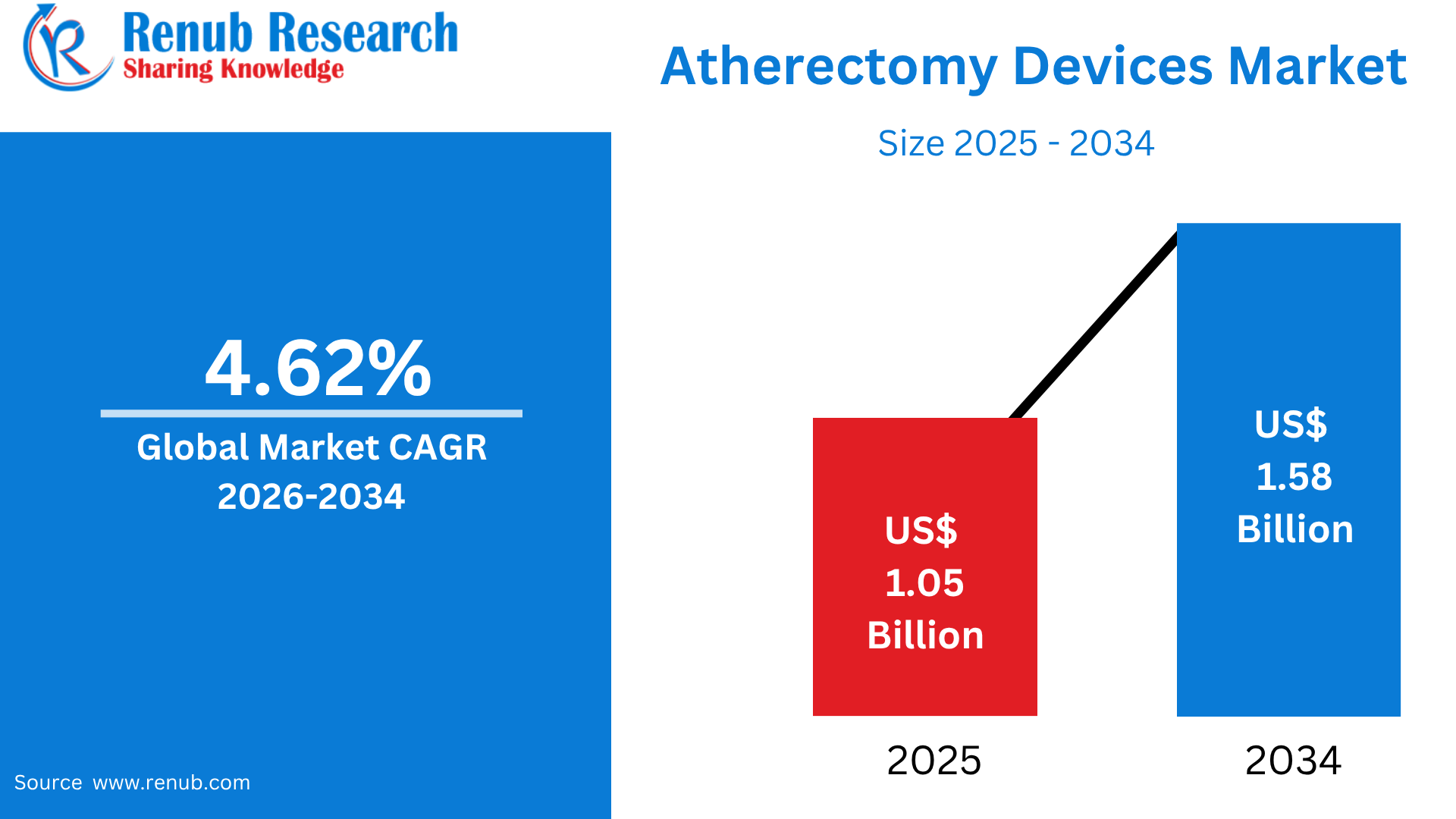
Global Atherectomy Devices Market is projected to expand from US$ 1.05 billion in 2025 to US$ 1.58 billion by 2034, registering a CAGR of 4.62% during 2026–2034. Market growth is being supported by the increasing prevalence of peripheral artery disease (PAD) and other vascular conditions, alongside the growing preference for minimally invasive procedures over conventional surgical interventions. Continuous advancements in atherectomy technologies, including improved catheter designs, enhanced plaque-removal mechanisms, and greater procedural precision, are further contributing to market expansion.
What are Atherectomy Devices and Their Uses & Popularity Worldwide
Atherectomy devices are minimally invasive, catheter-based medical devices designed to remove or modify atherosclerotic plaque from diseased arteries, thereby improving blood flow. According to the U.S. FDA, atherectomy technologies remove plaque through mechanisms such as cutting, shaving, sanding, or vaporizing. The four major categories are directional, rotational, orbital, and laser atherectomy. These devices are primarily used in the treatment of peripheral artery disease (PAD) and, depending on the specific technology and indication, coronary artery disease. Atherectomy can be performed before or alongside angioplasty, drug-coated balloon treatment, or stenting, particularly when lesions are calcified or difficult to treat. Worldwide demand is supported by the substantial and growing burden of PAD.
A 2026 Lancet Global Health study estimated that 316.54 million people aged 25 years and older had PAD globally in 2023, representing a prevalence of 6.58%. Aging populations, diabetes, smoking, obesity, and other cardiovascular risk factors are increasing the need for vascular interventions. Technological improvements in plaque modification, catheter design, imaging, and aspiration are further supporting adoption, making atherectomy an increasingly important tool in modern endovascular treatment.
Number of People with Diabetes Worldwide and by IDF Region (Age 20–79), 2024–2050
- World: 588.7 million people with diabetes in 2024, projected to reach 852.5 million by 2050, representing a 45% increase.
- Africa (AFR): 24.6 million in 2024, expected to rise to 59.5 million by 2050, an increase of 142%.
- Europe (EUR): 65.6 million in 2024, projected to reach 72.4 million by 2050, representing a 10% increase.
- Middle East & North Africa (MENA): 84.7 million in 2024, forecast to increase to 162.6 million by 2050, a 92% increase.
- North America & Caribbean (NAC): 56.2 million in 2024, expected to reach 68.1 million by 2050, an increase of 21%.
- South & Central America (SACA): 35.4 million in 2024, projected to reach 51.5 million by 2050, representing a 45% increase.
- South-East Asia (SEA): 106.9 million in 2024, expected to rise to 184.5 million by 2050, a 73% increase.
- Western Pacific (WP): 215.4 million in 2024, projected to reach 253.8 million by 2050, representing an 18% increase.
Source: International Diabetes Federation (IDF) Diabetes Atlas, 11th Edition, 2025.
Growth Drivers of the Atherectomy Devices Market
Rising Global Burden of Peripheral Artery Disease
The growing prevalence of peripheral artery disease is a major driver of the global atherectomy devices market. PAD develops when atherosclerotic plaque narrows or blocks arteries, most commonly affecting the lower extremities. Updated global research published in The Lancet Global Health estimated that 316.54 million people aged 25 years and older were living with PAD in 2023, equivalent to a global prevalence of 6.58%. The prevalence increases substantially with age, reaching 22.09% among people aged 90–99 years. This expanding patient population creates a large potential need for endovascular interventions. Atherectomy is particularly useful for selected complex lesions because it can remove or modify plaque before adjunctive treatment. The American College of Cardiology describes atherectomy as an important adjunct to angioplasty, stenting, and drug-delivery systems, particularly for calcified or fibrotic lesions. Furthermore, diabetes, smoking, hypertension, and aging are important PAD risk factors. As healthcare systems improve PAD diagnosis and treatment, more patients are likely to undergo vascular interventions. Consequently, the increasing global disease burden is creating sustained demand for sophisticated plaque-modification technologies.
Technological Advancements and Expansion of Treatment Options
Continuous innovation in atherectomy technology is supporting market growth by providing physicians with multiple approaches for managing different plaque characteristics and arterial anatomies. The FDA identifies four major categories—directional, rotational, orbital, and laser atherectomy, each using a different mechanism to remove or modify plaque. Directional devices use cutting mechanisms, rotational systems employ rapidly rotating burrs or cutters, orbital technologies sand plaque through an eccentric orbiting mechanism, while laser systems use high-energy light to vaporize plaque. Modern systems are increasingly designed with improved catheter flexibility, lesion-crossing capabilities, imaging integration, and, in some cases, aspiration to manage debris. The ACC notes that current atherectomy technologies can improve luminal gain and help optimize subsequent therapies such as drug-coated balloons and stents. Continued product development is also evident from recent regulatory activity. For example, the FDA recorded a 510(k) decision for the Rotarex Atherectomy System in January 2025, demonstrating ongoing development of peripheral atherectomy platforms. Such innovation expands treatment possibilities and supports adoption across specialized vascular centers worldwide.
Growing Preference for Minimally Invasive Vascular Treatment
The increasing preference for minimally invasive endovascular procedures is another important growth driver for the atherectomy devices market. Compared with conventional open vascular surgery, catheter-based interventions can provide physicians with less invasive approaches for appropriately selected patients with arterial disease. Atherectomy enables physicians to directly modify or remove obstructive plaque and can be incorporated with balloon angioplasty, drug-coated balloons, and stenting. The ACC reports that atherectomy can help improve luminal gain, modify lesion compliance, reduce flow-limiting dissections, and potentially reduce the need for bailout stenting in selected cases. This capability is particularly relevant as healthcare providers increasingly focus on improving patient recovery, reducing procedural trauma, and treating complex vascular lesions through endovascular methods. The expanding global PAD population further increases the potential patient base. In 2023, an estimated 316.54 million people aged 25 years and older worldwide had PAD, according to updated modeling published in The Lancet Global Health. Growth in specialized vascular centers, improved imaging, physician expertise, and better catheter technologies is also encouraging adoption. These factors collectively support the increasing integration of atherectomy into contemporary minimally invasive vascular treatment strategies.
Challenges of the Atherectomy Devices Market
Procedural Risks and Device-Related Safety Concerns
Safety concerns remain a significant challenge for the global atherectomy devices market because these systems operate directly within diseased arteries and require careful patient selection and skilled physician use. Potential complications can include vessel perforation, embolization, bleeding, dissection, thrombosis, and device malfunction. The FDA's guidance emphasizes that device selection depends on factors including plaque location, vessel characteristics, lesion length, plaque quantity and texture, and physician experience. Recent regulatory events demonstrate why safety remains important. In 2025, the FDA reported a serious safety issue involving certain Rotarex Atherectomy Systems, noting that BD had reported 30 serious injuries and four deaths, as well as 115 cases requiring additional intervention, associated with helix fracture or breakage. Such incidents can increase scrutiny from regulators, healthcare providers, and patients while requiring manufacturers to strengthen device design, instructions for use, training, and post-market monitoring. Atherectomy procedures may also require additional imaging and adjunctive interventions, increasing procedural complexity. Therefore, manufacturers must demonstrate strong safety and clinical performance while physicians need specialized training to use these technologies appropriately.
High Costs, Reimbursement Pressure, and Limited Clinical Evidence
The cost and economic complexity of atherectomy procedures can restrict adoption, particularly in healthcare systems where reimbursement is limited or hospitals face strict budget controls. Atherectomy requires specialized disposable catheters and, depending on the technology, dedicated consoles or supporting equipment. Additional imaging, adjunctive angioplasty, drug-coated balloons, or stenting may further increase the overall procedural expense. Reimbursement policies also differ substantially between countries, affecting the economic attractiveness of atherectomy compared with alternative treatment approaches. Another challenge is the continuing need for stronger comparative clinical evidence across different device types and patient populations. The 2026 ACC review notes that the evidence base includes randomized trials, prospective studies, registries, and real-world datasets, but also highlights unmet needs in the field. In addition, physicians must select the appropriate device according to lesion characteristics and individual patient anatomy, making standardized treatment pathways more difficult. In emerging markets, limited access to specialized vascular centers and trained interventional specialists can further constrain adoption. Consequently, demonstrating cost-effectiveness, generating robust long-term clinical evidence, improving reimbursement, and expanding physician training will be essential for broader worldwide market penetration.
Recent Developmental Activities in the Atherectomy Devices Market
- January 2025: AngioDynamics initiated a new clinical trial to evaluate the Auryon™ Atherectomy System and support the expansion of its indications for treating below-the-knee peripheral artery disease (PAD). The study is intended to generate additional clinical evidence for the system’s use in challenging below-the-knee lesions.
- January 2025: The FDA cleared the Rotarex™ Atherectomy System through a 510(k) substantial-equivalence determination (K242757). The clearance covered revised Instructions for Use (IFU) designed to reduce the risk of helix breakage. The physical design of the device itself was not changed as part of the clearance.
- November 2024: Philips announced the enrollment of the first U.S. patient in a clinical trial evaluating a combination catheter integrating laser atherectomy and intravascular lithotripsy (IVL). The dual-function technology is designed to combine two plaque-modification approaches within a single catheter-based procedure, potentially simplifying treatment of complex PAD lesions.
- September 2024: The relevant laser atherectomy technology received European CE Mark approval, enabling commercialization in Europe for PAD applications, including critical limb ischemia and in-stent restenosis. The approval represented an important step toward expanding the use of solid-state laser technology in peripheral vascular interventions.
- April 2024: Avinger, Inc. received FDA 510(k) clearance for Pantheris SV (Small Vessel), an image-guided atherectomy system designed specifically for treatment in smaller peripheral vessels. The product expands Avinger’s Pantheris portfolio and provides physicians with an additional option for image-guided plaque removal.
- March 2022: B. Braun acquired Intermedt Medizin & Technik GmbH, a company specializing in the preparation of dialysis concentrates. While the transaction was not directly related to atherectomy devices, it represented B. Braun’s broader expansion within the medical technology and healthcare sector.
- November 2023: Cardinal Health launched its SmartGown EDGE Breathable Surgical Gown with ASSIST Instrument Pockets in the United States. The product was designed to provide surgical teams with convenient access to instruments while maintaining protection and comfort in operating-room environments. Although not an atherectomy device, the launch reflects broader innovation in products supporting interventional and surgical healthcare settings.
Rotational Atherectomy Devices Market
The rotational atherectomy devices market is expanding as the prevalence of heavily calcified arterial lesions increases worldwide. These systems use a high-speed rotating burr to modify or remove hardened plaque, making them valuable for complex vascular interventions where conventional balloon angioplasty may provide limited results. The growing burden of cardiovascular disease, particularly coronary artery disease and peripheral artery disease (PAD), is creating a broader patient base for plaque-modification procedures. Globally, an estimated 316.54 million people aged 25 years and older were living with PAD in 2023, representing a prevalence of 6.58%. Aging populations and increasing rates of diabetes, obesity, hypertension, smoking, and high cholesterol are further contributing to arterial calcification and disease progression. Rotational atherectomy can facilitate lesion preparation and improve the ability to deliver and expand stents in appropriately selected patients. In addition, advances in catheter design, burr technology, imaging, and procedural control are improving physician capabilities. As healthcare providers increasingly favor minimally invasive approaches for complex vascular disease, rotational atherectomy is expected to remain an important segment of the global atherectomy devices market.
Cardiovascular Atherectomy Devices Market
The cardiovascular atherectomy devices market is growing alongside the increasing global burden of atherosclerotic cardiovascular disease. Coronary artery disease, peripheral artery disease, and other atherosclerotic conditions are associated with risk factors such as diabetes, obesity, hypertension, smoking, and high cholesterol. According to the World Health Organization, cardiovascular diseases caused approximately 19.8 million deaths worldwide in 2022, accounting for about 32% of all global deaths. Atherectomy devices provide physicians with minimally invasive tools for removing or modifying plaque in selected patients, particularly when lesions are calcified or difficult to treat with conventional balloon-based techniques. The growing preference for catheter-based interventions is encouraging adoption across hospitals, cardiac centers, and specialized vascular facilities. Improvements in intravascular imaging, catheter navigation, plaque-modification mechanisms, and procedural planning are also supporting treatment precision. Healthcare providers increasingly seek approaches that can improve lesion preparation while minimizing the need for open surgery. Furthermore, rising healthcare expenditure, expanding cardiovascular infrastructure, and greater awareness of early vascular disease management are creating favorable conditions for market expansion. Continued innovation and clinical research are expected to strengthen the role of atherectomy technologies in cardiovascular interventions.
Neurovascular Atherectomy Devices Market
The neurovascular atherectomy devices market is an emerging area associated with the broader development of endovascular technologies for treating vascular conditions affecting the brain. However, unlike peripheral and coronary atherectomy, neurovascular atherectomy remains a specialized and comparatively limited application, with established stroke treatment more commonly relying on thrombectomy, angioplasty, stenting, and other neurointerventional techniques. The underlying disease burden nevertheless represents a substantial opportunity for advanced neurovascular technologies. According to the World Health Organization, stroke is the second leading cause of death globally, accounting for approximately 11% of total deaths. Aging populations, hypertension, diabetes, obesity, and other vascular risk factors contribute to increasing cerebrovascular disease. Advances in microcatheter technology, high-resolution imaging, guidewire navigation, and minimally invasive neurointervention are improving physicians’ ability to access challenging cerebral vessels. Specialized stroke centers are also expanding in many countries to provide rapid diagnosis and intervention. However, the development and adoption of dedicated neurovascular atherectomy technologies face stringent safety requirements because cerebral vessels are highly sensitive to vessel injury and embolization. Future market opportunities will therefore depend heavily on clinical validation, regulatory approvals, device safety, and demonstrated benefits compared with established neurovascular treatment techniques.
Atherectomy Devices Hospitals Market
Hospitals represent a major end-user segment of the global atherectomy devices market because they possess the infrastructure, specialists, and procedural facilities required for complex endovascular interventions. Hospitals typically operate catheterization laboratories, vascular intervention units, advanced imaging systems, and multidisciplinary teams capable of treating patients with complicated arterial disease. The large global burden of PAD and cardiovascular disease continues to generate demand for minimally invasive vascular procedures. A 2026 global analysis estimated 316.54 million people aged 25 years and older were living with PAD in 2023, highlighting the substantial patient population requiring vascular evaluation and treatment. Hospitals increasingly adopt advanced atherectomy platforms to support plaque modification in appropriately selected patients and to facilitate subsequent angioplasty or stenting. Large academic and multispecialty hospitals are particularly important because they often participate in clinical research, physician training, and adoption of newly developed medical technologies. Expansion of cardiovascular departments, improved imaging capabilities, and increasing healthcare investment in emerging economies are further supporting hospital-based utilization. At the same time, hospitals must consider equipment costs, disposable-device expenses, reimbursement levels, training requirements, and procedural safety. Nevertheless, the growing need for sophisticated vascular care is expected to keep hospitals among the leading consumers of atherectomy devices.
United States Atherectomy Devices Market
United States atherectomy devices market is supported by a substantial aging population and a high prevalence of cardiovascular and metabolic risk factors. According to the U.S. Census Bureau, the number of Americans aged 65 years and older reached approximately 55.8 million in 2020, representing 16.8% of the population, and this demographic is projected to continue expanding. Aging is particularly relevant to atherectomy demand because PAD and atherosclerotic disease become more common with advancing age. The American Heart Association estimates that more than 8.5 million Americans have PAD, creating a significant patient population for vascular interventions. Diabetes, obesity, hypertension, smoking, and abnormal cholesterol levels further increase the risk of arterial disease. The CDC reports that approximately 86 million U.S. adults have high cholesterol, although the specific threshold and measurement used can vary by definition. The country’s advanced catheterization laboratories, experienced interventional physicians, strong medical-device industry, and access to sophisticated imaging technologies further support adoption. Growing preference for minimally invasive treatment and continuous innovation in directional, rotational, orbital, and laser systems are expected to sustain U.S. market growth.
Germany Atherectomy Devices Market
Germany atherectomy devices market is benefiting from an aging population, a sophisticated healthcare system, and increasing demand for minimally invasive treatment of vascular disease. Germany has one of Europe’s older populations, creating a substantial patient base susceptible to atherosclerosis, PAD, and other cardiovascular conditions. According to Destatis, approximately 19% of Germany’s population was aged 67 years or older in 2022, and this share is expected to increase substantially over the coming decades. The country’s established hospital network, specialist cardiovascular centers, catheterization laboratories, and advanced diagnostic infrastructure facilitate the adoption of sophisticated endovascular technologies. Atherectomy devices can be used in selected patients to modify or remove arterial plaque, particularly in complex lesions where conventional angioplasty may be challenging. Growing awareness of vascular disease, earlier diagnosis, and the preference for less invasive procedures are supporting demand. Germany’s reimbursement framework and European regulatory environment also influence the adoption of new medical technologies. In addition, continuous improvements in catheter design, imaging, and plaque-modification technologies are expanding physicians’ treatment options. Despite cost considerations and the need for specialized expertise, Germany’s mature healthcare infrastructure positions the country as an important European market for atherectomy devices.
India Atherectomy Devices Market
India atherectomy devices market is expanding as cardiovascular disease, diabetes, and other vascular risk factors become increasingly prevalent across the country. According to the International Diabetes Federation, approximately 89.8 million adults aged 20–79 in India were living with diabetes in 2024, making India one of the world’s largest diabetes populations. Diabetes is an important risk factor for vascular complications and can increase the likelihood of peripheral and coronary arterial disease. India’s rapidly expanding population, growing elderly demographic, urbanization, changing lifestyles, and increasing healthcare expenditure are creating additional demand for advanced cardiovascular treatment. Improvements in private hospitals, specialty cardiovascular centers, catheterization laboratories, and diagnostic imaging are making sophisticated endovascular procedures more accessible, particularly in major metropolitan areas. Increasing physician awareness and patient preference for minimally invasive procedures are also supporting adoption. Government initiatives aimed at expanding healthcare access and improving treatment affordability may further broaden the availability of advanced medical technologies. Nevertheless, high device costs, uneven healthcare infrastructure, and limited access to specialized vascular specialists in smaller cities remain important constraints. Continued investment in cardiovascular infrastructure, local medical-device manufacturing, physician training, and affordable treatment options is expected to support the long-term expansion of India’s atherectomy devices market.
Saudi Arabia Atherectomy Devices Market
Saudi Arabia atherectomy devices market is supported by a high burden of cardiovascular risk factors, expanding healthcare infrastructure, and government investment in advanced medical services. Diabetes represents a particularly important risk factor for vascular disease in the country. The International Diabetes Federation estimated that approximately 7.3 million adults aged 20–79 in Saudi Arabia were living with diabetes in 2024, highlighting a substantial population at risk of cardiovascular and peripheral vascular complications. Obesity, hypertension, and sedentary lifestyles further contribute to the country’s cardiovascular disease burden. Saudi Arabia is also investing heavily in healthcare modernization under Saudi Vision 2030, including development of specialized medical centers, digital healthcare capabilities, and advanced treatment infrastructure. These developments are increasing access to sophisticated cardiovascular and endovascular procedures. Hospitals and specialist cardiovascular centers are adopting advanced catheter-based technologies to provide less invasive alternatives for appropriately selected patients. Improvements in interventional imaging, catheter systems, and plaque-modification technologies are creating additional opportunities for atherectomy-device manufacturers. However, high equipment costs, dependence on imported medical technologies, and the need for specialized physician training can limit adoption. Overall, rising cardiovascular risk, healthcare modernization, and growing demand for minimally invasive treatment are expected to support continued development of the Saudi Arabian atherectomy devices market.
Atherectomy Devices Market Segmentation
Product Type
- Directional
- Rotational
- Orbital
- Laser
Application
- Cardiovascular
- Neurovascular
- Peripheral Vascular
End User
- Hospitals
- Ambulatory Care Service
- Medical Research Institutes
Countries
North America
- United States
- Canada
Europe
- France
- Germany
- Italy
- Spain
- United Kingdom
- Belgium
- Netherlands
- Turkey
Asia Pacific
- China
- Japan
- India
- Australia
- South Korea
- Thailand
- Malaysia
- Indonesia
- New Zealand
Latin America
- Brazil
- Mexico
- Argentina
Middle East & Africa
- South Africa
- Saudi Arabia
- United Arab Emirates
Rest of the World
All companies have been covered with 5 Viewpoints
- Overviews
- Key Person
- Recent Developments
- SWOT Analysis
- Revenue Analysis
Key Players Analysis
- Boston Scientific Corporation, Inc.
- Abbott Laboratories
- Medtronic plc
- Cardinal Health
- Terumo Corporation
- Integer Holdings Corporation
- Becton, Dickinson and Company
- AngioDynamics Inc.
Report Details:
| Report Features | Details |
| Base Year |
2025 |
| Historical Period |
2022 - 2025 |
| Forecast Period |
2026 - 2034 |
| Market |
US$ Billion |
| Segment Covered |
Product Type, Application, End User and Countries |
| Countries Covered |
|
| Companies Covered |
|
| Customization Scope |
20% Free Customization |
| Post-Sale Analyst Support |
1 Year (52 Weeks) |
| Delivery Format |
PDF and Excel through Email (We can also provide the editable version of the report in PPT/Word format on request) |
Key Questions Answered in This Report:
- What is the current size and projected growth of the global atherectomy devices market from 2025 to 2033?
- What are the major factors driving the demand for atherectomy devices worldwide?
- Which type of atherectomy device (directional, orbital, rotational, laser) holds the largest market share?
- How is the rise in peripheral artery disease (PAD) and cardiovascular diseases influencing market growth?
- What are the key technological advancements shaping the future of atherectomy procedures?
- Which application segment (cardiovascular, neurovascular, peripheral vascular) is expected to dominate the market?
- Who are the leading players in the global atherectomy devices market and what are their strategies?
- What are the major challenges and risks faced by the atherectomy devices industry?
- How do regional trends vary across North America, Europe, Asia-Pacific, and other regions?
- What are the future opportunities and investment trends in the global atherectomy devices market?
Customization Services available
- Analysis of Market Size and Its Segments
- More Company Profiles (Upto 10 without any additional cost):
- Additional Countries (Other than mentioned Countries):
- Region/Country Specific Reports:
- Market Entry Strategy:
- Region-Specific Market Dynamics:
- Regional Market Share Analysis:
- Trade Analysis:
- Production Insights:
- Others Customized Requests:
For more information contact our analysts.
Need More Assistance?
- Talk to our analysts to get more precious information on the current market trends.
- Include more countries and segments and customize the report based on the final requirement.
- Get a competitive advantage in your industry by knowing the report findings and making a positive impact on your revenues and operations.
- Our analysts are always ready to provide more help and pertinent information if you need any additional assistance.