Assortment and Space Optimization (ASO) Market Size, Share, Growth, Trends, Industry Analysis & Forecast 2026–2034
Buy NowAssortment and Space Optimization Market Size & Forecast
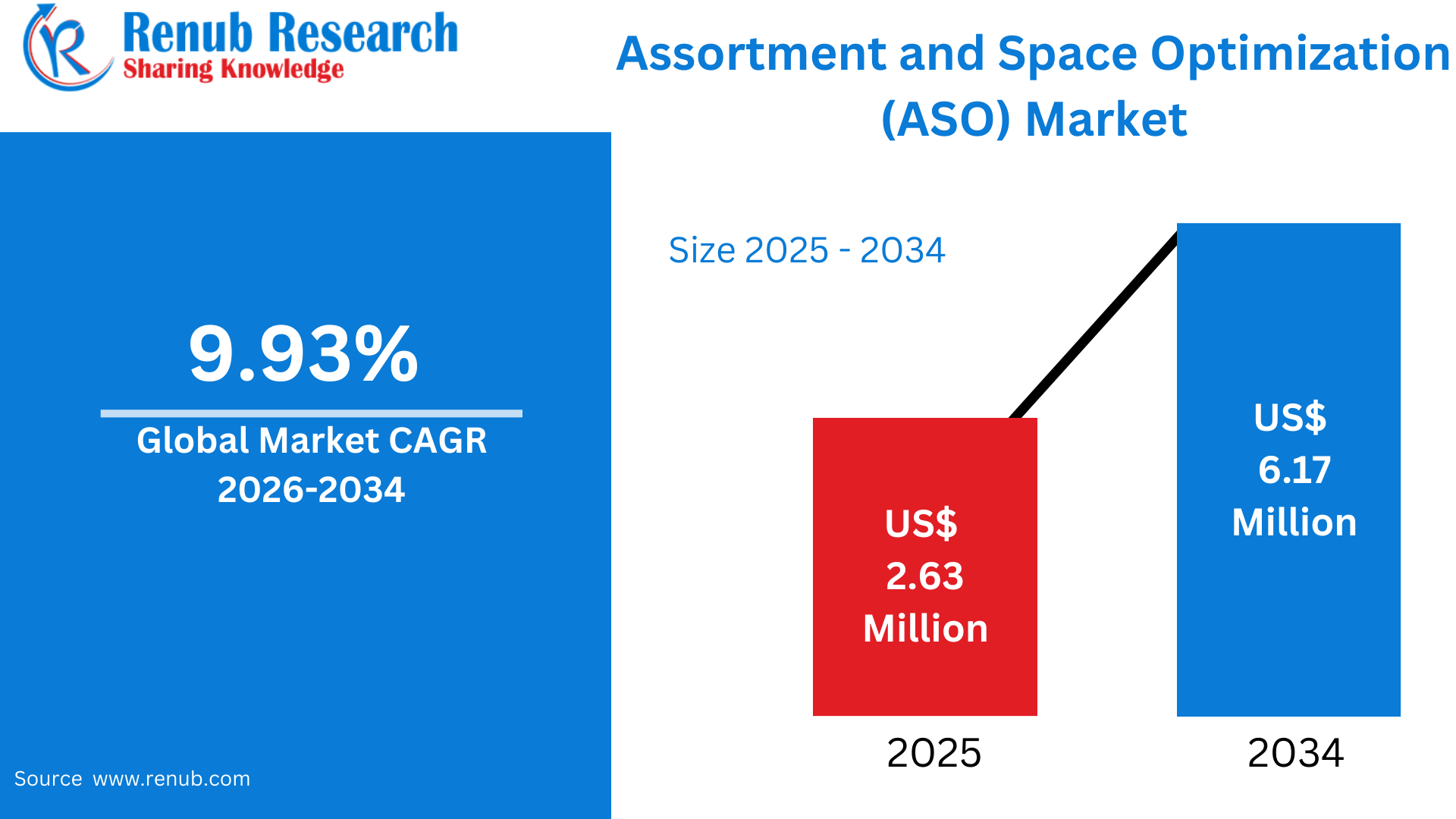
Assortment and Space Optimization (ASO) Market is projected to grow from US$ 2.63 million in 2025 to US$ 6.17 million by 2034, expanding at a CAGR of 9.93% during the forecast period from 2026 to 2034. Market growth is being driven by the increasing adoption of data-driven retail strategies, rising demand for efficient inventory management, and the growing need to maximize shelf productivity across physical and digital retail channels.
What is Assortment and Space Optimization and Its Uses & Popularity Worldwide?
Assortment and Space Optimization (ASO) is a retail planning strategy that uses advanced analytics, artificial intelligence (AI), machine learning, and data-driven software to determine the ideal mix of products and the most effective use of shelf space across stores and online channels. The objective is to ensure that the right products are available in the right locations and quantities, while maximizing sales, profitability, and customer satisfaction. ASO solutions analyze consumer purchasing behavior, regional demand, inventory levels, store layouts, seasonal trends, and product performance to create optimized assortments and merchandising plans. Retailers use these solutions to reduce stockouts, minimize excess inventory, improve shelf productivity, and enhance operational efficiency.
Globally, the popularity of assortment and space optimization is increasing as retailers embrace digital transformation, omnichannel commerce, and personalized shopping experiences. Supermarkets, hypermarkets, convenience stores, pharmacies, fashion retailers, and e-commerce companies widely implement ASO solutions to improve decision-making and profitability. Growing competition, rising consumer expectations, and advancements in predictive analytics and cloud-based retail technologies continue to drive the worldwide adoption of assortment and space optimization solutions across the retail industry.
Growth Drivers for the Assortment and Space Optimization (ASO) Market
Increasing Adoption of Data-Driven Retail Decision-Making
The growing reliance on data-driven decision-making is a major factor driving the Assortment and Space Optimization (ASO) market. As retailers manage larger product portfolios, diverse customer preferences, and omnichannel operations, advanced analytics have become essential for improving merchandising strategies. ASO solutions analyze point-of-sale transactions, inventory data, customer purchasing patterns, regional demand, and market trends to recommend the ideal product assortment and shelf allocation for each store or digital platform. These insights help retailers reduce stockouts, minimize excess inventory, improve product availability, and maximize sales performance. Artificial intelligence, machine learning, and predictive analytics further enhance decision-making by enabling real-time optimization and demand forecasting. Retailers can also improve pricing strategies, promotional planning, and planogram management using accurate data insights. As competition intensifies and customer expectations continue to evolve, businesses are increasingly investing in ASO solutions to improve operational efficiency, enhance shopping experiences, and increase profitability, making data-driven retail management a key driver of global market growth.
Expansion of Omnichannel Retail and E-Commerce
The rapid growth of omnichannel retailing and e-commerce is significantly accelerating demand for Assortment and Space Optimization solutions worldwide. Modern retailers operate across physical stores, online marketplaces, mobile applications, and click-and-collect services, making inventory management and product assortment increasingly complex. ASO platforms enable retailers to optimize product availability, digital merchandising, shelf allocation, and inventory visibility across every sales channel. In physical stores, these solutions improve shelf layouts, customer navigation, and promotional displays, while in digital commerce they enhance product recommendations, search visibility, and personalized shopping experiences. Retailers can respond quickly to changing consumer demand, seasonal purchasing trends, and regional preferences through centralized assortment planning. The continued expansion of online shopping and integrated retail ecosystems has increased the need for synchronized inventory and merchandising strategies. Consequently, businesses are adopting ASO technologies to deliver a seamless customer experience, improve operational agility, strengthen brand consistency, and maximize revenue across both physical and digital retail environments.
Growing Need to Maximize Retail Space and Profitability
Increasing pressure to improve retail profitability is another major driver supporting the growth of the Assortment and Space Optimization market. Rising commercial real estate costs, limited shelf capacity, and growing product portfolios require retailers to maximize the productivity of every square foot of selling space. ASO solutions help identify high-performing products, eliminate slow-moving inventory, and allocate shelf space according to customer demand and sales potential. This improves sales per square foot while reducing inventory carrying costs and waste. Retailers also use ASO platforms to optimize seasonal displays, promotional campaigns, category management, and cross-selling opportunities that encourage higher customer spending. In online retail, digital shelf optimization improves product visibility and prioritizes high-margin items to enhance conversion rates. As retail competition becomes increasingly intense and operating margins remain under pressure, businesses are investing in intelligent assortment planning and space optimization technologies to improve operational efficiency, increase profitability, and deliver better shopping experiences across all retail channels.
Assortment and Space Optimization Product Launches Worldwide
- SymphonyAI – CINDE Assortment and Space Platform (2026)
SymphonyAI launched CINDE Assortment and Space, an AI-powered platform that integrates assortment planning, planogram optimization, and in-store execution. The solution helps consumer goods companies accelerate category reviews from weeks to days using advanced AI and demand modeling. - Blue Yonder – Strategic Assortment Enhancements (December 2024)
Blue Yonder introduced new Strategic Assortment capabilities, including store-specific assortments and concentric assortment planning to better align product selections with local consumer demand and available shelf space. - Blue Yonder – Planogram Generator Enterprise Update (2024)
Blue Yonder enhanced its Planogram Generator Enterprise with vertical product stacking, improved shelf-space utilization, change-radius controls, and flexible merchandising capabilities for more efficient store layouts. - Blue Yonder – Intelligent Allocation Enhancements (2024)
Blue Yonder launched upgraded Intelligent Allocation capabilities featuring user-defined store allocation, multi-source data integration, administrator dashboards, and manual allocation overrides for more accurate assortment execution. - Blue Yonder – Allocation and Replenishment Solution (2024)
Blue Yonder introduced a unified Allocation and Replenishment solution that combines inventory planning, replenishment optimization, and assortment execution to improve product availability and reduce inventory costs. - Oracle Retail – Assortment and Space Optimization Cloud Services 25.2 (2025)
Oracle released Retail Assortment and Space Optimization Cloud Services 25.2, offering enhanced assortment optimization, statistical forecasting, demand transference analysis, and planogram-based space planning for retailers. - Oracle Retail – Assortment and Space Optimization Cloud Services 24.2 (2024)
Oracle launched Version 24.2 of its cloud-based assortment and space optimization platform, providing updated planning capabilities that improve shelf productivity and merchandising decisions. - Oracle Retail – Assortment and Space Optimization Cloud Services 24.1 (2024)
Oracle introduced Version 24.1 with enhanced forecasting models, business-rule optimization, and improved assortment planning tools designed to maximize retail space productivity. - Blue Yonder – Cognitive Merchandise Financial Planning (2024)
Blue Yonder launched its AI-driven Cognitive Merchandise Financial Planning solution, enabling retailers to optimize assortment investment, financial planning, and merchandising decisions using artificial intelligence. - SymphonyAI – AI Assortment Optimization Platform (2025–2026)
SymphonyAI expanded its AI-powered Assortment Optimization platform with advanced demand transference modeling, automated planogram generation, localized assortments, and AI-driven SKU optimization for global retailers and consumer goods companies.
Challenges in the Assortment and Space Optimization (ASO) Market
Data Quality and Integration Challenges
Maintaining high-quality data remains one of the biggest challenges for the Assortment and Space Optimization market. ASO platforms depend on accurate information from multiple sources, including sales transactions, inventory records, customer behavior, pricing, promotions, store layouts, and supply chain systems. However, retailers often operate with fragmented databases, inconsistent product information, and outdated records that reduce the accuracy of optimization recommendations. Missing or inaccurate data can result in poor assortment planning, inefficient shelf allocation, inventory imbalances, and missed sales opportunities. The continuous introduction of new products, changing consumer preferences, and seasonal demand fluctuations further increase data management complexity. Integrating information from external sources such as market trends and competitor activity also requires advanced analytics capabilities. To maximize the value of ASO solutions, retailers must invest in robust data governance, system integration, cloud infrastructure, and continuous data validation processes, which can increase implementation costs and operational complexity.
Balancing Standardization with Local Consumer Preferences
Finding the right balance between standardized merchandising strategies and localized assortment planning remains a significant challenge for retailers implementing ASO solutions. Standardized product assortments simplify operations, improve purchasing efficiency, and strengthen brand consistency across multiple store locations. However, consumer preferences vary considerably based on geography, demographics, cultural influences, climate, and purchasing behavior, requiring localized product selections to maximize customer satisfaction. Excessive customization increases inventory complexity, supply chain challenges, and operational costs, while excessive standardization may reduce product relevance and sales performance in specific markets. In addition, some merchandising teams and store managers remain hesitant to rely entirely on AI-driven recommendations, preferring traditional experience-based decision-making. Successfully implementing localized assortment strategies requires close coordination between merchandising, procurement, inventory management, supply chain operations, and store execution teams. Without effective collaboration and change management, retailers may struggle to realize the full benefits of Assortment and Space Optimization technologies, limiting improvements in profitability, operational efficiency, and customer experience.
Professional Consulting and Implementation Driving Adoption of Assortment and Space Optimization Services Industry
Assortment and Space Optimization Services Market is expanding steadily as retailers increasingly seek expert support to implement advanced merchandising and inventory optimization strategies. Service providers assist organizations with solution deployment, data integration, store layout planning, category management, planogram development, employee training, and ongoing system optimization. These services enable retailers to maximize shelf productivity, improve inventory allocation, and deliver a consistent shopping experience across physical and digital channels. Retail consulting firms also help businesses leverage artificial intelligence, predictive analytics, and consumer behavior insights to create customized assortment strategies based on regional demand and purchasing patterns. As retailers accelerate their digital transformation initiatives, demand for managed services, technical support, cloud migration, and performance monitoring continues to grow. Continuous optimization services also help businesses respond quickly to changing market trends, seasonal demand, and evolving consumer preferences. The increasing focus on operational efficiency, profitability, and customer satisfaction is expected to drive sustained growth in the global Assortment and Space Optimization Services Market.
Scalable Digital Solutions Accelerating Retail Transformation
Assortment and Space Optimization Cloud-based Market is experiencing rapid growth as retailers adopt cloud technologies to improve flexibility, scalability, and real-time decision-making. Cloud-based ASO platforms provide centralized access to merchandising data, inventory information, consumer insights, and analytics from multiple store locations through secure online environments. These solutions eliminate the need for extensive on-premise infrastructure while reducing implementation and maintenance costs. Retailers benefit from automatic software updates, faster deployment, enhanced collaboration, and seamless integration with enterprise resource planning, inventory management, and point-of-sale systems. Cloud-based ASO solutions also support artificial intelligence, machine learning, and predictive analytics that enable dynamic assortment planning, demand forecasting, and shelf optimization in real time. Growing adoption of omnichannel retailing, remote workforce management, and digital commerce further strengthens demand for cloud deployment models. As businesses continue investing in digital transformation, cloud-based assortment and space optimization solutions are expected to become the preferred choice for retailers seeking operational agility and long-term scalability.
Large Enterprise-Scale Retail Optimization Driving Growth
Large Enterprises Assortment and Space Optimization Market holds a significant share of the global market due to the extensive retail operations and complex product portfolios managed by multinational retailers. Large enterprises operate hundreds or thousands of stores across different regions, requiring advanced assortment planning and shelf optimization solutions to maintain consistency while addressing local customer preferences. ASO platforms enable these organizations to analyze massive volumes of sales data, inventory performance, customer behavior, and regional demand using artificial intelligence and advanced analytics. The solutions improve category management, promotional planning, inventory allocation, and planogram execution across multiple locations. Large retailers also integrate ASO with enterprise resource planning, customer relationship management, and supply chain systems to achieve end-to-end operational visibility. Continuous investments in digital transformation, automation, predictive analytics, and omnichannel retail strategies further accelerate adoption. As competition intensifies, large enterprises continue investing in ASO technologies to maximize profitability, improve customer experiences, and strengthen long-term operational efficiency.
Affordable Digital Solutions Supporting Small and Medium Enterprises Business Growth
Small and Medium Enterprises (SMEs) Assortment and Space Optimization Market is growing steadily as affordable cloud-based technologies make advanced retail optimization solutions more accessible to smaller businesses. SMEs are increasingly adopting ASO platforms to improve inventory management, optimize product assortments, enhance shelf utilization, and reduce operational costs without requiring large technology investments. These solutions help businesses better understand customer purchasing behavior, forecast demand, and allocate products efficiently based on local market preferences. Cloud deployment models, subscription-based pricing, and user-friendly interfaces have significantly lowered adoption barriers for small retailers. ASO platforms also support digital commerce, omnichannel retailing, and personalized merchandising strategies that help SMEs compete with larger retail chains. Integration with inventory management, point-of-sale systems, and e-commerce platforms enables businesses to improve operational efficiency while enhancing customer satisfaction. As digital transformation accelerates across the retail industry, increasing awareness of data-driven decision-making is expected to support sustained growth in the Small and Medium Enterprises Assortment and Space Optimization Market.
AI-Driven Retail Innovation Fueling United States Assortment and Space Optimization Market Growth
United States Assortment and Space Optimization Market is one of the largest globally, driven by the country’s highly developed retail industry and widespread adoption of advanced digital technologies. Major retailers are increasingly implementing artificial intelligence (AI), machine learning, predictive analytics, and cloud-based ASO platforms to optimize product assortments, improve shelf productivity, and enhance customer experiences. The rapid expansion of omnichannel retailing, e-commerce, and click-and-collect services has increased the need for real-time inventory visibility and intelligent merchandising solutions. Retailers utilize ASO software to improve category management, demand forecasting, promotional planning, and localized product assortments across multiple store formats. Integration with enterprise resource planning, customer relationship management, and supply chain management systems further improves operational efficiency. Rising consumer expectations for personalized shopping experiences and data-driven decision-making continue to encourage investments in ASO technologies. As digital transformation accelerates across the retail sector, the United States is expected to remain a leading market for assortment and space optimization solutions.
Digital Retail Modernization Supporting United Kingdom Assortment and Space Optimization Market Expansion
United Kingdom Assortment and Space Optimization Market is expanding steadily as retailers invest in digital technologies to improve merchandising efficiency and customer satisfaction. The country’s mature retail industry is rapidly adopting cloud-based ASO platforms to optimize product assortments, shelf layouts, and inventory management across supermarkets, department stores, convenience stores, and online retail channels. Growing consumer demand for personalized shopping experiences and seamless omnichannel services has increased the importance of data-driven assortment planning. Retailers leverage artificial intelligence, predictive analytics, and real-time customer insights to improve category performance and respond quickly to changing purchasing patterns. The expansion of online grocery shopping, home delivery services, and click-and-collect models has further accelerated adoption of advanced retail optimization solutions. Sustainability initiatives encouraging inventory efficiency and waste reduction also contribute to market growth. Continuous investments in retail automation, digital transformation, and intelligent merchandising strategies are expected to strengthen the long-term outlook of the United Kingdom Assortment and Space Optimization Market.
Organized Retail and Digital Commerce Driving India Assortment and Space Optimization Adoption
India Assortment and Space Optimization Market is witnessing strong growth as the country’s organized retail sector and e-commerce industry continue to expand rapidly. Retailers are increasingly adopting AI-powered assortment planning and space optimization solutions to manage growing product portfolios, improve inventory efficiency, and enhance customer experiences. Supermarkets, hypermarkets, fashion retailers, electronics stores, and online marketplaces are utilizing ASO technologies to optimize shelf utilization, reduce stockouts, and improve category performance across diverse regional markets. The rapid growth of digital payments, smartphone usage, and online shopping has created greater demand for intelligent retail analytics and omnichannel inventory management. Cloud-based deployment models have made ASO solutions more affordable and accessible for both large enterprises and small retailers. Government initiatives supporting digital transformation, combined with increasing investments in retail technology and modern supply chain infrastructure, are further accelerating adoption. As India’s retail ecosystem becomes increasingly technology-driven, demand for assortment and space optimization solutions is expected to grow significantly.
Retail Modernization and Vision 2030 Supporting Saudi Arabia Assortment and Space Optimization Industry Growth
- Saudi Arabia Assortment and Space Optimization Market is growing steadily as the Kingdom modernizes its retail sector under its economic diversification initiatives. Retailers are investing in advanced digital technologies to improve merchandising efficiency, inventory management, and customer experiences across supermarkets, hypermarkets, shopping malls, convenience stores, and luxury retail outlets. Artificial intelligence, cloud computing, predictive analytics, and data-driven merchandising solutions are helping businesses optimize product assortments based on regional consumer preferences and purchasing behavior. The rapid expansion of e-commerce, omnichannel retailing, and smart retail technologies has increased demand for intelligent space optimization platforms that improve operational performance and inventory visibility. International retail brands entering the Saudi market are also introducing advanced merchandising practices to strengthen competitiveness. Growing consumer spending, expanding retail infrastructure, and investments in smart city development further support market growth. As digital transformation continues across the Kingdom’s retail industry, the adoption of assortment and space optimization solutions is expected to accelerate in the coming years.
Market Segmentation
Component
- Solutions
- Services
Deployment Type
- On-premises
- Cloud-based
Enterprise Size
- Large Enterprises
- Small and Medium-sized Enterprises
Countries
North America
- United States
- Canada
Europe
- France
- Germany
- Italy
- Spain
- United Kingdom
- Belgium
- Netherlands
- Turkey
Asia Pacific
- China
- Japan
- India
- Australia
- South Korea
- Thailand
- Malaysia
- Indonesia
- New Zealand
Latin America
- Brazil
- Mexico
- Argentina
Middle East & Africa
- South Africa
- Saudi Arabia
- United Arab Emirates
All companies have been covered with 5 Viewpoints
- Overview
- Key Persons
- Recent Development
- SWOT Analysis
- Financial Insights
Company Analysis
- Accenture plc
- Aptos LLC
- Blue Yonder Group Inc. (Panasonic Holdings Corporation)
- Invent Analytics
- McKinsey & Company
- Nielsen Consumer LLC
- Oracle Corporation
- RELEX Solutions
- SymphonyAI
- TATA Consultancy Services Limited
Report Details:
| Report Features | Details |
| Base Year |
2025 |
| Historical Period |
2022 - 2025 |
| Forecast Period |
2026 - 2034 |
| Market |
US$ Billion |
| Segment Covered |
Component, Deployment Mode, Enterprise Size and Countries |
| Countries Covered |
|
| Companies Covered |
|
| Customization Scope |
20% Free Customization |
| Post-Sale Analyst Support |
1 Year (52 Weeks) |
| Delivery Format |
PDF and Excel through Email (We can also provide the editable version of the report in PPT/Word format on request) |
Key Questions Answered in Report:
- How big is the Assortment and Space Optimization (ASO) industry?
- What is the Assortment and Space Optimization (ASO) growth rate?
- Who are the key players in Assortment and Space Optimization (ASO) industry?
- What are the factors driving the Assortment and Space Optimization (ASO) industry?
- Which Region held the largest market share in the Assortment and Space Optimization (ASO) industry?
- What segments are covered in the Assortment and Space Optimization (ASO) Market report?
Customization Services available
- Analysis of Market Size and Its Segments
- More Company Profiles (Upto 10 without any additional cost):
- Additional Countries (Other than mentioned Countries):
- Region/Country Specific Reports:
- Market Entry Strategy:
- Region-Specific Market Dynamics:
- Regional Market Share Analysis:
- Trade Analysis:
- Production Insights:
- Others Customized Requests:
For more information contact our analysts.
Need More Assistance?
- Talk to our analysts to get more precious information on the current market trends.
- Include more countries and segments and customize the report based on the final requirement.
- Get a competitive advantage in your industry by knowing the report findings and making a positive impact on your revenues and operations.
- Our analysts are always ready to provide more help and pertinent information if you need any additional assistance.