Asia Pacific Artificial Intelligence Market Report by Solution, Technology, End-User, Countries and Companies Analysis 2026-2034
Buy NowAsia Pacific Artificial Intelligence Market Size and Forecast
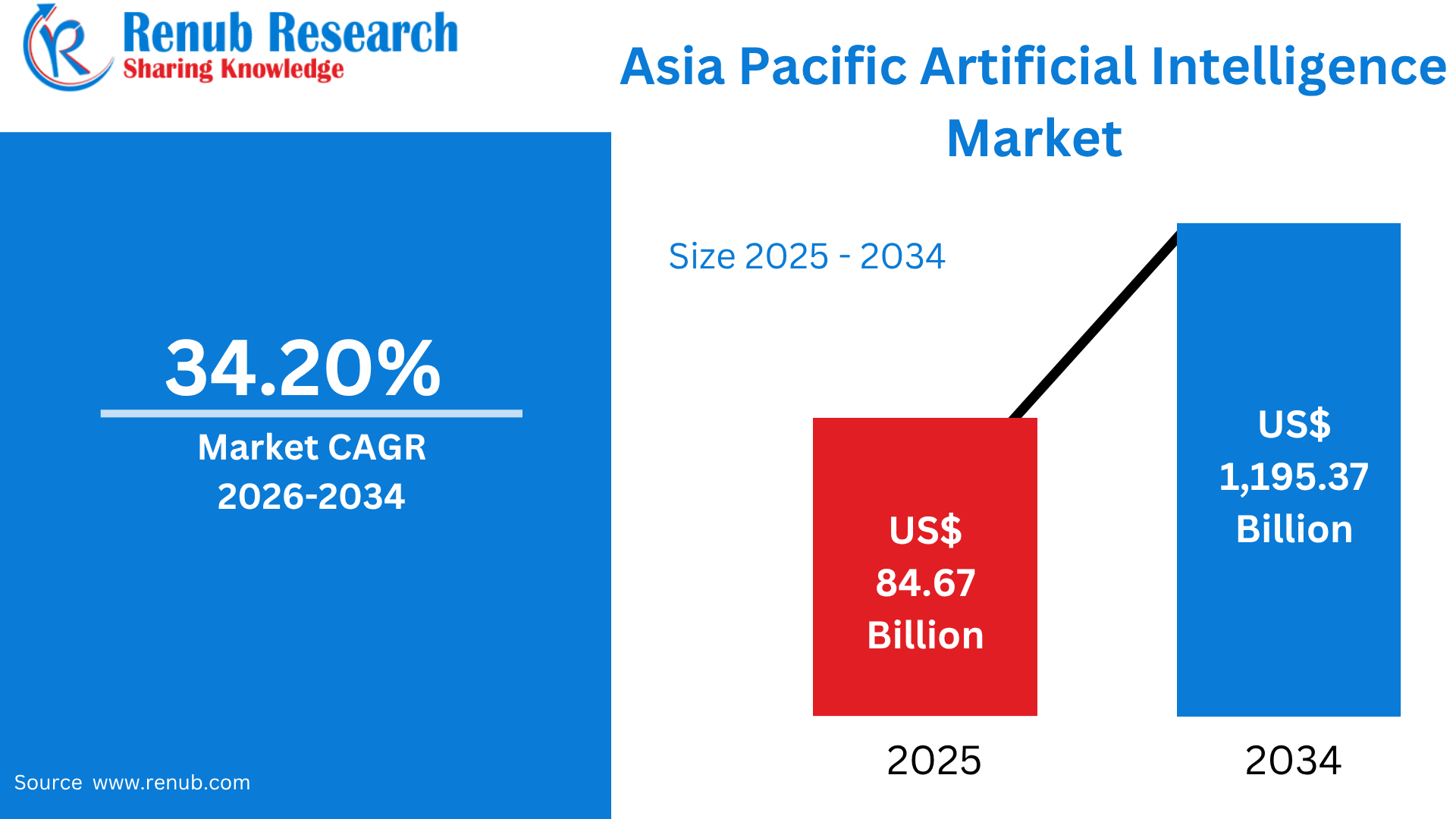
The Asia Pacific Artificial Intelligence Market is projected to reach US$ 1,195.37 billion by 2034, up from US$ 84.67 billion in 2025, at a CAGR of 34.2% during 2026–2034. The market is witnessing rapid growth driven by accelerating enterprise digital transformation, increasing investments in AI infrastructure, and the widespread adoption of generative AI technologies. Supportive government initiatives and policies promoting AI innovation are further strengthening the regional ecosystem.
What is Artificial Intelligence and Its Uses & Popularity in Asia Pacific
Artificial Intelligence (AI) refers to the use of computer systems and advanced algorithms to perform tasks that typically require human intelligence, including learning, reasoning, problem-solving, language understanding, image recognition, and decision-making. In Asia Pacific, AI is becoming increasingly popular as governments, enterprises, and technology companies invest heavily in digital transformation and advanced technologies. AI is widely used across industries such as healthcare, banking, manufacturing, retail, transportation, telecommunications, education, and logistics. Businesses use AI for predictive analytics, fraud detection, customer service chatbots, personalized recommendations, process automation, quality control, and supply-chain optimization.
Generative AI is further expanding adoption by enabling organizations to create content, analyze information, develop software, and automate knowledge-based tasks. Countries including China, Japan, South Korea, India, Singapore, and Australia are strengthening AI ecosystems through investments in research, cloud infrastructure, semiconductor technologies, and digital platforms. Growing data availability, expanding internet and smartphone penetration, rising demand for automation, and supportive government policies are contributing to the region’s strong AI adoption. Consequently, Asia Pacific is emerging as a major global hub for AI innovation and deployment.
Asia Pacific Data Center and AI Compute Demand
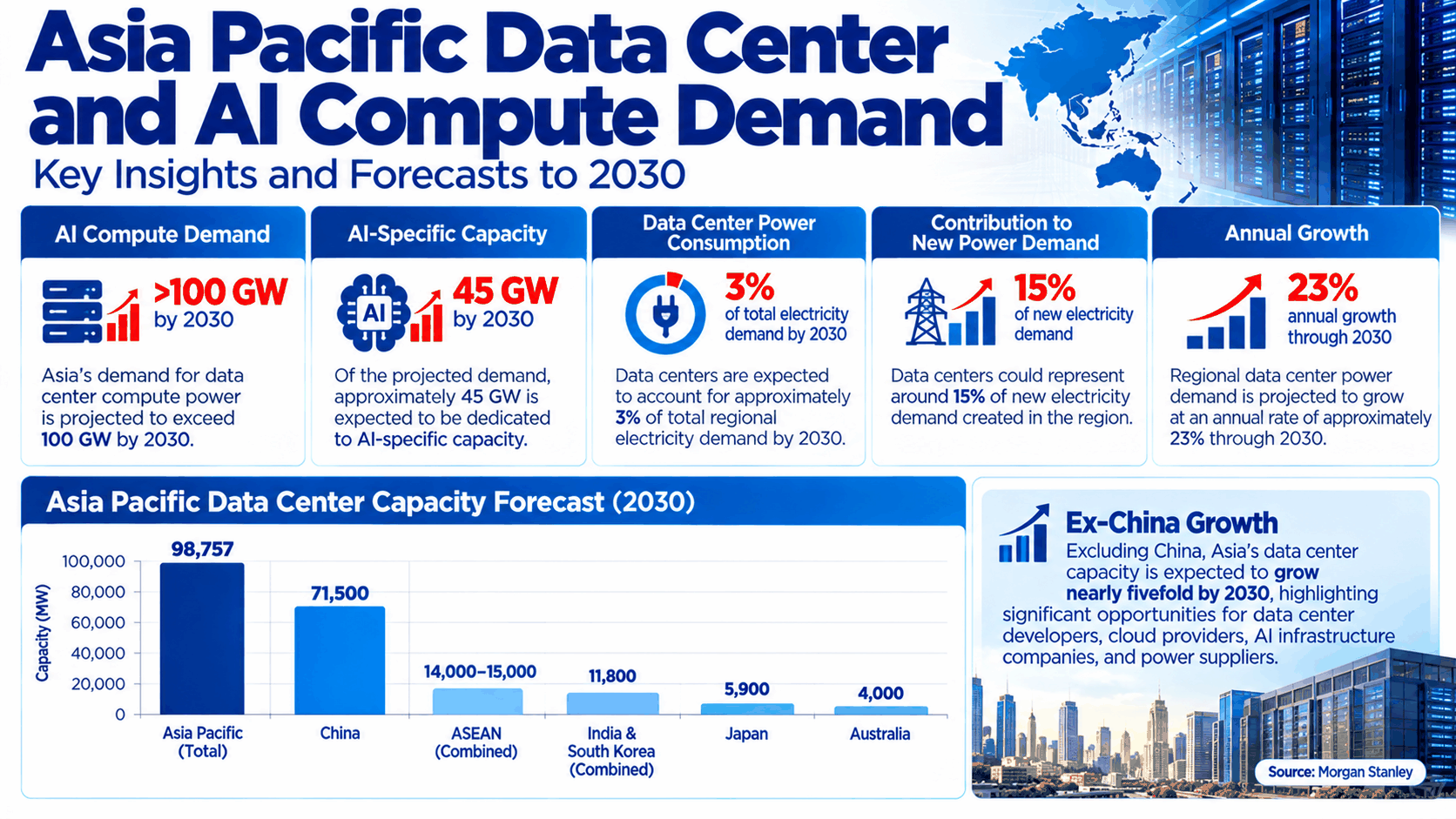
- AI Compute Demand: Asia’s demand for data center compute power is projected to exceed 100 GW by 2030, highlighting the region’s rapidly increasing need for computing infrastructure.
- AI-Specific Capacity: Of the projected demand, approximately 45 GW is expected to be dedicated to AI-specific capacity, driven by the expansion of generative AI, machine learning, and other high-performance computing workloads.
- Data Center Power Consumption: Data centers are expected to account for approximately 3% of total regional electricity demand by 2030, reflecting the growing energy requirements of cloud and AI infrastructure.
- Contribution to New Power Demand: Data centers could represent around 15% of new electricity demand created in the region, making them an increasingly important driver of power infrastructure investment.
- Annual Growth: Regional data center power demand is projected to grow at an annual rate of approximately 23% through 2030, supported by cloud adoption, digitalization, and AI deployment.
- Total Data Center Capacity: Asia Pacific’s total data center capacity is projected to reach approximately 98,757 MW, demonstrating the scale of infrastructure expansion required to support future digital workloads.
- China’s Dominance: China is expected to account for approximately 71,500 MW of data center capacity, making it the largest contributor to the region’s overall capacity.
- ASEAN Expansion: ASEAN countries are projected to collectively reach approximately 14,000–15,000 MW of data center capacity by 2030, supported by growing cloud services and digital economies.
- India and South Korea: India and South Korea are expected to reach approximately 11,800 MW of combined data center capacity, driven by increasing AI adoption, cloud computing, and enterprise digital transformation.
- Japan and Australia: Japan is projected to reach around 5,900 MW, while Australia is expected to reach approximately 4,000 MW of data center capacity.
- Ex-China Growth: Excluding China, Asia’s data center capacity is expected to grow nearly fivefold by 2030, highlighting significant opportunities for data center developers, cloud providers, AI infrastructure companies, and power suppliers.
Source: Morgan Stanley
Growth Drivers of the Asia Pacific Artificial Intelligence Market
Rapid Enterprise AI Adoption and Digital Transformation
The rapid digital transformation of businesses across Asia Pacific is a major growth driver for the artificial intelligence market. Enterprises are increasingly adopting AI to automate repetitive processes, improve customer experiences, enhance decision-making, and develop new revenue opportunities. According to Aon’s 2026 APAC study, 74% of organizations have already deployed or are piloting AI programs, demonstrating the region’s accelerating transition from experimentation toward implementation. IBM also reports that 64% of organizations are redirecting AI investments toward core business functions, where AI can generate customer value and revenue growth. AI applications are expanding across banking, healthcare, manufacturing, telecommunications, retail, logistics, and professional services. Customer service automation, predictive analytics, fraud detection, intelligent supply chains, and AI-powered software development are becoming increasingly important applications. The growing availability of digital data and enterprise cloud platforms is further simplifying AI deployment. As organizations increasingly prioritize productivity, innovation, and competitiveness, demand for AI platforms, applications, infrastructure, and professional services is expected to remain strong throughout the forecast period.
Rising Investment in AI Infrastructure, Cloud Computing, and Data Centers
Increasing investment in AI infrastructure is another significant factor accelerating the Asia Pacific artificial intelligence market. AI models require substantial computing power, specialized processors, high-speed connectivity, cloud platforms, and data-center capacity, encouraging governments and technology companies to expand regional infrastructure. IDC projects US$110 billion in AI infrastructure spending by the end of 2026, with AI infrastructure expected to expand at a 36% CAGR through 2029. The broader infrastructure investment trend is already visible, with Asia Pacific excluding Japan recording 47% year-over-year growth in AI infrastructure spending in Q4 2025, supported by hyperscaler expansion and regional cloud buildouts. Countries such as China, Japan, South Korea, India, Singapore, and Australia are strengthening their digital infrastructure and AI ecosystems. Growing cloud adoption allows enterprises to access advanced AI capabilities without making all infrastructure investments internally. Meanwhile, expanding data centers and semiconductor ecosystems improve computing availability and reduce deployment barriers. This infrastructure expansion is creating a strong foundation for generative AI, agentic AI, machine learning, and enterprise AI applications across the region.
Government Support and Increasing Adoption of Generative and Agentic AI
Strong government initiatives and rapid adoption of generative and agentic AI are creating substantial opportunities for the Asia Pacific AI market. Governments across the region are introducing national AI strategies, funding research, supporting startups, developing digital infrastructure, and establishing regulatory frameworks to strengthen domestic AI capabilities. At the enterprise level, AI is also moving beyond traditional analytics toward generative and agentic applications. IDC reports that 75% of Asia/Pacific Japan organizations had deployed agentic AI in at least some initiatives, while 61% of CEOs identified scaling agentic and generative AI as their top new investment priority. Generative AI is being used for content creation, software development, customer support, research, and knowledge management, while agentic AI enables increasingly autonomous workflows. Government backing combined with enterprise demand is therefore accelerating innovation, investment, and commercialization across the region.
Challenges of the Asia Pacific Artificial Intelligence Market
Shortage of Skilled AI Professionals and Workforce Readiness
The shortage of qualified AI professionals remains a major challenge to the expansion of artificial intelligence across Asia Pacific. Developing and deploying sophisticated AI systems requires expertise in machine learning, data science, cloud computing, cybersecurity, model engineering, and AI governance. However, workforce capabilities have not expanded at the same pace as enterprise adoption. Aon’s 2026 APAC study found that while 74% of organizations have deployed or are piloting AI programs, only 21% believe they can effectively recruit and retain sufficient AI talent, compared with 24% globally. This skills gap can delay AI implementation, increase project costs, and make it difficult for organizations to scale successful pilot projects. Smaller businesses may face greater challenges because they often lack the financial resources to hire specialized professionals or establish dedicated AI teams. IBM’s research also identified limited AI skills as a major challenge for Indian enterprises, with 42% of respondents highlighting the issue. Consequently, companies and governments need greater investment in AI education, employee training, reskilling, and specialized technical programs to support sustainable market development.
High Implementation Costs, Data Complexity, and Regulatory Risks
High implementation costs, complex data environments, cybersecurity concerns, and evolving regulations can restrict the widespread adoption of AI in Asia Pacific. AI deployment requires investment in computing infrastructure, cloud services, specialized hardware, software, skilled personnel, data management, and security systems. IBM’s APAC AI Outlook found that 36% of organizations identified the high cost of implementation and solutions as a key challenge, while 39% cited data complexity. Regulatory fragmentation adds another layer of difficulty because countries across Asia Pacific are developing different approaches to AI governance, privacy, algorithmic transparency, and data sovereignty. IDC notes that China, Japan, and India have differing regulatory approaches, creating compliance complexity for multinational enterprises. Security risks are also increasing as AI becomes embedded in critical business processes. IDC forecasts that one in five APJ enterprises could move GenAI into production in 2025 without comprehensive risk-based trust assessments, potentially exposing organizations to data leakage, bias, reputational damage, and regulatory penalties.
Artificial Intelligence Product Launches in Asia Pacific
- BharatGen – India (2025): India launched BharatGen, a government-funded multimodal large language model designed specifically for Indian languages. It supports multilingual AI applications and aims to make generative AI more inclusive and accessible across India.
- Samsung Galaxy S25 Series – South Korea (2025): Samsung launched the Galaxy S25 series with advanced AI capabilities, including Google’s Gemini AI integration, enhanced Bixby functionality, and the AI-powered Now Brief feature for personalized recommendations and assistance.
- Huawei Pura 80 Series – China (2025): Huawei introduced the Pura 80, Pura 80 Pro, Pura 80 Pro+, and Pura 80 Ultra, incorporating AI-enhanced camera capabilities and object-recognition features through its XMAGE imaging technology.
- AI Beauty Counselor – South Korea: Amorepacific developed its AI Beauty Counselor (AIBC) using Microsoft Azure OpenAI technology to provide personalized beauty consultations and recommendations, demonstrating the application of generative AI in the beauty and cosmetics industry.
- NOMI AI Assistant – China: NIO has upgraded its NOMI in-car assistant with Azure OpenAI, enabling enhanced conversational and intelligent assistance capabilities for vehicle users. The technology supports AI-driven automotive experiences and intelligent vehicle interaction.
- O-Beya AI System – Japan: Toyota introduced O-Beya, an AI system powered by Azure OpenAI and designed around nine intelligent agents. The system can assist users with questions related to areas such as vehicle vibration analysis and fuel consumption.
- CommBank Copilot – Australia: Commonwealth Bank of Australia developed CommBank Copilot, a generative AI solution designed to improve customer and developer experiences, support query resolution, and enhance financial-service interactions.
- Japan Post Office Generative AI Portal – Japan: Japan Post Office launched a generative AI portal and developed more than 70 AI micro-applications within six months, supporting internal digital transformation and encouraging employees to use AI-enabled tools.
- Huawei Ascend AI Chip Roadmap – China: Huawei expanded its AI computing portfolio around the Ascend series, with the Ascend 910C as a key current product and new Ascend 950, 960, and 970 processors planned for subsequent generations.
- NVIDIA AI Computing Deployment – South Korea (2025): NVIDIA announced plans to supply more than 260,000 advanced Blackwell AI chips to South Korea, supporting AI infrastructure projects involving the government, Samsung, SK Group, Hyundai Motor Group, and Naver.
Growing Asia Pacific Demand for High-Performance AI Computing
Asia Pacific artificial intelligence hardware market is expanding rapidly, supported by rising demand for high-performance computing infrastructure, GPUs, AI accelerators, ASICs, and specialized processors. Enterprises across healthcare, manufacturing, financial services, telecommunications, and research are increasing investments in advanced hardware to support machine learning, deep learning, and generative AI applications. The rapid development of cloud data centers and increasing deployment of edge AI devices are further strengthening demand for efficient and powerful computing systems. Countries such as China, Japan, South Korea, India, and Australia are also increasing investments in semiconductor manufacturing, AI infrastructure, and advanced computing technologies. As businesses seek faster data processing, lower latency, and improved AI model performance, demand for specialized AI hardware is expected to increase substantially. Furthermore, the expansion of generative AI and large-scale AI workloads is encouraging data-center operators and technology companies to deploy high-performance processors and accelerators, creating significant opportunities for AI hardware manufacturers throughout the region.
Expanding Asia Pacific Adoption of Advanced Neural Networks
Asia Pacific deep learning artificial intelligence market is witnessing rapid expansion as businesses increasingly adopt neural-network technologies to analyze large volumes of structured and unstructured data. Deep learning is being utilized across healthcare, financial services, retail, manufacturing, transportation, and cybersecurity for applications such as predictive analytics, automation, computer vision, speech recognition, fraud detection, and natural language processing. Increasing access to cloud computing platforms, AI accelerators, large datasets, and high-performance computing infrastructure is making deep learning technologies more accessible to organizations. China, Japan, India, South Korea, and Australia are strengthening investments in AI research, development, and commercialization, further supporting market growth. The rapid adoption of generative AI applications, intelligent virtual assistants, autonomous systems, and computer vision is also increasing demand for deep learning models. As enterprises focus on improving operational efficiency, automating complex processes, and delivering personalized services, deep learning is expected to remain a critical technology within the broader Asia Pacific artificial intelligence ecosystem.
Increasing Adoption of AI for Healthcare Innovation in Asia Pacific
Asia Pacific artificial intelligence healthcare market is growing significantly due to rising demand for advanced diagnostics, personalized medicine, predictive analytics, and automated healthcare solutions. AI technologies are increasingly being implemented for medical imaging, disease detection, drug discovery, patient monitoring, clinical decision support, and administrative automation. Rising healthcare expenditure, expanding digital healthcare infrastructure, increasing adoption of electronic health records, and growing patient volumes are creating favorable conditions for AI adoption. Countries including China, Japan, India, Australia, and Singapore are investing in AI-enabled healthcare technologies to improve service delivery, address healthcare workforce shortages, and enhance clinical efficiency. Machine learning, natural language processing, and computer vision are helping healthcare organizations analyze medical data and support faster and more accurate decision-making. In addition, the growing use of AI-powered diagnostic platforms, remote monitoring solutions, and digital health applications is accelerating healthcare transformation. Continued technological advancements and increasing demand for cost-efficient, accessible, and personalized healthcare are expected to create substantial opportunities for AI healthcare solutions across Asia Pacific.
Strong Government Support and Expanding AI Ecosystem in China
China has emerged as one of the world’s largest artificial intelligence markets, supported by substantial government investment, a strong technology ecosystem, extensive digital infrastructure, and widespread enterprise adoption. AI technologies are increasingly deployed across manufacturing, healthcare, financial services, transportation, retail, and smart-city applications. China’s large digitally connected population and extensive data resources provide a strong foundation for AI model development and commercialization. Generative AI, cloud computing, computer vision, and intelligent automation are becoming important components of corporate digital transformation strategies. In July 2025, China launched the World AI Cooperation Organization, an initiative focused on strengthening international AI governance, promoting accessible AI solutions, supporting developing countries, and contributing to the development of global AI standards. The initiative reflects China’s ambition to play a larger role in international AI governance while strengthening its domestic AI capabilities. Continued investments in AI research, semiconductor technologies, computing infrastructure, and domestic foundation models are expected to support further market expansion. China’s combination of government backing, large-scale data availability, technology companies, and enterprise demand positions it as a major AI innovation center in the Asia Pacific region.
Japan AI, Robotics, and Supercomputing Drive Market Development
Japan’s artificial intelligence market is expanding due to its advanced technology ecosystem, strong research capabilities, established robotics industry, and growing demand for automation. AI adoption is increasing across manufacturing, healthcare, financial services, transportation, robotics, and other industrial sectors. Japan’s aging population and persistent labor shortages are particularly encouraging businesses to deploy AI-powered automation, robotics, predictive maintenance, and intelligent systems to improve productivity. Government programs supporting digital transformation, research, and technological innovation are also contributing to market development. Japanese companies are increasingly implementing AI-powered analytics and automation to optimize production, reduce operating costs, and improve decision-making. In August 2025, RIKEN, Fujitsu, and NVIDIA announced a collaboration to develop FugakuNEXT, a next-generation AI-powered supercomputing platform targeted for launch around 2030. The system is designed to combine AI workloads with scientific simulations and is expected to deliver nearly 100 times higher performance than the existing Fugaku supercomputer. The collaboration combines Fujitsu’s processor technology with NVIDIA’s accelerated computing capabilities, supporting Japan’s ambitions in AI research, high-performance computing, scientific discovery, and next-generation digital innovation.
India Rapid Digitalization and Growing AI Adoption
India’s artificial intelligence market is experiencing rapid growth, supported by expanding digitalization, a large technology workforce, increasing cloud adoption, and government initiatives promoting AI innovation. Organizations in banking, healthcare, retail, manufacturing, telecommunications, and e-commerce are increasingly adopting AI to automate operations, improve customer engagement, analyze large datasets, and strengthen decision-making. India’s expanding digital-payment ecosystem, e-commerce sector, smartphone penetration, and data-driven business models are generating significant demand for AI-powered applications. The country is also developing into an important global center for AI development, research, technology services, and implementation. Consumer adoption is expanding alongside enterprise applications. In June 2025, Samsung India introduced its latest Bespoke AI appliance series, featuring AI-enabled appliances designed to improve household automation, convenience, and energy management. The products integrate technologies such as SmartThings, Bixby, and AI Home, demonstrating the increasing incorporation of AI into consumer products and connected-home ecosystems. Continued investment in AI infrastructure, digital public platforms, cloud services, and workforce development is expected to create significant opportunities for India’s AI market across both enterprise and consumer applications.
Australia Investment in AI Infrastructure and Healthcare Innovation
Australia’s artificial intelligence market is benefiting from increasing investments in digital infrastructure, research, high-performance computing, and enterprise innovation. AI adoption is expanding across healthcare, mining, financial services, agriculture, education, government, and professional services. Organizations are using AI to automate processes, analyze complex datasets, improve operational efficiency, enhance forecasting, and support decision-making. Government programs focused on digital transformation and responsible AI development are also creating a supportive environment for market growth. Healthcare is emerging as an important application area, particularly for medical research, diagnostics, and personalized medicine. In June 2025, Victoria launched a new AI supercomputer powered by NVIDIA DGX technology, supported by US$10 million from the Victorian Government and led by the Australian Centre for Artificial Intelligence in Medical Innovation (ACAMI). The infrastructure is designed to accelerate clinical research, personalized medicine, and healthcare innovation by providing advanced computing capabilities for AI workloads. Increasing investment in AI research infrastructure and commercial applications is strengthening Australia’s position as an emerging AI innovation hub in the Asia Pacific region.
Asia Pacific Artificial Intelligence Market Segmentation:
Solution
- Hardware
- Software
- AI Applications
- AI System Infrastructure Software
- AI Application Development & Deployment
- Artificial Intelligence Platforms
3. Services
Technology
- Deep Learning
- Natural Language Processing (NLP)
- Machine Learning
- Machine Vision
End User
- Healthcare
- BFSI
- LAW
- Retail
- Advertising & Media
- Automotive & Transportation
- Agriculture
- Manufacturing
- Others
Countries
- China
- Japan
- India
- South Korea
- Thailand
- Malaysia
- Indonesia
- Australia
- New Zealand
- Rest of Asia Pacific
All companies have been covered from 4 viewpoints:
- Overview
- Key Persons
- Recent Development
- Financial Insights
Company Analysis
- Microsoft Corporation
- IBM Corporation
- Amazon
- Baidu Inc.
- Nvidia Corporation
- Oracle Corporation
- Hewlett Packard Enterprise
- Salesforce Inc.
- Alphabet Inc.
Report Details:
| Report Features | Details |
| Base Year |
2025 |
| Historical Period |
2022 - 2025 |
| Forecast Period |
2026 - 2034 |
| Market |
US$ Billion |
| Segment Covered |
Solution, Software, Technology, End User and Countries |
| Countries Covered |
|
| Companies Covered |
|
| Customization Scope |
20% Free Customization |
| Post-Sale Analyst Support |
1 Year (52 Weeks) |
| Delivery Format |
PDF and Excel through Email (We can also provide the editable version of the report in PPT/Word format on request) |
Customization Services available
- Analysis of Market Size and Its Segments
- More Company Profiles (Upto 10 without any additional cost):
- Additional Countries (Other than mentioned Countries):
- Region/Country Specific Reports:
- Market Entry Strategy:
- Region-Specific Market Dynamics:
- Regional Market Share Analysis:
- Trade Analysis:
- Production Insights:
- Others Customized Requests:
For more information contact our analysts.
Need More Assistance?
- Talk to our analysts to get more precious information on the current market trends.
- Include more countries and segments and customize the report based on the final requirement.
- Get a competitive advantage in your industry by knowing the report findings and making a positive impact on your revenues and operations.
- Our analysts are always ready to provide more help and pertinent information if you need any additional assistance.