Anticoagulants Market Size, Share, Growth & Forecast Report, Company Analysis and Industry Trends 2025-2033
Buy NowAnticoagulants Market Outlook
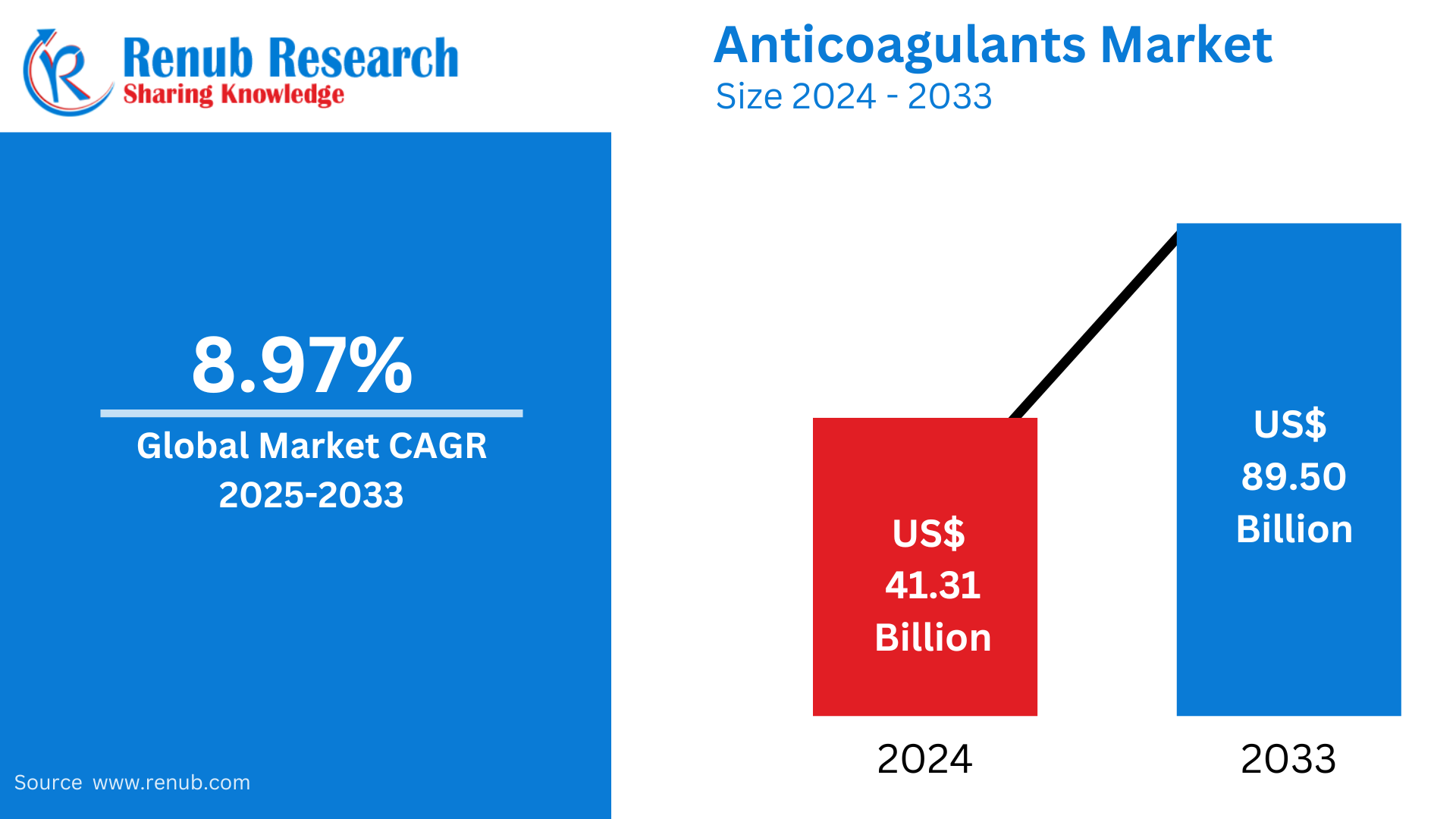
The international market for anticoagulants was estimated at around US$ 41.31 billion in 2024. It is expected to expand at a compound annual growth rate (CAGR) of 8.97% during the period 2025-2033 and reach an estimated value of around US$ 89.50 billion in 2033.
Anticoagulants are drugs that lower the risk of heart attacks, strokes, deep vein thrombosis (DVT), and pulmonary emboli by preventing or lessening the formation of blood clots in blood arteries. By blocking particular clotting factors or preventing platelets from adhering to one another, they disrupt the body's natural clotting mechanism. Heparin, warfarin, and more recent direct oral anticoagulants (DOACs) such dabigatran, apixaban, and rivaroxaban are common varieties. Anticoagulants are frequently used to avoid potentially fatal thromboembolic episodes in individuals with atrial fibrillation, mechanical heart valves, or following major surgery.
The market for anticoagulants is expanding rapidly as a result of the increased incidence of venous thromboembolism, stroke, and cardiovascular illnesses worldwide. Major contributing factors include the expanding older population, which is more susceptible to clot-related illnesses, and growing understanding of preventive healthcare. The market has expanded more quickly due to the use of novel oral anticoagulants (NOACs), which have better safety profiles and don't need to be monitored as frequently as warfarin. Demand is further increased by continuous clinical research, improved access to healthcare in emerging nations, and technological developments in drug formulation. Furthermore, the market for anticoagulants is continuing to develop thanks to advantageous reimbursement policies and a rise in the diagnosis of clotting disorders.
Top Companies in Anticoagulants Industry
1. Alexion Pharmaceuticals Inc.
Establishment: 1992
Headquarters: United States of America
Website: www.alexion.com
AstraZeneca Plc’s subsidiary, Alexion Pharmaceuticals Inc. (Alexion), is a biopharmaceutical company specializing in the discovery, development, and commercialization of therapies for rare and severe diseases. The company’s product portfolio includes eculizumab for treating atypical hemolytic uremic syndrome (aHUS) and paroxysmal nocturnal hemoglobinuria (PNH); asfotase alfa for hypophosphatasia (HPP); ravulizumab-cwvz and danicopan for PNH; and sebelipase alfa for lysosomal acid lipase (LAL) deficiency. Additionally, selumetinib is indicated for neurofibromatosis type 1 (NF1), while Alexion also develops therapies for generalized myasthenia gravis (gMG). Its key brands include SOLIRIS, ULTOMIRIS, STRENSIQ, KANUMA, KOSELUGO, and VOYDEYA. Alexion operates across North America, Europe, Latin America, Asia Pacific, and the Middle East, ensuring global access to its innovative treatments for rare diseases. The company’s headquarters are located in Boston, Massachusetts, USA.
2. Bristol-Myers Squibb Company
Establishment: 1887
Headquarters: United States of America
Website: www.bms.com
Bristol-Myers Squibb Co. (BMS) is a leading biopharmaceutical company engaged in the research, development, licensing, manufacturing, marketing, and distribution of innovative medicines. The company focuses on key therapeutic areas such as oncology, hematology, cardiovascular disease, immunology, and neurology. BMS collaborates with various partners through co-development, co-commercialization, licensing, and joint venture agreements to advance its pipeline and expand access to new treatments. Its product portfolio includes well-known brands such as Opdivo, Reblozyl, Krazati, Sprycel, and Sotyktu, among others. These products are supplied to wholesalers, distributors, specialty pharmacies, hospitals, clinics, retailers, and government organizations worldwide. The company operates manufacturing facilities in the United States, the Netherlands, Ireland, Switzerland, and Puerto Rico, ensuring global production and supply efficiency. Bristol-Myers Squibb is headquartered in Princeton, New Jersey, USA.
3. Daiichi Sankyo Company Limited
Establishment: 2005
Headquarters: Japan
Website: www.daiichisankyo.co.jp
Daiichi Sankyo Co., Ltd. is a global healthcare company committed to the discovery, development, and delivery of innovative medical solutions. The company offers a broad range of products, including prescription drugs, vaccines, and over-the-counter (OTC) medications. Its diverse portfolio covers treatments for oncology, cardiovascular, neurological, nephrological, diabetic, metabolic, and infectious diseases. In addition to its strong focus on cancer therapeutics, Daiichi Sankyo actively conducts research in immunological and rare diseases, aiming to address unmet medical needs worldwide. The company markets its products through an extensive network of medical representatives and affiliated group companies. With operations spanning Asia, Europe, North America, South America, and Central America, Daiichi Sankyo maintains a strong global presence.
4. GlaxoSmithKline plc
Establishment: 2000
Headquarters: United Kingdom
Website: www.gsk.com
GSK plc (GSK) is a global healthcare company focused on the research, development, manufacturing, and marketing of vaccines, specialty medicines, and general pharmaceuticals. The company provides treatments across multiple therapeutic areas, including HIV, respiratory diseases, oncology, immuno-inflammation, antivirals, central nervous system (CNS) disorders, metabolic and cardiovascular conditions, urogenital issues, dermatological diseases, and rare disorders. In addition to prescription drugs, GSK offers a wide range of over-the-counter (OTC) products for pain relief, gastrointestinal health, skin care, nutrition, and oral health. The company’s comprehensive vaccine portfolio protects against diseases such as hepatitis, diphtheria, tetanus, pertussis, rotavirus, human papillomavirus (HPV), measles, and bacterial meningitis. GSK distributes its products globally through pharmacies, hospitals, healthcare professionals, wholesalers, and other medical organizations. The company’s headquarters are located in London, England, United Kingdom.
5. Sanofi
Establishment: 1973
Headquarters: France
Website: www.sanofi.com
Sanofi is a global healthcare company engaged in the research, development, manufacturing, and distribution of a diverse range of pharmaceuticals, vaccines, and consumer health products. Its portfolio includes human vaccines that protect against various bacterial and viral diseases, along with therapies for cancer, rare diseases, and multiple sclerosis. The company also provides consumer healthcare solutions for women’s health, allergies, cough, cold, flu, sinus relief, pain management, and vitamins, minerals, and supplements (VMS). Sanofi’s research and development activities emphasize the creation of combination therapies to improve treatment outcomes and the development of novel biologic formulations for precision medicine. With operations across Europe, the Americas, Asia-Pacific, the Middle East, and Africa, Sanofi continues to advance global health innovation. The company’s headquarters are located in Paris, Île-de-France, France.
SWOT Analysis of Anticoagulants Market
AstraZeneca PLC
Strength – Strong R&D Pipeline and Strategic Collaborations
AstraZeneca’s strength in the anticoagulants market lies in its robust research and development (R&D) capabilities and strategic alliances with global healthcare institutions. The company has a proven track record in cardiovascular and metabolic disease research, with landmark drugs like Brilinta (ticagrelor) demonstrating its expertise in thrombosis management. AstraZeneca’s commitment to scientific innovation enables the continuous development of safer and more effective oral anticoagulants and combination therapies. Collaborations with biotechnology firms and research organizations enhance its access to novel drug targets and clinical data. The company’s global infrastructure and regulatory expertise further streamline product launches across diverse markets. AstraZeneca’s emphasis on patient-centric care, alongside investments in digital health technologies and real-world evidence generation, reinforces its leadership in anticoagulant innovation. This integrated approach strengthens its ability to respond rapidly to evolving clinical needs and maintain long-term competitive advantage in the cardiovascular therapeutics landscape.
Opportunity – Advancing Novel Oral Anticoagulants (NOACs) and Combination Therapies
AstraZeneca has a major opportunity to expand its footprint in the anticoagulants market by developing next-generation novel oral anticoagulants (NOACs) and combination therapies targeting patients with complex cardiovascular conditions. With the growing preference for NOACs over traditional warfarin due to improved safety and convenience, AstraZeneca can leverage its expertise in cardiovascular pharmacology to design differentiated products with lower bleeding risks and enhanced efficacy. The company’s focus on precision medicine and biomarkers can further support personalized anticoagulant dosing strategies. Moreover, combining anticoagulants with antiplatelet or lipid-lowering agents offers potential to address multiple risk factors simultaneously, aligning with the trend toward integrated cardiovascular management. Strategic partnerships with academic research centers and health technology firms could accelerate clinical validation and regulatory approvals. As global demand for advanced anticoagulants continues to grow, AstraZeneca is well-positioned to capture a larger market share through innovation-driven growth and patient-focused therapeutic solutions.
Abbott Laboratories
Strength – Strong Product Portfolio and Technological Innovation
Abbott Laboratories possesses a diversified and robust product portfolio that strengthens its position in the anticoagulants market. The company’s extensive expertise in cardiovascular health, diagnostics, and medical devices enables it to integrate innovative solutions for managing clot-related conditions. Abbott’s advanced diagnostic tools, such as i-STAT and Alinity systems, play a critical role in monitoring coagulation and patient response to anticoagulant therapies, ensuring precise and personalized care. Its global presence, strong R&D capabilities, and reputation for quality enhance its competitiveness and market trust. Moreover, Abbott’s continuous investment in digital health and connected care technologies allows for better patient adherence and data-driven treatment optimization. These synergies across diagnostics, pharmaceuticals, and medical devices uniquely position Abbott to develop and support safer, more effective anticoagulant solutions while maintaining regulatory compliance and expanding its leadership in the cardiovascular therapeutics space.
Opportunity – Expansion into Emerging Markets and Personalized Medicine
Emerging economies present significant growth opportunities for Abbott’s anticoagulant business, driven by rising incidences of cardiovascular diseases, improved healthcare infrastructure, and increasing awareness of preventive care. Countries in Asia-Pacific, Latin America, and the Middle East are witnessing higher demand for modern anticoagulants as healthcare systems evolve. Abbott can leverage its established distribution networks and partnerships to introduce cost-effective, high-quality anticoagulant solutions in these markets. Additionally, advancements in genomics and personalized medicine provide an opportunity for Abbott to innovate next-generation anticoagulants tailored to individual patient profiles, minimizing bleeding risks and maximizing therapeutic benefits. Integrating AI and data analytics into its R&D pipeline could further enhance patient outcomes and product differentiation. By expanding clinical trials and collaborations in these regions, Abbott can strengthen its presence, improve access to life-saving anticoagulant therapies, and solidify its reputation as a global healthcare leader committed to inclusive and personalized cardiovascular care.
Sustainability Analysis of Anticoagulants Market
Bayer AG
Bayer AG integrates sustainability deeply into its corporate strategy, aligning its operations with the United Nations Sustainable Development Goals (SDGs) and its mission of “Health for all, hunger for none.” The company has set ambitious climate targets, including achieving net-zero greenhouse gas emissions across its entire value chain by 2050 and reducing absolute emissions by 42% by 2029 compared to 2019 levels. Bayer’s operations increasingly rely on renewable energy, and the company continues to invest in energy-efficient production technologies and sustainable logistics. Its “Zero Carbon Manufacturing Program” promotes decarbonization in production sites worldwide while engaging suppliers through science-based emissions targets.
Beyond environmental responsibility, Bayer emphasizes sustainable agriculture and healthcare access. Through initiatives like the Bayer Carbon Initiative, it supports farmers in adopting climate-smart agricultural practices and regenerative farming to enhance soil health and biodiversity. In healthcare, Bayer aims to improve access to essential medicines and modern contraceptives for underserved populations, particularly in low- and middle-income countries.
Socially, Bayer prioritizes ethical business conduct, diversity, inclusion, and employee well-being. The company’s governance structure ensures accountability through transparent ESG reporting, aligning with international standards such as the Global Reporting Initiative (GRI) and the Task Force on Climate-Related Financial Disclosures (TCFD). Bayer also advances innovation in green chemistry, biodegradable crop protection, and life sciences to reduce environmental impact.
Recent Development in Anticoagulants Industry
- In October 2024, Pfizer Inc. announced that the U.S. FDA had approved HYMPAVZI (marstacimab-hncq) for the treatment of Hemophilia A or B without inhibitors. This once-weekly subcutaneous prophylactic therapy represents a significant advancement in simplifying treatment regimens for patients with hemophilia.
- In February 2024, Dr. Reddy’s Laboratories launched a biosimilar version of Apixaban (Eliquis) in India, providing a more affordable anticoagulant option for a broader patient base. The launch aligns with the company’s strategic focus on enhancing accessibility and expanding its footprint in the global cardiovascular therapeutics market.
- In December 2023, Boehringer Ingelheim received U.S. FDA approval for its anticoagulant Pradaxa (dabigatran) to treat acute Deep Vein Thrombosis (DVT) and Pulmonary Embolism (PE). This approval broadens Pradaxa’s therapeutic use, underscoring Boehringer Ingelheim’s continued commitment to advancing thromboembolic disease management.
- In October 2023, Johnson & Johnson announced a strategic partnership with Alliance Pharmaceuticals to co-develop and commercialize next-generation oral anticoagulants. The collaboration focuses on enhancing drug efficacy and safety by minimizing bleeding risks, reinforcing both companies’ efforts to innovate within the evolving anticoagulant therapy landscape.
Company Analysis Format
Anticoagulants Market & Forecast
- Historical Trends
- Forecast Analysis
Market Share Analysis – Anticoagulants Market
Company Analysis- Alexion Pharmaceuticals Inc.
Overview
- Company History and Mission
- Business Model and Operations
- Workforce
Key Persons
- Executive Leadership
- Operational Management
- Division Leaders
- Board Composition
Recent Development & Strategies
- Mergers & Acquisitions
- Partnerships
- Investment
Sustainability Analysis
- Renewable Energy Adoption
- Energy-Efficient Infrastructure
- Use of Sustainable Packaging Materials
- Water Usage and Conservation Strategies
- Waste Management and Circular Economy Initiatives
Product Analysis
- Product Profile
- Quality Standards
- Product Pipeline
- Product Benchmarking
Strategic Assessment: SWOT Analysis
- Strengths
- Weaknesses
- Opportunities
- Threats
Revenue Analysis
The above information will be provided for all the following companies:
1. Aspen Holdings
2. Bayer AG
3. Bristol-Myers Squibb Company
4. Daiichi Sankyo Company Limited
5. Dr. Reddy’s Laboratories Ltd
6. GlaxoSmithKline plc
7. Johnson & Johnson Private Limited
8. Pfizer Inc.
9. Sanofi
10. Boehringer Ingelheim International GmbH
11. Abbott Laboratories
12. AstraZeneca PLC
13. Merck & Co., Inc.
14. Novartis International AG
15. Eli Lilly and Company
16. Teva Pharmaceutical Industries Ltd
17. Portola Pharmaceuticals, Inc.
18. Sun Pharmaceutical Industries Ltd
19. Lupin Limited