Global Amniotic Membrane Market Report by Product, Application, End User, Country and Company Analysis 2026-2034
Buy NowAmniotic Membrane Market Size and Forecast
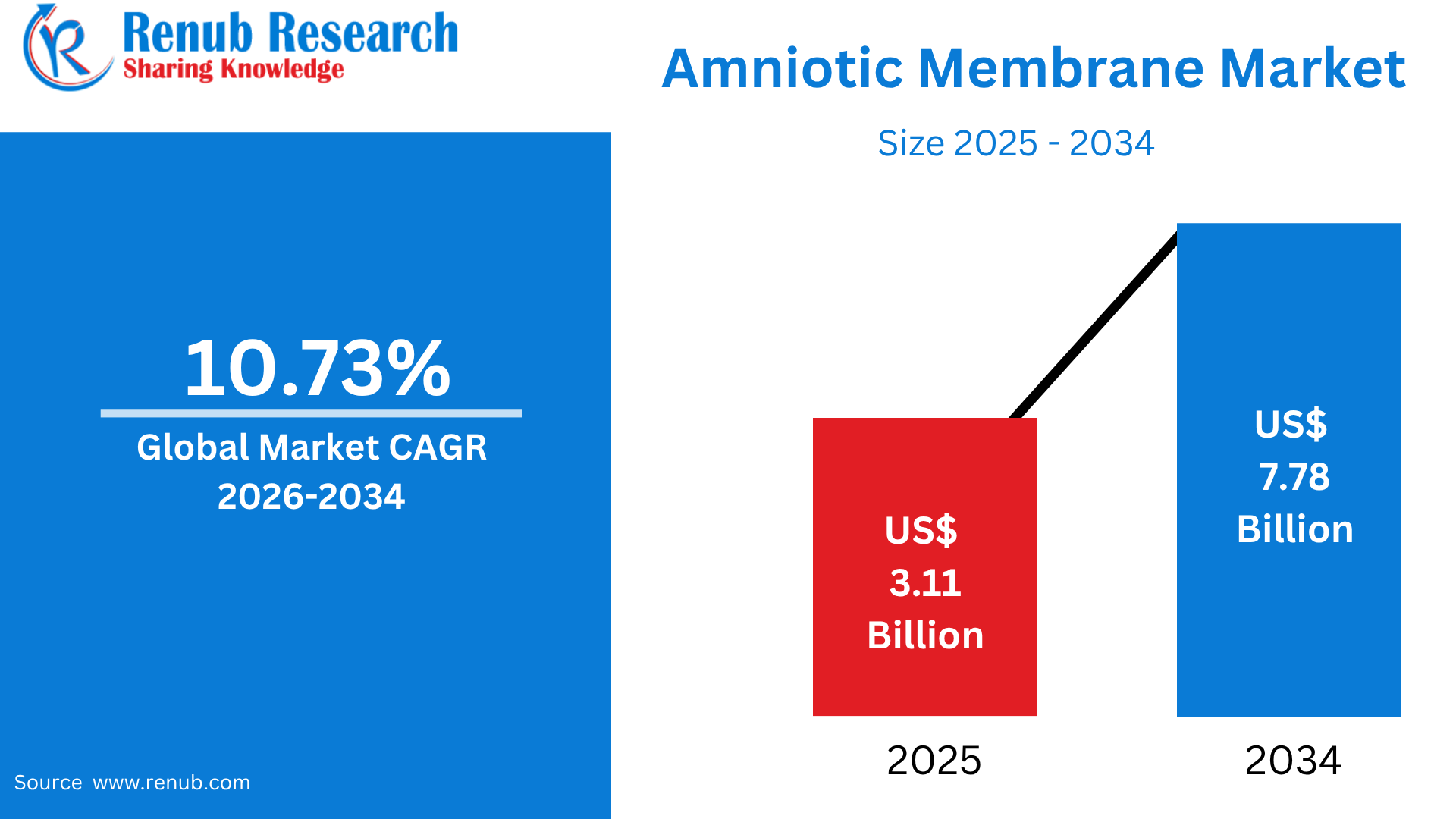
Amniotic Membrane Market is projected to grow from US$ 3.11 billion in 2025 to US$ 7.78 billion by 2034, expanding at a CAGR of 10.73% during 2026–2034. Market growth is being supported by the increasing use of amniotic membrane products in ophthalmic procedures, chronic wound management, orthopedic applications, and regenerative medicine. Rising prevalence of diabetes and other chronic conditions is creating greater demand for advanced wound-healing solutions, while improvements in tissue processing, preservation, sterilization, and graft manufacturing are enhancing product safety and clinical usability.
What is Amniotic Membrane and Its Uses & Popularity Worldwide
Amniotic membrane (AM) is the innermost layer of the placenta that surrounds and protects the developing fetus during pregnancy. It consists of a thin epithelial layer, a thick basement membrane, and an avascular stromal matrix. Its biological characteristics—including anti-inflammatory, anti-scarring, anti-angiogenic, antimicrobial, and tissue-regenerative properties—make it an important biomaterial in modern medicine.
Amniotic membrane is widely used in ophthalmology, wound care, regenerative medicine, burn treatment, orthopedics, dentistry, and reconstructive surgery. In ophthalmology, it is applied for persistent corneal epithelial defects, chemical and thermal burns, corneal ulcers, limbal stem-cell deficiency, pterygium surgery, and ocular-surface reconstruction. In wound management, AM-based products are used for diabetic foot ulcers, venous leg ulcers, pressure sores, burns, and surgical wounds because they can support re-epithelialization and help moderate inflammation.
Its worldwide popularity is increasing as healthcare providers seek biologically derived materials that support tissue repair while potentially reducing scarring and inflammation. More than 90 clinical trials reviewed for 2015–2020 examined AM applications, with ophthalmology, wound healing, and orthopedics among the leading areas of investigation.
Key facts
Around 1 in every 10 patients is harmed in health care, and more than 3 million deaths occur annually due to unsafe care. In low-to-middle-income countries, as many as 4 in 100 people die from unsafe care.
Above 50% of harm (1 in every 20 patients) is preventable; half of this harm is attributed to medications.
Some estimates suggest that as many as 4 in 10 patients are harmed in primary and ambulatory settings, while up to 80% (23.6–85%) of this harm can be avoided.
Common adverse events that may result in avoidable patient harm are medication errors, unsafe surgical procedures, health care-associated infections, diagnostic errors, patient falls, pressure ulcers, patient misidentification, unsafe blood transfusion, and venous thromboembolism.
Patient harm potentially reduces global economic growth by 0.7% a year. On a global scale, the indirect cost of harm amounts to trillions of US dollars each year.
Investment in reducing patient harm can lead to significant financial savings, and more importantly, better patient outcomes (5). An example of a good return on investment is patient engagement, which, if done well, can reduce the burden of harm by up to 15%.
Growth Drivers of the Amniotic Membrane Market
Rising Demand for Advanced Wound Care and Regenerative Therapies
The growing global burden of chronic and difficult-to-heal wounds is a major driver of the amniotic membrane market. Amniotic membrane products provide a biologically active scaffold that can support epithelial cell migration, regulate inflammation, reduce excessive scar formation, and facilitate tissue repair. Consequently, they are increasingly investigated and utilized for diabetic foot ulcers, venous leg ulcers, pressure injuries, burns, surgical wounds, and other complex wounds. The expanding regenerative medicine sector is further strengthening demand. A review of human amniotic membrane applications identified more than 90 clinical trials conducted during the five-year period from 2015 to 2020, covering wound healing, dermatology, orthopedics, ophthalmology, dentistry, urology, and oncology. The review also identified 31 of 51 available or developing products as being targeted toward acute and chronic wounds. The combination of increasing chronic wound prevalence, demand for advanced biologic dressings, and growing interest in tissue regeneration is encouraging healthcare companies to develop dehydrated, cryopreserved, micronized, and composite AM products. This product diversification is expanding clinical applications and supporting long-term market growth.
Expanding Ophthalmology Applications and Clinical Adoption
Ophthalmology represents one of the strongest growth areas for amniotic membrane because AM provides a biological substrate that supports epithelial healing while helping control inflammation and scarring. Current applications include persistent epithelial defects, corneal ulcers, chemical and thermal burns, limbal stem-cell deficiency, ocular-surface reconstruction, pterygium surgery, and other complex anterior-segment conditions. Clinical evidence is also supporting broader adoption. An American Academy of Ophthalmology assessment reviewed 474 citations, evaluated 58 articles in full text, and included 9 studies examining amniotic membrane grafting for chemical and thermal ocular injuries. Its assessment found that amniotic membrane grafting significantly improved corneal re-epithelialization compared with medical therapy alone in moderate-grade burns, although limitations in study design were noted. Improved processing and preservation technologies have also made AM products more practical for ophthalmic use. The 2026 ophthalmology review notes that clinical interest expanded substantially following improvements in processing and preservation. As ophthalmologists increasingly recognize AM as both a biological bandage and a regenerative substrate, demand for commercially available grafts and related products is expected to increase.
Increasing Research, Product Development, and Regenerative Medicine Investment
Growing research into regenerative medicine is creating new opportunities for amniotic membrane manufacturers. AM is not simply a physical covering; its extracellular matrix contains growth factors, cytokines, and other biological components that can influence inflammation, cell migration, tissue remodeling, and regeneration. It can therefore function as a natural scaffold for tissue engineering and regenerative applications. Research activity has expanded across multiple specialties. A comprehensive review identified more than 90 clinical trials during 2015–2020 and reported that more than 50% of clinical studies were conducted or being developed in the United States. China, Egypt, India, Iran, and Germany were also identified as countries with ongoing clinical research and potential for additional product development. At the same time, AM products are being developed in different formats, including cryopreserved and dehydrated grafts, decellularized scaffolds, micronized powders, hydrogels, and adhesive dressings. Such innovation can expand the addressable market beyond traditional transplantation into tissue engineering, wound management, orthopedics, dentistry, and other regenerative applications, supporting continued commercialization and market expansion.
Challenges of the Amniotic Membrane Market
Regulatory Complexity and Lack of Standardization
Regulatory complexity is a significant challenge for the amniotic membrane market, particularly as manufacturers develop products that go beyond traditional tissue grafts. Processing methods can substantially change the biological and structural characteristics of AM, creating uncertainty about the appropriate regulatory pathway and permissible claims. In the United States, the FDA has emphasized requirements related to minimal manipulation and homologous use for certain human cells, tissues, and cellular and tissue-based products (HCT/Ps). For example, in a 2024 FDA warning letter, the agency determined that a flowable amniotic product underwent more-than-minimal manipulation because processing altered characteristics such as its physical integrity, tensile strength, and elasticity. The FDA also concluded that certain wound-healing and tissue-regeneration claims did not represent homologous use under the applicable HCT/P framework. These regulatory requirements can increase development costs, delay commercialization, and limit the claims manufacturers can make about innovative products. Furthermore, differences in processing, preservation, donor screening, thickness, and biological composition can create variability between products. Greater harmonization of manufacturing standards, clinical evidence, labeling, and regulatory requirements would help reduce uncertainty and facilitate wider market adoption.
High Product Costs, Evidence Gaps, and Variability in Clinical Outcomes
The cost and clinical-evidence requirements associated with amniotic membrane products remain important barriers to broader adoption. Although AM can be relatively inexpensive to prepare and store in certain applications, commercially processed products require donor screening, tissue collection, testing, preservation, quality control, packaging, storage, and distribution. These requirements can increase final product costs, particularly in healthcare systems with limited reimbursement or constrained medical budgets. Another challenge is the variability of clinical evidence across indications and product formats. A review covering regenerative-medicine applications found more than 90 clinical trials over 2015–2020, but highlighted the need for additional analytical research to clarify clinical efficacy and cost-effectiveness. Similarly, the 2025 American Academy of Ophthalmology assessment of ocular burns included only 9 studies after screening 474 citations and noted limitations in study design, including inadequate power calculations in key studies. Consequently, healthcare providers may hesitate to adopt higher-priced AM products when comparative evidence, standardized protocols, long-term outcomes, or reimbursement support remain insufficient. Stronger randomized trials, standardized product characterization, and cost-effectiveness studies are therefore important for accelerating market penetration.
Amniotic Membrane Launches Worldwide
- EPIFIX® – February 2023, Japan: Gunze Medical began selling EPIFIX®, a dehydrated human amnion/chorion membrane (dHACM) allograft from MiMedx, for wound-care applications. It was described as Japan’s first and only approved dHACM product at the time of launch.
- Avenova® Allograft – September 2023, United States: NovaBay Pharmaceuticals commercially launched Avenova Allograft, an amniotic tissue allograft intended as a protective covering during ocular-surface repair.
- SimpliGraft™ – April 2024, United States: Xtant Medical commercially launched SimpliGraft, a dehydrated, terminally irradiated single-layer amniotic membrane sheet designed for protective coverage of acute and chronic wounds.
- SimpliMax™ – April 2024, United States: Xtant Medical simultaneously launched SimpliMax, a dual-layer dehydrated amniotic membrane allograft for acute and chronic wound applications.
- CAM360 AmnioGraft® – May 2024, United States: BioTissue introduced CAM360 AmnioGraft, a cryopreserved amniotic membrane product designed for dry-eye disease and other ocular-surface conditions.
- Avive+® Soft Tissue Matrix – June 2024, United States: Axogen launched Avive+ Soft Tissue Matrix, a resorbable multilayer amniotic membrane allograft intended to protect and separate tissues during peripheral nerve healing.
- Tri-Membrane Wrap – October 2024, United States: BioLab Sciences launched Tri-Membrane Wrap, a triple-layer dehydrated Amnion-Chorion-Amnion skin substitute developed for deep wounds and difficult-to-cover areas.
- AdvoGraft™ One – June 2025, United States: New Horizon Medical Solutions, through Precise Bioscience, launched AdvoGraft One, an amniotic membrane-based biologic wound-care product for acute and chronic wounds.
- AmchoPlast™ – July 2025, United States: New Horizon Medical Solutions launched AmchoPlast, an amniotic-chorionic membrane containing the intermediate layer and positioned for surgical and chronic wound applications.
- Natarajan Macuseal™ – September 2025, India/Global: Akriti Ophthalmic announced the global launch of Natarajan Macuseal, described as the world’s first desiccated amniotic membrane engineered specifically for retinal surgery, including macular-hole closure and giant retinal-tear repair.
Growing Demand for Biologically Active Grafts
Cryopreserved amniotic membranes are gaining popularity because their low-temperature preservation process helps retain important biological components, including extracellular matrix proteins, growth factors, and cytokines that support tissue repair. These products are particularly valuable in ophthalmology, wound care, orthopedics, and reconstructive surgery. More than 90 clinical trials evaluating human amniotic membrane applications were identified during 2015–2020, demonstrating expanding clinical and research interest across multiple therapeutic areas. In ophthalmology, cryopreserved membranes are used for corneal epithelial defects, ocular-surface reconstruction, chemical burns, and other challenging conditions. Their hydrated, ready-to-use format can simplify surgical application compared with some dehydrated alternatives. The growing prevalence of chronic wounds and increasing demand for regenerative therapies are further supporting adoption. Advances in cryopreservation, tissue processing, donor screening, and storage are improving product consistency and clinical usability. As healthcare providers increasingly seek biologic solutions that can support healing while reducing inflammation and scarring, demand for cryopreserved amniotic membrane products is expected to expand worldwide.
Rising Use in Advanced Surgical Wound Management
Amniotic membranes are increasingly being incorporated into surgical wound management because of their anti-inflammatory, anti-scarring, antimicrobial, and regenerative properties. The membrane provides a biological scaffold that can support cell migration, epithelialization, and tissue remodeling, making it useful for complex surgical wounds, burns, trauma, orthopedic procedures, and reconstructive surgeries. More than 90 clinical trials of human amniotic membrane applications conducted or developed during 2015–2020 covered areas including wound healing, orthopedics, ophthalmology, and surgery. The increasing global burden of diabetes is also creating opportunities because diabetic patients are more susceptible to chronic wounds and impaired healing. The International Diabetes Federation estimates that approximately 589 million adults aged 20–79 were living with diabetes worldwide in 2024, creating a substantial population at risk for diabetes-related complications. Furthermore, growing surgical volumes, advances in biologic tissue products, and preference for regenerative approaches are encouraging hospitals and specialized wound-care centers to adopt amniotic membranes. Improved processing, preservation, and application techniques are expected to further broaden their use in surgical wound treatment.
Rising Demand for Advanced Wound and Ophthalmic Care in the USA
U.S. amniotic membrane market is expanding as healthcare providers increasingly adopt biologic products for chronic wounds, ocular disorders, and tissue regeneration. Chronic wounds affect approximately 2.5% of the U.S. population, representing a substantial patient pool requiring advanced wound-management solutions. Amniotic membranes are used because their extracellular matrix and bioactive components can support epithelialization while helping regulate inflammation and scarring. Ophthalmology is another important application area, with an estimated 16 million Americans affected by dry eye disease, supporting demand for amniotic membrane products in ocular-surface treatment and reconstruction. Increasing adoption of minimally invasive and regenerative procedures, technological improvements in tissue processing and preservation, and strong healthcare infrastructure are further supporting market development. In addition, continued clinical research and increasing physician awareness of biologic grafts are improving acceptance across hospitals, ambulatory surgical centers, wound-care facilities, and specialty ophthalmology centers. The United States therefore remains a key market for innovation and commercialization of advanced amniotic membrane products.
Increasing Surgical Activity and Regenerative Medicine Adoption in the United Kingdom
UK amniotic membrane market is witnessing gradual expansion across ophthalmology, wound care, reconstructive surgery, and tissue regeneration. Growing surgical activity is creating opportunities for biologic grafts that can support healing and help manage inflammation and scarring. According to the British Association of Aesthetic Plastic Surgeons (BAAPS), the UK recorded 27,462 cosmetic procedures in 2024, representing a 5% increase from the previous year. Breast augmentation procedures increased by 6%, while liposuction grew by 8%, demonstrating rising activity in aesthetic surgery. Amniotic membranes can support postoperative tissue repair and are being investigated across several surgical and regenerative applications. In ophthalmology, their anti-inflammatory and epithelial-supporting properties make them useful for managing complex ocular-surface conditions. The UK’s established National Health Service, specialist surgical centers, and growing regenerative medicine research ecosystem provide favorable conditions for adoption. Increasing clinician awareness, improvements in tissue preservation, and demand for biologically derived wound-care materials are expected to further support the UK market.
High Diabetes Burden Creates Opportunities for Advanced Wound Care in India
India represents a promising growth market for amniotic membranes because of its large diabetic population and increasing need for advanced wound-management solutions. Diabetic foot complications create significant demand for biological materials capable of supporting tissue repair and controlling inflammation. Studies have reported a 6.2% prevalence of diabetic foot ulcers (DFUs) in India, with reported subgroup rates of approximately 14.5% among males and 7.7% among females. Amniotic membranes can be particularly valuable for complex wounds because their extracellular matrix and bioactive components may support cell migration, epithelialization, and tissue regeneration. Beyond wound care, increasing use of amniotic tissue in ophthalmology, burns, reconstructive surgery, orthopedics, and regenerative medicine is broadening the potential customer base. Expansion of private hospitals, specialty clinics, and advanced wound-care centers is improving access to biologic therapies, particularly in major metropolitan areas. Meanwhile, greater awareness among surgeons and ophthalmologists and increasing research activity are encouraging clinical adoption. Improvements in domestic healthcare infrastructure and growing interest in cost-effective regenerative treatments are expected to strengthen India’s amniotic membrane market over the coming years.
Diabetes and Healthcare Modernization Drive Saudi Arabia Market Development
Saudi Arabia’s amniotic membrane market is developing as healthcare providers increasingly explore regenerative solutions for chronic wounds, ophthalmic disorders, burns, and reconstructive procedures. Diabetes represents an important demand driver because patients with diabetes face an elevated risk of foot ulcers and delayed wound healing. According to Saudi Ministry of Health data, approximately 18% of adults in Saudi Arabia live with diabetes, creating a significant population requiring effective chronic-wound management. Amniotic membranes are increasingly attractive because their biological properties can support tissue regeneration while helping moderate inflammation and scar formation. Healthcare modernization under Saudi Vision 2030 is also encouraging investment in advanced hospitals, specialized treatment centers, medical technologies, and regenerative medicine capabilities. Growing availability of specialist ophthalmology and wound-care services is expanding potential applications for amniotic membrane products. In addition, increasing clinician awareness and improvements in tissue processing, preservation, and product availability are supporting adoption in both public and private healthcare facilities. As Saudi Arabia continues to invest in advanced healthcare infrastructure and specialized medical services, demand for innovative biologic grafts is expected to increase.
Amniotic Membrane Market Segments
Product
- Cryopreserved amniotic membranes
- Lyophilization Amniotic Membrane
Application
- Surgical Wounds
- Ophthalmology
- Others
End User
- Hospitals
- Ambulatory Surgical Centers
- Specialty Clinics
- Research & Academic Institutes
Country
North America
- United States
- Canada
Europe
- France
- Germany
- Italy
- Spain
- United Kingdom
- Belgium
- Netherlands
- Turkey
Asia Pacific
- China
- Japan
- India
- South Korea
- Thailand
- Malaysia
- Indonesia
- Australia
- New Zealand
Latin America
- Brazil
- Mexico
- Argentina
Middle East & Africa
- Saudi Arabia
- UAE
- South Africa
All companies have been covered with 5 Viewpoints
- Overviews
- Key Person
- Recent Developments
- SWOT Analysis
- Revenue Analysis
Company Analysis:
- Stryker Corporation
- Smith & Nephew plc
- Integra LifeSciences Holdings
- MiMedx
- Organogenesis Net
- Wright Medical Group Inc
- Applied Biologics LLC
- FzioMed Inc
- Katena, Inc.
- Tissue-Tech Inc
Report Details:
| Report Features | Details |
| Base Year |
2025 |
| Historical Period |
2022 - 2025 |
| Forecast Period |
2026 - 2034 |
| Market |
US$ Billion |
| Segment Covered |
Product, Application, End User and Country |
| Countries Covered |
|
| Companies Covered |
|
| Customization Scope |
20% Free Customization |
| Post-Sale Analyst Support |
1 Year (52 Weeks) |
| Delivery Format |
PDF and Excel through Email (We can also provide the editable version of the report in PPT/Word format on request) |
Key Questions Answered in This Report:
- What is the projected size of the global amniotic membrane market by 2034?
- What are the key factors driving the growth of the amniotic membrane market?
- How do cryopreserved and lyophilized amniotic membranes differ in market usage?
- Which applications are contributing the most to the amniotic membrane market growth?
- What are the major challenges faced by the amniotic membrane market?
- How does the regulatory environment impact the development and commercialization of amniotic membrane products?
- What role does regenerative medicine play in increasing the adoption of amniotic membranes?
- How is technological advancement enhancing the effectiveness of amniotic membranes?
- Which end users are the major consumers of amniotic membrane products?
- How is the amniotic membrane market performing in key countries like the United States, United Kingdom, India, and Saudi Arabia?
Customization Services available
- Analysis of Market Size and Its Segments
- More Company Profiles (Upto 10 without any additional cost):
- Additional Countries (Other than mentioned Countries):
- Region/Country Specific Reports:
- Market Entry Strategy:
- Region-Specific Market Dynamics:
- Regional Market Share Analysis:
- Trade Analysis:
- Production Insights:
- Others Customized Requests:
For more information contact our analysts.
Need More Assistance?
- Talk to our analysts to get more precious information on the current market trends.
- Include more countries and segments and customize the report based on the final requirement.
- Get a competitive advantage in your industry by knowing the report findings and making a positive impact on your revenues and operations.
- Our analysts are always ready to provide more help and pertinent information if you need any additional assistance.